
And the 2025 Kit Keller Award Goes To…

I got sick last week. So did my wife. We canceled our plans. We spent the weekend horizontal. We watched TV. On Sunday morning, I woke up and found my wife on the couch watching A League of Their Own. I did what anyone does when they catch a glimpse of the greatest baseball movie of all time on television. I sat down and watched the rest of it.
I’m still kind of sick. My wife is still fully sick. A League of Their Own is still on my mind. Specifically, I’ve been thinking about the scouting report that Rockford Peaches catcher Dottie Hinson (Geena Davis) delivered to pitcher Ellen Sue Gotlander (Freddie Simpson) with two outs and the tying run on first in the bottom of the ninth in Game 7 of the World Series in Racine. I had useful thoughts, and we’ll get to those in a moment. First, though, we’re going to wade through some useless thoughts. I beg you to humor me, because I am about to critique the baseball strategy in a perfect movie. I told you I’m sick.
There’s nothing wrong with making a mound visit in a big moment, giving the pitcher a break and reminding them of the scouting report. But the batter was Hinson’s sister Kit Keller (Lori Petty), who spent nearly the entire season with the Peaches, then faced them throughout the Series, including three times alone in Game 7. There’s no way Ellen Sue needed a refresher on that particular scouting report. Then, there’s the scouting report itself. “High fastballs,” Dottie said. “Can’t hit ‘em, can’t lay off ‘em.” It was right on the money, but they didn’t have to follow it on every single pitch, did they? Once they’d jumped ahead 0-2, did it never occur to Dottie or Ellen Sue to waste a breaking ball in the dirt in order to reset Kit’s eye level? I don’t care who’s at the plate; you can’t throw the same pitch to the same spot three times in a row and expect to get away with it.
OK, critique over. The thought we’re going to pursue today is a question: Who has a scouting report that most resembles Kit’s? That’s right — it’s time for the first ever Kit Keller High Fastballs Can’t Hit ‘Em Can’t Lay Off ‘Em Award. Nearly every batter has this problem at least to some extent. Any pitcher with a good four-seamer uses it to earn swinging strikes above the plate. That’s what that pitch is for. Still, some players are more susceptible than others. I pulled numbers for the 2025 season. I focused on hard pitches – four-seamers, sinkers, and cutters – in the upper third of the strike zone and above. For those of you familiar with Statcast’s Attack Zones, that means any zone that ends in a 1, 2, or 3. I used a sample of 308 players who saw at least 1,000 of those pitches this year.

Looking at the top of the zone and above it led me toward lots of height-related red herrings. Aaron Judge saw 1,381 pitches that were outside the strike zone in 2025, but because he’s 6’7”, fewer than 10% of them were actually above the zone, the lowest rate in baseball. Human mountains like Oneil Cruz, Jordan Walker, and James Wood were also at the bottom of the list. Their zone is so tall that it’s almost hard to locate the ball above it. The enormous Giancarlo Stanton and Matt Wallner swung at just five and 14 pitches above the zone, respectively, and they missed all of them. As you’d expect, the other side of the list is populated by smaller players like Davis Schneider, Jose Altuve, Matt McLain, Brayan Rocchio, and Sal Frelick. The top of their zones starts a whole lot lower.
The player with the highest swing rate on high fastballs, inside and outside the zone, was Josh Naylor. Naylor ran an absurd 66% swing rate on high fastballs. He truly can’t lay off ‘em. But here’s the thing: He can really hit ‘em! Naylor whiffed just 15% of the time on those pitches, which put him in the 89th percentile. Not only did he make tons of contact, but he recorded a .417 wOBA when those pitches ended a plate appearance. According to Statcast’s run values, he was worth 3.6 runs per 100 pitches, the 10th-best mark in the league. Naylor is the anti-Kit Keller.
It might be a surprise that the guy who swings at the most high fastballs turns out to be great against them, but the relationship between swing rate and whiff rate on high fastballs is extraordinarily weak. In 2025, among the 308 players who saw at least 1,000 total pitches, the correlation coefficient is -0.07. The graph below shows what that looks like. Naylor is the pink dot in the bottom right, and Luis García Jr. of the Nationals is right next to him. I’ve also highlighted the actual Kit winner on this graph and the next one, but what I really want you to note is the overall shape of the scatter plot.
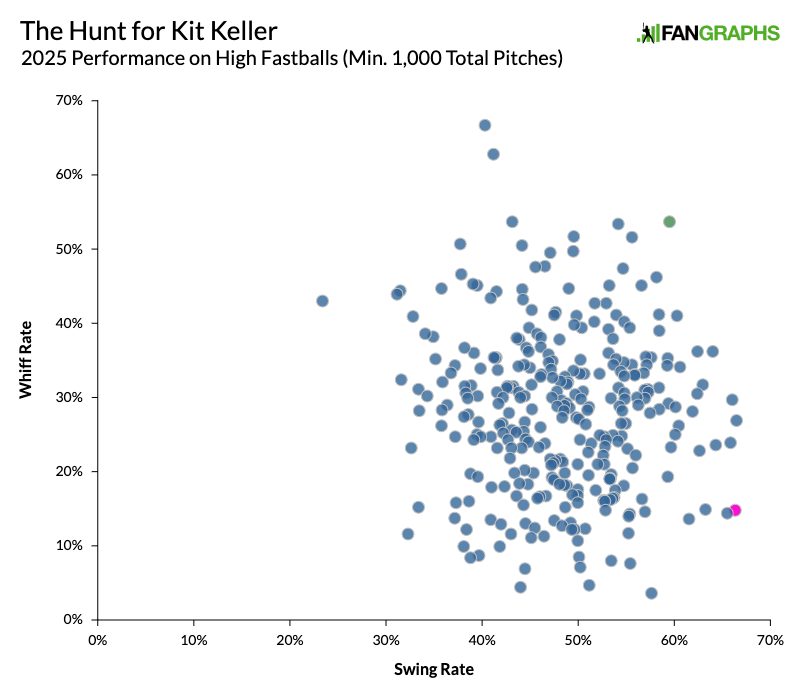
Yep, it looks like a big old blob. To the naked eye at least, there’s hardly any correlation there. Some players swing at those pitches a lot, and some players make a lot of contact on them. But that’s about all you can say. However, if you throw out high fastballs inside the zone and look only at pitches that are too high, then the correlation jumps all the way to -.28. The scatter plot is still a blob, but you can at least see outlines of the general trend.
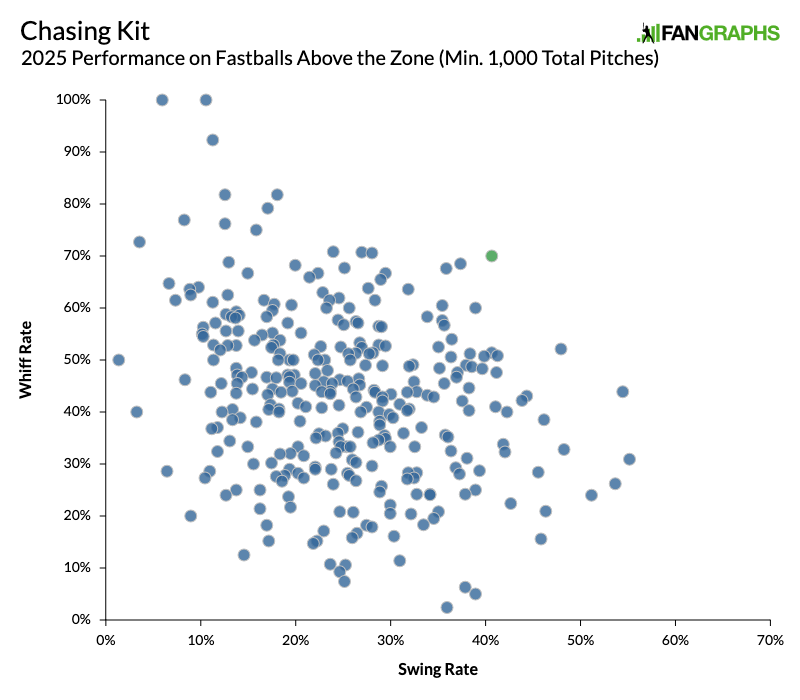
That might not be the direction you expected that correlation to go. The negative correlation means that players who swing more at those pitches make more contact against them. That’s because, generally speaking, players who chase a lot can’t afford to miss a lot. If you chase all the time and whiff when you do so, you’re going to strike out constantly, no pitcher will ever throw you a strike, and you’ll end up in some other profession. For that reason, the top right is devoid of dots. And because nobody is capable of laying off those pitches entirely or running a perfect contact rate, the bottom left is empty too. Contact hitters can put the barrel on anything, so they’re freer to swing at anything. And because they can hit anything, more pitches look hittable to them. The graph has to go from the top left to bottom right.
Alright, I think I’ve put you off long enough. Gabriel Arias of the Guardians, former teammate of Naylor’s, is our Kit Keller Award winner. Arias is the green dot in the top right of both graphs, where “Can’t Hit ‘Em” and “Can’t Lay Off ‘Em” finally meet. In 2025, Arias swung at just under 60% of the high fastballs he saw, which landed him at 21st on our list of 308 players. He whiffed on just under 54% of those pitches, which ranked fourth on the list. Put those two numbers together, and 32% of the high fastballs he saw turned into whiffs. No other player was above 29%. Arias also topped the list if you focus only on pitches above the strike zone, turning them into whiffs at a 29% rate, once again a couple percentage points above the player in second place. Please note that the 76-pitch supercut below is just a sample. It only shows four-seamers and sinkers, and it only shows pitches in the shadow, chase, and waste zones. I left 28 whiffs on the table, both to save myself some work and because I didn’t want Baseball Savant to think I was a bot and block my IP address.
None of this is necessarily a surprise. “Arias looks like a stud at 5 o’clock when he’s taking batting practice and infield,” wrote Eric Longenhagen in 2020, “but his in-game swing decisions have been a problem… The Padres threw every developmental trick in the book at him during the offseason, including virtual reality training, to try to get him to better identify balls from strikes and chase less often.” Eric went on to say that in the unlikely event that Arias learned how to swing at the pitches he could hit and lay off the ones he couldn’t, he’d be a star. Ben Clemens wrote about that star potential during this past spring training, but Arias went on to post a career-high 34.4% strikeout rate during the regular season. It was the highest of any player with at least 400 plate appearances. Arias is 25 now, and that future where he figures it out and turns into a fearsome power hitter with a great glove at shortstop looks fainter than ever, all because he can neither hit, nor lay off high fastballs. Still, you probably shouldn’t throw him three in a row.
Davy Andrews is a Brooklyn-based musician and a writer at FanGraphs. He can be found on Bluesky @davyandrewsdavy.bsky.social.
Fantastic article Davy!