Author Archive

The Best Defensive Team Of The Decade?

I think most people know that the Seattle Mariners put a good defense on the field this year. I’m not sure many people realize that this may be one of the best collection of defenders we’ve ever seen.

The M’s currently lead baseball in UZR by a huge margin. They are +84.5 runs above average, more than 20 runs ahead of second place Tampa Bay. Their team UZR total is the highest of any club in our data set, which goes back to 2002. In fact, the Mariners are only the fourth team in the last eight years to post a UZR over +70. The M’s passed that mark a month ago.

Amazingly, the team has achieved a record setting UZR despite making 102 errors. Their .982 fielding percentage ranks 23rd in baseball, and they have lost 13 runs from their UZR total thanks to the miscues – only the Nationals have cost themselves more runs via the error.

In fact, if we just focus on range, which is what most people associate UZR with, the Mariners are a staggering +91.2. Last year, the Rays put a track squad on the field and led baseball in Range Runs at +69.0, and they’re basically matched that with +62 range runs this year.

The 2008 Rays got to the World Series in large part because of how good their defenders were at covering ground. The 2009 Mariners have been 30% rangier than the 2008 Rays. There’s a reason the team leads the American League in ERA despite ranking 9th in the league in FIP. Franklin Gutierrez, Ichiro Suzuki, and Adrian Beltre have formed the nucleus of an historically great defensive team.

A Great Day

I generally try not to write about the Mariners too much here, as I figure if you wanted to read my ruminations on Seattle’s team, you’d just go over to USSM. But, last week, Felix Hernandez’s start against the Blue Jays sent me down a road that I found interesting, so hopefully you’ll forgive a brief Mariner-related post here.

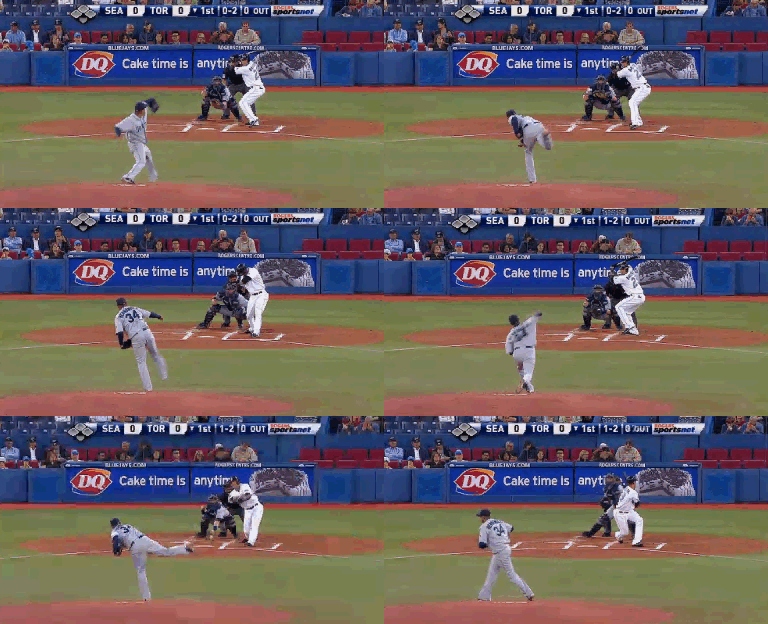
On Thursday, Felix had some of the best stuff he’s ever had, including these two ridiculous “change-ups” (thrown at 91 MPH apiece) which should probably be outlawed in the interest of fairness. Even though the Blue Jays managed to get four runs off of him, thanks to a Vernon Wells home run, he was a dominating force for eight strong innings. On the same night that he set his season high in strikeouts with 11, he also ran a 15-2 groundball rate.

Generally, groundballs and strikeouts are substitutes for one another. Hitters tend to swing through pitches up in the zone more often, so there’s a trade off between K and GB. When you can rack up both in the same game, odds are pretty good that you’re going to win, because the opponents just aren’t going to be able to string together any kind of rally.

So, I asked David to query the game logs over the last eights years to find the performances where a starter racked up the most combined GB+K in the same game. Perhaps not surprisingly, the most impressive performance came from Brandon Webb. On September 21st, 2005, he faced 28 batters – 26 of them either pounded the ball into the ground or struck out. In fact, that start is one of only three games since 2002 where the starter got a grounder or a strikeout from 90 percent of the batters he faced.

The other two performances of that quality? Webb, again, on May 20, 2006… and Zach Day. Not the name I was expecting either. But on May 1st, 2003, he shutout the Brewers by getting a staggering 23 groundballs, while also mixing in five strikeouts. He faced 31 batters, and got a combined 28 grounders and strikeouts.

Injuries derailed Day’s career, so he’s not going to be well remembered by future generations, but for one day at least, he was a force to be reckoned with.


Defense Hits The Market

This upcoming free agent class has generally been derided as one of the weaker groups in recent history. After seeing the likes of CC Sabathia and Derek Lowe hit the market last winter, this group lacks the same pizazz. However, there is one area where this group of free agents is particularly strong – defense. Those in the market for premium defensive players will have a lot of options this winter.

Need a second baseman? Placido Polanco is arguably the best defensive player at the position in baseball. Felipe Lopez can field the position fairly well, too.

Shortstop? Jack Wilson, again perhaps the best defender at the position in the game, may be available (if the Mariners don’t pick up his pricey $8.6 million option). Even if Wilson doesn’t hit the market, Adam Everett will be available.

Third base is more loaded than any others. Adrian Beltre, Chone Figgins, Pedro Feliz, and Joe Crede are among the very best glove guys in the game at the hot corner.

How about the outfield? Mike Cameron, Randy Winn, and CoCo Crisp (assuming KC turns down his option) will be available.

That is a lot of premium defenders all hitting the market at the same time. Last year, we saw a glut of players with the opposite skillset – big power hitters who belong at DH. Teams forced those guys to take huge pay cuts, though it’s tough to determine how much of that was the recession and how much was a new appreciation for defense.

This winter will be a better test. Defense has been remarkably undervalued for the last decade or so, but it’s making a comeback, thanks to the successes of teams like Tampa Bay and Seattle. With a surplus of elite defenders all becoming free agent eligible at the same time, we’ll get a better view of just how much the value of defense has shifted in the eyes of major league baseball teams.


The Impressive Derek Holland

Tonight, Derek Holland takes the mound for the Rangers. On the surface, he might look like a disappointing young pitcher who has found the transition to the majors to be a bumpy road. After all, he’s 7-12 with a 6.17 ERA. Those are the kinds of numbers that would usually lead to a ticket back to Triple-A next season.

Instead, we should be expecting Holland to take a big step forward next year. While he’s had some problems with the long ball, he’s controlled the strike zone in a way that should be very encouraging for Ranger fans. His BB/9 (3.12) and K/9 (7.16) are both terrific numbers for a rookie starter with minimal high level minor league experience.

For comparison, Holland is the 20th rookie pitcher in baseball history to throw at least 120 innings and post a BB/9 below 3.5 and a K/9 above 7.0. Of the 20 pitchers, only three others besides Holland have posted a below average ERA during that rookie season – John Danks in 2007, James Shields in 2006, and Roger Clemens in 1984.

In his second year, Danks saw his ERA drop from 5.50 to 3.32. Shields went from 4.84 to 3.85. Clemens went from 4.32 to 3.29. All of them knocked a run per game off their ERA totals the following year.

Danks is a particularly useful comparison, given how similar their profiles are. Holland’s issues with the home run are basically equal to Danks’, as they both gave up 1.8 homers per nine innings, in part due to a high HR/FB rate. Danks HR/9 fell to 0.69 the following year, which was the driving force in his second year improvement. Holland shouldn’t be expected to see an equal drop in home run rate, but it’s a good bet that he’ll be better at keeping balls in the park next year. And that’s going to make a big difference in his results.

For all the talk about some of the game’s most impressive young hurlers, Holland sholdn’t get lost in the discussion. Forget the amount of runs he’s given up – he’s shown enough to be considered a candidate for a huge step forward next year.


Underachievers? I Don’t Think So

Kenny Williams isn’t happy with his team. He believes he put together a playoff contender, but that the players just haven’t played up to their abilities, and he’s willing to say so publicly.

“They are underachievers,” Williams said before the White Sox played the Minnesota Twins on Wednesday. “We’re not playing up to our capabilities. Period.”

I’m curious, though – who exactly on his team was he expecting more from? The White Sox are fourth in baseball in pitcher win value, so I’m pretty sure he’s not complaining about a pitching staff that is one of the best in the game. The problem has to be the offense, right?

Aging veterans such as Jim Thome, Jermaine Dye, and Paul Konerko have been about as productive as you could have expected, and they were the core of the run producers. AJ Pierzynski is having one of the best years of his career, despite getting up there in age. Scott Podsednik came back from the dead to provide decent offense in center field. Gordon Beckham was a pleasant surprise just a year after being drafted. Alexei Ramirez transitioned from second base to shortstop nicely, and while his power has diminished, his overall offensive performance is similar to last season.

Really, the only significant underachiever on offense is Carlos Quentin. He has taken a big step back from last year’s breakout season, but injuries have been a lingering problem for him all year and regression should have been expected anyway. Does Williams really believe that Quentin should have matched his 2008 totals while playing through plantar fasciitis?

I’m sorry Mr. Williams, but your offense isn’t full of underachievers. It’s just not very good. The best players are just a bit above average, and your roster lacks any position players that are legitimate stars. Pierzynski is probably your best everyday player, and that’s a pretty big problem.

The failure of the 2009 White Sox isn’t a work ethic or motivational problem. It’s a talent problem. You didn’t build a team with enough of it to contend. That’s not the players’ fault.


Smoltz’s Playoff Role

With a magic number of one, the St. Louis Cardinals should lock up a playoff spot this weekend as the winners of the National League Central. With that hurdle officially cleared, they can begin to sort out their pitching staff for October, and more than most teams, they have some decisions to make.

Their top three starters are set, of course. Carpenter, Wainwright, and Pineiro is a formidable threesome, but they have to choose between either Kyle Lohse (assuming he’s healthy enough to pitch in October) or John Smoltz. Given that Smoltz has put to rest any doubt about his ability to still function as a major league pitcher, he would seem like the natural choice. After all, he’s running a 2.03 FIP since arriving in St. Louis, carving up National League hitters and making them look foolish.

Lohse, with his 4.69 FIP, is nowhere close to the pitcher than Smoltz is. That said, he’s not a total stiff, as his average-across-the-board skillset makes him a solid enough back-end starting pitcher. He’s not going to sink your chances of winning the one game per series where he takes the hill. But he’s clearly still the inferior pitcher in this decision, and the current injury situation muddies the waters a bit.

So, why would the Cardinals even consider choosing Lohse for the game 4 start? Because John Smoltz may be needed to help plug a bullpen that could cost them the series.

Ryan Franklin made the all-star team with a strong start to the season, but in the second half, he’s regressed into being, well, Ryan Franklin. He’s running an ugly 14/16 BB/K in the second half of the season, and given his career history, he should not be looked at as a true relief ace, even with the sparkling season ERA.

Likewise, the setup guys for Franklin are not the dominating types. Smoltz has significant experience coming out of the pen, and his stuff can play up for 15-20 pitches a night. As the #4 starter, he’s unlikely to work more than six or seven innings in any given playoff series, which we have to assume would be something close to even leverage. As a reliever, Smoltz could end up working in four or five high leverage critical situations, where the value of his performance would be enhanced even in a smaller number of innings overall.

Using him in relief also allows the team to minimize his exposure against left-handed hitters, who have given him the most problems this year. As a starter, the opposing manager will be able to stack the line-up with lefties to try to exploit his weakness, but that can be minimized through bullpen management.

As well as Smoltz has pitched since arriving in St. Louis, it’s probably in the Cardinals best interest to use him out of the bullpen in the playoffs. Using him as a reliever gives them their best chance of throwing a parade in November. Cardinal fans should be hoping that Lohse gets healthy in a hurry.


1999 Pedro

With a win over the Red Sox last night, Zack Greinke should have just about locked up the AL Cy Young award. Other pitchers are having good years, but no one has dominated like Greinke has. He’s been the best pitcher in the league by a pretty good margin. His 2.34 FIP looks like something right out of Pedro Martinez’s prime. But that thought process led me to look up Pedro’s page, and as always, that led to my eyes popping out of my head when I saw his 1999 line. It’s just not possible to look at his numbers from a decade ago and not be utterly amazed.

213 innings. 160 hits. 9 home runs. 37 walks. 313 strikeouts. 1.39 FIP.

1.39 FIP in a season where league average was 4.71. Pedro was 3.3 runs per nine innings better than a league average pitcher. Over 213 innings, thats 80 runs better than average, or about 100 runs better than replacement. A hundred runs. Pedro was worth something like +10 wins over the 1999 season. If it’s not the greatest pitcher season of all time, it’s in the discussion.

Or, if we want to get back to discussing Greinke, the 1999 version of Pedro was nearly a full run per game better than the guy who has been hands down the best pitcher in the American League this year. That’s not a knock against Greinke – Pedro’s 1999 season was just so remarkably good that we could go the rest of our lives without anyone ever touching it.

He’s obviously not the same guy now that he was in his prime, but it’s still worth remembering how amazing he was a decade ago.


More Than Werth It

Matt Holliday is making a strong case for a big payday as a free agent this winter, and he deserves it. Over the last two years, he’s accumulated more value than any outfielder in baseball, posting a +11.4 win value in 2008 and 2009. Want to know who is #2?

Jayson Werth, the new leading candidate for the most underrated player in the game.

Werth had a tremendous 2008 season, and he’s followed it up by proving it was no fluke. After hitting .273/.363/.498 last year, he’s topped it with a .274/.377/.523 line. He’s also a tremendous baserunner, having stolen 34 bases and been caught just four times over the past two seasons. He’s Ryan Howard with the benefit of speed and defense, but his slugging teammate continues to garner more press.

Werth shouldn’t be overlooked as one of the primary reasons the Phillies continue to contend in the National League, however. Over the last two years, he’s racked up +9.6 wins of value, ahead of the likes of Manny Ramirez, Ichiro Suzuki, or Ryan Braun. When the elite outfielders in the game are mentioned, however, he’s never mentioned.

Howard, Utley, Rollins, Hamels, and Ibanez have gotten the press, but Werth is just as important to the Phillies. He’s a tremendous player, and he’ll eventually get the recognition he deserves.


Torre Makes His Team Worse

If you haven’t been following the Dodgers of late, there’s an interesting development down in LA – Joe Torre has decided to give a significant chunk of the playing time at second base to Ronnie Belliard, sending Orlando Hudson to the bench in the process.

With most personnel decisions in baseball, there’s a gray area where a legitimate point could be argued for either side. This is not one of those scenarios. Belliard is half the player Hudson is, at best, and if Torre is actually contemplating swapping the two out as his team heads into the postseason, then the man should have his sanity questioned.

Hudson is a known quantity, and a productive one at that. His .342 wOBA so far this season is basically a dead even match for his .339 career mark. He’s a good contact hitter with some gap power and draws a fair share of walks, making him an above average hitter overall. UZR thinks his defense has been in decline, but still thinks he’s around average with the glove.

The total package makes Hudson a slightly better than average player – he’s been worth +2.2 and +3.3 wins in each of the last five years. He’s consistently a quality asset, and certainly the kind of guy you can win a world title with as your second baseman.

Belliard simply is an inferior player to Hudson. His entire production bump since the trade to LA is a function of a 25% HR/FB rate that has allowed him to slug .589 in 18 games. If you think that’s sustainable, I’ve got a bridge to sell you. Belliard is a swing-at-anything hack without the contact or power to make that kind of approach work. In 204 plate appearances before the Nationals shipped him to LA, he posted a .297 wOBA.

He’s not a defensive wizard. He doesn’t run well. He’s not as good of a hitter. The only thing Belliard can outdo Hudson in would be some kind of eating competition.

When October rolls around, Torre better have Hudson installed back at second base and Belliard on the bench where he belongs. Any other alignment will be a blow to the Dodgers chance of winning a World Series.


Pie In The Face

After suspending Milton Bradley for the rest of the season, the Cubs have made official what was already assumed – they’ll be dumping him on whatever team is willing to take the largest portion of his contract this winter. That will also put them back in the market for an outfielder. Not to throw salt in an open wound, but perhaps they should call the Orioles about Felix Pie.

The busted Cubs prospect is thriving in Baltimore of late, as he’s gotten regular playing time the last five weeks and making it pay off. Since August 14th, Pie is hitting .293/.366/.576, showing patience (12 walks in 112 PA) and power (13 of his 29 hits have been for extra bases) and finally living up to the potential he was known for in the minor leagues. With this late season surge, Pie has raised his overall line for the year to a respectable .258/.326/.436, making him essentially a league average hitter. That’s pretty nifty for a 24-year-old quality defensive outfielder.

Pie’s future in Baltimore appears limited, however. With Adam Jones and Nick Markakis locking down two outfield spots, Pie’s only hope for playing time is to beat out Nolan Reimold for the left field job, or more likely, to find some kind of job-sharing role that gives him a few hundred plate appearances per season. Given his upside, it’s way too early to pigeonhole Pie into some kind of fourth outfielder role, so he’ll likely have more value to another club than he will to the O’s. That makes him a pretty obvious trade candidate this winter.

Perhaps the Cubs won’t want to go down that road again – after all, reacquiring him would be tantamount to admitting that the series of deals that netted them Aaron Heilman was a mistake. But for a team in need of a young, cheap center fielder with upside, Pie is going to be an intriguing option this winter.