Author Archive

The Punto/Harris Decision

Last week, I noted that Ron Gardenhire put out a tragedy of an outfield defense when he stuck Michael Cuddyer in center field and flanked him with Delmon Young and Jason Kubel. The Twins are traditionally a defense oriented ballclub with a pitching staff full of pitch to contact strike throwers, so it was surprising to see Minnesota put such a poor collection of gloves on the field at the same time.

Well, the latest odd defensive decision from Gardenhire isn’t as disastrous as the no-glove outfield, but it might be just as weird.

The Twins gave Nick Punto a 2 year, $8 million contract over the winter to retain their starting shortstop. While he’s not much of a hitter, Punto has proven to be an extremely adept fielder, posting a career UZR/150 of +17.5 at shortstop and +19.5 at second base over 3,300 career innings up the middle. He’s not flashy, but he has good range and is very steady, rarely making errors. The combination makes him one of the better defensive shortstops in the game.

Well, Punto went on the disabled list at the end of May, and the Twins used Brendan Harris as his replacement while he was away. Harris, while an okay hitter for a middle infielder, is a lousy defender. He’s a career -9.5 UZR/150 at shortstop and -6.7 at second base, and he just doesn’t have the range to be a quality defender at an up the middle position.

Punto came off the DL on June 11th, and he’s been playing regularly for the last week. At second base.

Yes, Gardenhire has decided that when he puts Harris and Punto on the field together, he’s giving Harris the more challenging defensive position and putting Punto at the less important of the two middle infield spots. Remember, Punto is a borderline gold glover at short, while Harris probably shouldn’t be playing the position at all.

I don’t get it. If the Twins didn’t think Punto could play shortstop, they wouldn’t have re-signed him for $4 million a year – they’re not paying for his bat. So, did Harris make one great play that convinced Gardenhire that he’s a changed man defensively? Is he bribing him? What possible reason could the Twins have for running out a bad defender at shortstop and a really good defender at second base?


Granderson’s Odd Season

Curtis Granderson hit a pair of home runs last night, giving him 16 on the season. That’s the same amount of home runs as Prince Fielder and Justin Morneau have. He’s seven bombs away from tying his career high for long balls in a season, and we’re not even to July yet.

The home runs have come at the expense of his doubles and triples. He has just nine non-HR extra base hits, compared to 39 last year and 61 (!) the year before. Usually, when you see an uptick in home runs accompanied by a significant decline in doubles and triples, you can see a big spike in HR/FB rate that explains the differences. However, here’s Granderson’s HR/FB rates by year:

2006: 11.7%
2007: 10.9%
2008: 12.3%
2009: 14.8%

Yea, 15% is a little higher than 12%, but this isn’t an increase of the magnitude that I was expecting. I was thinking something more along the lines of Raul Ibanez, who had a 10.7% HR/FB rate last and is at 25.3% this year. Granderson has just seen a modest change rather than a dramatic one, at least in terms of how far his fly balls are traveling.

No, the interesting change with Granderson isn’t in the distance of his fly balls, but instead the quantity. He’s basically stopped hitting the ball on the ground, posting a 28.2% GB% that is the sixth lowest in baseball. The change in the loft of his swing has led to significantly more balls in the air.

It hasn’t necessarily made him a better hitter overall, though. After posting a .374 wOBA last year, he’s at .366 in 2009. The fly balls come with a trade-off – more outs. His batting average on balls in play has dropped from .317 last year (and .330 for his career) down to .271, and it’s not just bad luck – extreme flyball hitters simply don’t post high BABIPs, because fly balls turn into outs a lot more often than ground balls do.

The average BABIP for the ten guys with a FB% over 50% is .263. Among that group, Granderson’s .271 BABIP actually ranks fourth, well ahead of guys like Dan Uggla, Jason Giambi, and Chris Young. As long as Granderson keeps hitting the ball in the air this often, we shouldn’t expect regression from his BABIP. However, the Tigers will probably take a little bit of a drop in batting average if Granderson hits 30+ home runs this year. Either way, he’s still a terrific player.


The Ultimate Roogy

With the advent of Pitch F/x and the dissemination of velocity and pitch type data into the public over the last few years, and now leading to stuff like the linear weight values we have for specific pitches on the site here, it’s becoming easier and easier to figure out why some pitchers are successful and others are not. We’re able to quantify things that we’ve never been able to get a handle on before, and the analysis that’s being done with pitch data right now is tremendous.

However, even with all those advances, there’s still one glaring question that I don’t know that anyone has the answer to – how the hell is Mark DiFelice getting people out?

You probably have seen DiFelice at some point now that he’s thrown 45 innings as a major leaguer over the last two season and pitched for Italy in the World Baseball Classic this spring, where he threw four shutout innings against Venezuela. That wasn’t his only taste of success – since coming to the big leagues, he’s posted a 1.81 BB/9 and a 9.07 K/9, which have led to a sparkly 2.01 ERA. He’s been one of the reasons the Brewers bullpen has been holding leads all year.

But how he does it is beyond me. Here’s a Pitch F/x chart of what he throws in a normal game.

difelice

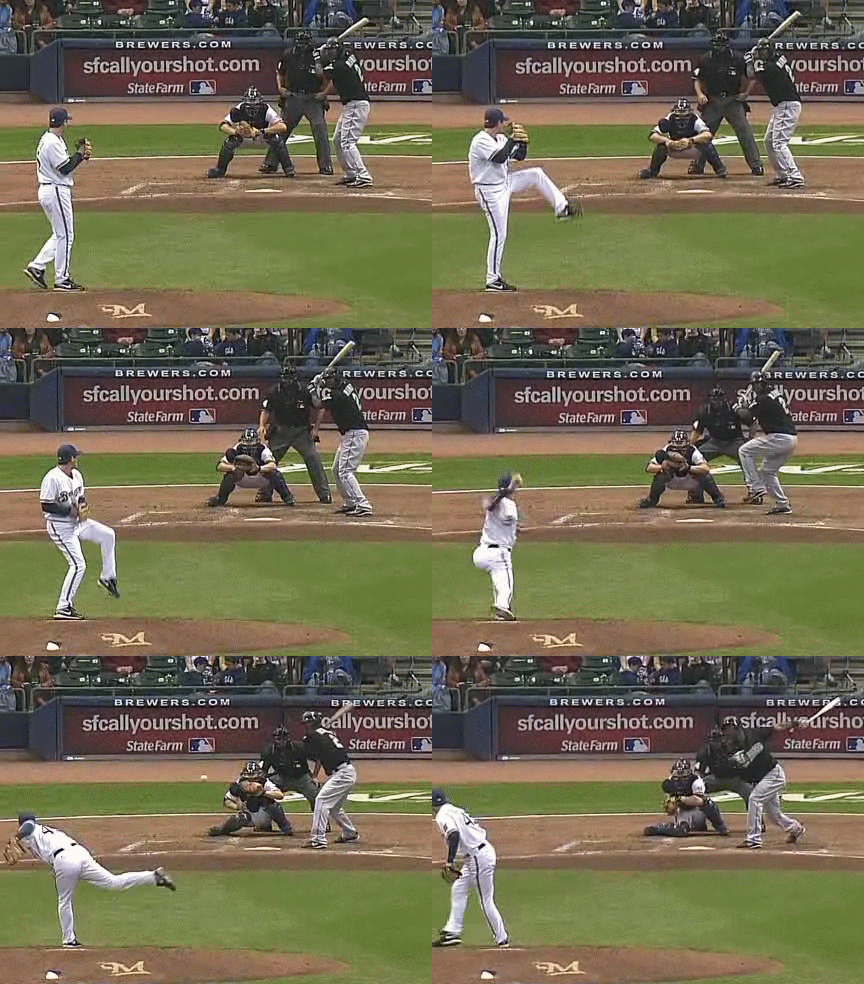
There’s 29 blobs in there representing pitches from DiFelice in that specific game (May 10th versus the Cubs). Pitch F/x labeled most of them sliders, while it called a few others change-ups, but in reality, it’s just a cut fastball thrown so slowly that the algorithm doesn’t recognize it as such. If you want to see the pitch, there’s a .gif over at Driveline Mechanics.

That’s his arsenal. An 80-84 MPH cut fastball. That’s it. He throws that pitch, and that pitch only, 99% of the time. He also has thrown this loopy 72 MPH curveball a couple of times this year, but practically every pitch he throws, in every game, is this low-80s fastball with some tailing action away from right-handers. I faced guys in high school who had better stuff than this.

However, whatever DiFelice does to his cut fastball, or however he hides the ball, or whatever voodoo spell he chants before he pitches, it works wonders against right-handed bats. Here’s his career splits since joining Milwaukee:

Vs RHB: .149/.192/.202, 120 PA
Vs LHB: .321/.357/.717, 56 PA

Opposing right-handers have a .393 OPS against DiFelice. Opposing left-handers have a 1.074 OPS against him. He basically turns every RH bat he faces into a pitcher, and every left-handed bat into Albert Pujols. This is the most ridiculous platoon split I have ever seen. Yes, it’s a small sample size, but given what DiFelice throws, we’d expect left handed major league batters to use him as batting practice, so that part is likely not an anomaly.

Can he really keep pitching like the best pitcher ever against right-handed bats while throwing one pitch in the low-80s, though? Everything I’ve ever been taught about baseball says no, but at this point, we’re on our second year of him embarrassing high quality bats, and I can’t come up with any reasons why he can’t keep doing this. Perhaps the real question shouldn’t be “how is Difelice getting people out”, but instead “why aren’t the Brewers forcing every pitcher they have to learn how to throw that thing?”


Chad Jenkins

If you’ve been reading the site for a while, you’ve probably figured out that I like groundball pitchers. Due to the emphasis placed on strikeout rates as a predictor of future success, too many sinkerball strike throwers have been overlooked as prospects on their way to success on the majors, and too often, their ability to get outs is dismissed as a fluke because they don’t generate an above average amount of swinging strikes. However, when you see guys like Aaron Cook, Jake Westbrook, Paul Maholm, and John Lannan consistently keep runs off the board, it becomes easier to realize that there’s a path to success that doesn’t involve high strikeout rates.

However, there’s a downside to being an extreme groundball pitcher. Most of the guys who rack up tons of groundballs rely heavily on their two seam fastball, and as Dave Allen showed with Pitch F/x data, the two seamer has the largest platoon split of any pitch in baseball. It is a terrific pitch against same-handed hitters, but it’s not much of a weapon against opposite handed hitters. Scouts have intuitively known this for a long time, which is why so many sinker-slider guys gets pigeonholed as relievers, where they can be used in situations where the platoon problem can be minimized.

If a groundball pitcher has a good change-up (or split finger, or even a curve in some cases – vertical movement is the key), he can neutralize opposite handed hitters and be an effective starting pitcher. However, without that off-speed pitch, he’s probably destined for the bullpen or a Vicente Padilla career path (check out his career L/R splits some time).

So, all that said, this post is actually about Chad Jenkins, the Toronto Blue Jays first round pick in last week’s draft. Jenkins was one of the more interesting pitchers in the draft for me, because I’m really curious to see how well his repertoire translates to professional baseball. The scouting report on him gives him a 90-94 MPH heavy sinking fastball, a potentially plus slider, and an average change-up. Given those pitches, we’d expect him to be a groundball guy with potentially a platoon problem.

Thanks to the work of Kent Bonham and Jeff Sackmann, we have split data for college players. How well does the data line up with our expectations based on the scouting report?

Vs RHB: 56 2/3 IP, 1.27 BB/9, 11.28 K/9, 1.75 G/F
Vs LHB: 28 1/3 IP, 2.22 BB/9, 7.62 K/9, 1.72 G/F

He destroyed right-handed bats, holding them to a .200/.230/.259 mark, but wasn’t nearly as good against lefties – .287/.341/.344. He still managed to get LH hitters to pound the ball into the ground, but his fastball/slider don’t work as out pitches against opposite handed hitters, and his change-up looks like it could use some work, based on both the scouting report and the data.

The Blue Jays love groundball pitchers almost as much as I do, but the ones they’ve had success with have developed good secondary stuff. That’s going to be the key for Jenkins as he gets into Toronto’s system. If he can refine his change-up and make it a real weapon against lefties, he has a chance to be one of my favorite pitchers in a few years. If he can’t, I hope he likes hanging out in the bullpen.


Wellemeyer’s Velocity

This afternoon, we looked at Johan Santana’s loss of velocity of late, and what it might mean for him going forward. Let’s pull a double header and take a look at another National League arm who has recently wondered where his fastball has gone – Todd Wellemeyer.

In a conversation after his last start, Wellemeyer told the St. Louis Post Dispatch “Last year I was throwing 94-96 (mph), this year I’m topping out at 90-91. I don’t know what it is but there’s definitely a difference. It makes things more of a challenge, that’s for sure.”

A 5 MPH decrease in fastball velocity would be a huge red flag, and something that very few pitchers could actually overcome. Thankfully, Wellemeyer hasn’t actually lost that much zip on his fastball. Here’s his Pitch F/x velocity chart.

As you can see, his fastball averaged 92-93 for most of last year, and there certainly were games where he was throwing 95 to 96 at the high end. This year, none of his top end speeds reach 95, and in three of his last four starts, the average fastball has come in around 90-91. So, while he hasn’t lost 5 MPH off his fastball, his average speed is down from 92.7 a year ago to 91.3 this year.

Unlike with Santana, who is still topping out at the same speed as always, Wellemeyer’s top end fastball is down significantly. He’s thrown 7 pitches at 94+ this year, the fastest of which was 94.4 MPH. For comparison, he threw 36 pitches at 94+ in one game last year (July 6th against the Cubs), the fastest of which was 96.1 MPH. 28 of those 36 pitches were faster than any pitch he’s thrown this year.

Why has his top end fastball gone away? Well, if he doesn’t know, and Dave Duncan doesn’t know, odds are pretty good that I don’t know either. But, unlike with Santana, I’d suggest this is certainly a legitimate cause for concern long term. A sharp, significant decrease in top end fastball velocity is fairly highly correlated with arm injuries. Not always, of course, but it’s pretty common that a guys fastball disappears and he ends up on the disabled list in the not too distant future.

I told Mets fan not to worry about Santana. Unfortunately for St. Louis fans, I’m not sure I can say the same thing here. It’s probably time to worry.


Johan’s Velocity

On Sunday, the Yankees blistered Johan Santana for nine runs, the most he’s ever given up in a start. We’re not used to seeing Johan get beat like he stole something, so after the game, theories began to fly. Almost all of them centered on his decrease in velocity of late, which is usually a pretty good reason to be concerned. Take a look at Santana’s velocity chart.

johan

As you can see, Santana’s velocity has been lower as of late, with a shift coming around the sixth start of the season. Let’s break Santana’s season into two parts, isolating his first five outings of the year and his most recent seven starts.

April 12th – May 6th.

Pitches of 87 MPH+ – 330 of 514 (64.2%)
Average of those pitches – 91.3 MPH
Pitches of 92 MPH+ – 94 of 514 (18.3%)
Average of those pitches – 92.7 MPH
Pitches of 93 MPH+ – 29 of 514 (5.6%)
Average of those pitches – 93.4 MPH

May 7th – June 14th.

Pitches of 87 MPH+ – 398 of 675 (58.9%)
Average of those pitches – 90.3 MPH
Pitches of 92 MPH+ – 40 of 675 (5.9%)
Average of those pitches – 92.6 MPH
Pitches of 93 MPH+ – 7 of 675 (1.0%)
Average of those pitches – 93.4 MPH

As you can see, the frequency with which he’s throwing higher velocity pitches is down, but the average of the pitches he throws at the top of his range hasn’t changed much. His top end velocity is basically still the same as it was at the start of the year – he’s just not getting the ball up to 93 as often.

This should be encouraging for Mets fans, I think. If the velocity drop was a sign of a serious arm problem, we’d see a bigger fall from top-end velocity. Instead, what we’re seeing is that he’s throwing more pitches in the 88-90 range that used to be in the 89-91 range, which is accounting for most of the 1 MPH dropoff he’s experienced in his overall fastball speed.

This data supports the blister theory that suggests he’s adjusted his grip to avoid popping the blister, and that the adjustment has caused his ball to cut a bit more with a bit less velocity. We’ll have to keep an eye on Santana’s velocity over the next few weeks, but I wouldn’t be surprised if this was just a temporary problem.


What We Learned In Week Ten

Welcome to the only recap of last week that won’t punish you with endless Luis Castillo references. Mets fans have endured enough. Besides the fact that ESPN will beat a single highlight into the ground, what else did we learn last week?

The Rockies have to be a wee bit frustrated

After an undefeated week where they ran their winning streak to 11 games, Colorado has closed the gap in the N.L. West to… 10 1/2 games. They haven’t lost in nearly two weeks and they’re still not even with shouting distance of the Dodgers. Part of that is how bad they were to start the season, but the other part is that the Dodgers just won’t stop playing like the best team in baseball. The Rockies have managed to insert themselves into the Wild Card race with their surge, and they now have the third best run differential in the National League, but they’re still fighting an uphill climb to get into the playoffs.

The Texas Rangers don’t win when they don’t score.

Despite all the talk about the improved run prevention down in Arlington, they still rely on their offense to win them baseball games, and last week, the hitters went into a collective slump. Nelson Cruz, Michael Young, and Ian Kinsler all had wOBAs below .200, and Elvis Andrus and Marlon Byrd weren’t much better. With half their line-up hitting like pitchers and Josh Hamilton on the DL, Texas scored just 14 runs last week. They’re going to have to hit early and often if they want to hold off the Angels for the A.L. West. Too many more weeks like this and they’ll be looking up at Anaheim in the standings.

Philadelphia might want to ramp up their search for a starter.

Ruben Amaro’s not been shy about his desire to add a frontline starter via trade to replace the injured Brett Myers, but the performances of J.A. Happ and Antonio Bastardo had bought him some time and allowed him to be patient while waiting for the right deal. Not this week. Happ walked 10 guys in two starts, while Bastardo gave up three hits and three walks in just one inning in his only start of the week. They gave up 14 runs in 12 innings between them, for a not-so-nifty 10.50 ERA. Time to burn up the phone lines again, Ruben.

Willy Taveras doesn’t want to get on base.

Okay, that’s probably not true. I’m sure he wants to, but he just can’t figure out how. The Reds center fielder went 0 for 22 last week, and has now gone 32 plate appearances without reaching first base safely. His disastrous slump has dropped his season line to .229/.283/.289, and while he’s playing solid defense in center field, the Reds can’t keep sticking a guy with a .267 wOBA in the line-up regularly. Taveras is going to have to get hot in a hurry if he wants to stay on the field, because even Dusty Baker won’t tolerate 0-for-weeks for too long.

The Angels didn’t want to wait for Howie Kendrick to regress to the mean.

Mike Scioscia had apparently seen enough of Kendrick for now, as the Angels shipped their starting second baseman back to Triple-A and have apparently given the starting job to Maicer Izturis, based on this weekend’s line-up. Kendrick was hitting just .231/.281/.355 when he was demoted, but had anything really changed? His walk rate, strikeout rate, and isolated power are all right in line with his career numbers. The drop in numbers is entirely due to a .269 batting average on balls in play, which is about 80 points lower than his career mark. Even if he’s not hitting the ball as hard this year (his line drive percentage is down a bit), there’s still no way you’d project him for a .269 BABIP going forward. He was going to find more holes, and given his defense at second base, the Angels should have been willing to wait for his luck to turn.


A Penny Saved

For a few weeks now, it’s been assumed that Brad Penny would be the odd man out in the overcrowded Boston rotation. Brought in on a one year deal as something of a reclamation project, Penny didn’t get off to a very strong start, and he was standing in thew ay of youngsters Justin Masterson and Clay Buchholz, which didn’t exactly endear him to Red Sox nation. With John Smoltz making his way back, trade rumors have been swirling around Penny for weeks. Over his last four starts, however, Penny has been pitching like a guy who wants to stick around.

5/25: 5 1/3 IP, 6 H, 3 R, 0 BB, 7 K, 4 GB, 8 FB
5/30: 6 IP, 10 H, 3 R, 0 BB, 5 K, 6 GB, 9 FB
6/5: 5 2/3 IP, 7 H, 5 R, 2 BB, 5 K, 10 GB, 5 FB
6/11: 6 IP, 6 H, 0 R, 1 BB, 5 K, 11 GB, 6 FB

That’s a 3.37 FIP over his last four trips to the mound, the last two of which were against the Rangers and Yankees. It’s not just his performances, either – take a look at his velocity chart.

penny

His fastball is trending upwards as the season has gone along, suggesting that the improved results aren’t just a good stretch but perhaps indicative of Penny returning towards his previously established performances when healthy. He probably never will get all the way back to what he was earlier in his career, but he’s showing that he can still be a quality major league performer, whether its for Boston or someone else. We’re past the point where Boston fans should be happy to see this guy go just so he can make room for the other starters in the organization. Penny’s spent the last few weeks proving that he still has value, and it will be interesting to see how Boston handles the situation.


Pity Nick Blackburn

In some ways, 2009 could be considered the year when defense became cool again. After seeing a shift away from glovework during the past 20 years, a handful of teams adopted outfields with multiple center fielders playing along side each other, and plodding sluggers saw their value in free agency crash through the floor. In both the blogopshere and MLB, defense is getting the respect it deserves again.

So, with that in mind, let me present to you the worst outfield defense of all time*, taking the field today for the Minnesota Twins.

LF – Delmon Young, career -17.3 UZR/150 in left field.
CF – Michael Cuddyer, career -6.3 UZR/150 in right field. He’s playing center!
RF – Jason Kubel, career -15.7 UZR/150 in right field.

Reports that the Twins have acquired Adam Dunn and plan on starting him at shortstop have yet to be confirmed. I know Denard Span is hurt and they wanted to give Morneau a half-day off by DH’ing him, but really Ron Gardenhire? Young-Cuddyer-Kubel seems like a good idea to you?

At least he’s not doing with Scott Baker or Kevin Slowey on the mound, but let’s pretend that Blackburn is some kind of extreme groundball guy. His career GB% is 44.8%, just barely above league average. He is, however, an extreme pitch to contact guy, averaging just 4.41 K/9 in his major league career. He’s not going to get outs on his own, but relies on his defense to make plays behind him.

The outfield defense that Gardenhire gave him today consists of two designated hitters and a poor defensive corner outfielder. Good luck, kid. You’re going to need it.

*It’s hyperbole. I’m sure there’s been a worse outfield put on the field at some point in history.


The Best Fastball Of 2009

A few weeks ago, David rolled out pitch type linear weights, which gives run values to each type of pitch that is thrown. This is a tremendous resource, as it gives us the ability to quantify the difference in value pitchers have been getting from their arsenal and to look for trends that could help us identify quality pitchers going forward.

Well, it went under the radar a bit, but David has updated the leaderboards to include this data, so you can now sort by pitch types and see which pitchers are having the most or least success with various pitch types. Not surprisingly, Justin Verlander has gotten the most value out of his fastball this year, as he’s dialing up his four seamer and racking up the strikeouts with it. His power fastball, thrown up in the zone, is a true out pitch.

However, did you know Verlander does not rank number one in value per 100 fastball thrown? If you haven’t already checked out the leaderboard, you will never guess who is at the top of the list.

Tim Wakefield.

No, I’m not kidding. The knuckleballer is getting better results from his fastball, on a per pitch basis, than any other pitcher in baseball this year. His fastball averages 72 MPH, or about what you’d face in a small private high school league, and he’s getting more value his heater than guys who throw 100.

You will never need more evidence than this that pitching really is all about disrupting a hitters timing. Wakefield’s fastball, on it’s own, is not a major league quality pitch. He doesn’t throw it with velocity or a ton of movement, but because he’s set it up with knuckleballs, an offering that should be a total meatball is acting like a true out pitch.

This is something to keep in mind when you look at Pitch F/x data or scouting reports. We’ve come a long way in our ability to quantify what a pitcher throws, but there’s still a hugely undiscovered realm of pitching that has to do with varying speeds and movement within an at-bat, and the value that can come from timing disruption.