
Can You Make More Contact by Standing Closer to the Plate?
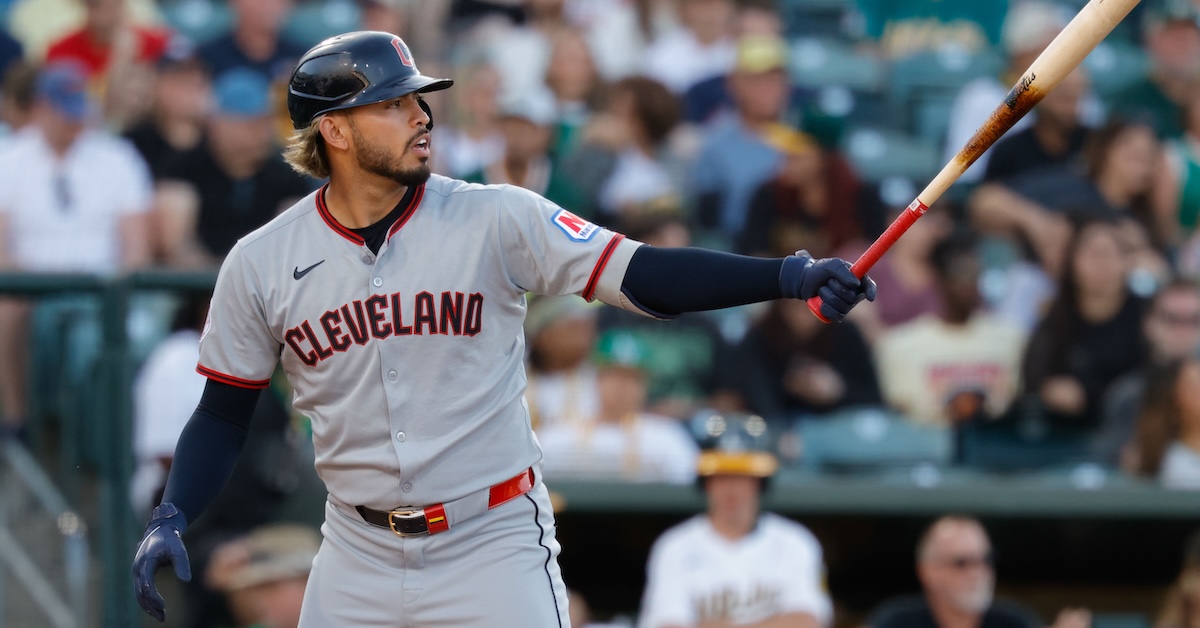
Back in the fall, Daniel R. Epstein of Baseball Prospectus wrote a couple of articles about where hitters stand in the batter’s box. Statcast released batting stance information last year as part of the ongoing rollout of bat tracking information that started in 2024. Understandably, the location of a hitter’s center of mass got a bit overshadowed by the wealth of information about how their bat moves through space and finds its way to the ball (or not), but Dan did his part to drag it into the light. He found a relationship between contact rate and where the batter stands. Specifically, standing deeper in the box and standing closer to home plate are both associated with higher contact rates.
Both of those findings are intuitive enough. Standing deeper in the box gives you a longer reaction time. It’s no surprise that batters who take advantage of that extra information make more contact. It’s also easy to spot a potential selection bias: The players in the back of the box are likely back there because they’re the kind of contact-oriented players who want the extra reaction time.
I saw less of a physical reason for players who stand farther from home plate to make more contact, unless they stand so far from the plate that they have trouble reaching the outside corner, but (almost) nobody actually does that. It might take your bat head slightly longer to reach the outside part of the plate, but the ideal contact point for an outside pitch is deeper anyway, so I assumed the two would balance out and chalked the difference up to selection bias. Bigger players with longer arms naturally feel more comfortable farther away from home plate, and those bigger players tend to have more powerful swings, which tend to result in more whiffs. Causation isn’t correlation, and I wasn’t ready to go so far as to assume that standing farther away from home plate actually causes a batter to make less contact. Then I watched A League of Their Own again.
After watching the movie, I did some research to find out which current major leaguer suffers from the worst case of Kit Keller Syndrome. Kit Keller Syndrome is a serious condition that affects thousands of Americans, and it’s associated with two debilitating symptoms: the inability to hit high fastballs, and the inability to lay off ‘em. (There’s also anecdotal evidence that suggests it also causes an innate, deep-seated resentment of Geena Davis). My search led me to Gabriel Arias of the Guardians, but it left me slightly unsatisfied. It’s true that Arias chases and misses high fastballs at a shockingly high rate, but it’s not because he’s particularly susceptible to that one pitch. He runs one of the highest overall chase rates in the league and the absolute lowest overall contact rate. He’s an equal opportunity hacker. He swings at high pitches. He swings at low pitches. He swings at inside pitches. He swings at – well, he actually swings just a bit less at outside pitches, and there’s an obvious reason for that.
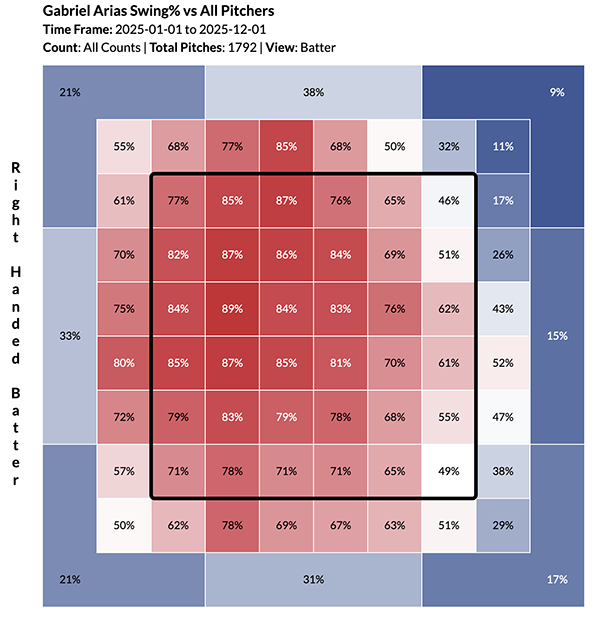
Back in June, Esteban Rivera took his own run at the new batting stance data with an article titled, “Wait, Gabriel Arias Is Standing Where in the Box?” It’s true that Arias has the kind of big, powerful swing that leads to lots of whiffs, but he is just 6-foot-1. Somehow, he sets up 35.6 inches away from home plate. That’s nearly a full yard(!) from the dish, and it’s the biggest gap in baseball. The only two players who are even within 3.5 inches of Arias are the Bunyanesque Paul Goldschmidt and the statuesque Aaron Judge. Goldschmidt and Judge have eaten breakfasts bigger than Gabriel Arias. He stands absurdly far from the plate, and Esteban illustrated the consequences of this approach with a series of GIFs that showed Arias reaching out and flailing helplessly at pitches on the outside corner. Esteban also noted that the move was likely deliberate. Arias averaged 31.9 inches away in 2023 and 33.0 in 2024. At the time of the article, Arias was averaging 35.4 inches, which means he backed away even farther during the second half.
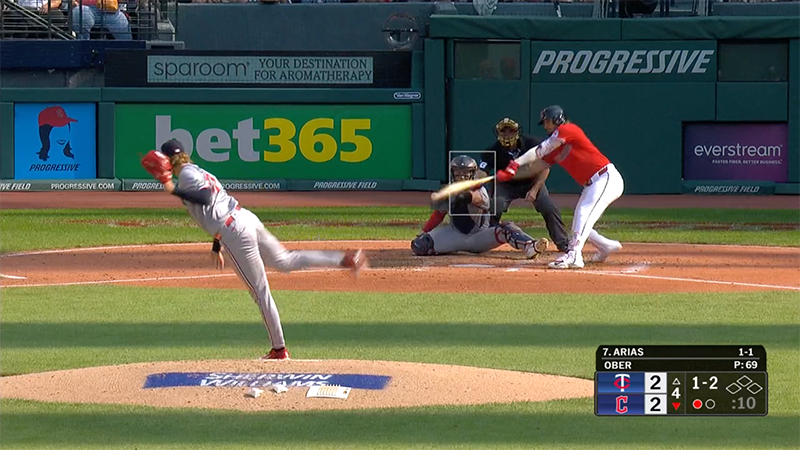
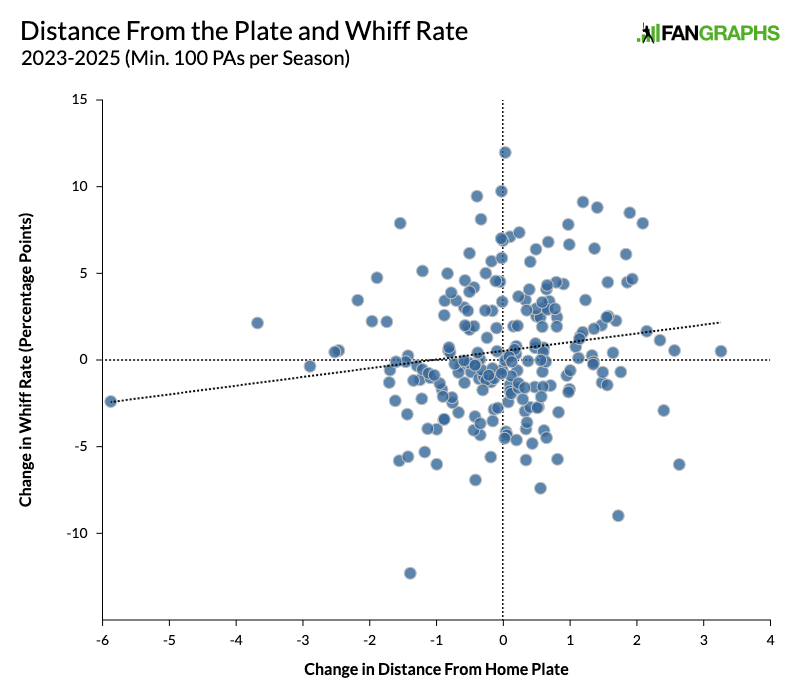
Everything I just laid out has been rolling around my brain for a couple weeks now, along with one other data point: Over the last two seasons, as he’s gotten farther and farther from home plate, Arias’s whiff rate has increased. I finally started wondering whether there was some causation going on after all. Maybe moving closer to the plate really does allow you to make more contact, and moving away from it results in more whiffs. To check, I compared the year-over-year stats. I pulled data for each batter with at least 100 plate appearances in two consecutive seasons, which left us with a sample of 221 sets of two player-seasons for comparison. That way, we’re comparing each player only to himself and getting rid of as many biases as we can. For our purposes, switch-hitters counted as two different players from either side of the plate. Because we only have second-half data for 2023, the vast majority of our sample sets are comparing 2024 numbers to 2025 numbers.
Now this is a small sample, and most players don’t move around much from year to year to begin with. Nearly 70% of the players in the sample averaged less than one inch of difference. And even if you were convinced that standing closer to the plate improves contact rate, you still wouldn’t expect the effect to be all that strong. Still, it’s detectible here, and I’m inclined to believe it’s real. The correlation coefficient between the differences in distance from the plate and whiff rates is .15. You can see a vague overall shape in the scatter plot, and the trendline shows that for every inch closer the batter stands to the plate, you’d expect them to add one percentage point of contact rate.
I ran the same numbers with hard-hit rate and wOBA, comparing them both to the change in distance from the plate. Hard-hit rate had a correlation coefficient of -.03. That’s so small as to be negligible, and it’s not in the direction we’d expect, meaning that moving closer to the plate was actually associated with a higher hard-hit rate. wOBA was the real surprise. It had a correlation coefficient of -.11, meaning that players who moved closer to the plate hit slightly better overall.
Again, these are all very small correlations, and we’re not dealing with a great sample. No front office is going to look at this scatter plot and start instructing its whiff-prone players to start crowding the plate, except maybe for Cleveland’s. If I worked for the Guardians, I’d definitely try to find out what would happen if Arias decided to stand in the same zip code as home plate. However, since I don’t work there, I’m mostly hoping to see him keep edging farther and farther back in the box year by year until he becomes the first player ever to make it a full meter between him and the dish. Still, I’m intrigued by the connection between distance and contact rate, and I definitely think we should check back in on it once we accumulate a few more seasons of data.
Davy Andrews is a Brooklyn-based musician and a writer at FanGraphs. He can be found on Bluesky @davyandrewsdavy.bsky.social.
This is interesting/thought provoking! I would be interested in seeing as well the specific hitters that are seeing contact gains as they move closer, and see if there are any identifiable characteristics of these hitters, or whether we think it is a more general effect.