
Chris Bassitt Trades Birds, Signs One-Year Deal With Orioles
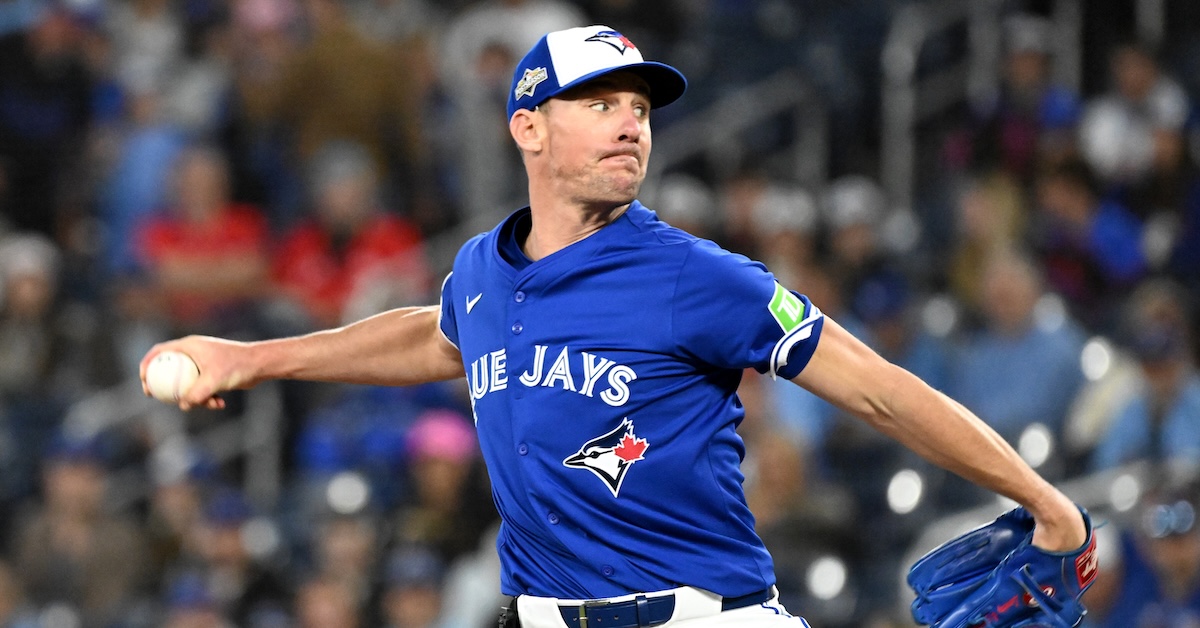
The Orioles have signed Chris Bassitt to a one-year, $18.5 million contract. That number includes a $3 million signing bonus, and Bassitt can earn another half a million if he reaches 27 starts, a feat he last failed to accomplish in the shortened 2020 season. That dependability is a major part of what the Orioles are paying for. Bassitt, who came in at no. 35 on our Top 50 Free Agents list, will turn 37 in 10 days, and at this stage of his career, he’s a player who raises your floor rather than your ceiling. With this signing, Orioles continue their recent strategy of coming into the season expecting their pitching staff to outperform middling projections. ESPN’s Jeff Passan broke the news first, because of course he did.
It’s easy to draw a dividing line in Bassitt’s career, starting in 2024. From his debut in 2014 through 2023, he owned a 62-42 record with a 3.49 ERA and 3.91 FIP. Over the past two years, he’s 21-23 with a 4.06 ERA and 4.04 FIP. However, the advanced numbers say he actually started faltering in 2023, when he ran a 3.60 ERA in spite of a 4.28 FIP. Knowing that, it’s important to note that despite similar top-line numbers, some advanced stats saw Bassitt as bouncing back a bit in 2025. The difference is especially apparent in the expected stats. His xERA dropped from 4.52 in 2024 to 4.16 in 2025, and his xFIP dropped from 4.28 to 3.84. He continued to drop his arm angle, which helped him induce a hair more soft contact and raise his groundball rate. That kind of change often comes with a reduction in a pitcher’s walk and strikeout rates, but Bassitt was able to lower his walk rate while keeping his strikeout rate roughly the same. That’s a neat trick if you can pull it off, but it’s by no means a sure thing that Bassitt will be able to keep it going in his age-37 season.
Bassitt throws the kitchen sink, boasting an eight-pitch repertoire that includes both a traditional changeup and a splitter, but that belies the fact that he is, for the most part, a sinkerballer. He throws the pitch nearly half the time against righties and 30% of the time against lefties, with his seven other pitches all playing off it. The sinker averaged just 91.6 mph in 2025, the lowest mark of his career. There’s a velocity floor for just about every pitcher, below which it doesn’t matter how many pitches you throw or how well you can place the ball. We don’t know what Bassitt’s is, but it stands to reason that it can’t be all that far below 91 mph. From here on out, the projections won’t trust him too much because they’ll always bake in a year of age-related decline. Still, the vast repertoire, the veteran savvy, and the long track record of success with below-average velocity make it easy to view Bassitt as one of those players who deserves the benefit of the doubt until he finally puts up a true clunker of a season.
As for where Bassitt slots into the Orioles rotation, we should start with the fact that he lost his rotation spot during Toronto’s World Series run. He worked out of the bullpen in the playoffs – he did a fantastic job there, running a 1.04 ERA and 1.52 FIP across seven appearances – but it says something that he was the odd man out rather than the 41-year-old Max Scherzer, who struggled all season with injuries and underperformance, or the compromised Shane Bieber. Whether or not the Orioles would actually go out and spend on starting pitching has been a point of concern for Baltimore fans for years now, and their biggest free agent pitcher may not end up in a position to start a playoff game for them.
Baltimore is clearly betting on its pitching development to raise the rotation’s ceiling. Despite plenty of skepticism when they traded for Trevor Rogers in 2024, the lefty just put up a remarkable season, coming back from a knee injury and running a 1.81 ERA and 2.82 FIP over 18 starts in 2025. Kyle Bradish has looked great on either side of the torn UCL that limited him to just 14 starts over the past two years. The team traded for Shane Baz, about whom GM Mike Elias said, “I think he hasn’t fully tapped into his ceiling yet, so we see him as a front-end-of-the-rotation starter.” They also re-signed Zach Eflin to a one-year deal with a mutual option for 2026.
But even with Baz and Bassitt in tow, our Depth Charts rank the Orioles’ starters 17th, projecting just 11.8 WAR. Here’s the pessimistic view of this rotation: Bassitt has a combined ERA of 4.06 over the past two seasons and his velocity is flirting with unplayability. The Orioles seem to be betting that they can beat the Rays at pitcher development. Baz has only pitched one full season and has never put up more than 2.0 WAR. Eflin just put up -0.3 WAR, and back injuries sent him to the IL three times in 2025. Rogers ran a 5.09 ERA from 2022 to 2024; he’s a massive regression candidate. Bradish isn’t all that far removed from Tommy John, and he’s definitely not going to keep striking out 37% of the batters he faces. Dean Kremer has a 4.14 ERA over the past three years. Cade Povich has not exactly impressed in his first two extended stints in Baltimore.
Still, there’s plenty of room for optimism, and that’s why Bassitt is an Oriole. Rogers is sure to regress some, but he could still be great. Moreover, you have to view his 2025 season as an encouraging sign both for him and Baltimore’s ability to unlock a pitcher’s potential. Baz may no longer have the ace upside that Elias expects, but he certainly has the talent and stuff to be a good mid-rotation starter. Bradish looked absolutely electric in his return from Tommy John, and he could very well be a no. 1 type. Eflin is a regression candidate in the other direction — it’s hard to get the 2.60 ERA he ran after the Orioles acquired him in 2024 out of your head. Povich actually took a big step forward in 2025 according to the advanced ERA estimators, and he’s still just 25. Kremer may have put up a 4.19 ERA last season, but he put up his best FIP in years, and if nothing else, he can consistently put up league-average innings. Bassitt is about as consistent a player as you’ll find, and he’ll bring a lot of experience to a staff that could use some.
Combine those two paragraphs and that’s how you end up with a rotation that projects to be right in the middle of the league. Not all of these things are going to go wrong or right in 2026. However, if the Orioles do make it to the playoffs, enough of them will have gone right. Two or three of Bradish, Rogers, Baz, Eflin, or Povich will have stepped up and pitched great. Bassitt or Kremer will have pumped out enough quality innings to keep things moving. At this point in his career, Bassitt is unlikely to be the guy who puts the Orioles over the top, but he can help them get there. And once they’re there, we just might get to see him turn into a relief ace again.
Davy Andrews is a Brooklyn-based musician and a writer at FanGraphs. He can be found on Bluesky @davyandrewsdavy.bsky.social.
Not Framber but better than nothing
Yeah. I could have talked myself into Gallen, but he seems destined to sign something like a 3/$60M with opt-outs, in which case, you’re seeing 1/$20M + QO pick for a guy whose median projection is half a win better than Bassitt.
I think that’s probably still preferabe especially since the QO pick would be a 3rd rounder (#82), but not by much.