
Chris Martin Runs It Back With the Rangers Once More
If you’re a regular FanGraphs reader, then you know that this week, the week after the Winter Meetings, is a week for roundups. The Rangers make a couple moves on a Friday? I’ll bundle them into one snug article. A passel of lefties comes off the board on a Tuesday? Michael Rosen will arrange them into a tidy bouquet. A couple teams talk themselves into believing that they could be the ones to figure out Josh Bell and Adolis García? Michael Baumann will slam his head into the wall repeatedly for our amusement. That’s how it goes.
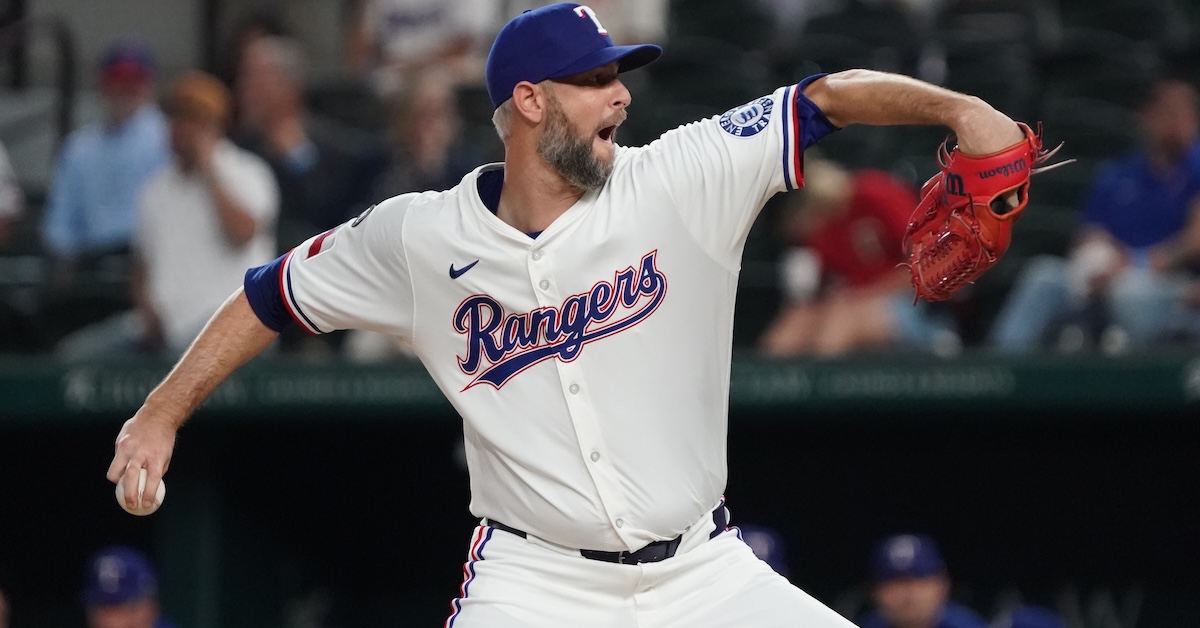
On Wednesday, Chris Martin, the big, 39-year-old middle reliever from Texas, signed up for one last rodeo with his hometown Rangers. As with many minor deals, no one has reported how much Martin will be paid for the 2026 season. The news seemed all but destined to occupy one quarter of a reliever roundup, but I’d like to give Martin single billing here, because I don’t think we’ve done a good enough job of celebrating just how good he’s been. Let’s start at the beginning.
Martin is 6-foot-8, and while many pitchers that tall need awhile to figure things out, his journey was considerably twistier. The Tigers selected him out of Arlington High School in the 18th round of the 2004 draft, but Martin went to McLennan Community College in Waco instead. The Rockies took him in the 21st round as a draft-and-follow in 2005, but he tore his labrum in his sophomore season, so they declined to sign him. In 2007, he tried out for and made the Fort Worth Cats, an independent team, but he didn’t stay long. His shoulder “just wasn’t ready to go,” he later told reporters.
Martin underwent surgery, found a warehouse job, and that was that, at least for a while. Three years later, he tried out for the indy ball Grand Prairie AirHogs. He made the rotation, ran a 1.96 ERA, and signed with the Red Sox. From 2011 to 2013, Martin put up a 3.12 ERA and 2.96 FIP in the minors, throwing more than 70 innings a season and peaking at Triple-A. The Red Sox traded him to the Rockies after the 2013 season, and he debuted for Colorado in 2014, then got sold to the Yankees for the 2015 season. Over those first two years of his career, pitching for the Rockies and the Yankees, Martin owned a 6.19 ERA despite a 3.71 FIP. He seemed monumentally unlucky, but the Yankees released him. At age 30, he went to pitch for the Nippon Ham Fighters in NPB. Martin was unhittable in Japan, posting a 1.11 ERA across the 2016 and 2017 seasons. Despite dealing with an ankle injury, he struck out 29% of the batters he faced and walked just 4% of them. That is to say, he walked 13 batters across two seasons and 89 1/3 innings. That’s good enough to bring you home.
The Rangers signed Martin to a two-year deal for $4 million. “The Martin signing is a fairly easy one to ignore, all things considered,” Jeff Sullivan wrote at the time. “I can’t make any promises. I don’t know what Martin might be capable of. But I feel almost obligated to try to talk him up. This seems like a forgettable deal, but Martin appears to have major upside.” In 2018, Martin once again underperformed his FIP in a major way, but things finally went right in 2019. How right did they go?
From 2019 to 2025, Martin has pitched 311 innings with a 2.84 ERA and a 2.88 FIP. Over those seven seasons, he’s put up 6.5 WAR as a reliever. That’s the 11th-highest total in baseball. The 10 players ahead of him have names like Clase, Hader, Díaz, Williams, Chapman, and Jansen. We are talking about the best relievers in baseball here. Martin has a better ERA than six of them. He has a better FIP than six of them, too. But every player ahead of him has at least 86 saves compared to Martin’s 15. That’s understandable. Martin doesn’t look like a closer. He doesn’t have one unhittable pitch. He throws a bunch of different ones. His fastball hangs out right around the league average in terms of velocity. He doesn’t rack up a ton of whiffs. His greatest skill is avoiding walks. But he does strike out a surprising number of batters, and he does keep the ball on the ground; that combination has allowed him to be one of the best relievers in the game into his late 30s.
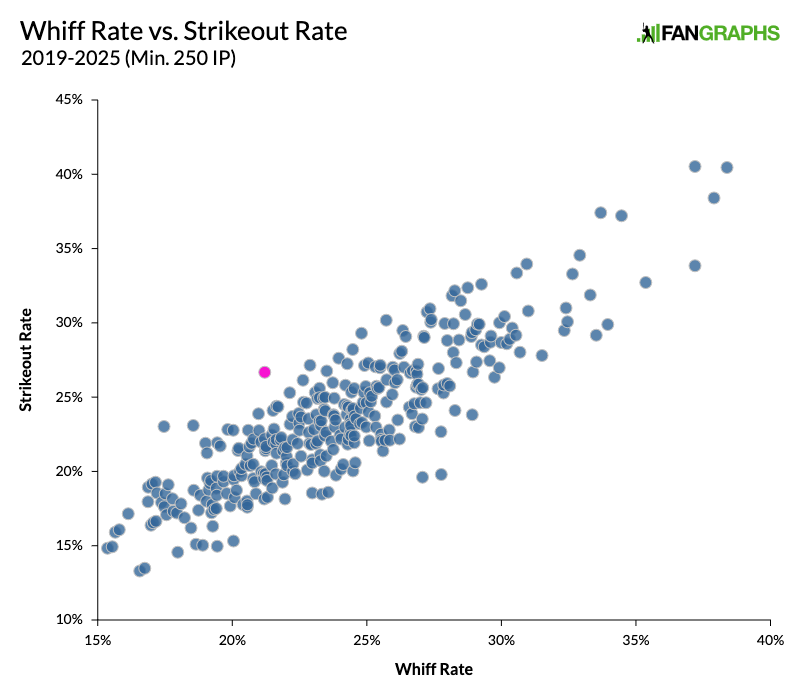
Martin’s ability to strike out batters without racking up whiffs is truly outlier stuff. As you surely know, the relationship there is extremely linear. Players who miss bats rack up strikeouts. Here’s a graph that shows every pitcher with at least 250 innings pitched over the past seven seasons. Martin is the pink dot with the strikeout rate that’s way higher than it should be.
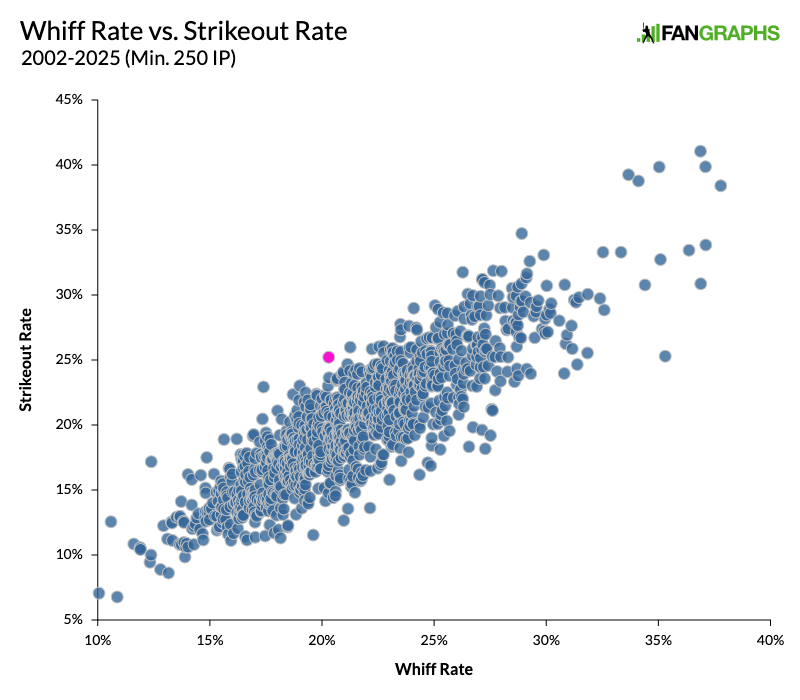
That’s just over the last six years, though. We’re cherry picking Martin’s best seasons. We’ve got whiff rates going back to 2002, and even when we factor in his odd, ugly first three major league campaigns, he still stands out from the pack.
How the hell does Martin do that? How does he rack up so many strikeouts without getting that many whiffs? It’s not by earning tons of called strikes. Among the 1,145 pitchers on that graph, his 16% called strike rate puts him in the 34th percentile. Martin strikes out all those batters by an even unsexier means. He induces tons of foul balls. Over the course of his career, when batters have swung at Martin’s pitches, they’ve fouled the ball off 42% of the time. Since 2008, 857 different pitchers have induced at least 2,000 swings. Among them, Martin’s 42% foul rate ranks 13th. That’s six spots below Mariano Rivera. Put it all together, and Martin has earned strikes on 51% of the pitches he’s thrown in the big leagues. Over the course of the pitch tracking era, that puts him in the 97th percentile, right between Garrett Crochet and Max Scherzer. I swear to God.
Once he finally stuck in the big leagues, Martin bounced around, going from the Rangers to the Braves (with whom he won a World Series), the Cubs, the Dodgers, and the Red Sox. After 2024, he indicated that he’d like to close out his career with one final season with the Rangers. He signed for one year and a hometown discount of $5.5 million. Echoing Jeff Sullivan eight years later, Michael Baumann wrote, “Martin is neither a workhorse nor a guy with knockout stuff. His career high in innings is 55 2/3, his fastball sits in the low-to-mid 90s, and he has no breaking ball worth speaking of.”
Everything Baumann said was true. Martin throws two fastballs and a changeup, and leads with the foul-inducing cutter. The most intimidating thing about him is his height, and things didn’t go all that great in 2025. Shoulder fatigue forced him to the IL in May, and a calf strain did the same in July. Scariest of all, his season ended a few weeks early to due thoracic outlet syndrome. For once, though, luck seemed to be on Martin’s side. Because he gave up a few more home runs and walks than usual, his 3.58 FIP was his highest since 2015. However, he finished with a 2.98 ERA over 42 1/3 innings.
So what should we expect from Martin in 2026? I guess I need to be the latest in a long line of FanGraphs writers to tamp down your expectations. There is no way to know what to expect from Martin at this point in his career. He will turn 40 in June. He faced multiple injuries last season. He will be pitching through thoracic outlet syndrome, which can be a career ender at any age. His fastball was solidly below average in velocity during his last few appearances, and he ran his lowest groundball rate since 2020. But I’m not going to count Martin out just yet. DRA- still thought he was great in 2025. Stuff+ liked every one of his pitches quite a bit (and it adored the sweeper that he basically never throws). The Rangers clearly still think he has something in the tank. He’s earned at least one more chance.
Davy Andrews is a Brooklyn-based musician and a writer at FanGraphs. He can be found on Bluesky @davyandrewsdavy.bsky.social.
The only reason there’s no Coldplay jokes in this article is because you’re Yellow.