
How Steven Kwan Keeps Earning Gold Gloves
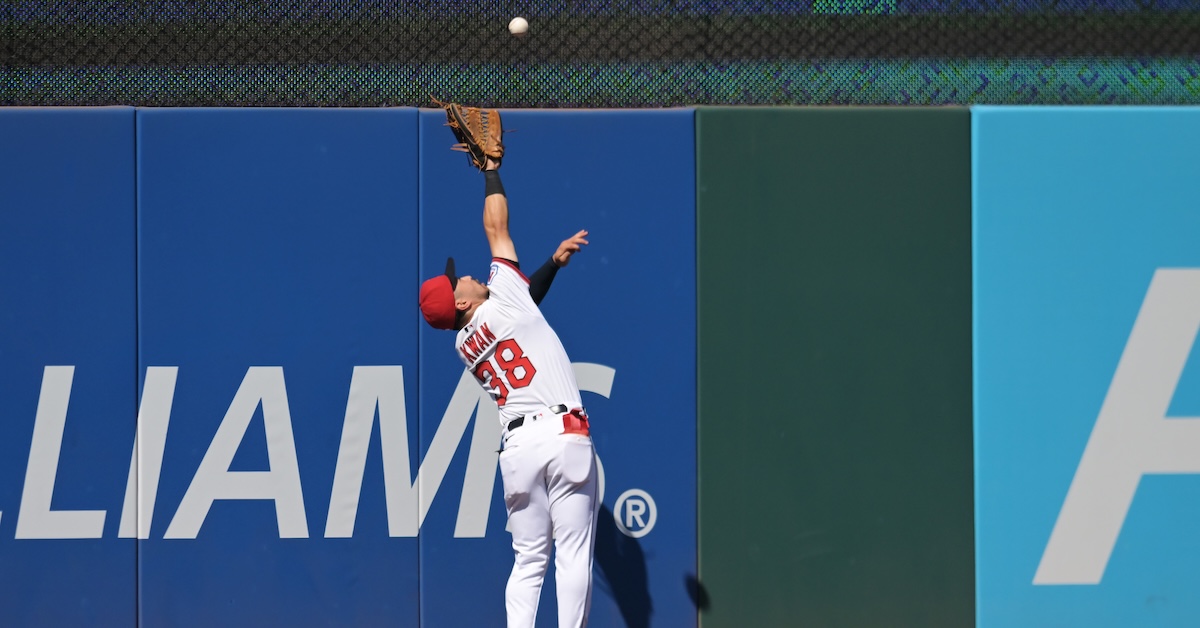
Steven Kwan looks like the kind of guy who gets underestimated. He’s undersized. He doesn’t hit the ball particularly hard. He plays for a franchise that’s most famous for refusing to spend money. Still, I don’t think many people are underestimating Kwan these days. He’s the undisputed second-best player on the Guardians, behind only future Hall of Famer José Ramírez. He’s a two-time All-Star. He’s never put up fewer than 3.0 WAR in a season. He’s never not won a Gold Glove. Everybody knows that he’s a great player, but I’d like to highlight a couple specific parts of his game that we tend to take for granted.
Kwan’s defense certainly receives plenty of appreciation. In two of his four major league seasons (2023 and 2025), he has swept the three advanced defensive metrics, finishing first among all left fielders in Defensive Runs Saved, Deserved Runs Prevented, and Fielding Run Value. In 2022, he finished first in both DRS and FRV, but didn’t lead in DRP. In 2024, he finished in second in FRV and fourth in DRS (but because of the arguably arcane innings minimum of 900, he did lead all Gold Glove-eligible left fielders in both metrics). The point of this complicated litany is that all of the major defensive metrics love Kwan, and that’s important because they use very different methods, methods don’t always line up. DRS detests Oneil Cruz, but FRV thinks he’s great. DRP loves Randy Arozarena even though the other two systems hate his guts. All the systems can agree on Kwan. Whether you’re breaking down video with human eyes or analyzing catch probability through the lens of a high-speed Statcast camera, when you look at Kwan, you’ll see the best left fielder in the game.
All the same, in a previous era, without these various advanced perspectives, we might not have appreciated Kwan like we should. He’s never possessed blazing speed, especially for an outfielder. Indeed, for the past two seasons, his speed has actually been below average. He also makes surprisingly few jaw-dropping catches. He makes a decent percentage of his four-and five-star chances, and like so many great defenders, he makes them look too easy. His highlight reel is shockingly light on the full-extension, gravity-defying diving catch we normally associate with premium outfield defense. This was the only example he offered in 2025:
These days, we know enough not to let that fool us. Kwan’s jumps grade out particularly well, and he’s aggressive when he attacks the ball in the gap and down the line. That’s more important than your top sprint speed. Kwan also does the little things well, and today we’re going to focus on two of those little things.
Progressive Field is particularly shallow in left field. It’s 325 feet down the line and 370 feet in the gap. As a result, opposing left fielders position themselves at an average depth of just 289 feet, shallower than every stadium except for Fenway Park. Progressive also has a high wall, and the combination of those two factors means that outfielders have to make a lot of plays at the wall. That’s a specialty of Kwan’s. According to Statcast, in 2025, he failed to catch just one ball that was near the wall and had a catch probability above 15%. In fact, over his entire four-season career, he’s failed to catch a ball like that just six times. Six! And while he doesn’t lay out all that much, he does make eye-popping plays at the wall:
Some of these plays, like the one above, look spectacular. But many of them don’t, and it’s surprisingly easy for an outfielder to hide a deficit of wall skills. When an outfielder is worried about crashing into the wall, they can slow down their pursuit of the ball a bit. By the time the ball comes down, it looks like they never had a chance of catching it in the first place. You’d never guess that these plays had respective catch percentages of 90% and 70%, even after factoring in a wall difficulty discount:
When that move loses its efficacy, the outfielder can pull up and field the ball on the hop. If they pull it off smoothly, it looks like they made the smart play all long by holding the runner to a single. It disguises the fact that the ball would have been very catchable had they, you know, tried to catch it. Of course, sometimes the ball bounces clear over the wall for a ground rule double, which does tend to break the spell:
If you’re wondering why I picked on Andrew Benintendi on all these plays, it’s because Statcast rated him as the worst outfielder in baseball going back in 2025. I couldn’t have put these clips together for Kwan. He always goes after the ball hard, and he nearly always catches it. Seriously, the guy is fearless:
Those plays at the wall are important not just because they look cool and feature injury risk. Balls at the wall represent big swings in terms of value. A wall ball that falls in is good for a double, more if you screw it up badly.
The last piece I’d like to mention is Kwan’s arm. It’s the reason I wanted to write about him in the first place. Kwan led all outfielders with 13 assists in 2025. It’s a big part of the reason he won his fourth Gold Glove, but I tend to be suspicious of gaudy outfield assist totals. They’re not particularly sticky year-over-year, because they involve a fair amount of luck and happenstance. A perfect throw can go for naught because the runner pulls up at the last moment, or because they execute a perfect swim move, or because they knock the ball out of the fielder’s glove, or because the fielder makes a clumsy tag, or because the fielder rushes to make the tag and fails to catch it — the list goes on. But Kwan has been unusually consistent. In his four seasons, he has racked up 40 assists, the most in the game. He’s led the league once and he’s never ranked below 11th.
Once again, all three major defensive metrics appreciate Kwan’s arm. It ranks ninth according to Statcast, 11th according DRS, and third according to DRP. Kwan has a track record of throwing runners out, and Statcast rates his arm strength as a bit above average for a left fielder. But let me show you something. The table below features the top 10 outfielders in arm value from 2022 to 2025. Kwan is the only left fielder on there.
Here’s how to read the table. The first four columns show run values, with the overall value first, then a breakdown of how it was accrued: the value lost when runners advanced and took an extra base, then the value gained by the runners the fielder threw out, and last, the value gained by runners who held up and didn’t even try to advance. The three columns on the right show the percentage of times that the runner tried to advance and take an extra base, then Statcast’s estimated advance attempt rate based on the specific details of the play, then the difference between the two. I’ve made the table sortable, so feel free to play around with it, but I’ve also highlighted every place where Kwan is either at the top or the bottom:
| Player | RV | Advance | Throw Out | Hold | Advance Att.% | Est. Att.% | Diff. |
|---|---|---|---|---|---|---|---|
| Nolan Jones | 14 | -16 | 19 | 11 | 37% | 37% | 0% |
| Ramón Laureano | 14 | -19 | 16 | 17 | 37% | 39% | -2% |
| Brenton Doyle | 13 | -20 | 12 | 22 | 39% | 43% | -4% |
| Ronald Acuña Jr. | 9 | -19 | 9 | 20 | 34% | 38% | -4% |
| Michael A. Taylor | 9 | -16 | 7 | 18 | 34% | 39% | -5% |
| Fernando Tatis Jr. | 9 | -20 | 12 | 16 | 35% | 37% | -2% |
| Lane Thomas | 9 | -26 | 18 | 17 | 37% | 37% | <1% |
| Adolis García | 8 | -27 | 15 | 21 | 33% | 35% | -2% |
| Steven Kwan | 8 | -29 | 22 | 15 | 33% | 32% | 1% |
| Aaron Judge | 8 | -15 | 6 | 17 | 33% | 38% | -5% |
Yeah, he’s at the top or the bottom an awful lot, and the common theme between these extreme marks is that runners are not respecting his arm like they should. He’s got the fewest holds and he’s lost the most value due to runners taking the extra base. He’s got the most value for runners thrown out. When you’re an outfielder, you don’t really get to decide how you accrue value (or don’t) with your arm. If you’re Aaron Judge and runners are afraid of your arm, then you’ll rack up passive value as they decline over and over again to take the extra base. If you’re Christian Yelich, who has a big league-worst five-point gap between his actual and expected advance attempt rates, then you’ve either got to throw runners out or watch your formerly Gold Glove-caliber defense go up in flames.
Kwan is the only player on the list whose actual advance rate is a full point higher than his estimated advance rate. Even if you go all the way down to the top 25, you’ll only find one other outfielder with an actual advance attempt rate that’s higher than their estimated rate. As a reminder, this is a list of the 10 most valuable outfield arms in baseball over a four-year period. Kwan has topped it for two years running now, and he’s done it the hard way, by throwing out runner after runner, and yet in terms of respect from baserunners, he grades out in just the 29th percentile.
Or at least he used to. Things have changed a bit more recently. If you break things down by year, you’ll find Statcast didn’t love Kwan’s arm in the first two seasons of his career, and neither did opposing runners, who ran up an attempt rate three points higher than the estimated rate. In the last two years, however, they’ve been a bit more cautious, going for the extra base one point less often than expected. Kwan is finally earning the smallest modicum of respect, but judging by his still-gaudy assist numbers, runners owe quite a bit more:
Davy Andrews is a Brooklyn-based musician and a writer at FanGraphs. He can be found on Bluesky @davyandrewsdavy.bsky.social.
these video compilations are very fun. What I see in the arm vids is not only a strong arm but a really really fast transfer.
The degree to which he is able to diagnose the play, shift his weight and fire off an accurate throw quickly is impressive. All the more so when you consider how frequently his back is to the infield when fielding the ball.
He also seems to have picked up a few outs on trailing runners, which implies to me a really high level of baseball acumen and an ability to process information quickly.
He also knows where he is going with the ball before it is in his glove and his back is still turned to the infield.
Caromgraphs
I still think every adult that thinks baseball is boring should take a routine big league fly ball, gain some perspective. One of the curses this sport has to work through is that those at the top level make the extravagant look simple.
The bit on Kwan not diving reminds me of JRod in CF. I’ve watched countless amounts of innings of him out there, and while he’s mastered the feet first slide coming in on a ball, I don’t think I’ve ever really seen him go full extension horizontal. I have seen him overrun 5 star catches tho 🤣
Also as an M’s fan, whatever metric that thinks Randy Arozarena is a good OF needs to be thrown in the garbage. If I don’t have to watch another play of him in the outfield it’ll be one too many.
I’m still skeptical of the wall adjustments, especially for tall walls. As an extreme example, this walk-off single by Carlos Navarez was rated a 50% catch probability.
https://baseballsavant.mlb.com/sporty-videos?playId=f625cde2-0d5c-3813-859f-6192ccdd91ee
No, that probability is 50% too high. That ball hit the Green Monster halfway up (at least). You could strap a jetpack on peak Kevin Kiermaier and he’d have trouble catching it.
I think Denzel Clarke’s signature home run robbery was rated at an 80% catch probability? There’s definitely a blind spot when it comes to home run robberies with statcast
I like how this stealthily turned from a Kwan appreciation to a Benintendi condemnation.
That arm tho – could he pitch??