
Los Angeles Dodgers Top 53 Prospects
Below is an analysis of the prospects in the farm system of the Los Angeles Dodgers. Scouting reports were compiled with information provided by industry sources as well as our own observations. This is the sixth year we’re delineating between two anticipated relief roles, the abbreviations for which you’ll see in the “position” column below: MIRP for multi-inning relief pitchers, and SIRP for single-inning relief pitchers. The ETAs listed generally correspond to the year a player has to be added to the 40-man roster to avoid being made eligible for the Rule 5 draft. Manual adjustments are made where they seem appropriate, but we use that as a rule of thumb.
A quick overview of what FV (Future Value) means can be found here. A much deeper overview can be found here.
All of the ranked prospects below also appear on The Board, a resource the site offers featuring sortable scouting information for every organization. It has more details (and updated TrackMan data from various sources) than this article and integrates every team’s list so readers can compare prospects across farm systems. It can be found here.
Editor’s Note: Rubel Arias (no. 35) was added to this list after signing in January as part of the 2026 international amateur class.
| Rk | Name | Age | Highest Level | Position | ETA | FV |
|---|---|---|---|---|---|---|
| 1 | Josue De Paula | 20.7 | AA | RF | 2027 | 55 |
| 2 | Zyhir Hope | 21.1 | AA | RF | 2028 | 50 |
| 3 | Eduardo Quintero | 20.4 | A+ | CF | 2028 | 50 |
| 4 | Emil Morales | 19.4 | A | SS | 2030 | 50 |
| 5 | River Ryan | 27.5 | MLB | SP | 2026 | 50 |
| 6 | Mike Sirota | 22.6 | A+ | CF | 2027 | 45+ |
| 7 | Christian Zazueta | 21.3 | A+ | SP | 2027 | 45+ |
| 8 | Alex Freeland | 24.5 | MLB | SS | 2026 | 45 |
| 9 | James Tibbs III | 23.4 | AA | RF | 2027 | 45 |
| 10 | Charles Davalan | 22.1 | A | LF | 2028 | 45 |
| 11 | Adam Serwinowski | 21.7 | AA | SP | 2027 | 45 |
| 12 | Marlon Nieves | 20.7 | A | SP | 2029 | 45 |
| 13 | Jackson Ferris | 22.1 | AA | SP | 2027 | 45 |
| 14 | Zach Ehrhard | 23.1 | AA | RF | 2028 | 40+ |
| 15 | Kendall George | 21.3 | A+ | CF | 2028 | 40+ |
| 16 | Zachary Root | 22.0 | R | SP | 2027 | 40+ |
| 17 | Luis Carias | 21.4 | A | SP | 2028 | 40+ |
| 18 | Oliver Gonzalez | 19.3 | R | SP | 2030 | 40+ |
| 19 | Joendry Vargas | 20.3 | A | SS | 2029 | 40 |
| 20 | Kellon Lindsey | 20.4 | A | CF | 2028 | 40 |
| 21 | Ryan Ward | 28.0 | AAA | LF | 2026 | 40 |
| 22 | Landyn Vidourek | 22.3 | A | RF | 2030 | 40 |
| 23 | Ching-Hsien Ko | 19.5 | A | RF | 2030 | 40 |
| 24 | Chase Harlan | 19.6 | A | 3B | 2030 | 40 |
| 25 | Brooks Auger | 24.3 | A+ | SP | 2028 | 40 |
| 26 | Reyli Mariano | 19.3 | R | 2B | 2030 | 40 |
| 27 | Sterling Patick | 20.7 | A+ | MIRP | 2028 | 40 |
| 28 | Kyle Hurt | 27.7 | MLB | SIRP | 2026 | 40 |
| 29 | Patrick Copen | 24.0 | AA | SIRP | 2027 | 40 |
| 30 | José Rodríguez | 24.6 | AAA | SIRP | 2026 | 40 |
| 31 | Noah Miller | 23.2 | AAA | SS | 2026 | 40 |
| 32 | Cam Leiter | 22.0 | R | SP | 2029 | 40 |
| 33 | Hyun-Seok Jang | 21.9 | A | SIRP | 2029 | 40 |
| 34 | Brady Smith | 21.0 | A | SIRP | 2028 | 40 |
| 35 | Rubel Arias | 17.1 | R | CF | 2032 | 40 |
| 36 | Eduardo Rojas | 19.0 | R | C | 2030 | 35+ |
| 37 | Elijah Hainline | 23.1 | AAA | 2B | 2028 | 35+ |
| 38 | Aidan West | 19.0 | R | 2B | 2031 | 35+ |
| 39 | Paul Gervase | 25.7 | MLB | SIRP | 2026 | 35+ |
| 40 | Garrett McDaniels | 26.2 | MLB | SIRP | 2026 | 35+ |
| 41 | Ronan Kopp | 23.5 | AAA | SIRP | 2026 | 35+ |
| 42 | Carson Hobbs | 24.0 | AA | SIRP | 2026 | 35+ |
| 43 | Jakob Wright | 22.7 | A | SIRP | 2027 | 35+ |
| 44 | Reynaldo Yean | 22.1 | A+ | SIRP | 2027 | 35+ |
| 45 | Aidan Foeller | 23.9 | A+ | SIRP | 2029 | 35+ |
| 46 | Logan Wagner | 21.9 | A+ | 3B | 2028 | 35+ |
| 47 | Samuel Munoz | 21.4 | A+ | LF | 2028 | 35+ |
| 48 | Peter Heubeck | 23.5 | AA | SIRP | 2026 | 35+ |
| 49 | Jared Karros | 25.2 | AA | SP | 2027 | 35+ |
| 50 | Isaac Ayon | 23.7 | A | SIRP | 2028 | 35+ |
| 51 | Dylan Tate | 21.8 | A | SIRP | 2029 | 35+ |
| 52 | Wyatt Crowell | 24.3 | AA | SIRP | 2027 | 35+ |
| 53 | Logan Tabeling | 24.5 | A+ | SIRP | 2029 | 35+ |
- All
- C
- 2B
- SS
- 3B
- LF
- CF
- RF
- SP
- SIRP
- MIRP
55 FV Prospects
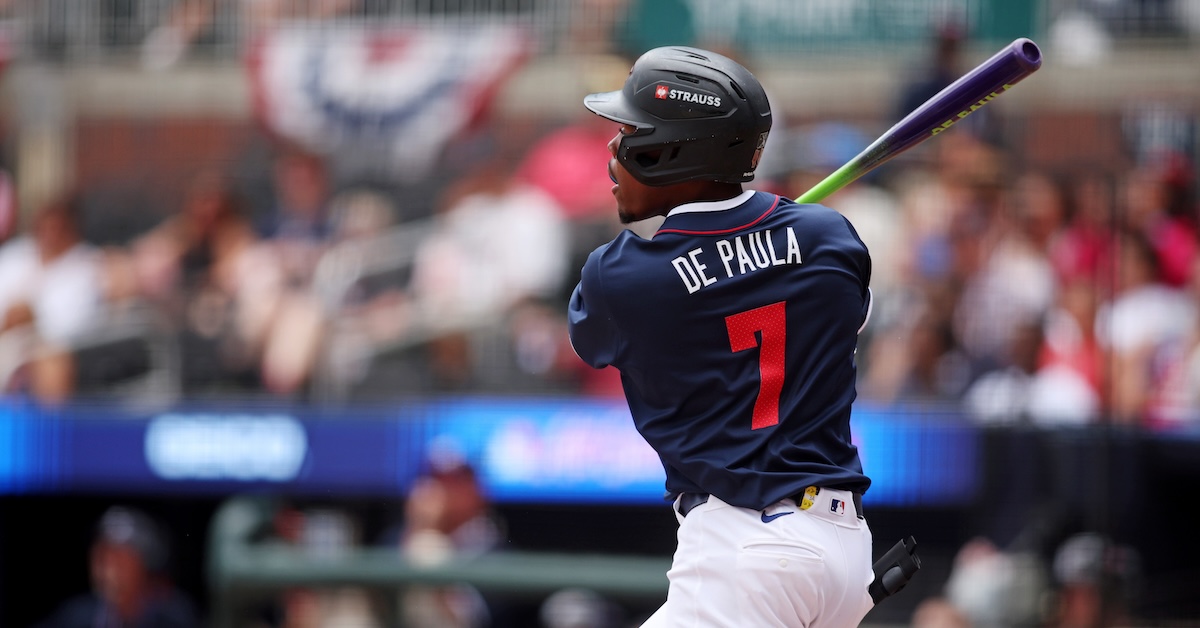
1. Josue De Paula, RF
| Age | 20.7 | Height | 6′ 3″ | Weight | 220 | Bat / Thr | L / L | FV | 55 |
|---|
| Hit | Raw Power | Game Power | Run | Fielding | Throw |
|---|---|---|---|---|---|
| 30/45 | 55/70 | 30/60 | 30/40 | 20/40 | 60 |
De Paula’s combination of present raw power and long-term physical projection give him a great shot to develop 40-homer raw power at peak, though it’s debatable whether his hitting skills are the kind that will allow him to actualize all of that raw thump in games. So far his raw power (De Paula turned 20 in the middle of the 2025 season, and his measureable pop is already a shade above the big league average) has played down in games, and he slashed .260/.412/.399 in 150 High-A games between 2024 and 2025 (a hamstring issue snuffed out his would-be Fall League stint). One might assume some of that was due to the miserable early-season weather in the Midwest League, but De Paula’s slug was well under .400 throughout the middle two thirds of the season. One reason for that is that De Paula’s best, most dangerous swings are grooved in the heart of the zone. He struggles to get on top of fastballs up and away from him, and he’s limited to much a lesser quality of contact when pitchers execute on the outer edge and force him to poke contact the opposite way.
The good news is that De Paula’s hands are strong enough to turn that oppo contact into singles and doubles already, and he’s only going to get stronger. This is a strapping, 6-foot-3 left-handed hitter with the broad, square-shouldered frame of a Ja(y)son Heyward or Werth. When combined with his projected pure strength, his soft skills as a hitter should help his hit tool play better than his 40-grade bat control. De Paula has remarkable breaking ball recognition and plate discipline. He rarely expands (including with two strikes) and will hunt pitches he can drive early in counts, just shy of two standard deviations better than the big league average in terms of his chase rates even when we split them by pitch type and count. He’s comfortable taking awkward swings if it means spoiling tough two-strike pitches (he cuts his stride down with two strikes), and running deeper and deeper counts to grind pitchers into dust. Big lefty power and OBP skills tend to pair well together, and in De Paula’s case, we expect they’ll more than cover up his blemishes (power playing down a tad, vulnerability to high heaters, poor defense) and allow him to be an impact corner outfielder.
50 FV Prospects
2. Zyhir Hope, RF
| Age | 21.1 | Height | 5′ 10″ | Weight | 230 | Bat / Thr | L / L | FV | 50 |
|---|
| Hit | Raw Power | Game Power | Run | Fielding | Throw |
|---|---|---|---|---|---|
| 30/40 | 65/65 | 35/65 | 60/55 | 40/50 | 60 |
Hope’s rise from 11th-round flier to impact prospect has been well chronicled here and elsewhere. Dealt from the Cubs to the Dodgers as part of the Michael Bush trade, Hope missed the first part of 2024 due to a shoulder injury and then exploded onto the scene almost as soon as his cleats left the clubhouse. Particularly notable was the increase in power, which surged from “we can dream on above-average” to “presently plus” practically overnight.
That power breakout facilitates his current projection, which is that of a slugging first-division regular in right field. Hope swings hard and with loft, and will do a ton of damage on contact. His max exits are pushing into plus-plus territory, the area in which you can mishit balls and still do plenty of damage. And while the hit tool is potentially a limiting factor, there are a few positive markers here as well. Hope shows feel for manipulating the bat head, can get his barrel nearly everywhere, and is able to adjust off of the fastball, even against lefties. The shortness of his levers and quickness of his bat are positive indicators that he’ll be able to continue doing all of this against more advanced competition.
The bugaboo here is the swing and miss. Hope’s contact rate in 2025 was just 66%, which is low, particularly given that his in-game power was more good than great. He tends to expand versus spin and changeups down and away, and he isn’t able to drive those pitches at all. Near the letters, Hope has a hole in the up-and-away box of the three-by-three strike zone grid. It’s not fatal by itself, and a number of players with big power and a similarly lofted plane have it, but you can start to see how pitchers are going to be able to attack him. He’s also prone to pulling off the plate and rolling over the odd grounder here and there, all of which contributes to hit tool volatility.
Hope will need to hit because, defensively, his already slim chances of remaining in center have faded further since our last check in. He’s fast enough for the job, but his feel for the position remains underbaked, and this isn’t a frame where you’d expect his speed to last forever anyway. He should be adequate to above average in right, where his plus arm will be an asset.
Don’t let those last two paragraphs distract too much from the upside here. Hope reached Double-A at age 20 and has years to make the kind of modest improvements to his approach that will help him unlock all that power. Remember, this is the kind of guy we (metaphorically, please) like to bet on: A good athlete with strong makeup reviews and not all that much high-level baseball on his CV. It all suggests growth ahead. Hope isn’t a sure thing, but there aren’t many guys who we can project to have plus game power. Hope is one of them, and he’s not so very far from turning potential into production.
3. Eduardo Quintero, CF
| Age | 20.4 | Height | 6′ 0″ | Weight | 190 | Bat / Thr | R / R | FV | 50 |
|---|
| Hit | Raw Power | Game Power | Run | Fielding | Throw |
|---|---|---|---|---|---|
| 35/50 | 45/50 | 30/50 | 55/55 | 45/60 | 60 |
Quintero is a converted catcher who crushed rookie ball throughout his first two pro seasons but struggled during his first two months of full season ball; he hit .196 at Rancho Cucamonga toward the end of 2024 and K’d 31% of the time there in April of 2025. After that Quintero seemed to adjust to the quality of pitching and returned to form, as he slashed .300/.423/.518 the rest of the season and spent his final seven weeks at High-A Great Lakes.
Quintero’s contact ability did take a dip in 2025 as better velocity exposed some of the length in his swing, which has a bit of an arm bar and is driven by his bottom hand. He can be late to the contact point against elevated fastballs and he swings underneath a good number of them, and his contact performance was more average (actually a little bit below within the confines of the strike zone) than exceptional. That’s okay, because he does basically everything well. Even though he has a bit of a hole in his swing, he’s still able to move his hands around and make high-quality contact throughout most of the rest of zone, and he sees pitches well and adjusts his bat path accordingly. He also has a lovely gap-to-gap approach. The way his body unwinds creates doubles power right now, and based on Quintero’s angular build and bodily verve, he should develop something close to average big league power at physical maturity.
An average hit and power combination on a plus-gloved center fielder is an exciting profile. Quintero lacks blazing top-end speed, but his reads, routes, and ball skills are all great, especially for a guy who was an amateur catcher. There’s still some risk that as Quintero climbs and faces better velocity, the issues he has catching high fastballs will worsen and impact his overall output. There’s also a chance that he’ll be able to shorten up as he gets stronger and remedy this particular issue. Here he’s projected as an average everyday center fielder tracking for a debut in the 2028-2029 range depending on the quality of the incumbent center fielder when Quintero arrives on the 40-man roster.
4. Emil Morales, SS
| Age | 19.4 | Height | 6′ 3″ | Weight | 210 | Bat / Thr | R / R | FV | 50 |
|---|
| Hit | Raw Power | Game Power | Run | Fielding | Throw |
|---|---|---|---|---|---|
| 30/40 | 50/65 | 30/55 | 50/50 | 40/50 | 60 |
Morales is one of the highest-variance prospects in the minors. This is a twitchy and explosive kid, a plus athlete with present strength and a frame that suggests more is on the way. Just 18 years old last season, Morales has already hit the ball 111 mph, and there’s a chance he grows into plus-plus raw as he fills out these next couple years. He’s also lean enough to potentially stay up the middle, and while he’s not a wizard, you can dream on a 30-homer guy with average defense at short. If it comes to fruition, that’s a star.
The rub here is that Morales has significant hit tool questions to address. Mechanically, he has an early hip leak that pulls him off the plate and limits his ability to stay on spin and cover the outer half. It also feeds into his aggressive approach: He likes to turn it loose, and while he’s not selling out for power recklessly, he’s also not exactly trying to poke one through the four hole either. There’s some steepness to the path that will let the power play but also foster some swing and miss, and while Morales is quick enough to reach fastballs up, he’s also going whiff on plenty of high heat. His swing decisions aren’t great, either. They’re not so bad as to think he’s hopeless, but he tends to chase spin, and he expands in all directions with two strikes. Morales has time to sand down some of these rough edges, and the projection here is that he will, at least to the degree necessary to profile as a power-over-hit regular. But for good and for ill, the range of outcomes here is pretty large.
5. River Ryan, SP
| Age | 27.5 | Height | 6′ 2″ | Weight | 220 | Bat / Thr | R / R | FV | 50 |
|---|
| Fastball | Slider | Curveball | Changeup | Cutter | Command | Sits/Tops |
|---|---|---|---|---|---|---|
| 60/60 | 55/60 | 55/60 | 40/50 | 55/70 | 40/45 | 95-98 / 100 |
Ryan has hung around these lists for long enough now that his story is probably familiar, so let’s recap it quickly. After playing middle infield and working as a closer at Division II UNC Pembroke, the Padres plucked Ryan in the 11th round of the 2021 draft. He DH’d a few times on the complex that summer, but it was his work in an offseason bullpen that impressed Padres pitching instructor Steve Lyons — right before Lyons left the org and became a scout for the Dodgers. Not coincidentally, Los Angeles soon acquired Ryan in exchange for Matt Beaty, put him on the bump full-time, and saw him blossom into a Top 100 prospect.
Ryan’s blend of athleticism, arm strength, and stuff helped him hit the ground running. By 2024, he had touched triple digits and developed three breaking balls that flashed plus. His change wasn’t quite in that tier but was improving, and it flashed above average when Brendan caught Ryan in his last Triple-A start in 2024. He looked like every bit of a mid-rotation starter that day and after one more tuneup on the complex, LA called him up. He pitched well, running a 1.33 ERA and 3.36 FIP in four starts before tearing his UCL in an August start against Pittsburgh.
Unfortunately, injuries and missed time have become a significant part of the story here, as Ryan will turn 28 next summer and has all of 196 professional innings under his belt. The Dodgers understandably managed his transition from college closer to pro starter carefully, working him three innings a pop in 2022 and four per outing in 2023. He then missed time in 2024 with a shoulder problem before blowing out 12 starts into the 2024 campaign. That isn’t a lot of reps, and it’s a little concerning that the big injury here came right as he started stretching out.
All of this makes Ryan’s future a lot murkier than when last we saw him. In the long run, we have no idea if he can hold up under a starter’s workload, and in the short run, he’ll be shaking off rust while trying to crack a very deep rotation. Ryan is throwing again and reportedly looked good in sim games this fall, so we still consider him a Top 100 arm. This is a big season for him, though, and he may well benefit from a trade to a club that won’t be tempted to push him to the bullpen at the first sign of trouble.
45+ FV Prospects
6. Mike Sirota, CF
| Age | 22.6 | Height | 6′ 3″ | Weight | 187 | Bat / Thr | R / R | FV | 45+ |
|---|
| Hit | Raw Power | Game Power | Run | Fielding | Throw |
|---|---|---|---|---|---|
| 30/40 | 60/60 | 35/55 | 60/60 | 30/40 | 60 |
Sirota entered his draft spring as a potential first round pick, then had a down (though still good) junior year compared to his 2023 output and fell to the third round. The Reds traded him to the Dodgers as part of the January 2025 Gavin Lux deal before Sirota had even played an official game at one of the Reds’ affiliates. Sirota broke 2025 camp on a slight delay and was sent to Low-A Rancho, where he raked for a month, then was promoted to Great Lakes, where he was again utterly dominant until he sprained his knee on an awkward slide in early July. Across 59 games, Sirota slashed an incredible .333/.452/.616 and hit 13 homers. Though Sirota’s underlying metrics weren’t quite as absurd — his contact performance, especially inside the strike zone, was a tad below average — his measurable power on contact was very exciting, as he posted a 53% hard-hit rate, a 107 mph EV90 and a 112.7 max exit velo, all plus or better on a big league scale.
A tightly wound athlete with a narrow build, Sirota is wiry and strong, and his hands are incredibly fast and powerful through contact. Pitchers do not want to miss down and in, as Sirota is very dangerous in that quadrant of the zone. This kind of bat speed on a nearly average contact hitter (if Sirota’s data is to be taken at face value) is Top 100 prospect material. Why then is Sirota floating a shade below the 50 FV tier? The context of his data (an injury-shortened sample, half of it generated by a college hitter against Low-A arms) makes it a little less reliable, and visual evaluation of Sirota’s contact feel is not as promising as his pure data. His swing is often poorly timed and very handsy, with lots of whiffs underneath in-zone fastballs. This might be SIrota adjusting to a new swing (the Dodgers tweaked his swing immediately, ditching his deep crouch and adding a bigger leg kick than he had in college), but he displayed similar issues at Northeastern. There are sources of ours who scout the Dodgers system who have Sirota in the tier above this with the other outfielders, and internally we have some disagreement about how Sirota’s hit tool will play, with Eric (who is piloting this list) the low man.
On defense, Sirota has the wheels to play center field, but his reads and routes are not especially crisp. His speed plays down on the bases, too, as he was only 5-for-10 on stolen base attempts in 2025. Sirota should be developed in center field because playing there will give his hit tool more margin for error. We expect he’ll be a productive big leaguer with some 20-homer peak seasons, but a sketchy hit tool will probably lead to some lean years too.
7. Christian Zazueta, SP
| Age | 21.3 | Height | 6′ 3″ | Weight | 200 | Bat / Thr | R / R | FV | 45+ |
|---|
| Fastball | Slider | Changeup | Command | Sits/Tops |
|---|---|---|---|---|
| 55/60 | 40/45 | 50/60 | 35/60 | 93-95 / 97 |
After two years on the Yankees’ DSL roster, Zazueta was acquired in the Caleb Ferguson trade just before the 2024 season and has spent most of last two years at the Dodgers’ Low-A affiliate in Rancho Cucamonga. He coasted through much of the 2025 first half, culminating in a five-inning, one baserunner, 10-K start against the Padres’ Cal League squad before he was shut down for most of the next six weeks due to a combination of an ankle sprain and workload tempering; he was deployed very carefully after he returned. It capped his 2025 innings total at just shy of 70 frames — his second consecutive season around that mark — and likely prevented him from spending more late-summer time at High-A Great Lakes. With a more robust workload and meaningful progression up the minor league ladder, we would have been tempted to stuff Zazueta in the 50 FV tier, as he has lots of exciting ingredients and is one of the few pitchers in the Dodgers system who has a realistic mid-rotation ceiling.
Zazueta is a limber 6-foot-3, with a powerful lower body and deceptive mechanics. He keeps his front side closed for a long time, but the pace of his delivery really picks up after his front foot lands, and this sudden burst keeps hitters on their heels. Though he doesn’t have surgical command, Zazueta’s delivery is polished enough for him to attack the upper arm-side quadrant of the zone, where his rise/run fastball plays best, and this consistency helped it miss bats at a plus-plus clip in 2025. Off of that fastball Zazueta locates a tailing changeup that’s roughly eight ticks slower than his heater. This fastball/changeup combo was enough for him to post a 2.44 ERA in the Cal League and strike out just under 30% of opponents. A dull 2,300-rpm slider rounds out Zazueta’s repertoire and relies on his advanced feel for location to survive. Unless he ends up throwing super duper hard, he’ll likely always have a below-average breaking ball. This and his lack of established durability are the two areas where we’d most like Zazueta to improve. The 2026 season is his 40-man platform year, so the Dodgers have incentive to stretch him out to 110-ish innings and push him to Double-A at some point to stress test that slider against better hitters. He’s on pace to make his big league debut in 2027 as a spot starter and then establish himself as key rotation cog in the years beyond. Our grade in this instance leaves room for Zazueta’s fastball velocity and command to improve thanks to his build and athletic traits.
45 FV Prospects
8. Alex Freeland, SS
| Age | 24.5 | Height | 6′ 2″ | Weight | 200 | Bat / Thr | S / R | FV | 45 |
|---|
| Hit | Raw Power | Game Power | Run | Fielding | Throw |
|---|---|---|---|---|---|
| 35/40 | 55/55 | 45/50 | 50/50 | 50/50 | 60 |
Freeland’s initial big league foray leaves unanswered some of the questions that made him a divisive prospect in the first place: Was his 2024 jump in contact rate real or a mirage? Will major league pitchers expose his very patient approach, and carve him when he hit right handed? It was a small sample, but those issues still loom large after a rough big league showing. Freeland’s contact rate plummeted in the majors, and his tendency to take pitches led to a lot of pitcher’s counts and subsequent punchouts. We don’t want to draw strong conclusions from what amounts to a handful of at-bats, but the way he got worked against lefties again leaves us wondering if he should quit switch-hitting. Visually, he’s more dynamic and fluid from the left side, and statistically, he’s performed significantly better that way.
Shaky performance aside, tools wise, a lot of the things we liked last year are still intact here. Freeland’s raw power is a shade above average, and his all-fields approach makes him dangerous from line to line as a lefty hitter. He can get passive at times, but his pitch recognition is pretty good and he covers the plate well. He may wind up walking and striking out too much from all those deep counts to ever hit for a great average, but the way he can use the whole field and move his bat head is evidence of some feel to hit.
Freeland’s defensive home is still a little up in the air as well. Some evaluators see him as third base only, while others think he can be average at short. For now we’re projecting the latter. What he lacks in range he compensates for with clean actions, a knack for getting his body in the right spots, and a strong arm. He’s a good example of a reliability-over-range defender, and if asked to take one over the other, managers will usually opt for the sure hands. Taking it all together, we’re rounding down a shade from last year, and see Freeland as more of a quality utility player or a second-division regular than a Top 100 guy.
9. James Tibbs III, RF
| Age | 23.4 | Height | 6′ 0″ | Weight | 200 | Bat / Thr | L / L | FV | 45 |
|---|
| Hit | Raw Power | Game Power | Run | Fielding | Throw |
|---|---|---|---|---|---|
| 35/45 | 55/55 | 35/50 | 50/50 | 40/40 | 55 |
Scouts who watched Tibbs last year all see a useful player, but they’re divided on whether the hit/power combo is good enough to carry an everyday role on a playoff team. That he was traded twice midseason speaks to an eye-of-the-beholder profile. Everyone agrees that he has enough pop to be dangerous, as well as a mature approach at the plate. There’s also broad consensus that Tibbs is just fair defensively, and it’s notable that both of the teams that acquired him used him at first base. He’s also already succeeding in Double-A, corroborating the draft-day sentiment that he didn’t need a ton of seasoning.
Two developments have us intrigued here. The first is the power. Though not seen as especially projectable, Tibbs’ max exit velo was a hair under 114 mph in 2025. His 90th percentiles were more in line with the 55 grade we had last summer, but you can entertain the idea of plus power. The second is that he hung in well against lefties. He hit for less power against southpaws, but his splits were otherwise pretty neutral and the visual evaluation was encouraging: You can occasionally beat him up with velo, but he otherwise covers the plate very well, and his eye was very good on spin just off the dish.
Ultimately, the soundness of his approach and quality of his contact facilitates a relatively low-variance prospect profile. We wouldn’t be shocked if Tibbs is a low-end regular, but for now, we think that the defensive piece and questions about his ability to drive the ball against elite lefties dampen the profile enough that he’s a better fit in a platoon than as a true everyday guy. Regardless, Tibbs should be productive in some capacity, and you can think of him as one of the best of the tweeners we’ll write about this winter.
10. Charles Davalan, LF
| Age | 22.1 | Height | 5′ 9″ | Weight | 190 | Bat / Thr | L / R | FV | 45 |
|---|
| Hit | Raw Power | Game Power | Run | Fielding | Throw |
|---|---|---|---|---|---|
| 35/60 | 40/45 | 35/40 | 60/60 | 45/50 | 40 |
The compactly-built Canadian filled out his frame and spread out his stance ahead of a junior year transfer from Florida Gulf Coast to Arkansas. Loading his hands farther out from his body and shrinking his leg kick, Davalan’s contact performance improved significantly even while upgrading to SEC pitching. His .346/.433/.561 batting line and 8.5% strikeout rate helped prod the Dodgers to pop him 41st overall with a bonus just under $2 million, and his hit tool looked legit (51% hard-hit rate) in eight games at Rancho Cucamonga before a right hamstring strain ended his pro debut.
Even with healthy legs, Davalan is walking a bit of a narrow path. He has above-average speed and the reads to provide average present work in center, but he lacks the build and look of a long-term fixture there, and his throwing arm makes left field his fallback corner. At his 5-foot-9 listed height, there isn’t much raw power that his swing plane is eschewing. Despite lifting 14 homers in 65 games at Arkansas, Davalan has opted for a more level cut that enables his exceptional ability to square up pitches above the belt. Buying Davalan as a future everyday guy likely requires him maturing into one of the best contact hitters in the game down the road, and the available evidence has him more in the Xavier Edwards and Caleb Durbin bucket of hit tools than Steven Kwan or Jacob Wilson.
11. Adam Serwinowski, SP
| Age | 21.7 | Height | 6′ 5″ | Weight | 210 | Bat / Thr | L / L | FV | 45 |
|---|
| Fastball | Slider | Changeup | Command | Sits/Tops |
|---|---|---|---|---|
| 55/60 | 60/70 | 30/40 | 30/45 | 92-95 / 97 |
Drafted as a $125,000 developmental project, Serwinowski (a South Carolina commit) became one of the more exciting pitchers in the Reds system during his first two years of pro ball. The 6-foot-5 lefty had a 4.84 ERA, a 27.7% strikeout rate, and a 11.7% walk rate in 74.1 innings at High-A Dayton when he was traded to the Dodgers at the 2025 deadline as part of the three-team Zack Littell swap with the Rays and Reds. After Serwinowski became a Dodger, his slider’s bat-missing performance took a huge leap (though nothing about it seems to have changed) and he more consistently elevated his fastball. Though it only has roughly average velocity — Serwinowski will sit 92-95 mph throughout the entirety of his starts, and he can rip 94-97 in short bursts — his heater plays like a plus pitch thanks to his quick, ultra-short arm stroke, his nearly seven feet of extension, and the nasty riding life and angle created by his delivery, which shares some visual similarity with that of Yusei Kikuchi. Serwinowski’s plus 77-84 mph slider has big two-plane arc. He’s much more comfortable landing it in the zone than he is locating it in an enticing spot off the plate, but that pitch generated a 53% miss rate after the trade deadline, which is elite.
This is the foundation of a nasty lefty reliever with a mid-rotation starter’s right tail outcome. The changeup/splitter projection here is tough. Serinowski’s ultra-short arm action is less fluid than that of pitchers who tend to have positive long-term changeup development, and he only threw it about 5% of the time in 2025. His slider plays as a bat-misser to the back foot of righties, so he doesn’t necessarily need a changeup to act as a platoon-neutralizing finisher as much as he just needs a distinct third pitch to give hitters something else to think about. Perhaps that’ll eventually be a cutter. The training wheels came off a little bit after the Dodgers acquired Serwinowski, and he was allowed to pitch deeper than the sixth inning for the first couple of times in his career. All together he worked 111.2 innings, putting him in great position to work roughly 130 frames in 2026 and be added to the Dodgers’ 40-man roster at the end of that year.
12. Marlon Nieves, SP
| Age | 20.7 | Height | 6′ 3″ | Weight | 170 | Bat / Thr | R / R | FV | 45 |
|---|
| Fastball | Slider | Changeup | Command | Sits/Tops |
|---|---|---|---|---|
| 55/60 | 50/70 | 40/50 | 30/40 | 93-97 / 99 |
Nieves is a popup arm, a loose and lean athlete with a quick arm and a chance for three above-average pitches or better. Befitting a guy who signed late, he is a blend of intriguing traits and undercooked physicality. He’s got a pretty, low-effort stroke, and can reach the upper 90s without breaking a sweat. He throws two fastballs, and while the four-seamer probably won’t miss a ton of bats on movement alone, he should have above-average sink on the two-seamer. Nieves is still growing into his body, and some of the wildness he’s shown can be partly attributed to a lack of leg and core strength that should develop in due time.
Inconsistency abounds here, and Nieves’ slider is a good case in point. If you watch and grade every single one he’s thrown, the average wouldn’t be anything special, and there are bad misses to either side littered around his pitch chart. At the top end of the range, though, you’ll find a couple of 70s, sharp, sweeping bucklers with late finish that leave a helpless batter in their wake. Nieves’ change is even less far along. He doesn’t use it much and it can get firm on him. Still, he’s able to generate sink on it without sacrificing much arm speed, and he also has the athleticism and shorter stroke we like to see when projecting on a change.
Pitching is risky and there’s work to do ahead, both in terms of Nieves’ physical development and in the consistency of his execution. But there’s a pretty high ceiling here. Nieves has the physical traits and pitch shape characteristics to justify a mid-rotation future grade. That may sound lofty given some of what’s written above, but when guys are this far away, this is what it looks like.
13. Jackson Ferris, SP
| Age | 22.1 | Height | 6′ 4″ | Weight | 230 | Bat / Thr | L / L | FV | 45 |
|---|
| Fastball | Slider | Curveball | Changeup | Command | Sits/Tops |
|---|---|---|---|---|---|
| 50/50 | 50/55 | 45/45 | 40/40 | 50/60 | 92-95 / 96 |
Signed for just over $3 million as a second rounder in 2022, Ferris was handled pretty conservatively during his first 18 months in pro ball and had only pitched 56 innings when he was traded to Los Angeles during the 2023-24 offseason as part of the Michael Busch swap with the Cubs. Each of the last two years, Ferris has worked 126 innings and posted an ERA in the 3.00s.
Ferris’ delivery looks a little more cross-bodied now than when he was with the Cubs. He hides the ball for a long time and delivers a 94-95 mph fastball from a true three-quarters slot. Ferris’ fastball doesn’t move a ton and plays like more of a fringe average pitch. His slider is more comfortably average, and those two offerings make up roughly 85% of Ferris’ usage. Even against righties, when one might expect Ferris to lean more on his curveball and changeup, he’s overwhelmingly a fastball/slider guy. Ferris’ size, consistent delivery, and ability to fill the zone still make him a high-floored starting pitching prospect, but his stuff is more that of a backend starter than a mid-rotation piece. Ferris is one of the more durable, reliable, high-floored pitching prospects in the Dodgers system, and he should begin a spot start role for them in 2027 and grow into a no. 4/5 starter, though he could end up as trade bait or relegated to up-down duty if they continue to function as a de facto All-Star team.
40+ FV Prospects
14. Zach Ehrhard, RF
| Age | 23.1 | Height | 5′ 11″ | Weight | 230 | Bat / Thr | R / R | FV | 40+ |
|---|
| Hit | Raw Power | Game Power | Run | Fielding | Throw |
|---|---|---|---|---|---|
| 30/45 | 50/50 | 40/50 | 55/55 | 45/50 | 60 |
Ehrhard’s success at Double-A makes us pretty confident he’s going to be useful. He’s not the most elegant hitter in the box, as he has a high-effort and punchy uphill swing with an odd front foot kick for timing, all of which sometimes leaves him off balance. But hitters hit, and Ehrhard does that. He’s patient, he makes a lot of contact, he recognizes offspeed well, and he’s good at tapping into his pull-side power. And after watching Trey Yesavage dominate all October long, it’s hard to not be impressed with the way Ehrhard caught up to one of his high fastballs and dumped it over the left field wall last summer.
Ehrhard’s defensive value will also give teams plenty of flexibility. He’s playable in center, on the 45/50 line, and good in a corner with a strong arm. There’s enough effort in his swing, and some vulnerability on the outer half, to keep us from going bananas with his hit tool, and we ultimately think he fits best in a role where he plays a lot, if not quite enough to be considered an everyday guy. We still really like him and it wouldn’t completely shock us if he exceeds expectations and winds up starting for a little bit.
15. Kendall George, CF
| Age | 21.3 | Height | 5′ 10″ | Weight | 170 | Bat / Thr | L / L | FV | 40+ |
|---|
| Hit | Raw Power | Game Power | Run | Fielding | Throw |
|---|---|---|---|---|---|
| 40/50 | 30/35 | 30/40 | 70/70 | 40/55 | 40 |
The Dodgers took George with their first pick in the 2023 draft, which was pushed to no. 36 overall by a CBA overage penalty; the Houston-area native was selected one spot ahead of Kevin McGonigle. Short, slight, and speedy, George’s 100 (!!) stolen bases last season are reason enough to interrogate whether his hit tool has made a leap, since his 2024 performance found the former element of the outfielder’s slash-and-dash profile to be largely absent.
After a 72% contact rate in Low-A last year, which drove our 30 present/40 future hit grade for George, he ran an 81% mark at High-A in 2025, with some reduced loading actions to match. There’s a far smaller hand pump to move George’s barrel into a more vertical position, and he’s switched out his big leg kick for a slight counter-rotation and coil move from his front foot to sync up both halves. There’s no getting a fastball past him middle or in anymore, but George’s short levers still find him swinging inside well-executed velocity to the outer third. And the simplified construction of his swing has him hewing closer to slash-and-dash stereotypes, as his groundball rate spiked to over 60% and he managed to hit .295/.409/.370 in 111 games at Great Lakes with 70-grade speed, though he didn’t crack 10 doubles.
There’s still a path to a fun baserunning and defense-fronted fourth outfielder profile here – Jake Mangum comes to mind, if you swapped out a grade of contact for more speed – even if a plus projection on George’s work in center field is still rooted more in speed than the 20-year-old’s current work.
16. Zachary Root, SP
| Age | 22.0 | Height | 6′ 2″ | Weight | 210 | Bat / Thr | S / L | FV | 40+ |
|---|
| Fastball | Curveball | Changeup | Cutter | Command | Sits/Tops |
|---|---|---|---|---|---|
| 35/35 | 55/60 | 50/55 | 45/50 | 35/60 | 91-93 / 97 |
Pulling the ball out of the glove almost immediately after beginning his delivery, Root reaches a point where his front foot is pulled up to his waist and coiled inward, with his throwing hand hidden behind his head as his glove has already started toward the plate. But from this moment (and as a prospect profile), Root takes a pretty funky path to a fairly stable destination. He’s balanced as he lands his front leg and rotates around it, and he maintained an 8% walk rate over his last two years in college across ECU and Arkansas. It’s hard to look at the raw action of his low-80s curve, nasty as it is to lefties from his low-three-quarters angle, or his tailing changeup and see him repeating his 30% junior year strikeout rate in pro ball. But he peppers the zone with his secondaries, and his running fastball generates enough grounders to project a high-probability backend starter.
Heaters this vulnerable (Root had an 11% miss rate at Arkansas last year) are hard to pitch around, and he was already using it less than 40% of the time in college. Root didn’t pitch after draft night, but it’s easy to envision the Dodgers looking for a second fastball shape to fashion out of his lower slot, even if the action is unremarkable. Root is physically mature, and whether he can sustain the mid-90s velocity he’s flashed rather than retreat to his 91-94 mph baseline is one of the few lingering questions surrounding an otherwise stable performer.
17. Luis Carias, SP
| Age | 21.4 | Height | 6′ 4″ | Weight | 170 | Bat / Thr | R / R | FV | 40+ |
|---|
| Fastball | Slider | Changeup | Command | Sits/Tops |
|---|---|---|---|---|
| 50/60 | 45/55 | 35/50 | 30/50 | 93-96 / 98 |
Carias shares a few similarities with Marlon Nieves. Both signed without any fanfare as old-for-their-class pitchers prior to the 2023 season, and they’ve been promoted at a similar pace since, each reaching Low-A Rancho by the end of last season. An inch taller than Nieves and just as thin, Carias is also a good athlete with a clean arm stroke. They’re both mostly arm speed and projection at this point; both sit in the mid-90s and can bump 98 when they reach back for something extra. Physical development looms large for the pair, as neither has great fastball shape, and both will need to get stronger to maintain their present velocity in longer stretches.
Where they diverge is in the quality of their respective secondaries. Carias’ slider is arguably more consistent, but his best ones don’t reach the same heights as his teammate’s, and his change is even more unrefined. It’s projectable and the arm speed is fine, but there’s not much action or consistency of execution yet. You can squint and see a no. 4 starter, but the gap between present and potential is large, and the lack of an obvious out pitch tilts Carias’ projection toward the back of the rotation.
18. Oliver Gonzalez, SP
| Age | 19.3 | Height | 6′ 4″ | Weight | 200 | Bat / Thr | R / R | FV | 40+ |
|---|
| Fastball | Slider | Curveball | Changeup | Command | Sits/Tops |
|---|---|---|---|---|---|
| 50/70 | 40/50 | 45/55 | 20/45 | 20/45 | 91-94 / 96 |
Gonzalez was pitching in a piggyback role on the Cardinals’ DSL roster when he was traded as part of the 2024 multi-team deal that also netted the Dodgers Tommy Edman. It was a little surprising, given how much scouts like Gonzalez, that he was sent back the DSL for a second season in 2025. His strike-throwing struggles (he had a 17.4% walk rate in 35 innings) helped clarify why he hasn’t yet come to the states, but his stuff and size are still so exciting that he holds a prominent FV grade, on par with that of a second round draft prospect.
Gonzalez is a fairly projectable 6-foot-4, he generates just over seven feet of extension, his fastball creeps into the mid-90s, and it averages 20 inches of vertical break. DSL TrackMan data should be taken with a healthy grain of salt because the units are not always properly calibrated, but independent of that, it’s worth noting that the shape of Gonzalez’s fastball is way different than in 2024, when it was more rise/run than purely vertical like it is now. This has a chance to be a monstrous pitch for Gonzalez even if he only ever sits in the 91-95 mph range, and he’s young and sizable enough that he might end up throwing harder as he matures.
Gonzalez has two different breaking balls that run together in the 76-83 mph range, and both are about average and feature roughly average raw spin. Because Gonzalez’s delivery is so vertically oriented, he should be able to create some extra depth on these pitches as he develops, though it might be challenging for him to learn an offspeed pitch from this arm slot. This is a deep projection starting pitching prospect whose fastball is going to carry him, with Gonzalez’s ultimate ceiling dictated by whether he can sharpen the rest of his repertoire and his command.
40 FV Prospects
19. Joendry Vargas, SS
| Age | 20.3 | Height | 6′ 3″ | Weight | 190 | Bat / Thr | S / R | FV | 40 |
|---|
| Hit | Raw Power | Game Power | Run | Fielding | Throw |
|---|---|---|---|---|---|
| 20/30 | 40/60 | 20/50 | 50/45 | 40/50 | 60 |
The Dodgers’ 2023 international class is littered throughout these rankings and Vargas was their top target, a $2 million signee who had the chance to develop meaningful power while staying at shortstop. The toolsy, athletic foundation that made him a coveted prospect is still in place, even as his path from blue chipper to ballplayer has been a little rocky.
Let’s start with the bat. Vargas looks like he’s going to grow into wiry strength, and he has a shot to develop above-average raw power. His leveraged swing is helping him lift the ball when he does connect, and you can see a path to usable in-game power. His feel to hit, however, is not good. The approach is raw, with a bad blend of high chase (a system-high 41%, albeit in limited action) and low contact (63%). He’s vulnerable both on fastballs up and spin down low. The visual evaluation is in line with the alarming data, as Vargas is clearly having trouble getting his swing to the upper part of the zone, his barrel accuracy is subpar, and both an early front side leak and bouncy head are concerning physical markers as well. It’s early and he’s athletic, which gives him a chance, but there are warning signs that this may just be a 30 bat.
Can the glove save the profile? Here, reputation and recent performance diverge a bit. On tape, Vargas looks graceful and quick, and he’s making plays in all directions at both short and third. He only played a month last year, but in that time his glovework looked good, his actions were clean, he put together a few highlight reel moments, and for the most part his throws were strong and on line. That last part hasn’t always been the case, and the Dodgers have reportedly been concerned that arm issues may push him away from short. We think Vargas can stay there, and see a shot for him to be pretty good. We also think he’ll need to be, as we ultimately see a flawed power-over-hit bat, one who needs to contribute significantly with the glove in order to profile.
20. Kellon Lindsey, CF
| Age | 20.4 | Height | 6′ 2″ | Weight | 175 | Bat / Thr | R / R | FV | 40 |
|---|
| Hit | Raw Power | Game Power | Run | Fielding | Throw |
|---|---|---|---|---|---|
| 20/40 | 35/45 | 20/40 | 80/80 | 30/60 | 45 |
Lindsey, who was slightly underscouted during his pre-draft summer and fall due to injury and football, was maybe the fastest player in the 2024 draft. He ran the best 30-yard dash at the Combine at a blazing 3.53 seconds, and often runs close to 4.00 from home to first. He drew some early North Carolina State-era Trea Turner comps before the draft thanks to his wheels, slight build, oppo-oriented swing, and shaky shortstop defense. Lindsey looked overmatched during his first spring training but was sent to Rancho with zeal, and while his surface stats were okay — .280/.394/.390 in just 28 games — he struck out over 30% of the time and still presented a mixed bag on defense before a shoulder impingement put him on the IL in mid-May. Lindsey tried to rehab in July but was shut down after just a couple outings, this time with a lower back strain, which ended his season.
Though he already looks a good bit stronger than he did before the draft, Lindsey’s swing remains long and bottom-hand dominant. He was getting worked by elevated fastballs during spring training and that continued at Rancho. If there was an area Lindsey made progress in the industry’s brief 2025 look, it was on defense. Below-average hands and middling arm strength forced a center field projection for him during the last list cycle. To accommodate his throwing limitations, Lindsey appeared to be positioned deeper than most shortstops so that he could make most of his throws with his momentum coming in toward the grass and first base. He looked pretty comfortable doing that, and some of our scout sources think he has a chance to stick at short, though we still think center field is a more likely long-term outcome. Lindsey is still a toolsy dev project, one who we learned little new information about during 2025 due to injury.
21. Ryan Ward, LF
| Age | 28.0 | Height | 5′ 11″ | Weight | 200 | Bat / Thr | L / R | FV | 40 |
|---|
| Hit | Raw Power | Game Power | Run | Fielding | Throw |
|---|---|---|---|---|---|
| 40/40 | 55/55 | 50/50 | 45/45 | 50/50 | 30 |
Ward is the Crash Davis of our times. He’s spent the last three years marinating at Triple-A, where he comfortably set the Oklahoma City Comets franchise home run record and became an annual presence on the target lists of scouts with PCL coverage. Buried on the Dodgers depth chart, he probably would have debuted for a couple dozen other clubs by this point, and who knows how agonizingly close he’s been to a ring-netting cup of coffee with Los Angeles.
Power is Ward’s best skill, and he’s able to bring plenty of his above-average raw into games. While he uses the entire field, he’s also gotten better at identifying which pitches he can turn on and drive. Befitting a power bat off the bench, he swings a fair bit, but he’s not recklessly aggressive either. He’s average in a corner and has played a little first base, so there’s a bit of defensive versatility here. The quality of his at-bats declines considerably against lefties: He doesn’t see their spin well, and ideally would never face them. He’s on the Quad-A/platoon buffer, and for his sake, we’re hoping 2026 brings more clarity about which side of the line he belongs on.
22. Landyn Vidourek, RF
| Age | 22.3 | Height | 6′ 1″ | Weight | 192 | Bat / Thr | L / R | FV | 40 |
|---|
| Hit | Raw Power | Game Power | Run | Fielding | Throw |
|---|---|---|---|---|---|
| 30/35 | 55/60 | 40/50 | 60/60 | 40/50 | 70 |
Somewhere between James Outman and Jeren Kendall is the Dodgers’ most recent lefty-swinging outfielder with superb physical tools stacked around big-time whiffs. Broader and longer-levered than even his 6-foot-1 frame would suggest, Vidourek flashed his easy above-average raw power at the MLB Draft combine and racked up a 51% hard-hit rate in a tiny sample at Low-A Rancho Cucamonga. He also struck out a third of the time there despite below-average chase and signs of good spin recognition. Vidourek’s hands are busy in his load, and his lower and upper halves are often out of sync with each other, rarely allowing him to make mid-flight adjustments.
Vidourek’s plate approach is as polished as his barrel control is unrefined, and while he’s speedy enough to cover center for now, he’s best in the right field corner where his huge throwing arm is a true weapon. As a college hitter, even one this tooled up, he could probably be dismissed for such protracted hit tool issues in a lesser player development operation. But players who post 90th-percentile exit velocities in their pro debut merit watching for what their swing looks like in the spring, and Vidourek looks strong enough to swing hard with a quieter operation. Even a 40 hit tool could be enough to make him a regular. Outman and Kendall remind us that’s more than an idle notion.
23. Ching-Hsien Ko, RF
| Age | 19.5 | Height | 6′ 3″ | Weight | 220 | Bat / Thr | L / L | FV | 40 |
|---|
| Hit | Raw Power | Game Power | Run | Fielding | Throw |
|---|---|---|---|---|---|
| 30/45 | 45/55 | 25/45 | 50/50 | 40/50 | 45 |
On the surface, Ko crushed the complex in 2025 to the tune of a .367/.487/.539 line. For an 18-year-old, especially one spry enough to occasionally man center field, that’s a good start. But it’s important not to scout the statline here. The Arizona complexes are unlike anywhere else in minor league baseball. Rock-hard infields turn routine grounders into singles. Bad defenders make a meal out of three-hoppers and lose pop flies — along with the occasional high chopper — in the sun. Overwhelmed scorekeepers will sometimes ask a player’s teammate whether they should rule something a hit or an error; there isn’t a grain of salt big enough for the ACL.
This applies to Ko as much as anyone. For a big guy, his swing is often conservative, and he tends to slash and mishit pitches to left when he should be turning on them instead. A lot of his knocks came from dinking and dunking the ball to the opposite field in a way he’s unlikely to replicate against better pitching. Given his lever length, the swing is actually pretty short, but he’s still having trouble getting his barrel to the upper part of the zone. There’s projectable power here, but all of these issues raise questions about how much he’ll be able to generate in games.
That’s not to say that Ko can’t play at all. He’s a big, strong kid, he has the makings of a decent approach, and he could be an average defender in a corner. Still, this is more likely a tweener/platoon profile than a future regular.
24. Chase Harlan, 3B
| Age | 19.6 | Height | 6′ 3″ | Weight | 215 | Bat / Thr | R / R | FV | 40 |
|---|
| Hit | Raw Power | Game Power | Run | Fielding | Throw |
|---|---|---|---|---|---|
| 20/30 | 60/70 | 25/60 | 40/40 | 30/40 | 50 |
Harlan entered his draft spring with hit tool question marks that he wasn’t necessarily able to resolve playing varsity ball in Eastern PA. He was one of the 2024 Draft Combine’s most impressive performers and hit several balls 108 mph or harder during BP, one of the loudest sessions of any player there, let alone the high schoolers. He ranked 85th on the 2024 Draft Board and signed for just over $1.7 million to eschew a commitment to Clemson. Raw as both a hitter and defender, Harlan spent most of 2025 on the Dodgers’ complex in Arizona, first in extended spring training and then the Complex League (.856 OPS) before a late-season promotion to Rancho.
Harlan has huge juice and is capable of threatening the warning track with just the flick of his wrist. He hit a ball 114 mph in 2025, but his other power metrics snitch on his raw hitting skills. For instance, Harlan’s 37% hard-hit rate is a shade below the big league average. It’s still impressive for a teenage hitter, but below what’s typical for someone with the power to hit a ball 114. There’s a pause midway through Harlan’s load, and his hands stop cold as he’s deciding whether or not to swing. Sometimes they fire late and he’s not at the contact point soon enough to square up the baseball. As he gets stronger and gains experience, this might become less of an issue. Combined throughout all of 2025, Harlan had a roughly 70% contact rate (it was 66% after he was sent to Rancho). That isn’t great, but it’s workable if Harlan’s raw power ends up in the stratosphere we think it will.
Harlan’s high-end offensive outcomes look something like Mark Reynolds. He has a similar defensive profile in that he’s not the best third baseman. Throwing accuracy and general quickness were issues for Harlan late in 2025. Right field and first base are more likely fits for him down the line, though there’s no downside to the Dodgers developing him at third for at least another full season. Harlan’s contact profile makes him pretty dicey, but he’s definitely a prospect because of his high-end power projection.
25. Brooks Auger, SP
| Age | 24.3 | Height | 6′ 5″ | Weight | 215 | Bat / Thr | R / R | FV | 40 |
|---|
| Fastball | Slider | Changeup | Cutter | Command | Sits/Tops |
|---|---|---|---|---|---|
| 50/50 | 50/55 | 30/40 | 45/50 | 30/50 | 92-96 / 97 |
Auger began his college career at Hinds Community College and then transferred to Mississippi State, where he pitched out of the bullpen as a sophomore in 2022. He blew out in mid-April, had TJ, and missed 2023 recovering. In 2024, he was back in the Bulldogs ‘pen until the end of the season, when he made some starts down the stretch. The best of those was an eye-opening, eight-inning, 13-strikeout start against Ole Miss in the SEC tournament. It gave teams a glimpse of what Auger might be able to do in a pro rotation, and that’s exactly where the Dodgers deployed him as he made his pro debut in 2025.
Auger’s aggressive High-A assignment and throttled-up workload (this guy made five total major conference starts in college, then started 17 times in 2025, doubling his single season innings total to 91.1 innings) might be part of why some of his performance (and, late in the year, his stuff) was unexciting. Auger K’d just 6 per 9 IP, had a 10.3% walk rate, and threw a below-average rate of strikes with most of his four pitches. By the end of his season, his fastball velo was down a couple of ticks from his spring training peak, when he was sitting 95 and touching 98. But Auger is built like a starter, he moves like a starter, and to the eye he has starter-quality feel for sequencing and locating his pitches. He attacks the glove side of the plate with a slider and cutter, elevates his fastball, and parachutes his changeup into the top of the zone. His changeup usage is atypical, but otherwise Auger looks like a pretty standard high-floored backend starter prospect. If his stuff proves to be more resilient during his second full season in the rotation, he’ll have more upside than merely a generic no. 5, which would be a great outcome given his draft position.
26. Reyli Mariano, 2B
| Age | 19.3 | Height | 6′ 7″ | Weight | 160 | Bat / Thr | S / R | FV | 40 |
|---|
| Hit | Raw Power | Game Power | Run | Fielding | Throw |
|---|---|---|---|---|---|
| 25/50 | 30/45 | 20/45 | 60/60 | 30/50 | 45 |
Mariano is a switch-hitting middle infielder who draws Ozzie Albies starter kit comparisons from his most ardent proponents. He slashed .336/.466/.580 with more walks than strikeouts in his second DSL season after adding relevant physicality between years one and two. Mariano is built like a wiry defensive back. He’s undersized but is definitely bigger than his listed 5-foot-7, 140 pounds, and his gorgeous swing is actualized to get to the modest power he currently has. This isn’t a super projectable hitter likely to fit at a premium position (Mariano has experience at several positions, but our sources think second base is his best fit) and grow into big power, but Mariano is a special athlete who worked hard to add meaningful strength, and he’s a skilled enough hitter that he might be able to punch above his weight. He’s a high priority target on the 2026 Arizona Complex circuit.
27. Sterling Patick, MIRP
| Age | 20.7 | Height | 6′ 2″ | Weight | 175 | Bat / Thr | L / L | FV | 40 |
|---|
| Fastball | Slider | Curveball | Changeup | Cutter | Command | Sits/Tops |
|---|---|---|---|---|---|---|
| 45/50 | 50/55 | 40/45 | 30/40 | 45/45 | 35/45 | 92-95 / 96 |
After the Dodgers dropped sixth-round money on Patick, a slender left-hander from their backyard (West Covina, CA), he didn’t pitch at an affiliate in his draft year and injury kept him out of action until the second half of the following season. His 92.1 innings in 2025 felt like his full-season professional debut, and a successful one at that; he posted a 17.2% K-BB with no drop-off in a late-season, two-start cameo at High-A. He settled into a 92-95 mph (touch 96) velocity band over 25 appearances, working exclusively as a starter after April and making use of a contact-heavy high-80s cutter to lessen the burden on his heater, which has below-average ride.
While his heater doesn’t have compelling raw action, Patick’s unique delivery opens with a big leg kick and counter-rotation that sets up every pitch in his arsenal to come from a high, crossfire angle. It’s a big movement that he struggles to time up with his arm stroke. That, along with his lack of a reliable changeup or a demonstrated ability to land his curveball for strikes — it generated goofy whiff numbers in A-ball, but mostly projects as a device to throw off hitters from timing his slider — drives a relief projection at this juncture. But the extra tilt allows his slider to flash above-average potential, with left-handers ducking out of the way of some of the benders he lands for strikes and Patick showing some nascent feel for landing it backfoot to righties. Despite Patick’s slender frame, there’s not much projection left. Still, he has the tools to be a death-to-lefties reliever at present, with the velo, spin talent, and early performance to keep pushing toward a back-end starter future.
| Age | 27.7 | Height | 6′ 3″ | Weight | 240 | Bat / Thr | R / R | FV | 40 |
|---|
| Fastball | Slider | Curveball | Changeup | Command | Sits/Tops |
|---|---|---|---|---|---|
| 60/60 | 40/40 | 45/45 | 60/60 | 40/40 | 94-97 / 99 |
Hurt was a SoCal high school arm of some repute, a projectable 6-foot-3 guy with low-90s heat who went to school and didn’t get much better as an underclassman. Just before the COVID shutdown, Hurt shoved against TCU at a heavily attended tournament in Los Angeles, the best he ever looked at Southern Cal, and he might have dramatically improved his draft stock had he pitched the whole spring. The Marlins selected him in the fifth round, then later traded him and Alex Vesia to the Dodgers for Dylan Floro. Hurt spent most of 2021 on the shelf and only pitched 21 innings during the regular season before he looked really nasty — 94-97 mph with natural cut and a plus changeup — in the Arizona Fall League. Over the next two seasons, Hurt built his innings count to 100 frames while retaining the velo spike, his tailing changeup continued to improve to the point where it became one of the best in the minors, and his 19.7% swinging strike rate was the highest in the 2023 minor leagues among pitchers who threw at least 80 innings. He made a brief big league debut and entered 2024 as a Top 100 prospect, but he quickly moved to the bullpen, blew out, and had TJ late enough in the year that it cost him most of 2025.
When Hurt returned (he got into Arizona rehab games in August and was back at Triple-A in September), his velocity was intact and he bumped 98-99 a handful of times down the stretch. But his feel for locating his changeup was rusty; too often that pitch was catching the meat of the zone, and it performed more like a plus offering than a truly elite one. Hurt looked like a high-leverage reliever when his changeup was at its best, but the snapshot look we got at the end of 2025 puts him more in the standard middle relief tier. Because Hurt has multiple option years remaining (while the Dodgers’ veteran lefty-dousing contingent otherwise does not), it’s very likely that he spends 2026 shuttling back and forth between Oklahoma City and Chavez Ravine a few times, hopefully enough to finally exhaust his rookie eligibility.
29. Patrick Copen, SIRP
| Age | 24.0 | Height | 6′ 6″ | Weight | 220 | Bat / Thr | R / R | FV | 40 |
|---|
| Fastball | Slider | Cutter | Command | Sits/Tops |
|---|---|---|---|---|
| 60/65 | 50/60 | 50/60 | 30/35 | 94-99 / 100 |
Copen’s heater peaked in the 96-99 mph range a handful of times during his junior year at Marshall, and he’s able to sit there (often with natural cut) during the early innings of his pro starts, with his velo slipping closer to 94 the deeper he works in games. Copen should eventually sit in the mid-to-upper 90s consistently because even though he’s reached Double-A as a starter, he struggles badly to repeat his delivery and throw strikes.
Copen is an ultra-long 6-foot-6 and has an inconsistent release point, with his walk rates in the 13-16% range since he entered pro ball. His size and small school background justified early-career development as a starter just in case things clicked late, but realistically he’s going to be limited to the bullpen by his command, which is lacking. Copen’s stuff is nasty enough that he might be able to work in a late-inning role upon conversion, especially if he throws harder once he’s deployed an inning at a time, but his command is also bad enough that it will be tough to trust him in high-leverage spots. He can mix a sinker variant of his fastball in with the cutting version, and he has a distinct cutter that sits 90-92 mph, as well as a mid-80s slider of mixed quality. Copen’s breaking balls have enormous potential because of his ability to spin them up around 3,000 rpm, but their movement is erratic right now. This is a big arrow up guy compared to when he was drafted and is a potential impact reliever on track to debut in 2027.
30. José Rodríguez, SIRP
| Age | 24.6 | Height | 6′ 6″ | Weight | 200 | Bat / Thr | R / R | FV | 40 |
|---|
| Fastball | Slider | Changeup | Command | Sits/Tops |
|---|---|---|---|---|
| 40/45 | 70/70 | 60/60 | 30/40 | 92-96 / 98 |
Rodríguez is a fun watch. He’s got a throwback, 70s-style delivery where he starts completely closed to the plate, nearly knees himself in the chin as he coils, somehow rocks back even further as his arm stretches toward the ground, and then springs toward the plate. For Super Smash fans, the load-and-go effect is somewhat reminiscent of watching Samus queue up her arm cannon. What comes out of the arm is pretty interesting too. Rodríguez will touch 100, albeit with mediocre shape, and both the slider and changeup project as plus offerings.
Not surprisingly given the delivery, Rodríguez isn’t a good strike thrower, and that caught up to him in 2025. After running very good BB/9 numbers in the low minors, more advanced bats were able to lay off more often — fewer than half of Rodríguez’s pitches wind up in the zone — and he’ll need to make an adjustment to reach his seventh-inning ceiling. The conundrum that keeps him this far down the list is that there’s no fool-proof path forward. His slider plays in the zone, but the fastball really doesn’t. The change is a pure chase pitch, and he’s never going to be more than a 40 command guy with his delivery anyway. Add it all up, and Rodríguez projects as a stuff-over-strikes middle reliever with the kind of arm talent that will periodically tease better when he’s running right.
31. Noah Miller, SS
| Age | 23.2 | Height | 6′ 1″ | Weight | 190 | Bat / Thr | S / R | FV | 40 |
|---|
| Hit | Raw Power | Game Power | Run | Fielding | Throw |
|---|---|---|---|---|---|
| 40/50 | 35/35 | 30/30 | 50/50 | 60/60 | 60 |
Miller has some hit skill, as he’s a switch-hitter who can spray the ball to all fields and his feel for contact makes him tough to punch out. But he’s also a singles hitter, as his raw power is well below average, and his approach isn’t going to facilitate more than the occasional wall scraper or ball in the gap. Miller’s glove should keep him employed, however, as he’s a rangy middle infielder with good instincts and clean actions. He’s a plus defender at short with a quick release and accurate arm. There’s second-division upside for a club that can live with him in the nine-hole, but on a contender, he projects as a utility infielder.
32. Cam Leiter, SP
| Age | 22.0 | Height | 6′ 5″ | Weight | 215 | Bat / Thr | R / R | FV | 40 |
|---|
| Fastball | Slider | Curveball | Changeup | Command | Sits/Tops |
|---|---|---|---|---|---|
| 55/60 | 40/50 | 40/40 | 45/55 | 30/40 | 94-97 / 99 |
The last glimpse of Leiter in game action saw him pumping 97-98, piling up whiffs with a short and hard high-80s slider, landing some sharp-breaking high-70s curves and showing good arm speed, if not much feel for location on his changeup. To be honest, Leiter walked 22 in 35 innings during his final year at FSU; his arm action is longer and lighter on deception, so his feel for locating all his pitches is inconsistent. Also, he’s reportedly already ditched his straight change for his cousin Mark’s splitter.
But the real rub for this otherwise clear first-round talent is that the last glimpse of Leiter in game action was March 2024, with shoulder discomfort and an eventual surgery last fall interrupting his ascension to the top of the draft board. No stranger to huge stuff arms who are on friendly terms with Dr. Keith Meister, the Dodgers still took Leiter 65th overall at full slot value, and don’t have any of their arms pitch in their draft year anyway. When he re–emerges, Leiter has the ideal pitcher’s frame and raw ingredients to project for mid-rotation impact, but his shoulder history is scary and has already impeded the progress of his control, which will need to improve by at least a grade for him to stay out of the bullpen.
33. Hyun-Seok Jang, SIRP
| Age | 21.9 | Height | 6′ 4″ | Weight | 200 | Bat / Thr | R / R | FV | 40 |
|---|
| Fastball | Slider | Curveball | Changeup | Command | Sits/Tops |
|---|---|---|---|---|---|
| 50/55 | 45/60 | 50/60 | 45/55 | 30/40 | 94-98 / 99 |
Jang signed for $900,000 late in the summer of 2023 after the Dodgers traded a couple of pitching prospects to the White Sox for international pool space in order to get a deal done. His first two years in the system have been exciting but messy, as Jang has been hurt (lumbar spine inflammation two seasons in a row) and struggled to throw strikes when healthy. In 2025, he worked 40.2 regular season innings across 13 starts and then went to the Arizona Fall League, where he only picked up nine more innings. He has walked or hit 66 batters in 77 career innings, and has a violent delivery (look how big his head whack is in the linked video) more commonly found in the bullpen.
Jang remains more of a high-variance developmental prospect than a slam dunk big league weapon, but his stuff is huge and has allowed him to strike out 36% of opponents throughout his brief career. He’ll sit 94-97 mph — at times with natural cut — and has one hell of a mid-70s curveball with absurd depth and bite. Jang also has a hard upper-80s slider and a firm low-90s changeup, neither of which he has especially good feel for locating. It’s a starter’s mix in a reliever’s mechanical and durability package. This guy is going to be a slower burn and is at least two years away from the 40-man roster, possibly three if the Dodgers want to keep fleshing him out as a starter. Here he’s projected as a future reliever, though Jang needs to improve his strike throwing quite a bit to be a reliable one.
34. Brady Smith, SIRP
| Age | 21.0 | Height | 6′ 2″ | Weight | 170 | Bat / Thr | R / R | FV | 40 |
|---|
| Fastball | Slider | Curveball | Changeup | Command | Sits/Tops |
|---|---|---|---|---|---|
| 45/60 | 20/55 | 55/60 | 30/50 | 30/50 | 90-93 / 95 |
Smith popped onto the FanGraphs scouting radar at the 2023 Draft Combine, where he showed plus fastball ride, nasty secondary pitches, and special athleticism, albeit in an undersized package. The Dodgers got a deal done with him for just over $700,000, but Smith (a Virginia Tech commit) had Tommy John during the 2023-24 offseason and missed all of 2024. He returned with huge stuff in the spring of 2025, but forearm tightness and then issues throwing strikes on the backfields limited him to just four walk-prone, late-season appearances at an affiliate.
Smith doesn’t yet have anything remotely close to sentient control of his explosive movements and athleticism, and he scatters his pitches all over the place, walking just shy of a batter per inning in 2025. There is absolutely a starter’s pitch mix lurking here, as Smith will sit 93-96 with big life, bend in a plus curveball, and flash a nasty tailing changeup. His pure stuff is among the best in the Dodgers system, but he is currently too wild to be successful in a low minors rotation, and probably needs to improve at least two grades worth of control before we can comfortably say that he even has a big league reliever’s floor. Still a developmental pitching prospect of extreme variance, Smith will look to improve both his work load and strike-throwing across the next two seasons to put himself in the mix for a post-2027 40-man roster addition.
35. Rubel Arias, CF
| Age | 17.1 | Height | 6′ 1″ | Weight | 180 | Bat / Thr | L / L | FV | 40 |
|---|
| Hit | Raw Power | Game Power | Run | Fielding | Throw |
|---|---|---|---|---|---|
| 20/45 | 40/50 | 20/45 | 60/60 | 40/50 | 50 |
Arias is a twitchy, medium-framed outfielder who runs well enough to develop in center field. He swings pretty hard, but it requires a good bit of effort for him to do so, creating risk that he’ll whiff more as he climbs. His $1.2 million deal with the Dodgers was one of the earlier handshake agreements in the class.
35+ FV Prospects
36. Eduardo Rojas, C
| Age | 19.0 | Height | 5′ 11″ | Weight | 175 | Bat / Thr | S / R | FV | 35+ |
|---|
| Hit | Raw Power | Game Power | Run | Fielding | Throw |
|---|---|---|---|---|---|
| 25/50 | 30/40 | 30/40 | 30/30 | 40/55 | 45 |
Rojas is a switch-hitting catcher who slashed .278/.450/.348 in his second DSL season, with twice as many walks as strikeouts. He’s a fluid-in-the-hips rotator with a lovely swing and precocious feel for contact, but Rojas lacks big bat speed and physical projection, as he’s already fairly physically mature. The risk and time horizon for teenage catchers dilutes Rojas’ FV grade a good bit here, but he has the skills to not only stick back there, but to add value as a defender via pitch framing and throwing. He’s more of a slow-burning, skills-over-projection type who’ll be challenged by the caliber of stuff he faces in Arizona next year.
37. Elijah Hainline, 2B
| Age | 23.1 | Height | 5′ 10″ | Weight | 181 | Bat / Thr | R / R | FV | 35+ |
|---|
| Hit | Raw Power | Game Power | Run | Fielding | Throw |
|---|---|---|---|---|---|
| 35/40 | 55/55 | 30/35 | 50/50 | 40/40 | 40 |
The duality of man is a universal concept, but Hainline embodies it better than most. He was the double play partner of 2024 first overall pick Travis Bazzana at Oregon State, but largely slid under the radar and signed with the Dodgers for $50,000 less than his seventh round slot value. Despite a medium build, he has at least average raw power and posted a 44% hard-hit rate in his first full year, but his swing plane doesn’t lift the ball (eight homers in 111 games). Hainline’s swing is level but grooved, and he works around a below-average contact rate by almost never chasing — just 21% (!!) in two-strike counts — which shook out to a .288/.417/.418 line across two levels of A-ball and a brief Triple-A cameo last season. It’s rare to turn below-average hit and power into a regular, and the Dodgers have already begun bouncing Hainline all over the diamond, but his range and arm portend a shaky fit outside of second base (though Hainline’s defensive metrics are nuts). There’s some genuine ability here, as Hainline’s approach is real and not just passivity against wild low-level pitchers, but his defensive foibles make him an atypical utilityman fit.
38. Aidan West, 2B
| Age | 19.0 | Height | 6′ 2″ | Weight | 205 | Bat / Thr | L / R | FV | 35+ |
|---|
| Hit | Raw Power | Game Power | Run | Fielding | Throw |
|---|---|---|---|---|---|
| 20/50 | 40/50 | 20/45 | 50/50 | 30/50 | 45 |
The Maryland prep infielder didn’t play the best competition before getting popped by the Dodgers for $1.27 million last July. Already listed at 6-foot-2, 205 pounds, West doesn’t have the most physical projection left and seems unlikely to stick as a long-term shortstop. He also didn’t have the best showcase circuit showing, posting a sub-70% contact rate.
However, the whiffs overwhelmingly came on secondaries, lining up with West’s lack of experience against higher level competition. His aesthetically pleasing swing is defined by a compact and level plane with quiet hands, which is enough to maintain a dream of average contact and power from second base, even if it will likely take a while to get there.
39. Paul Gervase, SIRP
| Age | 25.7 | Height | 6′ 10″ | Weight | 230 | Bat / Thr | R / R | FV | 35+ |
|---|
| Fastball | Slider | Cutter | Command | Sits/Tops |
|---|---|---|---|---|
| 60/60 | 45/45 | 45/45 | 30/35 | 91-94 / 96 |
The hunt for outlier traits has led several clubs with strong pitcher development pipelines to Gervase, a long-striding 6-foot-10 reliever with big extension and a low release height. He’ll touch 97, but it’s the other characteristics that have helped his four-seamer play ahead of the radar gun throughout his career. His slider and cutter haven’t benefited to the same degree, as both play a complementary role in a fastball-dominant mix.
The bigger issue here — please take a moment to catch your breath — is that Gervase doesn’t throw quality strikes. You can track the tradeoffs at work over his past few seasons: He didn’t hit the box at all when he was in the Mets system, became dinger-prone overnight when the Rays coaxed him into the zone more often, then was the worst of both worlds with the Dodgers down the stretch. Still, he wouldn’t be the first tall guy to need a decade to learn how to align his limbs, and you can squint and see a mid-leverage role if functional command arrives late.
40. Garrett McDaniels, SIRP
| Age | 26.2 | Height | 6′ 2″ | Weight | 180 | Bat / Thr | L / L | FV | 35+ |
|---|
| Fastball | Slider | Command | Sits/Tops |
|---|---|---|---|
| 50/55 | 55/55 | 40/40 | 93-94 / 95 |
McDaniels was selected in the Rule 5 Draft by the Angels in 2024, and pitched in a handful of games before left biceps tendonitis put him on the shelf. Upon his return, he was DFA’d and returned to the Dodgers; he spent the rest of the season with Triple-A Oklahoma City. He’s predominantly a sinker/slider reliever with two above-average offerings. Fringy control/command have limited the lefty’s ability to consistently crack a big league roster, and both the length of his arm swing and the moving parts in his delivery suggest that he’s brushed up against the ceiling of his ability to throw quality strikes. The stuff is good enough for all of this to work in a mid-leverage capacity. Despite coming over the top, McDaniels gets pretty good run on his two-seamer, which should foster barrel-missing utility even if he’s not consistently hitting his spots. The slider misses bats when he runs it beneath the zone, and he should be able to do that enough to play some sort of relief role, possibly yo-yoing between Triple-A and the big leagues throughout his pre-arb years.
41. Ronan Kopp, SIRP
| Age | 23.5 | Height | 6′ 7″ | Weight | 250 | Bat / Thr | L / L | FV | 35+ |
|---|
| Fastball | Slider | Changeup | Command | Sits/Tops |
|---|---|---|---|---|
| 60/60 | 55/55 | 30/40 | 20/35 | 95-98 / 100 |
Kopp is a slow-twitch, long-levered giant. Inevitably there’s some length to his arm path, and despite an otherwise low-effort delivery, he’s never thrown strikes. The stuff is plenty good: He’ll touch 97, his height and release give it an unfamiliar shape, and his best sliders have devastating late break. Because he’s left-handed and relatively young, teams are going to do all they can to get him to 40 control. The Dodgers recently added him to their 40-man roster, which speaks to the way even the best club will try to find room for an arm like this. We see mid-leverage upside if Kopp is a late bloomer, though it’s more likely that he’ll bounce up and down from the minors for several years.
42. Carson Hobbs, SIRP
| Age | 24.0 | Height | 6′ 1″ | Weight | 197 | Bat / Thr | R / R | FV | 35+ |
|---|
| Fastball | Slider | Curveball | Command | Sits/Tops |
|---|---|---|---|---|
| 55/55 | 50/55 | 50/50 | 35/40 | 94-97 / 98 |
An 11th rounder back in 2023, Hobbs had a mini breakout in 2025, turning in 53 innings of very tidy work between High- and Double-A. He’s a hard thrower with an effortful, if controlled, delivery. He’ll touch 98 with his four-seamer, and he averages 18 inches of vertical break, all of which helps it play off a slider that projects above average. The curve is sharp but is up out of the hand, and he’s appropriately using it occasionally as a steal-a-strike pitch. The effort in his delivery limits his command, and he’ll probably have no better than average control. Still, that’s a lot more strikes than most of the high-octane arms L.A. is trying to churn into useful depth. Consider Hobbs a safer, if lower ceiling, version of the prototype, with middle relief ceiling and the chance to be an up-down option for the Dodgers as early as this season.
43. Jakob Wright, SIRP
| Age | 22.7 | Height | 6′ 0″ | Weight | 170 | Bat / Thr | L / L | FV | 35+ |
|---|
| Fastball | Slider | Curveball | Changeup | Command | Sits/Tops |
|---|---|---|---|---|---|
| 55/60 | 55/60 | 50/55 | 30/40 | 30/40 | 93-96 / 97 |
Wright had the internal brace style of UCL surgery as a freshman at Cal Poly and pitched just 18.2 innings as a redshirt freshman, then threw 88 frames as a draft-eligible sophomore in 2024. His fastball sat in the low 90s at the time, but Wright’s velo was way, way up during the spring of 2025, topping out in the 95-97 mph range. We haven’t been able to see whether that’s sustainable for him as a starter because he was shut down after his first regular season outing with Rancho due to a blister, then hit the IL again in June with an intercostal strain. He worked just 27 total innings even when you factor in his Arizona Fall League stint, where he issued 13 free passes in seven innings and carried a bloated ERA.
Wright’s fastball was more in the 93-96 mph range during his AFL window, and it plays up due to flat angle and riding life. He’s a loose, explosive athlete with a beautiful delivery that he has poor feel for repeating with any kind of consistency. Wright’s two breaking balls — an upper-70s curveball and a mid-80s slider — are both consistently plus and give him a floor of sorts because southpaws with breakers this good tend to at least carve out a lefty specialist bullpen role. There was a point during the early part of 2025 when it looked like the Dodgers had found a small school sleeper, and Wright has still barely pitched in pro ball, so it’s possible he still has developing to do, but his feel for location was so poor in the Fall League that at this point it looks like his realistic ceiling is as a solid lefty reliever.
44. Reynaldo Yean, SIRP
| Age | 22.1 | Height | 6′ 4″ | Weight | 240 | Bat / Thr | R / R | FV | 35+ |
|---|
| Fastball | Slider | Command | Sits/Tops |
|---|---|---|---|
| 70/70 | 55/60 | 20/20 | 98-100 / 102 |
Yean’s fastball lives on either side of 100 mph, and he pairs it with a sharp, plus slider. When he’s throwing strikes, it’s a combination that has overwhelmed hapless A-ball hitters, one with late-inning potential. The rub here is that he’s wild almost beyond measure, as fringy athleticism and a max-effort delivery make him a threat to hit the bull on just about every pitch. He’s made zero progress as a strike-thrower since our last check in and walked more than a batter per inning over each of the last two seasons. The late-inning upside we’ve written about for years is flickering, just brightly enough for Yean to hang on the list for another year.
45. Aidan Foeller, SIRP
| Age | 23.9 | Height | 6′ 3″ | Weight | 220 | Bat / Thr | R / R | FV | 35+ |
|---|
| Fastball | Slider | Cutter | Command | Sits/Tops |
|---|---|---|---|---|
| 60/70 | 40/40 | 40/50 | 30/40 | 92-96 / 98 |
Foeller spent three years at a Mississippi JUCO before transferring to Southern Illinois, and after one year there, he had offers from SEC schools that were hoping he’d transfer again. Instead, Foeller was motivated to play pro ball and signed for just under $150,000 in the 11th round. Foeller worked as a fastball-heavy A-ball starter in 2025, as he K’d 30.6% of opponents while throwing 72% heaters. He works in the 92-96 mph range and generates over seven feet of extension even though his line to the plate is indirect. His closed stride adds some cross-bodied deception to his delivery and creates funky angle on his fastball, which features 19 inches of vertical break and generated a whopping 33% miss rate in 2025, both plus-plus marks. A power fastball is basically all Foeller has right now. His breaking balls are all below average (they span the 81-90 mph range, some are cutter-y, some more sliderish), and his control is too. His delivery is kind of stiff and deliberate; it’s not especially fluid and looks a lot like that of a typical reliever. If Foeller throws harder one day in a relief role, he might have an elite fastball and be able to deal with hitters for an inning at a time even if he barely develops in other ways.
46. Logan Wagner, 3B
| Age | 21.9 | Height | 6′ 1″ | Weight | 200 | Bat / Thr | S / R | FV | 35+ |
|---|
| Hit | Raw Power | Game Power | Run | Fielding | Throw |
|---|---|---|---|---|---|
| 20/30 | 55/60 | 30/50 | 40/40 | 30/40 | 50 |
Wagner was drafted out of P27 Academy in South Carolina, an athletics training facility in which the student athletes take online charter school classes. He signed for $600,000 rather than go to Louisville and was brought along pretty slowly in his first full season, which he spent on the complex in 2023. He broke out in 2024 at Rancho Cucamonga, when Wagner hit .246/.405/.484 and was among the organizational leaders in hard-hit rate at 45%. He struggled to repeat that at High-A Great Lakes in 2025, especially later in the year when he was hitting beneath the Mendoza line. Wagner still has switch-hitting mistake power and is particularly adept at pulling fastballs around his hands, especially from the left side. Wagner’s vulnerability to secondary stuff, especially changeups, severely limits his overall contact ability. But switch-hitters with plus bat speed tend to play a role even if it’s a marginal one. Wagner’s defensive versatility (he’s a poor third baseman, an acceptable second baseman, and began to get reps at first during the 2025 Fall League) seasons his roster fit enough to project him as a situational bench weapon who can run into the occasional extra base hit in a big spot.
47. Samuel Munoz, LF
| Age | 21.4 | Height | 6′ 1″ | Weight | 190 | Bat / Thr | L / R | FV | 35+ |
|---|
| Hit | Raw Power | Game Power | Run | Fielding | Throw |
|---|---|---|---|---|---|
| 35/55 | 35/50 | 30/45 | 40/40 | 30/50 | 45 |
Munoz is a contact-oriented 1B/LF prospect with exciting barrel feel and timing to pull. He can move the bat all over the strike zone, but he didn’t hit for much power (.342 SLG in 2024) at Rancho, then slashed .248/.355/.411 in a repeat performance there in 2025 before struggling late at Great Lakes. Munoz probably won’t grow into impact power, but he should develop enough to be an above-replacement hitter. Experimentation with Munoz in center field occurred in 2023 and 2024 but now appears to be over, and he played left field in all but one game in 2025. Ideally he’ll be able to incorporate first base into his portfolio, as versatility would make him easier to roster. He’s tracking like a fringe 40-man candidate whose ceiling will be dictated by how much stronger Munoz can become.
48. Peter Heubeck, SIRP
| Age | 23.5 | Height | 6′ 3″ | Weight | 170 | Bat / Thr | R / R | FV | 35+ |
|---|
| Fastball | Slider | Curveball | Changeup | Command | Sits/Tops |
|---|---|---|---|---|---|
| 55/55 | 55/60 | 70/70 | 30/30 | 30/40 | 93-95 / 96 |
It took a little over $1.2 million to sign Heubeck away from a Wake Forest commitment when he was a rail thin 6-foot-3 and had lovely natural breaking ball depth. He was seemingly poised to break out whenever he could add weight and velo, and shore up his strike-throwing. In the four years since he was drafted, Heubeck has added some arm strength and has been able to sustain it across (at most) 91 innings, but the command piece of his profile hasn’t improved and he’s had double-digit walk rates at every minor league level.
Heubeck’s delivery is similar to that of former Dodgers prospect Clayton Beeter. He has a drop-and-drive style, hides the ball for a long time, and has a nearly perfect vertical arm slot on release. It creates huge ride on Heubeck’s fastball, which averages just over 20 inches of vertical break, but he doesn’t command it. Both of Heubeck’s breaking pitches — a truly beautiful 12-to-6 curveball and a mid-80s gyro slider — have tended to generate plus or better rates of swing-and-miss. Because Heubeck’s slider feel is the best of all his pitches, he leaned on it more often as a strike-getter in 2025 and it wasn’t as successful at missing bats. Rotator cuff inflammation curtailed his 2025 innings output and the Dodgers chose not to put him on their 40-man roster after the season. We think he’d perform in a relief role where his scattershot control would be less of an issue and allow him to use his slider for chase again.
49. Jared Karros, SP
| Age | 25.2 | Height | 6′ 7″ | Weight | 195 | Bat / Thr | R / R | FV | 35+ |
|---|
| Fastball | Slider | Curveball | Changeup | Command | Sits/Tops |
|---|---|---|---|---|---|
| 40/40 | 50/50 | 45/45 | 50/55 | 50/60 | 91-94 / 95 |
Eric Karros has two boys in pro ball (Jared and Kyle), and they’re set to have concurrent big league careers, as Kyle has already debuted and Jared has a chance to do so soon if he can stay healthy in 2026. Jared is the oldest, a spot starter with plus command and a much improved changeup. Injuries and missed reps add risk to his profile, but also they give him late bloomer characteristics. The pandemic knocked out just about all of his freshman season at UCLA, while a nagging back injury limited him to seven appearances as a sophomore and wiped out his entire junior season. In pro ball, Karros missed roughly 10 weeks of 2024 with a flexor strain, and his 2025 ended in June due to a forearm muscle injury.
When healthy, Karros looks like a command-oriented innings-eater. He has rare size at 6-foot-7 and has a high arm slot, giving him a release height of about 6-foot-9. It creates huge downhill plane on all of his pitches, aiding the effectiveness of his well-commanded breaking balls, which have a little extra depth as a result. He employs a slider-heavy approach against righties and a fastball/changeup mix against lefties. In 2025, Karros was more consistently creating sink and tailing action on his changeup, which has become his best pitch from a miss and chase standpoint, though none of his pitches are overtly plus. Uncommon mechanical consistency for a pitcher his size helps him throw starter-quality strikes, which is the bedrock of his fifth starter profile. Karros’ injuries slid him further down in this FV tier than he would have been had he stayed healthy for all of 2025.
50. Isaac Ayon, SIRP
| Age | 23.7 | Height | 6′ 4″ | Weight | 230 | Bat / Thr | R / R | FV | 35+ |
|---|
| Fastball | Slider | Command | Sits/Tops |
|---|---|---|---|
| 50/55 | 45/55 | 30/40 | 93-96 / 97 |
Elbow injuries and Tommy John surgery cost Ayon his 2023 and 2024 college seasons, but the Dodgers stayed on him and popped him in the 18th round. That pick looks like a good flier. Working in relatively short stints, Ayon tended to sit 93-96 and flashed an above-average slider in 2025. He’s around the plate, and any lack of precision can at least be partially whisked away by the lengthy layoff he’s returning from. His hips open early, which limits his deception — and perhaps his command in the long run — and his changeup lags, so this is probably a reliever, but he’s an interesting one who was nowhere near the radar this time last year.
51. Dylan Tate, SIRP
| Age | 21.8 | Height | 5′ 11″ | Weight | 194 | Bat / Thr | R / R | FV | 35+ |
|---|
| Fastball | Slider | Changeup | Command | Sits/Tops |
|---|---|---|---|---|
| 60/60 | 40/50 | 40/50 | 30/40 | 94-96 / 97 |
Tate is a deep sleeper who got $251,500 in the 2025 11th round. To a degree, Tate and the Dodgers are starting from scratch. He only lettered in baseball once in high school due to a Tommy John, pitched at a junior college for a year, and then threw just a handful of innings at Oklahoma due to a humeral injury his draft year. Tate pitched late in the year and then on Cape Cod, but his stuff spiked when he was sent to A-ball after the draft, where he was 94-97 in just a couple of appearances. Tate’s vertical arm slot creates some backspin on his heater and might help it play up. His changeup and slider, both in the mid-80s, are understandably crude given Tate’s lack of high level experience. He’s a fresh-faced arm strength dev project who strikes us as a “tip of the iceberg” type.
52. Wyatt Crowell, SIRP
| Age | 24.3 | Height | 6′ 0″ | Weight | 169 | Bat / Thr | L / L | FV | 35+ |
|---|
| Fastball | Slider | Changeup | Cutter | Command | Sits/Tops |
|---|---|---|---|---|---|
| 40/45 | 50/60 | 40/45 | 35/40 | 30/40 | 91-93 / 95 |
The little low-slot lefty is already pitching like a reliever – a plurality of sliders, too many walks — and he profiles as a useful one whenever the Dodgers decide to make it official. After undergoing TJ in his draft year, Crowell’s velo has stayed in the low 90s with the sort of action where he’d need to dot it to survive in the rotation. With a 16.4% walk rate in 2025, that’s not in the cards. But Crowell’s short stride really emphasizes the massive two-plane break of a slider he can manipulate well, splitting the plate horizontally with running sinkers that hitters largely chop in the ground. It’s enough for a lefty specialist profile with substantial bust risk due to Crowell’s control problems.
53. Logan Tabeling, SIRP
| Age | 24.5 | Height | 5′ 11″ | Weight | 205 | Bat / Thr | R / R | FV | 35+ |
|---|
| Fastball | Slider | Curveball | Command | Sits/Tops |
|---|---|---|---|---|
| 50/50 | 60/60 | 60/60 | 30/40 | 92-95 / 98 |
Tabeling began his college career at Wright State and ended it at Illinois. He was an undrafted senior sign who was sitting 92-93 at instructs in the fall of 2024, then came out pumping upper-90s gas early in 2025 before he backed into the 92-96 range for the bulk of the season as a starter. Tableing’s best pitches are a pair of plus breaking balls, which both have bat-missing vertical depth. After walking 8 per 9 IP throughout all of college, Tabeling’s 5.89 walks per 9 in 2025 was actually a marked improvement, but his lack of fastball command is still pretty likely to force him into a bullpen role eventually. Would he be able to sustain his early 2025 velo spike in such a role? That’d be fun, and would help Tabeling’s fastball (which lacks big life) play more like an impact pitch. Right now, he looks like an up-down middle reliever.
Other Prospects of Note
Grouped by type and listed in order of preference within each category.
More Fringe Relievers
Mason Estrada, RHP
Luke Fox, LHP
Antoine Kelly, LHP
Lucas Wepf, RHP
Roque Gutierrez, RHP
Cam Day, RHP
Livan Reinoso, RHP
Alex Makarewich, RHP
Ricardo Montero, RHP
Estrada signed for a little over $440,000 out of MIT after he was pumping 95 mph at the Combine. His delivery is very violent, and he needs to prove he can throw strikes in a pro setting to be considered for the main section of the list. Fox is a 23-year-old lefty from Duke who has touched 96 and can offer multiple breaking ball shapes from a funky crossfire angle that is very difficult on fellow southpaws. Kelly is a former Brewers second round pick out of a junior college who has struggled to throw strikes in a couple different orgs, and signed a minor league deal with the Dodgers this offseason. He was up to 99 last year. Something in Wepf’s big frame and wonky delivery lends a ton of deception to his mid-90s four-seamer, allowing it to threaten a 40% miss rate out of the bullpen despite a downhill plane. It’s a double-edged sword, as mechanical inconsistency drives double-digit walk rates, and his 40-man platform year ended in June due to right knee problems. Barrel-chested with a freaky short stride, Gutierrez has fringe average velocity, his arm is often late, and his primary offerings got hammered in Double-A. But his high arm slot and vertical hand position give a promising look to his split change if he can locate enough to play a bigger role. Day hasn’t produced results dating back to college, and a messy delivery doesn’t leave much mystery as to why, but he’s touched 99 mph and his slider shows above-average potential, so an up-down relief future remains a possibility. Reinoso, who went to high school in Joe Maddon’s native Hazleton, PA, has had perhaps the most interesting career arc of any player on this list. He played five collegiate seasons at three different schools (Chesapeake College, Erskine College, and Tennessee Wesleyan), all as an infielder. In his lone season at Wesleyan, he played both ways as the team went 56-8 and Reinoso slashed .417/.495/.921. He had a brief Savannah Bananas tenure in 2022, and in that season signed with the Dodgers as a pitcher. He’ll show you 96-99, but with lots of effort and little command. Makarewich has a plus-plus breaking ball and will peak in the upper 90s, but he doesn’t throw strikes. Montero is one of several burly righties with upper-90s heat and poor feel to pitch.
DSL Arms
Adrian Marrero, RHP
Adrian Torres, LHP
Joseph Deng Thon, RHP
Luis Gamez, RHP
Shai Romero, RHP
Marrero was a acquired from Miami in an offseason trade for Esteury Ruiz. He is an 18-year-old righty with a 3,000 rpm slider and an average changeup who made his pro debut in the 2025 DSL. He’s only sitting in the upper 80s right now and his build is physically mature for a prospect his age, but if better mechanical sequencing can improve his velocity and control, he’ll become very interesting very quickly. His delivery is out of sync a lot of the time right now. Torres, 17, is a 6-foot-3 lefty who was sitting 93-96 and touched 97 in the 2025 DSL. He was walk-prone and got hurt after just shy of 10 innings. The Dodgers have a growing scouting and dev presence in Africa, and to this point Deng (who is from Sudan) is the most exciting player they’ve signed. He looks like a young Tracy McGrady throwing a baseball, a super lanky 6-foot-6 teenage righty whose fastball peaked at 98 in 2025. Deng generates over seven feet of extension and has exciting, almost unprecedented physical traits for a baseball prospect, but he has also thrown just 3.2 pro innings and could not throw strikes. He’s a name you need to know, but he’s sushi raw, too undercooked to have real prospect value. Yet. Gamez is a boxy 19-year-old Mexican righty with a low release of lateral action stuff, including a 92-95 mph fastball and a 82-86 mph slider. Romero can touch 99 but doesn’t locate.
Not Enough Stick to Stick
Chris Newell, OF
Brendan Tunink, OF
Jaron Elkins, OF
Austin Gauthier, UTIL
Nico Perez, 2B
Damon Keith, OF
Newell is a power-hitting outfielder from UVA who took off in mid-2025 after he made tweaks to his approach. He has plus power but can only hit fastballs and hangers, and he strikes out nearly a third of the time. Tunink and Elkins are former high school draftees who each signed for a little more than $400,000. Both of them have big tools but struck out roughly 30% of the time in the lower levels. Gauthier and Perez are smaller, well-rounded second basemen (Gauthier plays everywhere, Perez eventually might) who are good replacement players. Gauthier was a better fit for the three-man bench era, when his ability to feasibly cover several positions made him a roster fit despite fringy tools across the board. Keith is Newell’s right-handed complement, with even more juice but a very grooved swing.
Depth Starters
Samuel Sanchez, RHP
Payton Martin, RHP
Chris Campos, RHP
Sanchez, 20, is a physical A-ball pitcher with an easy delivery. He throws quality fastball strikes with his riding 90 mph heater, but his secondary pitches aren’t very nasty. Martin and Campos are athletic, undersized righties who struggle to pitch off their fastballs and need to work backwards more than is typical of a big league starter.
System Overview
The Dodgers have found myriad ways to lean into their financial advantages, and those trickle down into the search for small wins on the minor league side. One of the reasons they do so well at the margins is that, well, their guys at the margins are pretty interesting. Whether due to their favorable location, the chance to sneak a World Series ring onto the mantle, or because they’re willing and able to pay top dollar (relatively speaking), the Dodgers get their pick of minor league free agents.
They also play the penny slots. As an example, take another glance at all those relievers with big fastballs or other outlier traits and no ability to throw strikes. No one of those guys is particularly likely to develop enough control to contribute meaningfully, but if just one of them does, the Dodgers will have found a leverage reliever out of nowhere. The strength of the big league club allows and encourages big, low probability swings like this: These are the only types of players who are going to be capable of breaking through to the big league roster, so you might as well accumulate a bunch of them and hope one of them figures it out. In a similar vein, they’ve been able to use mid-six-figure draft bonuses to coax some toolsy high schoolers into the org.
Even though the Dodgers are perpetual buyers, they still find a way to trade for prospects pretty frequently. They stick their noses into multi-team deals and trade for players who were recently drafted or signed so they can get their dev team’s hands on them early in the player’s career. Zyhir Hope, Mike Sirota, River Ryan, Christian Zazueta, James Tibbs III… the list is long. Acquiring players early in their pro careers prevents the sort of short-term roster surplus that can plague teams with lots of star big leaguers who can’t be usurped by most prospects. When the Dodgers have a Michael Busch (a damn good player, but not Freddie Freeman), he gets flipped for multiple valuable pieces, and the Dodgers snowball their players the way the Rays tend to, just with a much higher octane financial fuel.
The Dodgers’ 2025 DSL group was uncharacteristically shallow because they used their pool space to sign Roki Sasaki. As much as any one org can box out entire continents, the Dodgers are doing that. Their global clout tends to give them better access to the best Taiwanese, Korean, and Japanese players, and they’re also operating a facility in Africa without much competition there. Few teams would be able to bankroll some of this stuff, let alone execute it well. The Dodgers do both and are arguably the best overall franchise in American sports right now. This system is awesome and one of the best handful in the game despite lacking much polished impact pitching.
People who think the Dodgers win only because they have a big MLB payroll either forget or are just ignorant of how well they develop young players and leverage all their assets everywhere.
They are just incredibly solid from top to bottom.
Almost no one thinks that is the only reason they win, however the money they do have is a monster advantage and save for will smith is how their core was built. And plenty of these hyped prospects have fizzled out (downs/de leon/ruiz/gray ect). Pepiot looking like an outlier
many people (mostly casuals) think that is the only reason they win.
Teams should just stop trading their good trade pieces to the Dodgers at this point. In those deals they are trading away guys who are highly rated, close to the majors or already in the majors, and very clearly not in their plans. If the prospect or post-prospect is seen as valuable then they know something about them that you don’t. And that means you should stay far, far away.
I think Pepiot and Busch are the only exceptions to teams who haven’t been burned terribly. But I wouldn’t trade for Freeland or Rushing at this point, even though I liked them as prospects. If the Dodgers are getting rid of them, they’re not good enough for you either.
On the other hand, teams should absolutely trade their less valuable trade pieces for their low-level fliers with big power. If you want my lower level rental reliever at the deadline and you’re only willing to give me an FV40, I’m asking for Chase Harlan and will accept no substitute (okay, maybe Joendry Vargas).
But yeah, this team is not particularly close to being home-grown at this point. Smith and Pages are the only position players with at least 150 PAs and positive fWAR last year that were home grown, and the only home grown pitchers who lost rookie eligibility with them in the last decade (or are still eligible) and pitched in the playoffs for more than 5 innings in 2025* are Sasaki, Wrobleski, and Sheehan. You can throw in Jack Dreyer and Alex Vesia and Edgardo Henriquez if you’re feeling generous, but seven of those eight players are making the minimum and had a $396M payroll ending in 2025.
You can’t say they’re not smart about how they spend their money, because they are. And they traded for some of their big money guys before extending them, and you have to hand it to them that they know how to send out prospects who look good on paper but are actually not good at all. And a lot of this is just because their first pick has been somewhere between 25 and 40 for the last decade, which adds up over time. But I would not characterize them as having a set of prospects on par with the Brewers, Tigers, or Mets right now (or the Pirates, although that’s mostly Konnor Griffin), and the raw results of their recent graduates don’t provide much support either.
*edited “in the playoffs,” didn’t mean to leave that out
Sheehan has #2 starter stuff and was instrumental to them in game 7. Wrobleski looked like a young Josh Hader in the playoffs. And that barley scratches the surface of the group of pitchers they collected. No farm system has anything close to the 15 deep the Dodgers do. All those teams (except NYM) have an individual prospect better than any Dodger and you even admitted it Pirates were just Konnor. Their farm is in the best shape its ever been under Friedman
“Home grown” is a bogus label, too. As aptly demonstrated by mentioning Sasaki, who the dodgers basically did nothing at all to develop. Just such a wide range of what “home grown” means between players who walk in the door and onto the mlb roster, players who were traded for far into their development, college players, high school players, and 16 year old international players. If Emil Morales makes this roster someday, it’s gonna be a hell of a lot of difference in what the dodgers did to get him there than if Tibbs does.
I don’t usually like the idea of “draft and develop” or “home grown” because no team can actually field an entire competitive team without trading for upper-level prospects or major leaguers or signing free agents. But in this case I think the idea of “lost rookie eligibility with the team” is helpful for understanding that the vast majority of the Dodgers’ on-field performance did not come from this source.
I typed out a big long thing using the Yankees as an example, concluding that they probably relied more on “home grown” players this year, but I deleted it because it was too long even for me to look at. The point is, if you’re close enough to the Yankees (who are famous for buying players from elsewhere) that a comparison can even be made, this is clearly not a story about “home grown” players the way the phrase is meant to evoke. And that’s before we compare them to, say, the Braves or Cubs or Red Sox, much less the Cardinals, Twins, or Mariners.
OK, so who do you think of as a “home grown team” by this standard? The truth of the matter is that half the league is “home grown” out of sheer necessity and the other half is not because they don’t need to be. The Dodgers farm system serves the team’s purposes exceedingly well, and that’s the whole point of the farm system; they turn prospects into mid-season acquisitions and offseason trades for players who stick around and help win championships.
Also funny that you mention the Cubs, considering the Dodgers traded them Busch simply because they didn’t have a place to play him.
Braves, Cardinals, Astros, D-Backs, Twins, Tigers, Orioles, Royals, and Guardians are the “home-grown” group of teams IMO. The Red Sox and Mets are probably part of that group too, although I think to a lesser extent. Mariners and Cubs are maybes.
People think of the Rays and all of their front office alumni as having home grown teams but they really don’t. They are constantly out there flipping guys. The Brewers, Rays, Dodgers, and now the Marlins do not bring up a lot of players through their all system. They’re just incredibly opportunistic in grabbing players that other teams gave up on. Although that may change for the Brewers soon because their farm system is loaded.
Their prospects are just fine. Don’t count our money.
Wasn’t Gavin Lux supposed to be good?
He’s now Sirota
He was serviceable, and had one objectively good season (2022), and then he got hurt, and now he’s Mike Sirota. A lot of the hype surrounding Lux, however, came from Gavin Lux himself.
Josiah Gray was an all-star and then had TJ and Ryan Pepiot is a solid #3, not to mention regular starting lineup fixtures like Miguel Vargas, Zach McKinstry, and Luke Raley. Ruiz and Lux might not have lived up to their prospect billing, but have still become major league regulars and Michael Busch has become one of the best 1B in the game.
Dodgers prospects have generally fared no worse as a group in the majors than any other org’s, but because Dodgers prospects are more well known by the casual baseball viewerbase they’re expected to light the world on fire.
Also, I’m not sure how it’s the Dodgers’ fault that teams acquire some of their prospects and fail to turn them into productive big leaguers. That feels more an indictment of some of these other teams’ systems?
Whether or not the prospects succeed at the MLB level is not the only measure by which we might judge if the organization drafts/develops well nor the only measure by which we might judge if such development is a contributing factor to the organization’s recent success.
If prospects end up highly valued enough that they can be traded for MLB-impactful talent who then, in turn, helps them win in the regular season or postseason, then said prospects have played a part in the recent success (as such, it isn’t just about financial resources). The returns for Downs, de Leon, Ruiz, Wong, Gray, and Pepiot (Betts, Scherzer, Trea Turner, Forsythe, & Glasnow) no doubt played important roles in the Dodgers’ MLB roster succeeding in the regular season and postseason from 2017 to 2025.
Sure, the FO should get credit for trading away overvalued pieces. However the mookie trade only even had a chance to happen cause they had the money to pay him long term, same for glasnow (though return is decent there i will admit). They outright signed snell/ohtani/Freeman/yamamoto. Yes there are other factors but the biggest factor has been the money they have. Their player development regardless of rep has had mediocre results.
Yeah, the Yankees draft and develop pitchers extraordinarily well.
They just don’t keep many of them.
I completely agree with this comment. The dodgers farm system plan seems to be to identify and then trade guys that mash A+/AA but bust at the MLB level. They’re excellent at that plan.
Tons of people think this. It’s basically a trope at this point.
How do we know whether the Dodgers would be so successful without the free agents at the top? The effects of all that money would be expected to show up throughout the system, wouldn’t they? Specifically, if you don’t need to trade prospects to get superstars, of course your farm system gets rich. If you want a counterpoint, look at where the Padres are, and then consider where they would be if they had just gone out and purchased a Juan Soto and a Mason Miller. We would be extolling their farm system as the greatest in the history of mankind.
This question: what are the odds that any of these prospects will be good enough to reach MLB playing for the Dodgers?
Meanwhile, I’m just like OJ. I’m still looking for the guy who gave Gavin Lux a 65 raw power grade and a 70 overall.
OJ died. He ain’t still looking.
Padres decided to trade Leo for a Rp while already having a good pen. That is on them for being foolish
Gleyber Torres’s career would be a great outcome for de Vries.
If they think Mason Miller is Aroldis Chapman, circa 2012…you make that trade eight days a week.
So you are saying that you were the one who gave Gavin Lux 65 raw and 70 overall?
We’re ALL looking for the guy who did this!
This is mostly right and certainly in the right spirit, but the money does help with sustaining your farm system too. When you can pay Freddie Freeman to play 1st for a decade, you have flexibility to flip one great prospect in Michael Busch for two great prospects in Hope and Ferris, as an example. Being able to trade from prospect depth because they never have to fill roster holes helps the Dodgers continue to percolate young talent, and gives them chips to trade for big name rentals basically every trade deadline.
This team has a lot of outfielders that are interesting.
I thought the writeup on De Paula specifically was especially interesting–I have been wondering for years why someone with this much power wasn’t hitting homers, even with him being young and not fully developed yet. It’s hard to find a comp for him because 40 corner outfielders don’t play out there that much, but just purely on hitting I think you can look at guys who have EV90s in the 105-110 range but who are more 25-homer types than 35-homer types. Guys like the 2025 versions of Gunnar Henderson or Tyler Soderstrom, who are in the 120-125 range of wRC+. Or if we think he’ll draw more walks, Christian Yelich or Bryce Harper from 2022-2023 (representing the low and high cases, respectively).
Interesting how many players there are with 60-ish grade raw power and suspect hit tools. Hope, Morales, Freeland, and Sirota. These guys are all scary but if one of them puts it all together he’ll be scary good–like for Morales, he’s got peak Trevor Story upside.
Zyhir Hope sounds a lot like Nolan Gorman offensively, which is scary. The list of players who have been good major leaguers with a sub-70% contact rate without 80 grade power isn’t super long. Just among left handers, Gallo, Wood, Ohtani, Oneil Cruz, and Wallner all have a lot more raw power than him. I guess Kyle Stowers and Brandon Lowe have done pretty well for themselves, and Luke Raley is okay as long as you never let him face left handed pitching. Most of the players who are even close to the 70% contact rate line are players we don’t hear about anymore like DJ Stewart and Brad Miller.
Call me crazy but I’ll bet against the 27 year old pitcher with minimal MILB success coming off a major injury
I’m sure they’ll try him again as a starter because he still has options and he has three, maybe four pitches in that 55 to 60 range. But the most he has ever pitched in a single year has been 104 innings, and then he blew out his arm after 44 the next year.
The optimist says he “doesn’t have many miles on his arm” but they don’t call me sadtrombone because I’m an optimist. I think if he is staying healthy, it’s probably as a reliever (but maybe he’s a really good one).
Go for it. He’s not a linchpin to our season but could help a lot. Great makeup. Fiery.
Have you watched him pitch?
RR still holding 50 FV seems optimistic at best given he’s pitched in 11 total AAA/MLB games and will be 28 next season.
You have Reyli Mariano listed at 6-7, 160 pounds. The comment says he’s definitely bigger than his listed 5-7, 140, but that still seems questionable.
The Great Zazu! He’s going to rocket up lists this year, especially as they will need to push him like you mentioned. Good job being early on this kid.
It is amazing that they’re not only a dynastic super team but that they have a top three to five farm system. I don’t think Skubal is available but they’re one of the few teams with the farm system to get him and still have a strong farm. This team is the most likely team to be still great a decade from now as long as they have Andrew Friedman is running things.
And every prospect DET would get back flames out immediately
Need a Robin Hood figure who manufactures draft or signing violations against the Dodgers and gets a large swath of these prospects freed to sign with other organizations. They can’t keep getting away with it!
Rule 5 mebbe
I’m almost never one to say a team should trade just because they have a lot of players at one position. Sh*t happens, people get hurt or underperform or whatever. But the Dodgers really do have quite an opportunity to trade from the outfield depth here. At least De Paula, Hope, Quintero and possibly Sirota have a LOT of trade value and should be able to get some good pitching or a current mlb OF in there who can help the team now. Figuring out which ones you want to keep and bet on is a fun problem to have. If you want to be stubborn about it then George, Tibbs, Ehrhard and Lindsey could be at least part of a package that gets some solid MLB help even for a team that good.
I completely agree. But also, that’s pretty much the whole reason Rule 5 exists. Before that, you could keep all those guys if you wanted even if some of them were talented enough to play every day in the bigs.
They seem to have no faith in Edman or Teoscar Hernandez in the outfield right now, so they certainly are not being blocked.
They could really use a couple of them to pan out for them. And if this was a normal team I would say “it’s risky to deal some because you don’t know which ones are going to pan out,” so in that scenario you’d want to keep them because you know you need some.
But they do seem to know which ones won’t pan out. Which is also why I don’t think I’d trade for any of them if I were another team.
Edman’s fine in the OF except for the injury/rehab
Edman played hurt last year and put up his worst season in MLB. They’re expecting more from him next season, but he’ll still be a super-sub type player, not someone they’ll put down to fill a single position.
A testament to the daily alchemy of the Dodgers’ front office. Having watched it evolve from the chaotic delightful madness of the Fernandomania days, through the barren McCourt era, to the current Zen state of calculated, ruthless and graceful efficiency, this is honestly a joy.
The sheer audacity of the asset maximization on display is remarkable. The Dodgers rinse and repeat of tying into deals and plucking underserved/developed gems and polishing them, while preventing roster compression, is amazing. The most striking evidence is the veritable army of SIRPs and MIRPs of legit value littering the list, validating the “bullpen shuffle” strategy we’ve watched over the last half-decade, churning through volume to find the outliers.
The OF depth is bordering on gluttonous. With Josue De Paula and Zyhir Hope sitting at the top, there’s a pile of significant trade currency at the least, and it gives them rope to explore the current and post-Teo world without necessarily having to go for a Bellinger or Tucker. I’d personally like to see Ward get a shot at some at bats, and Hope looks like a light heavyweight boxer or old friend Yasiel Puig, that same coil of kinetic energy.
Finally, look at the sheer volume of pitching prospects. From River Ryan down through the dozens of arms listed, the strategy is transparent: Volume is King. Pitching prospects are notoriously volatile (heartbreak is part of the gig) so the Dodgers simply hoard them. By having this many tickets in the lottery, the likelihood of pulling a winning number increases exponentially. They don’t need all of them to be aces, just need the system to produce enough quality to keep the machine humming.
Looking past the marquee names to the esoteric cuts (because that is where the true aficionado finds fun) this list offers some delightful textures. Mariano moves with a ropy, kinetic grace that recalls an NFL defensive back more than a typical middle infielder, pure, twitchy athletic projection that simply cannot be taught. On the mound, the organization’s fascination with leverage is embodied by the terrifying twin towers of Gervase and Kopp; not pitchers so much as optical illusions, with massive frames and extreme extension allowing them to essentially bypass the distance to the plate and place the ball directly into the catcher’s mitt. The Dodgers love throwing multiple looks at a lineup and these guys create a geometry problem that leaves batters utterly baffled and uncomfortable. I don’t sleep on Chase Harlan, who possesses skytower power. If the hitting coordinators can smooth out the mechanics of his swing just a touch, he is a powder keg waiting to detonate.
Another masterclass by the best run franchise in US sport.
Fuck yeah, son
Let’s all hope AI slop doesn’t keep finding its way into the comments here
I really do not know what to make of Kellon Lindsey, but at least it sounds like I’m not alone
Given De Paula is a 20 defensively who projects to a 40,what are the chances he winds up as a below average LF or DH (on a par with Schwarber or Rooker)? I imagine a 40 defensively is a passable to average RF, but if he’s a DH he has to be a top 10 hitter to be a good player not just a solid one. The defensive profile feels like a huge risk, especially when I think of a guy like Chris Morel who was a 40 defensively and played SS but wound up LF/DH at the major league level.
And unless the power actualizes in games more, Yelich might be a better comp for a good outcome than Schwarber/Rooker.
Yeah, along this thread, I’m a bit skeptical on De Paula. Hope and Quintero seem like prospects with similar upside but not the same downside (especially Quintero given his reputation on defense).
Based on Zyhir Hope”s write up, I’d say Riley Greene is a good comp.
When Riley Greene was 20, he did quite a bit better in AAA than Hope did in A+.
The guy Riley Greene’s been to date is Hope’s pie-in-the-sky upside.
“The ETAs listed generally correspond to the year a player has to be added to the 40-man roster to avoid being made eligible for the Rule 5 draft. Manual adjustments are made where they seem appropriate, but we use that as a rule of thumb.”
I’m not sure what this means, but in the case of Z. Hope, his 2028 ETA seems pessimistic. He’s a top prospect obviously, and already has a few AB in AA. Maybe he doesn’t play in MLB in 2026, but short of injury, it seems like 2027 is likely. Is this just a slip up, or am I missing something?
Hope is R5 eligible in the 2027-28 offseason, hence his MLB ETA is set in 2028. He could very well debut before then, but it’s pretty much impossible to know when the Dodgers (or a team that he’s traded to) will need him and/or think he can’t be held down any longer.
There was a moment as I clicked on this where I didn’t know if this was the first of 2026 or the last of 2025 😀
Hopefully this is a good sign for getting these out in some sort of timely manner before all the information becomes hopelessly out of date.
That’d be nice for a change! Seemed like July of last year when the reports were complete. Not sure on the date and could be my mind exaggerating, but they certainly went well, well, wellll into the season — an absolute unprofessional joke.
What a jackass comment.