
Roman Anthony Prepares To Conquer the World Baseball Classic
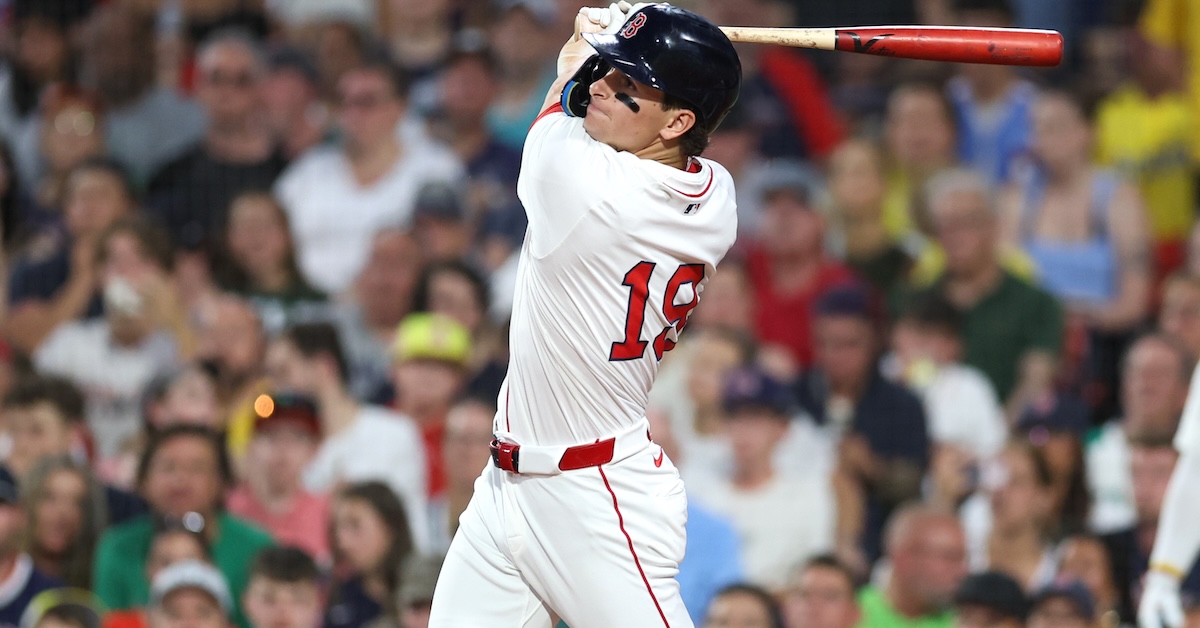
If all goes well, Corbin Carroll’s broken hamate bone won’t affect either his career or the Diamondbacks’ season too much. He will miss spring training and likely some time at the beginning of the season, but it’s not out of the question that when he returns, he’ll look like the perennial MVP candidate we know and love. On the other hand (Fun fact about the English language: When you use the phrase “On the other hand,” the hand you’re referring to is recovering from hamate bone surgery), the injury will very much change the look of Team USA at the World Baseball Classic. Carroll is out, and manager Mark DeRosa has found an exciting replacement in Roman Anthony. Team USA’s outfield is a mix of youth and experience, with Anthony joining Pete Crow-Armstrong and veterans Byron Buxton and Aaron Judge.
The Red Sox selected Anthony out of high school with the 79th pick in the 2022 draft. Scouts started talking about him soon after, because while in Low-A, his poor offensive numbers belied a wild combination of underlying metrics. He was running shockingly low swing rates, walking more than he struck out, and absolutely pasting the ball when he did swing. The Red Sox promoted him aggressively, and with good reason. Despite his youth, he put up a combined 141 wRC+ in the minors, and he did so with the same impressive plate discipline and exit velocity, the kinds of tools that tend to translate to big league success.
Anthony arrived in Boston in June as the consensus top prospect in baseball, and after taking a week to get acclimated, he finished the season with a 140 wRC+ and excellent defensive numbers. He placed third in the Rookie of the Year voting. Despite getting into just 71 games, his 2.7 WAR ranked sixth on the team. Extended over a full season, it was a six-win pace. Among players with at least 300 plate appearances, that 140 wRC+ tied Anthony with Michael Busch as the 14th-best hitter in the game. Just to put that in context, in AL/NL history, 346 players have made at least 300 plate appearances in their age-21 season. Anthony became the 26th one of them to post a wRC+ of 140 or better. By my count, 15 of those 26 are Hall of Famers, and Mike Trout is well on his way to joining them.
It’s probably unreasonable to expect Anthony to keep producing a 140 wRC+ in his sophomore campaign. Although he didn’t overperform his xwOBA, he did have a BABIP above .400, and DRC+ pegged him as the 42nd-best hitter in baseball at 119. Likewise, our 2026 projections tab him for a wRC+ between 115 and 124. The interesting thing, though, is that all those projections pretty much bought into his rookie season. They generally expect him to be within one point of his 13.2% walk rate, and they expect him to knock roughly three points off his 27.7% strikeout rate. They even expect him to improve upon his .171 isolated slugging percentage by a couple points. The downturn they foresee is simply because they expect his BABIP to drop down into the .320s or .330s.
Before he reached the Red Sox, the biggest concern about Anthony was that he might be too passive. It’s a lot easier to run an absurdly high walk rate in the minors, especially when you’re the top prospect and everybody’s afraid of you. In the majors, where the pitchers have better control and a lot more confidence, it seemed safe to assume that he’d see a lot more pitches in the zone. If he wasn’t prepared to attack them, he’d find himself behind in the count, he’d whiff more, strike out more, walk less. He’d have to adjust, and something would have to give. Unfortunately, we can’t dismiss that concern just yet, because major league pitchers didn’t attack the zone against him.
It’s true that Anthony saw more pitches in the zone in the majors. Last year, he had a zone rate of 46.5% in Triple-A and 48.5% in the majors. However, that put him in just the 17th percentile, nestled in among free swingers like Bo Bichette, Gabriel Arias, and Adolis García. The relationship here is pretty stable. You can see it in the graph below. If you chase a lot, you’re going to see fewer pitches inside the zone, because why would pitchers bother to throw something in the zone if you’ll swing at a ball?
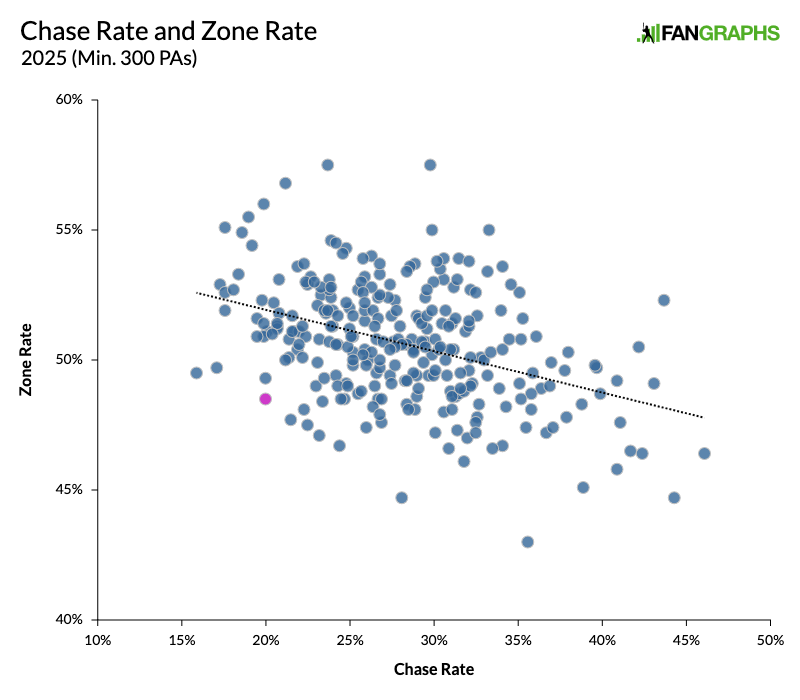
Anthony is that pink dot way down at the bottom left. Maybe major league pitchers do respect the top prospect a little more than we thought, or maybe they were just responding to Anthony’s 60% hard-hit rate, which was the best mark in baseball, just ahead of Kyle Schwarber, Shohei Ohtani, and Judge. Speaking of those three, let’s zoom in on the bottom left section of that graph, and I’ll add some labels to that line of dots far, far away from the trend line.
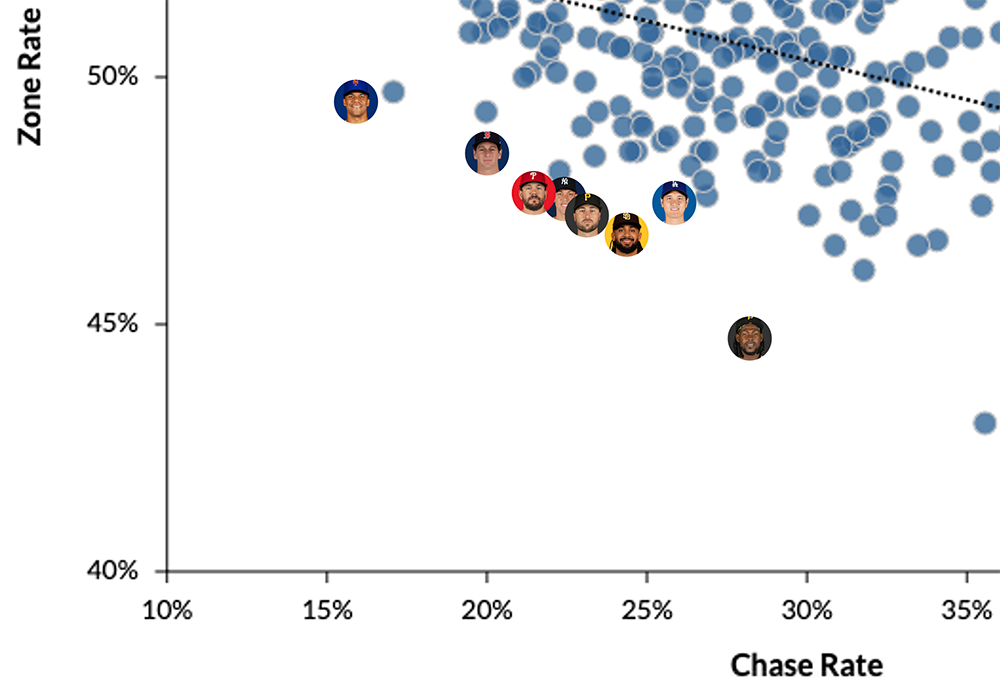
It sure looks like pitchers immediately started pitching Anthony the same way they pitched the most fearsome sluggers in the league (and also Joey Bart, whose plate discipline was so surprising that I wrote a whole article about it in November).
Anthony whiffed on just 20% of his swings in the zone, well below the rates of those other three sluggers. However, that’s still worse than the league average. He can definitely be beaten in the zone. He also hits the ball on the ground way more than they do. In fact, his 51% groundball rate was the 16th highest in the game, which is why not one of our projections has him reaching 20 home runs in 2026. He shouldn’t be as scary as those other guys, right? Pitchers are still going to figure out that they need to challenge him, right?
I think they will. I think at some point, if for no other reason than they’re sick of walking him, pitchers will try going after Anthony in the zone a bit more. Then again, it’s possible that I’m wrong. It didn’t happen over his first 71 games, and the reasons for that are fairly apparent. Even though he had that disconcertingly high groundball rate, Anthony still hit the ball so hard that his barrel rate ranked 20th in the league. So he’s still capable of lifting the ball often enough to do damage. Next, chase rate is far from the only factor that informs zone rate. One of those factors is pitch type. Fastballs and cutters tend to be thrown in the strike zone much more than breaking pitches or offspeed stuff, and Anthony absolutely clobbered hard stuff in 2025. His .450 wOBA against heat was the fifth-highest mark in baseball. As long as he’s destroying fastballs, he’s going to keep seeing bendy stuff, which is going to keep his zone rate down.
Maybe opposing pitchers will decide to attack Anthony with soft stuff in the zone, and that might just work. In 2025, he was well below average against breaking and offspeed pitches in the zone, putting up a .279 wOBA and .293 xwOBA and costing the Red Sox eight runs, according to Baseball Savant’s run values. Those other sluggers we mentioned all produced xwOBAs of .360 or better against those pitches in the zone, and Ohtani led the league at .455. So maybe that is a weakness, at least for now. Anthony won’t turn 22 for a couple months, and regardless of whether he repeats his excellent rookie season, he’s still probably going to get better.
Davy Andrews is a Brooklyn-based musician and a writer at FanGraphs. He can be found on Bluesky @davyandrewsdavy.bsky.social.
isn’t this guy’s dad named tony anthony
No, his dad’s name is Roman Romanthony. Easily Googleable.
The projections seem low to me on Anthony. If he’s only striking out 24% of the time, I would be surprised if his wRC+ doesn’t match his rookie year. The bear case is that pitchers eat him alive with offspeed and he strikes out 30%+ of the time. That was starting to happen before his injury, but he was at the same time elevating the ball more and taking advantage of his hard contact. Projection models like to regress BABIP, but Anthony was made in a lab to BABIP .375. He had the highest hard-hit rate in MLB and a low launch angle. After adding more strength (relevant given he’s 21), if he BABIPs .330 it’ll either be because of injury, bad luck, or because those doubles have turned into homers. I don’t think a healthy Anthony is likely to ISO .170 and BABIP .330. One of those will be substantially higher.
I have huge hopes for Anthony but am trying to set my expectations to a reasonable level for his age and limited experience. However, his extraordinary patience and pitch recognition at such a young age last season is also the reason to be optimistic that his sophomore could be really, really good. I’m looking forward to it!