
Which Ballplayers Would Make the Best Ice Dancers?
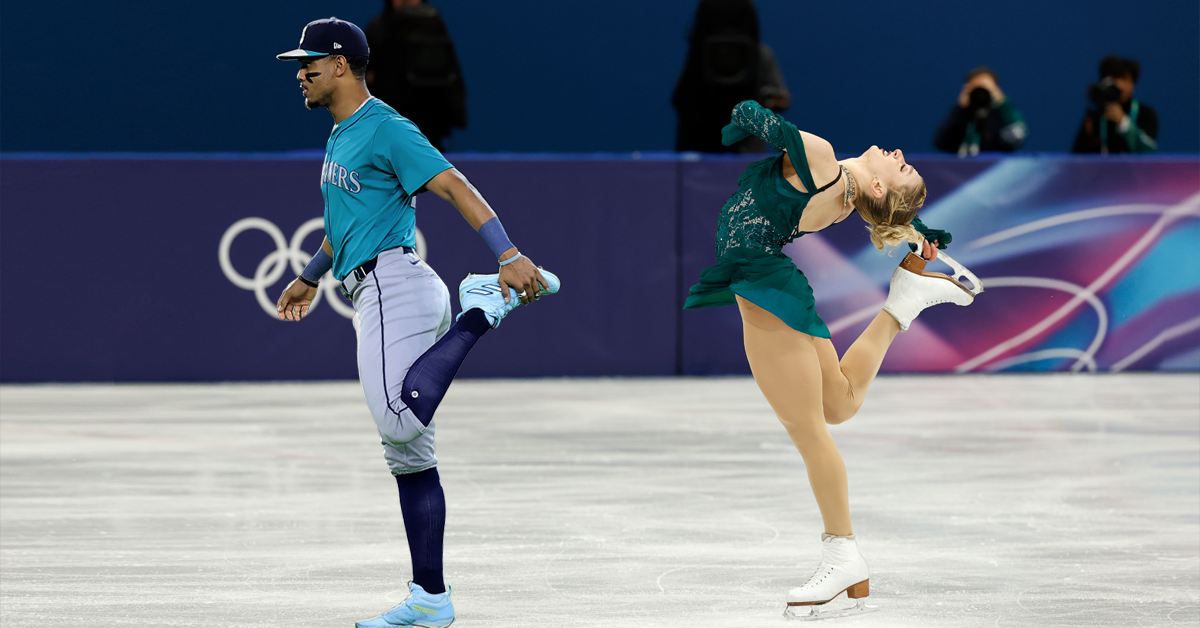
This winter, I’ve really gotten into the Olympic spirit. It turns out that cheering for wholesome, fresh-faced athletes who represent the idea of the United States is a decent balm for the psychic wounds inflicted by watching the actual United States speed-run a collapse into kleptocratic authoritarianism. Also, I’m already a Peacock subscriber because I love Parks & Recreation. So I’m watching the curling. I’m watching the hockey. I’m watching the long-track speed skating and the short-track speed skating, even though short-track speed skating is basically just a cross between demolition derby and cockfighting. And if you told me two weeks ago how much cross-country skiing I would be watching this week, I would have asked you whether I was about to suffer some sort of brain injury.
The one sport I haven’t watched much of is figure skating. I wish I could watch it more often, but unfortunately, I suffer from a debilitating sequin allergy. I can make it through a short routine with nothing more than some acute rhinitis, but after even a few seconds of exposure to Tara Lapinski and Johnny Weir, I have to sit on a whole case of EpiPens. Still, one night last week, I pregamed with a dangerous amount of Benadryl and Allegra (or as the kids call it, Ballegradyl) and watched the ice dancing with my charming wife. Like so many people across the globe, we came away with a newfound appreciation for Twizzles. The Twizzle is the most difficult maneuver in ice dancing. It involves collecting a great deal of speed and then spinning across the ice on one skate, close to your partner, in perfect synchronization. Here’s the greatest Twizzle sequence ever performed, according to a YouTube user who is an owl.
In this article, we will capitalize the word Twizzle, partly out of respect for the extremely capricious linguistic conventions of the International Skating Union rulebook, but mostly because it’s fun. A Level 4 Twizzle, the highest degree of Twizzle, involves two sets of at least four rotations. In the second set, you have to rotate in the opposite direction and on a different edge of your skate.
During your Twizzles, you also have to include at least 4 Additional Features from 3 different Groups (I told you the capitalization was wild). Those additional features are movements that make Twizzling more difficult, such as continuous arm movement (Group A, upper body), holding the blade of your skate (Group B, skating leg and free leg), or starting your Twizzle with a Dance Jump (Group C, pattern, entry, exit). Was that enough to set your head to Twizzling? Maybe it would help to watch a quick instructional video with a voiceover that sounds like it was recorded in a particularly narrow crawlspace:
So that’s Twizzling. What’s it got to do with baseball? Sadly, not as much as one might hope. The competitors do boast bulging quadriceps, and they do move gracefully across a pristine surface while wearing shoes that have knives attached to the bottoms, and they do put all of their effort into generating maximum rotational energy, but as it’s rare to see baseball players spin more than once, and it’s even rarer to see them start those spins with a Dance Jump. The closest baseball equivalent to a Twizzle is when the center fielder chases down a ball in the gap and then has to fire the ball back in to the infield. Because all their momentum is pushing them toward their glove side and away from the infield, the only way they can get anything on the throw is to use that momentum to execute a neat little spin. It’s sort of the baseball equivalent of the gravity assist.
I’ve always been fascinated by this particular move. I still remember the first time I ever saw it. I was a junior in high school, and during batting practice before a game, this enormous guy from Strasburg just did it as nonchalantly as you’d scoop up a routine grounder at first. I was flabbergasted. His name was Joe Bauserman. Later that night, I would throw him a fastball that just missed the corner low and outside, and he would reach out and swat it over the right field fence, which is not generally a thing that happens when you’re a junior in high school. A couple years after that, he’d get drafted by the Pirates and spend a few months playing alongside Andrew McCutchen. I like to think they still keep in touch.
I usually play in the infield, so I’ve only had one occasion to try the Baseball Twizzle. I was playing in an adult league in Queens, and somebody smoked a line drive into the right field gap with a runner on third. I lit after it and made one of my better running catches, then swung around to fire the ball home. But I didn’t Twizzle. I wasn’t an outfielder, and, unlike Andrew McCutchen, I’d forgotten all about Joe Bauserman. Instead of turning away from the infield and executing a full spin, I fought against momentum and turned toward the infield. It was a mistake. I was no match for the momentum, which slammed me backwards into the ground. Luckily, our pitcher was a doctor, and he declared me concussion-free (though I do recall that for the next few days, I experienced an unusual urge to watch cross-country skiing).
In the interest of international cooperation, we’re going to award medals to the best Twizzlers in the major leagues. I spent much of Wednesday watching clips of center fielders making plays in the gaps and taking note of all the Twizzles I could find. We’re now going to count down the top three Twizzlers. To maintain the spirit of the ice dancing at the actual Olympics, the judging will meander from opaque to capricious to arbitrary to downright corrupt. (As such, should any big league center fielder want to move into medal contention, hit me up on Venmo and we’ll work something out.) I will say, however, that I did not intend to recognize players from three different countries, or that all three are participating in the World Baseball Classic. That honestly was a pure case of Olympic serendipity. Here we go. Get yourself a big old dose of Ballegardyl and let’s hand out some Twizzling medals. (Editor’s Note: Do not under any circumstances take Ballegradyl. We’re still writing settlement checks for the Percoviagranax debacle.)
Bronze Medal: Jung Hoo Lee
The first medal goes to South Korea’s Jung Hoo Lee, an excellent showing for a player in his first full season here in the states. Lee is about to represent South Korea in the World Baseball Classic, so keep an eye out for Twizzles in Pool C. Still, Lee reached the podium more due to quantity than quality, which is why he’s down here with a bronze. He just barely beat out Rockies fly-chaser Brenton Doyle, whose Twizzles were smoother, but less frequent. Lee’s Twizzles were often lackadaisical, and he rarely included Additional Features – would it kill the guy to lift his cleat over his head every once in a while? – but the judges appreciated that he sometimes seemed to go out of his way to execute a twirl. He just needs to string together a couple in a row and he’ll be in business.
Silver Medal: Pete Crow-Armstrong
Pete Crow-Armstrong is a fitting recipient for a silver medal here. Like Lee, he’s about to represent his home country in the World Baseball Classic, when he mans center field for Team USA in Pool B. More importantly, he’s is one of the best defenders in baseball. As with so much of his game, PCA’s Twizzles erupt in a frothy blend of ebullient puppy-dog energy and athletic grace. It’s worth noting that he overcame a slight hurdle to get here. Lefties get fewer chances to Twizzle than righties, because when they’re moving toward their glove side, they’re moving toward third base, so a spin isn’t always required for that particular throw. That didn’t stop Crow-Armstrong, who executed multiple Twizzles to third, and even Twizzled out of a dive once, an Additional Feature that won over even the cynical (and definitely corrupt) French judge.
Gold Medal: Julio Rodríguez
Our gold medal Twizzler is representing the Dominican Republic in the WBC. Julio Rodríguez’s Twizzles aren’t always as flashy as Crow-Armstrong’s, but no player Twizzled more than J-Rod. His Twizzles weren’t just an affectation, either. Rodríguez always Twizzled with purpose. He broke down his steps. He pivoted hard. He came up firing. He sent the ball toward the base on a hop to make sure that he never overthrew anybody. All of this results in Twizzles so fundamentally sound that they brought a tear to the eye of even the curmudgeonly Ukrainian judge, and let me tell you, that guy has seen some stuff.
Rodríguez’s Twizzles kept runners from advancing multiple times. He often looked like a twirling ballet dancer, whipping his head around to locate his target as quickly as possible in order to ensure an accurate throw. On one play, he was just backing up the right fielder. It didn’t look like there was much chance the ball would even get to him, but not only was he ready, he was ready to execute a textbook Twizzle, and it might have even been scored a Level 2 Twizzle if he’d just Dance Jumped into it.
Congratulations to all of our medalists, and please join us tomorrow as we break down which ballplayers would be best at doubles luge.
Davy Andrews is a Brooklyn-based musician and a writer at FanGraphs. He can be found on Bluesky @davyandrewsdavy.bsky.social.
Alejandro Kirk. Next question.
i know he’s got 1st %ile speed, but the guy’s a legit athlete, my goodness. more importantly, though, he’s probably the most spherical mlb guy i know, so some deranged physics prof would probably love to place him in a low-friction environment to study macro-scale ball-player interactions
One of my favorite baseball things is I love seeing guys who have my body type do things that I couldn’t imagine doing
As a fellow infielder, I am saddened that you award no credit to the Infield Twizzle: a shortstop ranging up the middle and fielding a ground ball so far out to the left that he has no choice but to follow his rotational momentum 360 degrees around to the glove side before whipping a throw to first.
https://www.youtube.com/watch?v=7Nwa15Ye6Ek
You know, I spent a fair amount of time watching hunting these plays too, but I found that they’re much rarer than the outfield Twizzle.
i’m caught on the little chop-step-hop-plant-throw part of this whole equation. i keep thinking about how dansby swanson does his slide to the backhand side, sticks his cleat, pops up, transfers his weight, and throws. perhaps the infield twizzle is a better example of utilizing existing momentum but the throw is 90° to the right from the momentum of the defender, hence the need for the twirl. the hips and chest are committed in one direction, and i have never seen someone try to backhand a baseball like a frisbee a full 90+ feet, let alone on the run.*
i think in the escobar play you linked, his overall momentum is still carrying him into shallow right after the throw, but he’s planted his right foot ahead of him (and probably slightly left of his center) to flip the hips around in the right direction, and in one or two steps at that. he’s also not stopping at all, just setting an axis of rotation, converting part of his linear momentum into angular momentum to get the throw off, and once that angular momentum is spent, he’s still left with linear momentum into right field.
in all the outfield plays above, the fielder has to (depending on his speed approaching or at the catch point) chop their feet, plant their arm-side leg, and then do a little crow-hop, often completely killing their momentum in the catch direction. obviously they need to get a bit more behind the throw, they have a hundred or so more feet to throw it, but it was just striking to me how different the footwork ends up. if julio is charging glove side at full speed, he takes like a full second of chopping his feet to get to the point where he can safely plant and throw without exploding his acl.
*i’m sure someone could backhand a baseball a good long ways off a good platform, though it’s worth more rigorous testing. also, i think it would have mostly topspin or sidespin, and wouldn’t carry well.
There’s also the Third Base Twizzle, which is usually where the third baseman makes a reaction play to his backhand, but the ball is hit so hard that his momentum takes him spinning around to the arm side before throwing to first. Sometimes, but not always, there’s a little slidey-thing or drop to the right knee involved. That to me is the best example of an infielder completely reversing their momentum with a spin to get a throw off.
Here’s a Machado example that’s kind of what i mean, but a little more slidey than the “Pure Third Base Twizzle” I have in mind, in which the fielder stays on his feet the whole time.
https://www.mlb.com/padres/video/manny-machado-s-smooth-play
i think this kind of play is a good spin, but since there’s no linear momentum involved but the ball, for me it doesn’t pass muster for a twizzle. if done in the air there’s a case to be made for many kinds of jumps but i wouldn’t know a lutz if it bit me in the face.
i think, upon reflection, the only analogue i can think of for the full change of momentum is a hockey stop, which is not very figure-skater of me.
Mets announcer Gary Cohen calls this the Spin-o-Rama and I was also surprised the article wasn’t about it. Shortstop is the most balletic position.
“Twizzle? unserious sport,” I say before going back to obsessing about Paul Skenes’s splinker.
from the makers of the slurve, churve, slambio, and eephus.
and who could forget will ferrell’s famed slurge?
This is fantastic, thank you
Bring back notgraphs
Julio’s hammies alone get him on the podium, his form is just the finisher
Once again, the award for best video editing goes to Davy Andrews, of FanGraphs, who Dance Jumps into the crossover coverage you didn’t know you needed and Dazzles with Twizzles.
Ahem. Trea Turner? https://www.youtube.com/watch?v=TmdxWPhk7Ug
This was a great fun read. Thanks, Davy!
I read Fangraphs as a break from the “real world”. For me, sports are escapism and a mental break.
Could you please leave the politics out of the articles?
–reads two sentences of first paragraph–
“My opinion on this matter is finalized”
I expressed no opinion on the rest of the article (which I enjoyed) and no opinion on the politics of the statement (and I will continue to do so because it is irrelevant).
I’d simply prefer that in their articles, the writers refrain from politics because I like to be able to go read Fangraphs as a respite from a crazy real world.
“respite from a crazy real world” was literally the entire premise of the article.
I appreciate that one of my favorite baseball writers is allowed to express his concern over the current US government as part of his segue into the article
Also, the juxtaposition with the next sentence was funny.
I truly have a hard time understanding the fragility required to be so offended by this as to feel the need to comment on it.
No.
If I genuinely had to pick a player from the current MLB teams to train up as an ice dancer, if I’m not overlooking any junior hockey guys like Nyjer Morgan, I would go with Mookie Betts. First of all, he can Twizzle. But also, the amazing body control that it takes to switch back and forth between outfield and shortstop, and also bowl 300, and everything else he does, makes me think he’d be one of the players who could pick up skating the fastest.
Mike Soroka was a standout prep hockey goalie.
Ladies and gentlemen, I give you the base stealing stylings of Mr. Josh Naylor, representing Canada.
I was honestly expecting Kike Hernandez.