
A Conversation With Joey Cantillo, Who Has the Best Stuff on the Cleveland Staff
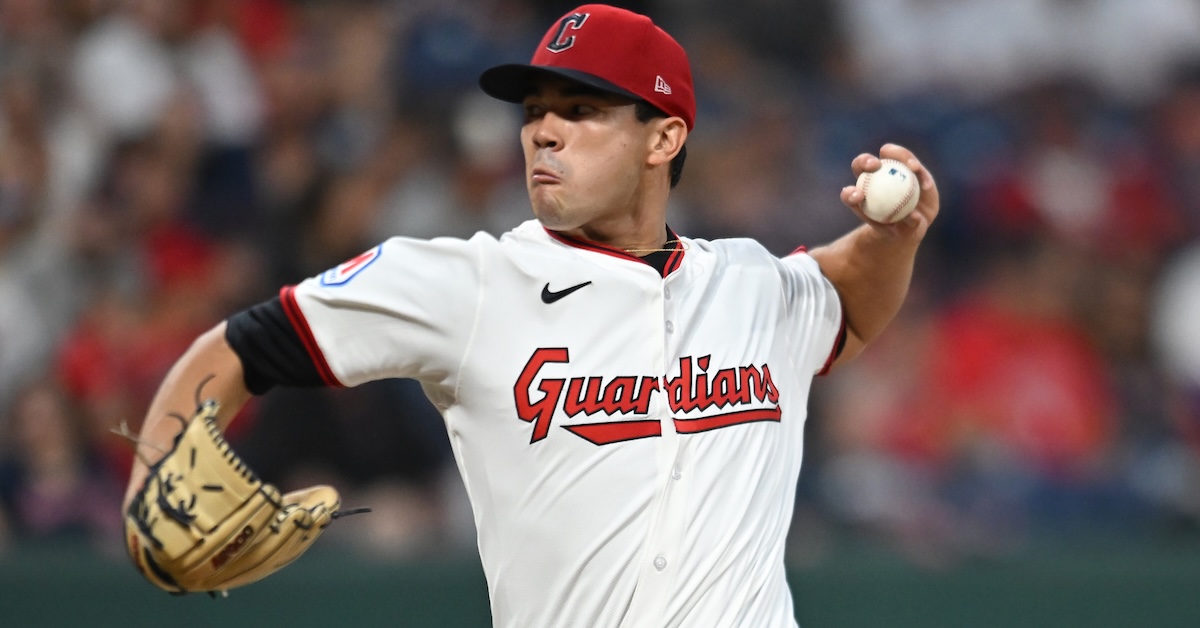
“He has the best stuff on the staff. His pitches move all over the place.”
Those words, which were spoken to me in the Progressive Field press box in late September, came from someone who had not only seen the Cleveland Guardians on a regular basis throughout the season, but a person whose background also includes having played in the big leagues. His assessment of 25-year-old left-hander Joey Cantillo was based both on experience and expertise. (As we were chatting informally, I’m opting not to quote him by name.)
Cantillo’s numbers in is first full major league season suggest that he has a bright future. Initially pitching out of the bullpen, the Honolulu native moved into Cleveland’s starting rotation in early July and proceeded to log a 2.96 ERA, a 3.21 FIP, and a 25.9% strikeout rate over 13 outings comprising 67 innings. Counting his 21 appearances as a reliever, he put up 3.21 ERA, a 3.55 FIP, and a 26.9% strikeout rate over 95 1/3 frames in 2025. All told, Cantillo held opposing batters to a .217 average and a .289 wOBA.
The southpaw was originally drafted by the San Diego Padres in the 16th round of the 2017 draft out of a Kailua, Hawaii high school. (Coincidentally, two picks earlier, the Minnesota Twins took Cleveland reliever Cade Smith out of a British Columbia high school, only to have him eschew signing and attend the University of Hawaii). The Guardians subsequently acquired Cantillo in August 2020 as part of a nine-player trade that included Mike Clevinger, Austin Hedges, and Josh Naylor.
Cantillo sat down to discuss his development path and his four-pitch arsenal in the final week of the regular season.
———
David Laurila: How much have you changed since coming here from San Diego?
Joey Cantillo: “A bunch. When I first got here I wasn’t really throwing very hard. I was one of those guys where it was like, ‘Hey, if he can throw harder he could really do some good things.’ Getting here, it was, ‘Hey, let’s start to move the body faster, get the body in better positions and use it better.’
“That’s what we focused on those first couple years, and it was a struggle. When you’re out there on the mound thinking about things like body positions, it takes away from your over-the-plate focus at times. I needed to learn to balance that. Mechanics and competing are two different things.”
Laurila: What did you do mechanically to make your delivery better?
Cantillo: “It started off with a lot of glute work, getting into my hips and into to some better hinge patterns — overall movement stuff — and from there we kind of increased my tempo. We worked on my rhythm, moving with velocity and power down the mound. It was kind of blending those two things: the shape of the delivery, and then the speed of the delivery.”
Laurila: That didn’t happen with the Padres?
Cantillo: “When I first started over there, it was a lot more developmental. I wasn’t a big prospect or anything like that, so it was kind of, ‘Hey, go out there and perform. Get outs and see what you can do.’ We had good pitching coordinators over there, we just never really focused on velocity, or on too much from a mechanical standpoint. Being at a young age and in my first couple of years in pro ball, I think, ‘Let’s just get outs,’ was fine.”
Laurila: How much has your velocity increased?
Cantillo: “When I got drafted, I was 86 to 89 [mph]. Slowly, the last couple of years… in 2021, I had an oblique injury, and coming back from that I was throwing a lot more 91s and 92s. The first time I had a big jump was 2022. That’s when I started throwing into the mid-90s a little more consistently. In 2023, I was actually throwing a little harder than I am now [91.7 on average with the four-seamer in 2025]. We’re trying to slowly get back there. That’s something I’ll focus on in the offseason, getting some of that power back.”
Laurila: Has the movement profile of your fastball changed at all?
Cantillo: “No, I think I’ve always been somebody that stays behind the ball and rides the baseball. Right now. I think I’m getting anywhere from 16 to 20 inches of ride. I’m also getting some more run back, so it’s a little more of a true fastball, whereas at times I had a little cut-ride in the past. I think I could probably average around six to seven horizontal, arm side, and 17 to 18 [vertical] on a good day.”
Laurila: The changeup has always been a big pitch for you…
Cantillo: “Yes. I was throwing the same changeup in high school. My high school coach — his name is Corey Ishigo — taught it to me, although I didn’t have to use it all that much. My first year in pro ball they said to throw my changeup every day from 90 feet, and the more I did that, the more comfortable I got. Over the years, it’s gotten better just from throwing it more.”
Laurila: How do you grip your changeup?
Cantillo: “It’s a Vulcan. I think more guys have been going to one. It’s a comfortability thing. A lot of guys are throwing splitters, but it’s kind of what your fingers can do. A Vulcan is just another way to create some friction and impact the baseball in a different way. If I were just to do a circle [change], I don’t think I would get quite the velo differential or the movement profile. I get more of the traditional changeup sidespin, but with the split grip.”
Laurila: More generally, is there anything you’ve done in the last year or two to really take that next step and reach the big leagues?
Cantillo: “I think it’s mostly just trusting my stuff and landing everything in the strike zone. I’ve got unique shapes. I’ve got the big curveball, the changeup, a good fastball. I’m also mixing in the slider a little bit more; having that to throw against lefties helps me out a lot. Throwing four pitches competitively in the strike zone plays.”
Laurila: How big is your curveball?
Cantillo: “I think it averages 20-something inches of vertical depth, so it’s kind of a downer curveball. But really, it’s not one specific pitch, or one specific thing. It’s just that when you have different pitches that move in different ways, the hitter has more to think about. The big overhand curveball, the fastball that plays at the top, then a changeup and a slider that are going in two different directions… the hitters have to deal with all of those.”
David Laurila grew up in Michigan's Upper Peninsula and now writes about baseball from his home in Cambridge, Mass. He authored the Prospectus Q&A series at Baseball Prospectus from December 2006-May 2011 before being claimed off waivers by FanGraphs. He can be followed on Twitter @DavidLaurilaQA.
This is a bit of a nothing burger of a comment, but I’m just amazed at the way players talk about the science of their craft as opposed to 20 or 30 years ago.
Thanks for the article, it’s fascinating to me.