
A’s Prospect Mason Barnett Has an Atypical Arm Angle and an Old-School Approach
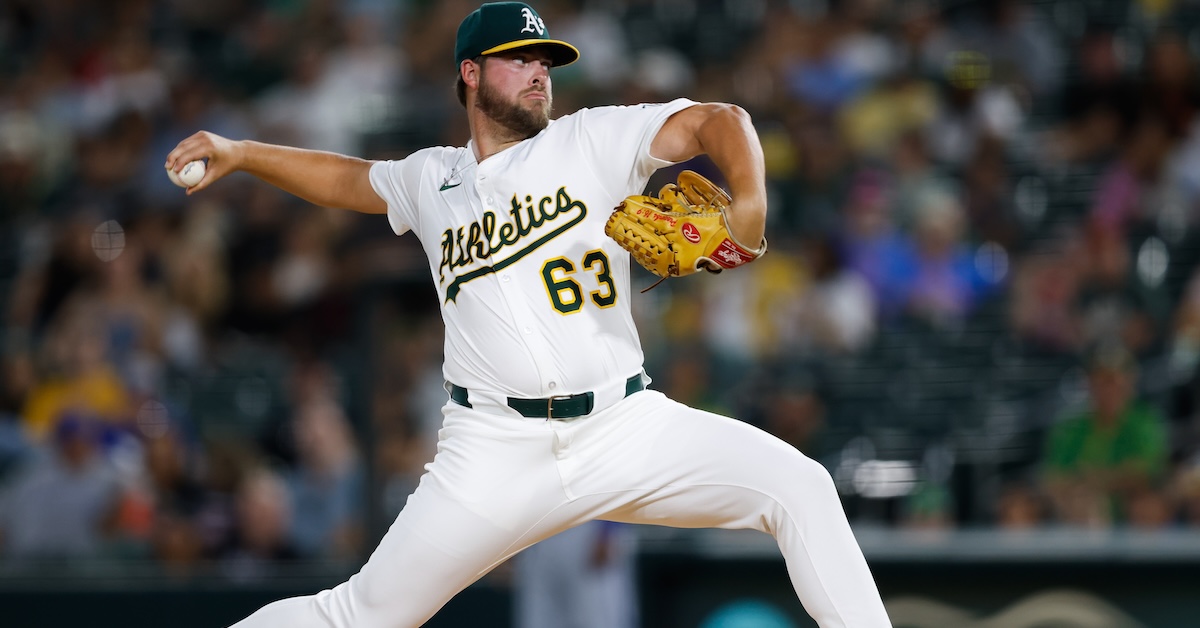
Mason Barnett doesn’t profile as a front-of-the-rotation starter, but he does project to provide solid innings for a major league staff. A 25-year-old right-hander who made his MLB debut with the Athletics at the end of August, Barnett is currently viewed by Eric Longenhagen as “a big league starter who has demonstrated durability [and] is a no. 4/5 on a good team.” Our lead prospect evaluator anticipates assigning him a 45 FV when our 2026 A’s list is published in the not-too-distant future.
The Kennesaw, Georgia native was originally in the Kansas City system. Drafted 87th overall by the Royals in 2022 out of Auburn University, Barnett was subsequently traded to his current club in the 2024 deadline deal that sent Lucas Erceg to America’s Heartland. With his time down on the farm now mostly complete, Barnett will head into the forthcoming campaign having logged a 6.85 ERA and a 4.88 FIP over five starts comprising 22 1/3 innings in his initial major league opportunity.
Longenhagen has assigned a 40/45 on the righty’s command, and it was that aspect of his game that Scott Emerson emphasized when I asked him about Barnett toward the tail end of last season.
“Barnett, interesting guy,” said the longtime Athletics pitching coach. “Very good competitor. Throws strikes with his fastball, which has some cut-ride. He’s got a good developing changeup. He spins the ball really well and has both the sweeper and the curveball. For me, a lot of it with Barnett is his being able to execute his pitches inside the strike zone when he needs to, and then being able to make them chase outside of the strike zone when he’s ahead in the count. He’s one of our guys who needs to learn to command the ball better.”
The numbers back that up. Barnett had a 10.8% walk rate (as well as a 17.3% strikeout rate) in his big league cameo, while in Triple-A those numbers were 11.9% and 22.8%. But, while concerning, it’s not as though he can’t throw strikes or miss bats. In 2024, he punched out Double-A batters at a 28.5% clip, and walked them at a more-acceptable (albeit still not great) 8.7% over 133 innings of work. Like Longenhagen and Emerson, Barnett also recognizes the need to improve his strike-throwing.
“In baseball, consistency is always the right answer,” Barnett said when asked what he sees as the next step in his development. “And not results-wise. I need to be more consistent with my delivery and making competitive pitches. I think my stuff is good enough. I just have to make big league pitches and compete with what I’ve got.”
One of the things Barnett has is a delivery that helps his stuff play up. Admittedly “more old-school” in how he approaches the game, the stocky, 6-foot-1, 220-pound hurler has been told that he throws from a higher slot and with a lower vertical approach angle, although those aren’t things to which he pays much attention.
“I don’t look at the metrics very often,” he told me. “That’s kind of the way I was brought up. It was always, ‘Hey, compete first and everything else comes from that,’ so while I understand some of it — the release height and all that — it’s more something for my pitching coach and our analytics guys. I just know that how I throw is a little unique. I’m over the top, and my fastball has a slight cut to it, so it’s a profile that hitters don’t see very often.”
What hitters see is Barnett throwing from a release height of 71.5 to 72.5 inches (the professional average is 68.8) with his fastball, changeup, and sweeper, while he delivers his curveball from a slightly higher 75 inches.
Barnett considers his 93-97 mph heater his best pitch, although the metrics say otherwise. Stuff+ gives the offering a 30, while grading his 2,700-rpm slider, which comes in at 83-87 mph, as a 70. He began throwing the latter in high school, and for the most part it hasn’t changed much. That includes how he defines it.
“I’d probably go with my slider as my best secondary pitch,” said Barnett. “I call it a slider, but it profiles as a sweeper. The grip has maybe changed, but not a lot; it’s pretty much the same one I’ve always had. I’ve had different cues with it, but at the end of the day it’s the same pitch. It will catch and get up to 15-16 inches at times.”
Interestingly, it was a pitcher who was known primarily for a 12-6 hammer curveball that Emerson volunteered as a comp for Barnett.
“A guy he reminds me of is Ben Sheets,” Emerson said. “He’s got a high arm slot. He’s working top-to-bottom. He’s got a strong lower half in his delivery. Now we just have to see if he can pitch like that. Sheets had incredible makeup and fight, and he located his pitches. If Barney can locate his pitches, I think you can look at him to be a second Ben Sheets.”
It’s safe to say that the A’s would be pleased as punch if that were to happen. Pitching for the Milwaukee Brewers, and briefly the Oakland A’s and Atlanta Braves, Sheets fashioned a 3.78 ERA and a 3.66 FIP while making 250 starts from 2001-2012. Moreover, he was a four-time All-Star.
And then there is a 1999-2015 right-hander who also made four All-Star teams (raise your hand if you’re surprised it wasn’t more) while pitching for both Oakland and Atlanta, as well as for the San Francisco Giants. Talking to Barnett, I learned that he was mentored by Tim Hudson.
“He was my pitching coach when I was at Auburn,” Barnett explained. “That was really cool. Not only did I grow up a huge Braves fan, having an almost Hall of Famer in your back pocket is something not many people get. As much as anything, he helped me with my mentality. With Huddy, it was kind of, ‘Hey, there’s a guy in the box; spin his cap and just get him out.’ The metrics aren’t what matter. You can have the best metrics in the world, but if they’re hitting piss-rockets, you’re doing something wrong. Huddy wanted me to go out there and focus on getting outs. That’s what I do.”
David Laurila grew up in Michigan's Upper Peninsula and now writes about baseball from his home in Cambridge, Mass. He authored the Prospectus Q&A series at Baseball Prospectus from December 2006-May 2011 before being claimed off waivers by FanGraphs. He can be followed on Twitter @DavidLaurilaQA.
First appearance of the term “piss-rockets” in a Fangraphs article?