Author Archive

Angels re-sign Teixeira… sort of

Over the winter, the Angels lost out on a bidding war to retain Mark Teixeira and watched him end up in pinstripes. In order to fill the hole on their offense, they gave their first base job to… Mark Teixeira?

Tex, 2009: .280/.380/.541, .392 wOBA, +4.0 wins
Kendry Morales, 2009: .314/.355/.597, .398 wOBA, +3.8 wins

Morales doesn’t have the same style of production as T-Rex, but in terms of overall value, the Angels have essentially matched what the Yankees got from Teixeira, and they did it with a guy who was viewed as a bust coming into the season. It wasn’t like Morales was a guy with projections all over the map, either – CHONE had him as a .327 wOBA guy, ZIPS at .325.

This is, of course, way out of line with anything Morales had done before. These are better numbers than he put up in Triple-A last year, when he posted a .387 wOBA. The main difference has been the power, where Morales is posting a .287 ISO, tied fort he seventh highest mark in baseball. That’s 120 points higher than the projections had him at, and really the only area where he’s exceeding what we should have expected by any large margin.

Power is one of those things that stabilizes fairly quickly, however, so while there are examples of Brady Anderson style flukes, we have to assume that our previous beliefs about how much thunder exists in Morales’ bat were wrong. It’s really, really hard to luck your way into 69 extra base hits in 506 plate appearances.

ZIPS still projects a pretty heavy regression for Morales going forward, as his rest-of-season projection has his ISO dropping to .202 – 40 points better than the preseason projectoin, but 80 points lower than his current ISO. But the projections have changed enough that, given what we know right now, we can say the Angels certainly made the right choice in letting Teixeira go and replacing him with Morales. Given their relative price and performance, Morales is the clear choice.

Vlad Impales Again

The last two years had been a steep slope for Vladimir Guerrero. A variety of health problems robbed him of his ability to play defense, and his legendary offensive skills seemed to decline fairly quickly. After being a mortal lock for a ~.400 wOBA, Guerrero posted a .373 mark last year, and then began this season without any power. When the Angels put him on the disabled list with a bum knee on July 7th, he was hitting .290/.319/.415 with a whopping four home runs. Considering his status as a DH, he was performing below replacement level. It was hard to believe, but he had become the weak link on the Angels roster.

After about a month recovering on the sidelines, the Angels brought Guerrero back. And Guerrero brought the old version along this time. Since returning, he’s hitting .337/.389/.625. He hit two home runs last night, giving him nine in 26 games. His wOBA over the last month is .429. Last night, he homered on a pitch about six inches off the ground – just classic Vlad.

Now, no one thinks this is his true talent level, of course, but he’s certainly better than he performed prior to going on the DL. ZIPS projects a .309/.365/.489 mark from him over the rest of the season, which is a step down from his heyday but a quality hitter nonetheless. The Angels didn’t need an offensive boost, but they’re getting one anyway. Guerrero is on a mission to show that he’s still got something left, just in time for the playoffs to roll around.

Be afraid, American League pitchers. Vladimir Guerrero has found his power stroke again. That ridiculous offense just got stronger.


Three Late Deals

The second trade deadline is usually fairly boring, as most of the interesting players don’t clear waivers and teams are unwilling to surrender much in value for a one month rental. This year, however, two NL west clubs made three deals at the final hour, and all of them are kind of interesting.

First off, the Dodgers acquired Jon Garland from the D’Backs. After a disastrous start to the season, Garland has rebounded to put up a season right in line with the rest of his career – not many walks, strikeouts, or home runs allowed, living and dying with the results of his balls in play in any given start. Lately, the results have been great, and the Dodgers are willing to pay a premium for a guy who should be able to eat innings at the back of their rotation down the stretch. He’s basically insurance for Hiroki Kuroda in case his recovery from a concussion doesn’t go so well. Dodger fans should be hoping he doesn’t start any playoff games this winter.

LA wasn’t done, however, also adding Jim Thome to provide some punch off the bench. If this deal were made five years ago, James Loney would have to fear for his job, but Thome’s been strictly a DH for a few years now and would seem to be nothing more than a pinch-hitter for the Dodgers. He’ll improve LA’s bench in October, and because of the reduced need for pitchers in the playoffs, they should be able to carry a pure bench bat.

Finally, the Rockies got into the trade fun by acquiring Jose Contreras to help patch their pitching staff. Contreras is a tough guy to get a read on, because his stuff is still good, his peripherals are strong, but he remains awful when men are on base, so his absurdly low strand rates lead to less value than his FIP would suggest. Usually, we chalk stuff like that up to random variation, but Contreras has been underachieving in LOB% for so long that its getting hard to ignore. If the Rockies can figure out how to fix his problems with leaving runners on, they could have a nice addition, but that seems like a tough task to pull off in four weeks time.

None of these moves are likely to have a huge impact on the playoff races. The Dodgers are still huge favorites to win the NL West, and the Rockies acquisition of Contreras is just an attempt to balance out the Giants addition of Brad Penny. However, given the usual boredom August 31st brings, it’s interesting to see three fairly big name guys moved this late in the trade season.


A Notes Post

With no one subject grabbing me as worthy of a whole post, but a lot of minor interesting news items floating around today, let’s do a brief overview of those topics.

Royals extend Dayton Moore through 2014.

This is just a bizarre decision. Moore should have been closer to losing his job than getting more security, given some of the decisions he’s made over the last few years and how poor the Royals are yet again. A significant handful of his decisions are utterly indefensible – the Jose Guillen and Kyle Farnsworth signings along with the trades for Mike Jacobs and Yuniesky Betancourt have been well covered, but quite simply, a GM should not get free passes for making four terrible decisions that close together. Especially given the Royals budget constraints, Moore simply couldn’t afford to waste the money he had available, yet he did.

You don’t have to be a total stathead to be a good GM, but Moore has done nothing to prove that he’s good enough at traditional player evaluation to also be ignorant of the statistical tools available that he’s actively ignoring. That the Royals willingly signed up for more of his management style should be enough to cause Kansas City fans to weep.

Giants signed Brad Penny.

Smart choice – he not only lands in the DH-free National League, but he also picks a team with quality defenders behind him as he looks to impress down the stretch before hitting free agency. The results for any pitcher can vary significantly over a month, so there’s no guarantee that Penny will turn his season around instantly, but given what we know about the difference in quality among the leagues and Penny’s decent performance in the AL East, it looks pretty likely that the Giants added a pretty good arm for the stretch drive.

Jarrod Washburn got torched again.

I actually feel bad for Tigers fans. I’ve seen Bad Jarrod Washburn pitch, and it’s not fun. That he’s been this bad since ending up in Detroit is pretty surprising, as we’re long past the point of this being regression to the mean. Right now, Washburn is regressing to Dontrelle Willis‘ mean. Coupled with the out-of-nowhere Barry Zito career renaissance, 2009 is shaping up to be a reminder that pitchers are just not to be counted on. What they did last year, last month, or even last week won’t necessarily manifest today. They’re the flakiest creatures in sports. Relying on a starting pitcher is like putting all of your money on a tech stock. Smart investors diversify – smart teams spend money on hitters.


Bourn Finds His Identity

Not a lot of things have gone right in Houston this year. Despite an aging, expensive roster, they find themselves non-contenders again, caught in the awkward stage of not winning but not rebuilding either. Never a fun place to be.

However, there has been one bright shining light to come out of Houston this year – Michael Bourn showing enough abilities to make himself a pretty decent center fielder.

When the Phillies sent him to Houston for Brad Lidge in 2007, he was purely a speed-and-defense guy, the classic questionable bat center field type. He could run, but whether he could get on base enough to make it matter was less clear. A disastrous 2008 season, where he hit .229/.288/.300, struck out 111 times, and was worth -0.1 wins in 514 plate appearances didn’t assuage any fears. His defense in center was good but not great, so he’d have to get on base at a reasonable clip to justify his spot in the line-up.

In 2009, he’s done that and more. He’s at .293/.366/.406 for the season, and while he’s still striking out at a decent clip, he’s found the key to success for his skillset – pound the ball into the ground and run like mad. Last year, 29.4% of his balls in play were flyballs, which are almost always outs from no-power guys like Bourn. This year, only 22% of his balls in play have been classified as flys, as he’s traded them in for more grounders and line drives, and his BABIP has soared as a result.

His .370 BABIP probably isn’t sustainable, but guys with his speed and bunting ability (he already has 15 bunt hits this season) can keep their averages on balls in play well above the norm for the league as a whole. Toss in the solid walk rate (10.4%) and some power (38 extra base hits), along with terrific ability on the bases (48 for 58 in SB attempts) and the total package adds up to around an average hitter.

When you have a guy who can play CF (and Bourn can, with a career +10.9 UZR in over 2,100 innings out there) and produce something close to league average offense, you have a pretty nice piece. The +4 win season he’s produced this year is the very top of his potential, but even with some regression built in he’s a +2 to +3 win player going forward.

As a pre-arbitration 26-year-old, Bourn represents something the Astros badly need more of – young, cheap, productive players.


Bradley Taking The Fall

If all you knew about Milton Bradley’s 2009 season was the opening lines from this article, you would think he’s single-handedly destroyed the Cubs season.

Cub fans and Milton Bradley have one thing in common: they both can’t wait for him to go home. The Milton Bradley experience has been the biggest disaster in a season of disasters for Cubs general manager Jim Hendry in 2009.

I know he’s not media friendly, he’s run himself out of nearly every organization he’s ever played for, and he says some stuff that angers people, but can we get a little reality injected into this analysis? Bradley is getting destroyed as a massive disappointment while posting a .387 on base percentage. Sure, the power hasn’t translated to Chicago, and the Cubs had to be hoping for more than a .350 wOBA from the guy, but he’s been an above average hitter and a decent enough fielder for them this year.

In just over 400 plate appearances, he’s been worth +1.2 wins to the Cubs, which translates to $5.4 million in salary. Factor in his expected September production, and he’ll probably end the year with a performance worth around $7 million – less than what the Cubs are paying him, but not anything close to the biggest disaster on the team.

Alfonso Soriano has performed below replacement this year. He earned – sorry, was paid – $16 million this year, and there’s $90 million left on the final five years of his contract. His performance suggests he owes the Cubs $3.3 million for taking 0.7 wins off their total for 2009, so Soriano has cost the Cubs almost $20 million this year. Bradley could cuss out every fan in Wrigley and still not match Soriano for disastrous results this year.

Things have gone wrong in Chicago this year, and Bradley makes an easy target for criticism, much of it earned. But regardless of whether he likes the fans or media, Bradley hasn’t been the thing that caused the club to collapse. It’s hard to win a bunch of baseball games when your “superstar” left fielder plays like he belongs in the minors.

Just because Bradley makes himself an easy target doesn’t mean he’s the right one.


Top Of The Hill

I knew Aaron Hill was having a remarkable season, but it still caught me off guard when the game I was watching displayed the American League home run leaderboard.

Carlos Pena, 37
Russ Branyan, 31
Mark Teixeira, 31
Aaron Hill, 30
Justin Morneau, 29

This is like the old third grade test – “which of these is not like the others?” You have four traditional power hitting first baseman, known for their ability to drive the ball with regularity. And then there’s Hill – a 5’11 second baseman who had 28 career home runs before the season began.

Hill has always been a good player, mainly because of his range on the infield and his ability to hold his own at the plate. He’s made his mark as a good contact, gap power guy, but there were some questions about his true offensive abilities after a miserable 2008 season that saw him .263/.324/.361 in just 55 games.

He’s put last year behind him and then some, keeping pace with the premier sluggers in the game despite no drastic changes in his skillset. His contact rate is about the same as always, though he has increased his swing rates slightly, becoming more aggressive as he gains MLB experience, especially in terms of chasing pitches out of the zone. His O-Swing% is a career high 28%, for instance.

Beyond that, his batted ball profile is still neutral, which suggests his swing plane isn’t much different than it has been in the past. However, balls that used to land on in the gap are now flying over the wall – his HR/FB rate is 16.7%, when his career average coming into the season was about 5%. For a pitcher, this would be a sign that he’s been the victim of extremely bad luck, but hitters have far more control over their HR/FB rate than pitchers do. That doesn’t mean that Hill hasn’t been the beneficiary of good fortune, but we can’t just chalk up HR/FB rate to random variation.

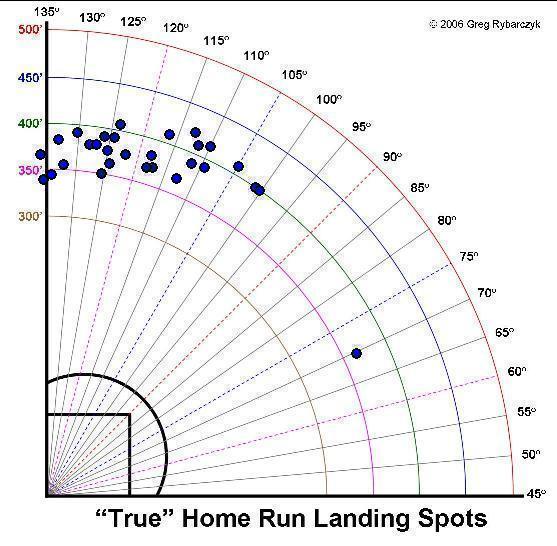
To better look at his home runs, we turn to HitTracker.

Hill

The first thing we notice is that he’s an extreme pull power guy, with nearly all of his home runs flying out to left field. The next thing you notice, if you scroll down to his individual HR listing, is how many are labeled “JE”, which stands for “just enough”. Hill is tied with Joe Mauer and Kevin Youkilis for the league lead in home runs that were barely home runs, as 11 of his long balls have been categorized as cutting it close.

In fact, looking at the list of average home run length on Hit Tracker’s site, Hill’s 384.6 foot average distance is one of the lowest in the league. The guys whose home runs average 380-390 feet are mostly middle infielders (and Johnny Damon). On this list, he’s no longer anywhere near guys like Pena or Branyan.

We can also see that the extra home runs are coming from balls that used to be doubles just by looking at his total rate of extra base hits. In his healthy 2007 season, 37% of Hill’s hits were of the extra base variety. This year, 36% of his hits have gone for extra bases. There’s no change in how often he’s whacking the ball – just what category of XBH those balls are being classified as. Due to whatever reason, Hill has been able to clear the fence (barely, in some cases) with more regularity this year, but it doesn’t look like he’s actually added much in the way of power.

Aaron Hill is a good player, but he’s not a 30 HR guy. Odds are he never does this again.


Penny Released

For the second time this month, the Red Sox have overreacted to a recent poor stretch of results and granted free agency to a quality major league pitcher. First, they cut John Smoltz loose, and now they’ve let Brad Penny out of his contract after they removed him from their starting rotation and he expressed a desire to start for another team down the stretch. The list of suitors lining up for Penny will be long, just as it should be – the guy can still pitch.

Even with his recent struggles, he’s running a 4.48 FIP on the season, thanks to recording twice as many strikeouts as walks and maintaining a neutral home run rate. That makes him around a league average starting pitcher for the season. Yes, he throws his fastball too much, but that’s always been true – he’s averaged 70% or more fastballs every year since 2004, and he’s proven he can be at least moderately successful pounding the zone with heaters.

The chink in his results – a .336 batting average on balls in play, which isn’t particularly predictive of anything. ZIPS projects a 4.44 FIP from Penny going forward, and that’s assuming he stays in the American League. Someone’s going to get a quality pitcher for nothing – who are the contenders for his services?

Detroit makes a lot of sense, as the back of their rotation is a bit of a mess. They just sent Aramando Galarraga to Triple-A for a brief stint, Jarrod Washburn is turning into a pumpkin, and they are simultaneously trying to limit Rick Porcello’s innings, leading to things like Nate Robertson and Zach Miner splitting a start this weekend. With a 67 percent chance to win the division, they’re the clear favorites in the AL Central, and Penny would have a good shot at cracking their playoff rotation.

If he wanted to go back to the National League, Colorado has a clear need for a starting pitcher after just losing Aaron Cook with an arm problem. The Rockies are leading the Wild Card race in the NL and should be an aggressive suitor, but as a free agent to be, Penny might not want to ply his trade in Coors Field for the last month of the season.

That would leave Florida as the best fit in the NL. Penny obviously has history there, and he would be a clear upgrade over Sean West in the Marlins rotation. At 4 1/2 games behind the Rockies in the Wild Card standings, they’re a long shot to play in October, but it would be a chance at some meaningful baseball in September in an environment that he knows fairly well.

I’d bet on Detroit, but regardless of where he ends up, he’s likely to be an asset. Boston has to hope that this doesn’t come back and bite them in the playoffs.


Anderson’s Step Forward

I watched Brett Anderson carve up the Mariner offense (granted, one missing both Ichiro and Adrian Beltre) last night and was highly impressed, as is getting to be routine. If you watch this 21-year-old throw and don’t come away thinking that the A’s have found their future ace, you’re in the minority. Anderson is opening eyes every time he takes the hill.

The interesting thing about last night, though, is how much better his stuff was than the first time I saw him pitch this year. On April 10th, he gave up five runs in seven innings against the Mariners, only notching two strikeouts, while his fastball topped out at 93 and his breaking ball was in the low-80s. It was his major league debut, but the stuff was less than what had been reported in the minors.

Last night, it was better than I had heard coming into the year. Up to 97 with the fastball and a mid-80s hard breaking ball that no one could touch made him look utterly dominating. It wasn’t a one night fluke, either – here’s Anderson’s velocity chart for the season.

Anderson

Whether the reason, Anderson didn’t leave spring training with his best stuff. His first six starts, he managed just 31 innings, gave up 28 runs, walked 10, and struck out 15. The stuff was just okay, the command wasn’t great, and he just didn’t look like a premier young pitcher.

Then, towards the end of May, the stuff shot up. Instead of averaging 90-91 with the fastball, he was suddenly at 93-94, topping out in the high-90s, and the slider went from 82 to 85. The results have been dramatically different since then:

18 starts, 109 innings, 49 runs, 29 walks, 102 strikeouts, 12 HR, 3.61 FIP.

That’s an impressive run for any pitcher, much less a 21-year-old rookie who had all of six starts at Double-A coming into the season. And, with the stuff taking a significant step forward, there’s a real reason for the improvement. His overall season line might not blow you away, but for the last three months, Anderson has been one of the best pitchers in baseball.

I have a feeling we’re going to be saying that about him for a long, long time. This kid is good.


Wagner And The 2010 Option

The Red Sox acquired Billy Wagner from the Mets today after a few days of drama surrounding the waiver claim, ranging from Wagner and Papelbon sparring over Twitter (is anyone surprised, with these two involved?), Wagner apparently invoking his no-trade clause to block the deal, and finally his “change of heart” that allowed the trade to be completed. The deal was certainly complicated, and came down to the last few minutes before the 48-hour window expired for everyone to get on the same page.

However, the most curious part of the negotiations center the team’s right to exercise his 2010 option, worth $8 million. Wagner apparently demanded that the Red Sox guarantee they would not pick up the option, making him a free agent this winter. However, he did not get the same assurance that they would not offer arbitration, and as a Type A free agent, Boston will have some incentive to do so.

By turning down his option and then offering arbitration, the Red Sox get the best of both worlds. If he accepts, they have him for 2010 at a price that should be in the same ballpark as his 2010 option was worth – maybe a bit more, but not outrageously so. If he declines and signs with another team, they’ll get two compensatory draft picks, which is the outcome you have to believe they’re hoping for.

But if Wagner thinks he’s going to hit free agency with Type A status hanging over his head, after just a month of pitching in the big leagues, and land a significant contract as a 38-year-old, he’s kinda crazy. Juan Cruz just had to suffer through a miserable off-season of avoidance as teams decided that relief pitchers weren’t worth both the loss of a pick and a big contract, and he finally ended up taking a two year, $6 million deal with the Royals as a last resort. And he wasn’t coming off arm surgery, nearly 40 years old, and known as a guy who causes issues with other players.

If the Red Sox offer arbitration and Wagner declines in order to become a free agent, he’s unlikely to get anything close to what he feels is fair market value for his services. Teams might be willing to give the pick if he’ll sign for peanuts, but I can’t imagine a 1 year, $2 or $3 million deal is what he’s looking forward to at the moment.

The only way this works out for Wagner is if the Red Sox decide not to offer him arbitration. Of course, if he pitches well down the stretch, that doesn’t seem likely, so the scenarios that involve them not tendering an arbitration offer also include Wagner not pitching well in September, and that isn’t likely to lead to a big payday for him either.

All in all, it seems like Wagner should have been asking the Red Sox to guarantee his option for 2010, exactly the opposite of the thing he negotiated. It was the only way he was going to get a guaranteed paycheck for 2010. Now, he’s going to have to hope for a pretty interesting set of circumstances to occur – he has to pitch well enough to re-establish his value to other clubs but not well enough for Boston to risk the chance that he could come back as a highly paid set-up guy for one year. I’m not sure I see too many ways that happens.