Author Archive

I Thought You Had Power?

Minnesota and Tampa Bay completed one of the more interesting trades of the winter when the Rays sent former #1 overall pick Delmon Young to Minnesota for a pu-pu platter of interesting players. Young had been thought of as part of the foundation of Tampa’s rebuilding project, and had just finished playing an entire season as their starting right fielder at the age of 21. Due to his physical stature, offensive potential, and some issues with maturity, the most common comparison heard when scouts discussed Young was Albert Belle. The Twins certainly believed that they were getting a potential cleanup hitter that they could build their offense around, and gushed over Young’s bat after the deal was announced.

Two months in, Minnesota has to be wondering where the power went. Young not only has failed to hit a home run in his new digs, he’s also only racked up 10 extra base hits and a meager .071 Isolated Slugging Percentage. That’s lower than Tony Pena Jr’s career ISO, and as we mentioned yesterday, he might be one of the worst hitters in baseball history. Young isn’t supposed to be hitting like a middle infielder, and he’s certainly not supposed to be hitting like one of the feeblest middle infielders around.

Where has the power gone? Well, take a look at these two charts.
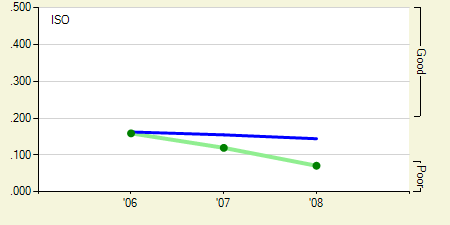
ISO

GB/FB/LD

The first graph is his ISO, which shows that his current performance is well below average compared to just a normal hitter, not even accounting for the fact that he’s a corner outfielder without much defensive value. The second chart, however, shows the main problem – a skyrocketing ground ball rate and a nosediving line drive rate. After hitting the ball on the ground 46.6% and 46.3% of the time respectively the last two seasons, Young’s groundball rate is currently at 62.7%. For comparison, Luis Castillo’s career ground ball rate is 62.9%, and I’m sure that the Twins’ fans who remember him slapping the ball onto the Metrodome astroturf weren’t expecting Young to do a spot on impression.

Ground balls and power just don’t go together. The guys who hit the ball on the ground 60% of the time or more are slap-hitting infielders. In fact, of the five guys currently posting a GB% over 60%, Young is the only one who doesn’t play shortstop. You can’t become the next Albert Belle by constantly driving the ball into the ground, so it’s time for someone in Minnesota to talk to Delmon about his swing and get him lifting the ball again. Until he remembers how to get under the ball and drive it with authority, he’s going to be a colossal disappointment and a hindrance to the Twins’ playoff chances.


How The Mighty Have Fallen

At the end of the last decade, the American League boasted a pretty remarkable group of shortstops. It had almost always been a position of light hitters, but Alex Rodriguez, Nomar Garciaparra, and Derek Jeter provided all-star bats at the position and led to something of a revolution at the position. In fact, in 1998, the average American League shortstop hit .274/.323/.407.

10 years later, and things are back to normal. American League shorstops are hitting .254/.305/.354 so far this year, and if you’re filling out your All-Star ballot, you’re going to hard pressed to get excited about the shortstop vote. Derek Jeter is going to be the starter, but he’s hitting .280/.333/.382 and playing his usual awful defense. Michael Young will probably be the backup, but he’s hitting .278/.339/.408 and, like Jeter, is pretty lousy defensively, and his offensive production gets a boost from playing half his game in a hitter friendly park. Neither of them are having all-star seasons, but realistically, what are the alternatives?

Jhonny Peralta is hitting for power, but he has a .282 on base percentage. You have to be Ozzie Smith defensively to make an all-star team when you’re making outs that often, and Peralta is no Ozzie Smith.

Marco Scutaro is getting on base at a nifty .372 clip, but he has no power, and he’s Marco Scutaro.

Everyone else is either having a bad year or a bad career. The dearth of talent at the position is really pretty shocking, especially considering the quality of the players playing shortstop just ten years ago.


He’s Hitting What?

Tony Pena Jr plays a good shortstop, so the Royals have given him a mostly regular job at shortstop over the last year and a half. During that time, we have learned one clear truth.

Tony Pena Jr can’t hit.

I’m not talking about Pena struggling at the plate. I’m not saying he’s a bad hitter for a major leaguer. I’m saying that Tony Pena Jr might be one of the worst hitters ever to put on a major league uniform. He’s unbelievably bad. For the season, he’s hitting .160/.181/.200. The average pitcher in the National League is hitting .141/.180/.177. At least he’s better than them as a group, but the margin couldn’t be much smaller.

While Pena’s not really this bad, he is pretty terrible. For his career, he has a 2.2% BB% thanks to a 39.06% O-Swing%. He swings at almost 40% of pitches out of the strike zone, and due to that aggressiveness, he never ever walks. But it’s not like his aggressiveness comes with its own rewards, because he’s not good at making contact either. His contact rate is just 79.44%, and his career K% is 17.1%. This isn’t a guy who is swinging at everything because he can actually put the bat on the ball. He’s just swinging at everything because… well, I have no idea why.

Even when he does make contact, pitchers don’t care. His Isolated Slugging % this year is a dreadful .041 (and .080 for his career), as he has just five extra base hits on the season. Most of that is because he’s an extreme groundball hitter with a career GB% of 55.8%. When you pound the ball into the ground, you’re basically hoping for a single at best, and that limits the value of your hits. In fact, most guys with extreme groundball tendencies and some speed teach themselves how to bunt so that they can maximize their skills, but Pena’s not even good at that – he has seven career bunt hits. For comparison, Luis Castillo got 16 bunt hits last year.

Pena is the complete package – ridiculously aggressive with poor contact skills, no power, and an inability to bunt himself on base. Add it all up, and you get a guy with a career .242/.261/.321 line that no amount of good defense can compensate for. I wasn’t sure I would ever see a team give regular at-bats to a guy with less offensive ability than Rey Ordonez, but along came Tony Pena Jr.

Royals fans, you have my sympathy.


Marmol and Flyballs

This morning, I mentioned that Jason Bergmann had the second highest flyball rate in the major leagues among pitchers with at least 30 innings. Only one pitcher in baseball allows hitters to put the ball into the air with more frequency than Bergmann, but in a striking contrast, Carlos Marmol couldn’t be any more different as a pitcher than Bergmann.

Marmol has been a revelation out of the Cubs bullpen the last two years after struggling in the rotation during 2006. As a reliever, he’s blowing hitters away with his power fastball/slider combination, having scrapped the curve he used as a starter in favor of the harder breaking ball. His 93 MPH fastball and 81 MPH slider are both knockout pitches, and his huge jump in strikeout rate shows the effect of the new pitch and the increased velocity since moving to relief full time.

K/9

Marmol leads all major league relievers with 47 strikeouts, and Joel Hanrahan is the only other guy over 40 on the year. With a strikeout rate exceeding 12.0 K/9, its easy to see why Marmol has been successful. It’s hard to score runs if you can’t make contact.

However, when hitters do put the bat on the ball against Marmol, odds are its going to be a flyball. When looking for a late inning relief ace to protect a one run lead, a flyball isn’t necessarily the outcome you’re looking for in a lot of cases. In fact, Marmol’s flyball rate is so extreme that he’s going to have to sustain an unbelievably low HR/F rate in order to keep from giving up a few high leverage home runs. While relievers do post lower HR/F rates than starting pitchers, even the great relievers are going to have problems keeping their HR/F rates below 5% consistently, and that’s really where Marmol is going to have to live considering how often the ball reaches the outfield when hitters make contact.

He’s undoubtedly one of the best relief pitchers in the game, but if I’m a Cubs fan and Marmol comes trotting in to protect a one run lead, I’m going to be hoping like crazy for a strikeout, because his non-strikeout events could be rather scary.


Bergmann Wants To Stay This Time

On May 15th, I wrote this:

They (Washington) won’t win a championship with Perez-Hill-Lannan-Redding, but they’re the epitome of what you can do with freely available talent when you’re willing to take some flyers on guys with question marks. Along with that comes the downside of what they’ve gotten from their #5 starters, however. Washington has done well filling the front four spots in their rotation, but they’re going to have to do some more work to get a fifth starter who won’t cancel out all the work already done.

At that point in time, Jason Bergmann had given up 16 runs in 12 1/3 innings for a sparkly 11.68 ERA and had spent the previous month in Columbus while the Nationals tried other options. However, the night I posted the article above, Bergmann got the call back to the majors and returned in style, with seven shutout innings against the Mets. He followed that up with another seven shutout inning performance against the Phillies, and then tossed 5 2/3 scoreless innings against the Brewers on Memorial Day. In all, since getting the call back from Triple-A, Bergmann has given Washington 19 2/3 scoreless innings, a stretch that includes a nifty 6/22 BB/K rate.

However, Bergmann was sporting a 2/12 BB/K rate during his disastrous first three starts of the year, so we can’t really chalk up the difference in results to an improvement in his ability to work around the zone. The change can really be tied to one simple fact; Bergmann is an extreme flyball pitcher (his 58.4% FB% is second highest in baseball), and his performance hinges on how often those fly balls go over the wall. During his first three starts, five of his 23 flyballs left the yard, but he hasn’t given up a single home run despite allowing 29 flyballs in his most recent three starts.

Obviously, neither his early home run rate nor his late home run suppression are sustainable, and the truth of his abilities lies between the two extreme performances. However, due to Bergmann’s proclivity for letting opponents put the ball in the air, Nationals’ fans should continue to expect inconsistency, as his ability to keep runs off the board is almost entirely tied to his home run rate.


Here A Catcher, There A Catcher

If you have MLB.tv, you’re well aware that MLB has opened up voting for the 2008 All-Star Game, as the commercial every half inning reminds us constantly. And while the game itself doesn’t mean anything, regardless of Bud Selig’s protestations, being named to the team is still considered a pretty big honor among the players. In some cases, the choice is obvious – not voting for Albert Pujols is a felony in Missouri, for instance – but in others, the picture is a little more muddied. Nowhere is the water darker than behind the plate in the National League, however, and it’s not for the usual reasons.

A decade ago, the NL catcher position was Mike Piazza and a host of catch-and-throw guys who hit like catch-and-throw guys. The landscape has changed a bit, however, as the current crop of young backstops are showing that they have some punch at the plate as well as behind it. In no particular order:

Brian McCann

In his third full year, McCann is showing that his ’06 season was no fluke and he’s significantly better than he showed last year, and at the age of 24, he appears to be blossoming into a full blown superstar. He’s hitting .333/.394/.603 while drawing as many walks as strikeouts (18 apiece). Contact and power together are the signs of greatness at the plate, and McCann is showing the ability to hit the ball frequently and with violence. He doesn’t even have to maintain this level of success to be one of the game’s truly great players, but if he does, you can start polishing his Cooperstown plaque now. He’s just 24 years old, by the way.

Geovany Soto

The leading candidate for National League rookie of the yaer, Soto is matching McCann at the plate, hitting .299/.401/.569 in his first year of regular work. However, his underlying skillset isn’t quite as good as McCann’s – he strikes out a lot (27.5%), which means he’s going to have to sustain his much higher than average batting average on balls in play to keep hitting for average. This isn’t to say he can’t, but slow footed catchers don’t usually show up on the league leaders in BABIP, so even though he’s spraying line drives all over the field, we should probably expect a little regression. Like McCann, though, he could fall a long way and still be a very good playerl, and at age 25, he appears to be at the start of a nice career as well.

Russell Martin

Also 25 years old, Martin doesn’t have the power that either McCann or Soto possess, but he’s a great contact hitter with the ability to drive the ball into the gaps, and he’s clearly the best defensive catcher of the group mentioned so far. If you liked Jason Kendall in his prime, you’ll love Martin, and the Dodgers certainly do.

Ryan Doumit

The late bloomer of this group, Doumit is already 27 and scouts don’t love his work behind the plate, but he can hit, and the new regime in Pittsburgh seems committed to maximizing his value as an offensive minded backstop. He’s not as good as the .350/.383/.573 line that he’s currently posting, and his extreme aggressive approach can lead to him getting himself out too often, but the power is legit. His drawbacks might limit him to being the new B.J. Surhoff, but that’s still a quality player, especially if the Pirates can figure out how to keep him behind the plate.

Chris Snyder

Snyder’s behind a quality part-time backstop in Arizona the last two years, and now, given the chance to play regularly, is showing that he can thrive as an every day player. His .277/.377/.492 isn’t as eye popping as the first few guys on the list, but they’re just setting the bar ridiculously high. Snyder’s proving that you can count on him for a .775-.800 OPS from behind the plate, and every team in baseball would have gladly taken that kind of production from their catching position if offered before the year started. Like Doumit, he’s 27 and unlikely to become a star, but he’s the kind of valuable role player that you find on championship clubs.

Assuming the NL only takes three catchers, you have to omit two of the guys above as well as Bengie Molina, who is on pace to have the best season of his career at the age of 34. Picking the catchers for the N.L. All-Star squad this year won’t be easy. I’d bet on McCann, Soto, and Martin, but you could make a case for Snyder, Doumit, and even Molina.

How fitting that in the year that Mike Piazza hangs up his spikes, the National League has multiple successors to his throne.


Steal Of The Winter

The Diamondbacks have one of the best outfields in baseball, with Eric Byrnes, Chris Young, and Justin Upton providing both offense and defense for the team that looks like the National League’s best. In order to make room for Upton, however, they shipped off Carlos Quentin, and he’s quickly making them regret that decision.

After another huge night, where he was the White Sox offense against John Lackey, Quentin continues to solidify his position as the best hitter in the American League so far in 2008. His .301/.415/.608 line gives him the league’s highest WPA/LI, and his 14 home runs also lead the junior circuit while matching his career total coming into the ’08 season. When you can double your career home run total in 166 at-bats, you’ve either had an amazing year or a pretty lousy career to that point, or more probably, both.

Quentin was a pretty big disappointment in Arizona, and his power was a question mark after just okay performances in some pretty good hitters parks. He’s answering those questions in a big way this year, however. 22 of his 50 hits have gone for extra bases, and when you combine the ability to drive the ball with good pitch selection (13.3% BB%, 17.8% K%), you get an all-star offensive performer. Unlike many hot starters, Quentin’s early strong performance is not driven by an unsustainable rate of hits falling in front of fielders, as his .287 BABIP is actually a little below the league average. His goodness is coming from hitting the ball over the wall, and while he won’t keep getting home runs at this rate, he’s a talented player who is breaking free of the bust label.

Considering the White Sox got him for a decent-but-not-great prospect in Chris Carter, the acquisition of Quentin has to be considered the steal of the offseason, and is one of the main reasons Chicago is a surprising contender in the A.L. Central.


Big Hurt Still Hurtful

Right after he was released by the Toronto Blue Jays, we asked the question “is Frank Thomas done?”

At the time of his release, Thomas had posted the following core statistics: 15.5% BB%, 21.7% K%, 11.5% HR/FB%. The driving force behind his struggles was a .159 batting average on balls in play, which screamed regression to the mean. Based on the fact that his underlying skill set hadn’t changed, I concluded that Thomas still had productive baseball left in his bat, and there was no reason to believe that he had fallen off a sudden cliff.

Since signing with the A’s, Thomas has posted the following core statistics: 14.6% BB%, 22.0% K%, 11.1% HR/FB%. The driving force behind his rebound is a .350 batting average on balls in play. That’s actually regression a little bit past the mean, but the idea still works. There’s been absolutely no change in Thomas’ skills since moving to Oakland – he’s just getting better results from those same skills.

There were all kinds of subjective opinions being offered up that Thomas was overweight, had a slower bat, or wasn’t trying. All of those opinions flew in the face of the fact that Thomas’ results simply hadn’t matched his skills for a few weeks, which happens all the time in baseball. Given a larger sample, we can now state with confidence that jumping to the conclusion that Thomas was finished was obviously incorrect.

Frank Thomas can still hit a baseball, and that’s not any more true today than it was a month ago. Teams that let themselves be deceived by three weeks worth of results missed out on a solid player because they failed to grasp the power of regression to the mean.


Clayton Kershaw

On Thursday night, Dodgers prospect Clayton Kershaw was pulled from his start after just one inning. He’s healthy, he’s pitching well, and the Dodgers need a fifth starter exactly five days from last night. Putting two and two together, it’s becoming obvious that Kershaw will be making his major league debut next Tuesday in Wrigley Field.

So, what should Dodgers fans expect from Kershaw?

Let’s start with his stuff. Kershaw features a 93-96 MPH fastball from the left side and a knee buckling 72-78 MPH curveball that is a true knockout pitch. He’s fiddled with a change-up, but I wouldn’t expect to see much of it on Tuesday; 20 year olds making their major league debut often stick with what they’re comfortable with, and Kershaw’s most comfortable with his top two offerings. Command had been his primary concern heading into this season (he walked 15.9% of batters he faced in Double-A last year), but he’s improved his fastball location and is learning to pitch more efficiently. However, he’s still not a great bet to work deep in games right off the bat.

Kershaw’s fastball/curveball combination gets him plenty of strikeouts, drawing comparisons from Dave Righetti to Josh Beckett, though he adds in the wrinkle of being a southpaw as well. His minor league career strikeout rate is right around 30%, and even when matched up against Double-A hitters, his inexperience hasn’t stopped him from ringing them up left and right. Kershaw’s stuff is good enough to get a lot of swings and misses, no matter what caliber of hitter he’s facing.

Generally, when a kid this good comes up from the minors, the adjustment period isn’t a long one. He will take some lumps as he grows, but let’s not confuse him with good but not great pitching prospects who have come up before their time and struggled. Kershaw has all the skills to be a legitimate major league starter right now, and the Dodgers are making the right call by sticking him in their rotation. The race for the N.L. West is a two team sprint, and the Dodgers are on the verge of adding a pretty significant horse.

Tuesday should be a lot of fun.


Contreras 2.0

There’s a good chance that Jose Contreras is currently 64 years old. I wouldn’t be surprised to learn that his grandchildren were throwing 94 and learning a split finger. If you need some ammunition for baseball related comedy, you can’t go wrong with making fun of Jose Contreras’ age. But, however old he is (and his listed age of 37 seems about as likely as 16), we should notice that he is reinventing himself to extend his career.

After getting bombed in New York on July 31st of last year, Contreras’ ERA stood at 6.60 and people were speculating that he had reached the end of his career. Unable to trade him, the White Sox placed him on waivers, where every single team in baseball passed on taking on the last year and two months of his contract. He got pulled from Chicago’s rotation, called out publicly by the manager, and given his proverbial last rights.

However, he apparently wasn’t done, and so Contreras decided to become Aaron Cook.

GB/FB/LD

See that straight green line? That was a remarkably consistent ground ball rate during the 2004-2007 seasons, fluctuating from 44.1 to 44.9%. In 2008, he’s getting ground balls at a 57% rate. However, Contreras’ strikeout rate wasn’t holding as steady.

K/9

Doesn’t take a scientist to see the pattern there.

Realizing that his ability to miss bats was deteriorating, Contreras has focused on getting ground balls, and the results speak for themselves – a 3.26 FIP that is the best he’s ever posted as a starting pitcher. Now, that’s not sustainable, as he’s posting a ridiculously low 4.3% HR/FB rate that just won’t continue. However, the extra ground balls will cut down on his home run rate, and when combined with his above average command, this version of Jose Contreras is a pretty good pitcher.

Apparently, you can teach an old dog new tricks, as long as you don’t have any idea how old the dog really is.