
Blue Jays Continue Bullpen Overhaul, Sign Tyler Rogers
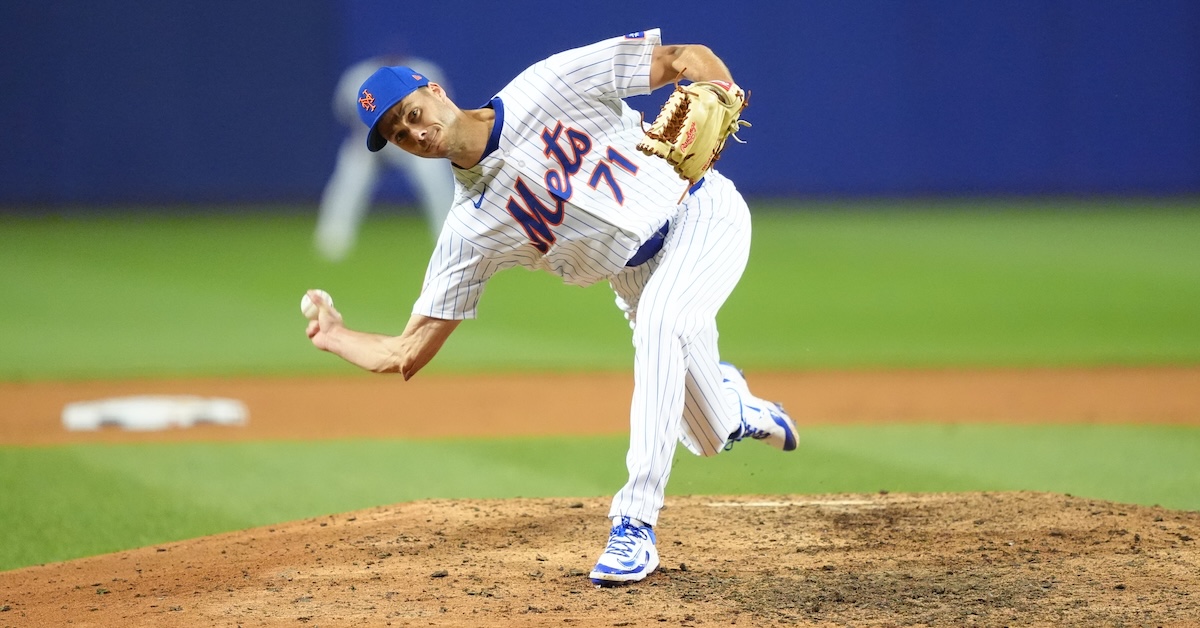
Two months ago, the Blue Jays marauded their way through the playoffs despite a bullpen they preferred not to touch with a thirty-nine-and-a-half-foot pole. They started the offseason by adding to the rotation, with Dylan Cease the big name acquisition and KBO MVP Cody Ponce an interesting flier. Now, they’ve turned their attention to relief pitching, and they’re working every angle there. They selected hard-throwing relief option Spencer Miles in the Rule 5 draft, traded for sidearmer Chase Lee, and late last week added the piece de resistance, the weirdest reliever in baseball. That’s right: Tyler Rogers and Toronto agreed to terms on a three-year, $37 million deal with a vesting option that could push it to four years and $48 million.
I’m legally obligated to lead any article about Rogers by mentioning his unconventional delivery. He throws upside down, it’s true. He throws in the low-to-mid-80s as a result, with movement that resembles nothing else in baseball. It’s hard to wrap your head around how his pitches move. His slider has huge positive vertical break; it’s a regular slider turned upside down. His fastball, naturally enough, breaks downward, which results in some incredibly counter-intuitive at-bats; despite being about 10 miles an hour faster, it falls meaningfully more than the slider on its path homeward.
With that out of the way, forget what Rogers throws like for a while. I’m sure that’s interesting to the Blue Jays, but what actually matters at the end of the day is how effective he is. He’s very effective, as it turns out. His career 2.76 ERA is flattered slightly by all his years calling spacious Oracle Park home, but not as much as you’d think. His 67 ERA- is a top-15 mark among relievers since his 2019 debut, and I actually think ERA- punishes him, because his specific game doesn’t benefit as much as most pitchers from a big outfield. He gets a ton of grounders. He perennially runs a low BABIP allowed, and it’s no fluke; batters just can’t square him up.
So long as you’re willing to live with a low strikeout rate – Rogers might baffle hitters, but his pitches are so slow that they often put the ball in play even if they’re fooled – he offers pretty much everything else. He almost never walks anyone; he’s walked 13 batters in his last two years of work, across nearly 150 innings. Two of those were intentional, even. He’s an iron man; throwing so much softer means that he can appear more frequently, and he’s topped 70 innings in each full major league season. He’s 40 innings ahead of the next closest reliever over that span. He’s never had elbow problems. He’s never even hit the IL.
Some sidearmers have platoon issues. But Rogers isn’t a sidearmer; he’s an underhander, and as a result he gives lefties plenty of trouble too. In his career, he’s allowed a .275 wOBA to righties and a .276 wOBA to lefties. The closest thing he has to a limitation is that he generally goes one inning at a time, but that’s less of a problem when you throw so many games a year. In other words, Rogers is bottled competency, the kind of reliever that a manager would make up if you let them write baseball fan fiction.
If Rogers has a weakness, it’s that he’s very reliant on the defense behind him. No one in baseball had a higher rate of balls in play per plate appearance. That might be a problem for some teams, but the Jays boast one of the best defenses in baseball. The exact composition of next year’s infield isn’t set in stone, what with Bo Bichette a free agent, but any defensive alignment will feature Ernie Clement and Andrés Giménez, two of the best defensive infielders in the league.
The only question about Rogers’ effectiveness is how long it can last. At 35, he’s squarely into the back half of his career. On the other hand, I have absolutely no idea how a pitcher like Rogers “should” age, because there haven’t been many pitchers like him. Is declining velocity a worry? I assume not; he’s been sitting 80-81 with his sinker for pretty much his entire major league career and doing just fine. I’m not convinced that it suddenly wouldn’t work at 78-79.
Still, there’s meaningful risk here. Three years out, Rogers might lose enough stuff or command that his one weird trick suddenly stops working. Maybe there’s some threshold past which batters gain enough familiarity with his unconventional arsenal to neutralize it. It’s hard to put boundaries on the possible outcomes Rogers could achieve because there’s just much less history to draw on in guessing the range of outcomes. Projection systems have absolutely no idea what to do with Rogers; Steamer has him down for a 4.06 ERA and 4.05 FIP, which bears basically no resemblance to his career line. Stuff models can’t handle him, either; they look for similar pitches and there are no similar pitches to anything Rogers throws. The error bands are wide. How could they be otherwise?
The Jays no doubt see that risk as well. But on the other hand, if there were no risk to signing Rogers, you couldn’t get him for the deal he signed. Think of it this way: Robert Suarez surged to prominence the past two years with a 2.87 ERA across 134 innings. He parlayed that into a three-year, $45 million deal ahead of his age-35 season. Rogers managed a 2.38 ERA across 147 innings over the same two years. He also posted a 2.93 ERA over the three years before that, in 230 innings. He signed for less money anyway. Suarez throws 100 and strikes out a ton of batters. That’s just a more projectable way to get dudes out, and teams pay for that certainty.
Me? I’ll take the unconventional reliever. The truth is that projecting relievers is a sucker’s game anyway. Hard throwers turn into pumpkins overnight all the time. You don’t get a certificate of nastiness when you sign someone even if their fastball has afterburners. Particularly in a winter where the Blue Jays have been shopping toward the top of the free agency market, I like their decision to also look at the store brand aisle, and Rogers is basically an elite closer without the shiny packaging.
The Jays are presumably just about finished adding pitchers in free agency now, and they’ve done an admirable job of overhauling their bullpen and rotation at once. Manager John Schneider went to great lengths to hide his bullpen in October, and while he was mostly successful in doing so, there was no reason to try to make that same plan work again when the problem could be solved with nothing more than money. I think this is a great signing in pursuit of that – and I think Rogers is going to end up as one of the best signings of the winter. A playoff contender in need of solid relief innings, the more the better? He’s the exact right man for the job.
Ben is a writer at FanGraphs. He can be found on Bluesky @benclemens.
I read a story on him where when he was still stuck in the minors at age 29 he was ready to retire and become a fireman, but before he did he got called up and the rest is history. He’s been as consistent as they come the last six years. I’m glad he got paid after grinding in the minors for so long.