
Braves Bolster Bullpen by Adding Robert Suarez
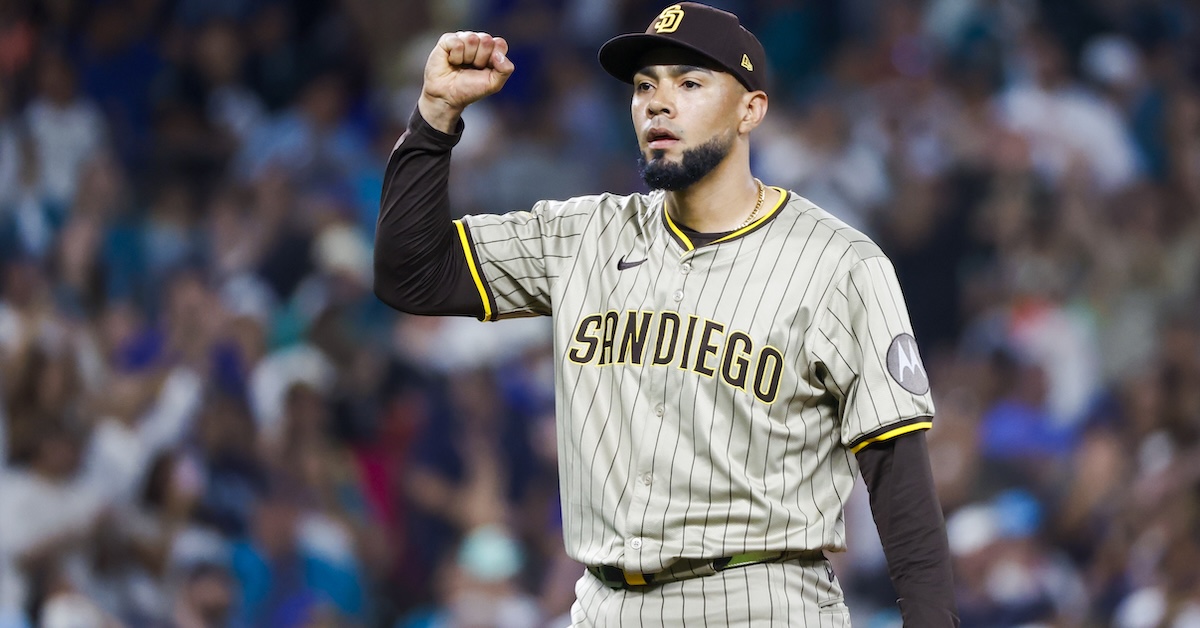
Last month, the Braves retained Raisel Iglesias following a rollercoaster season in which he temporarily lost his closer job before reclaiming it and dominating down the stretch. Mind you, a stretch during which the team was playing out the string on its way to an 86-loss season and a fourth-place finish in the NL East. Now Atlanta has added another late-game reliever in Robert Suarez, who after opting out of his deal with the Padres has agreed to a three-year, $45 million contract with the Braves.
Suarez, who will turn 35 on March 1, spent the past four seasons with the Padres after pitching in Japan from 2016–21, a span interrupted by Tommy John surgery in ’17. After a strong stateside debut in 2022, he rejected a $5 million player option and quickly re-signed with San Diego on a five-year, $46 million contract. That deal paid him $10 million annually from 2023–25 and included performance bonuses as well as a pair of $8 million player options, which he declined after this year’s World Series, allowing him to hit the open market. Reportedly, his new deal pays him $13 million in 2026, with salaries of $16 million in both ’27 and ’28; none of the money is deferred. With that, the Braves currently have the relievers with the fifth- and sixth-highest average annual values in the majors, with only Edwin Díaz ($23 million AAV), Josh Hader ($19 million AAV), Tanner Scott ($18 million AAV), and Devin Williams ($17 million AAV) ahead of Iglesias ($16 million, on a one-year deal) and Suarez ($15 million AAV).
Suarez made the NL All-Star team in both 2024 and ’25 while closing for the Padres, putting up a pair of superficially similar seasons: a 2.77 ERA in 65 innings, with 36 saves (third in the league) in 42 opportunities in the former, and a 2.97 ERA in 69 2/3 innings, with an NL-high 40 saves in 45 opportunities in the latter. Below the surface, his FIP dropped from 3.49 to 2.88, driven by a spike in strikeout rate from 22.9% to 27.9%, and less dramatic drops in his already-low walk rate (from 6.2% to 5.9%) and home run rate (from 0.97 per nine to 0.78). As a result of that improved FIP, his WAR more than doubled, from 0.9 to 1.9.
Suarez missed more bats while shaking up a fairly simple plan. He’s got outstanding command of two high-spin, high-velocity fastballs, a four-seamer that averaged 98.6 mph in 2025 and a sinker that averaged 98.4 mph; he offsets those with a changeup that itself hums along at an average of 90.5 mph. In 2025, he decreased the usage of his four-seamer to 60.4%, down from 72.4%; he compensated by throwing his changeup about twice as often (from 12.6% to 23.9%) while holding his sinker usage more or less constant (15.5% in 2025). Though his whiff rate on the changeup dropped from 45.2% to 32.8% from 2024 to ’25, that was still well ahead of the 24% whiff rate he generated with his heater.
That said, batters found the slower pitch much more hittable, batting .310 and slugging .483 for a .345 wOBA against the changeup, compared to a .155 AVG and .239 SLG with a .211 wOBA against the four-seamer. So despite Suarez’s improved strikeout and walk rates, his xERA rose from 3.05 to 3.66, as he was hit harder, with his average exit velocity increasing from 89 mph to 90.5, and his barrel rate from 7.7% to 9.1%; the latter represented a drop from the 49th percentile to the 36th, closer to where his 42.6% hard-hit ranked (31st percentile). That’s a bit of a concern. As Ben Clemens summarized while ranking the right-hander no. 22 on our Top 50 Free Agents list, “Suarez is going to turn 35 before Opening Day, he relies heavily on velocity, and he’s so fastball-dominant that any loss of shape could make him shockingly hittable overnight.”
Both PitchingBot and Stuff+ really like Suarez’s arsenal and his command, though outside of the four-seamer, they differ on the other two offerings:
| Season | botStf FA | botStf SI | botStf CH | botStf | botCmd | botOvr |
|---|---|---|---|---|---|---|
| 2024 | 67 | 56 | 70 | 63 | 55 | 63 |
| 2025 | 65 | 55 | 71 | 65 | 63 | 71 |
| Season | Stf+ FA | Stf+ SI | Stf+ CH | Stuff+ | Location+ | Pitching+ |
| 2024 | 119 | 113 | 107 | 116 | 97 | 111 |
| 2025 | 115 | 117 | 106 | 113 | 108 | 119 |
What’s jarring, then, is that ZiPS does not seem to be a fan of Suarez, especially over the lifetime of this deal:
| Year | W | L | ERA | G | GS | IP | H | ER | HR | BB | SO | ERA+ | WAR |
|---|---|---|---|---|---|---|---|---|---|---|---|---|---|
| 2026 | 5 | 4 | 3.60 | 57 | 0 | 55.0 | 48 | 22 | 6 | 17 | 54 | 115 | 0.7 |
| 2027 | 5 | 3 | 3.86 | 54 | 0 | 51.3 | 47 | 22 | 6 | 18 | 48 | 108 | 0.4 |
| 2028 | 4 | 4 | 4.28 | 51 | 0 | 48.3 | 47 | 23 | 6 | 19 | 43 | 97 | 0.0 |
Even Dan Szymborski, who provided that projection, seemed puzzled, telling me, “ZiPS is very grumpy about Suarez for a reason I haven’t figured out.” The system is particularly skeptical about Suarez retaining his higher strikeout rate. I wonder if it’s as simple as Clemens’ concern about age taking a bite out of Suarez’s fastball to the point that it becomes much more hittable — or, more to the point, that his actual and expected results on the four-seamer converge. He allowed a .214 xBA (59 points higher than his AVG, a .373 xSLG (134 points higher than his SLG), and a .286 xwOBA (75 points higher than his wOBA). That -.075 wOBA-xwOBA gap places him in the 93rd percentile among pitchers with at least 100 results against their four-seamer.
Despite Suarez’s recent success closing, Atlanta’s plan, at least for now, is to use him as a setup man in front of Iglesias. It’s not hard to see the flexibility this affords the team. If Iglesias — who turned his 2025 season around after dialing back the usage of his slider — regresses in 2026, is dealt to a contender near the trade deadline if the Braves don’t rebound from their first sub-.500 season (and first playoff miss) since 2017, or departs as a free agent at the end of the season, they’ve got an obvious successor.
The Suarez move wasn’t Atlanta’s only one at the tail end of the Winter Meetings. On Wednesday night, they added outfielder Mike Yastrzemski to the fold on a two-year, $23 million deal, which we’ll cover in a separate piece tomorrow. Neither of those moves, nor the return of Iglesias, is going to turn the Braves from a 76-win team back into a contender, but each is a step in the right direction.
Brooklyn-based Jay Jaffe is a senior writer for FanGraphs, the author of The Cooperstown Casebook (Thomas Dunne Books, 2017) and the creator of the JAWS (Jaffe WAR Score) metric for Hall of Fame analysis. He founded the Futility Infielder website (2001), was a columnist for Baseball Prospectus (2005-2012) and a contributing writer for Sports Illustrated (2012-2018). He has been a recurring guest on MLB Network and a member of the BBWAA since 2011, and a Hall of Fame voter since 2021. Follow him on BlueSky @jayjaffe.bsky.social.
I’m underwhelmed by these additions of Suarez, Yastrzemski and Iglesias but no SS. It’s like the Boris Grushenko like that he’s writing a book and he’s written all the little details, and now he just needs the main points.
Clearly there is no SS to be had at a reasonable price, so upgrade elsewhere is the plan. They can upgrade SS during the season. Dubon will be fine until then.
I don’t know, I think that they are pretty helpful… a team that wants to go deep into the playoffs (as a healthy Braves roster should) needs good relief arms, and Yaz is a small but real improvement.
But if these signings mean that they will not be getting themselves a ss better than Dubon, well, that’s not a good move I think.
They could really use Kim.
Oh well. Maybe he comes back?
The only realistic chance of that at this point is if his market just tanks, which isn’t impossible, especially if Abrams and/or Seager are traded. Almost all of the contenders have an entrenched shortstop or are the poor teams. Kim doesn’t project as well if he’s just a second baseman.
If his market falls apart, I could see the Braves coming in with 2/$36m. Most likely someone else will give him more, or will give him the player opt out the Braves almost certainly will withhold.
Would have been nice if they had traded for that Vaughn Grissom fellow who just changed teams.
Don’t think they need a DH.
God no. He has a brick glove.
I love that the Braves are finally serious about building their depth. Injuries and a lack prospects ready to fill in (other than Baldwin) have hurt them deeply in recent years. Yaz, Dubon and Suarez are clear signs the Braves are spending and building a deep team. Kim is a Boras client and Boras loves to wait until later in the winter for most of his clients to sign. It wouldn’t surprise me if the Braves add someone else to their infield depth, in case Kim signs elsewhere.
I think 2023 was an outlier season in many ways, but perhaps the most overlooked aspect was good luck with health. Most of our guys had career years AND stayed healthy. In hindsight, expecting both to continue with minimal depth was a fools errand.
This is an odd sentence: “Neither of those moves, nor the return of Iglesias, is going to turn the Braves from a 76-win team back into a contender, but each is a step in the right direction.”
We’re talking a gap of 10 wins. What are they going to do, trade for Judge?
Besides that, the Braves only need to have normal-ish luck with injuries to be a contender again.
I’m usually pretty skeptical of big contracts for relievers but I think the four contracts I like best for teams are the ones for Helsley, Suarez, Williams, and Diaz. I think all of them came in about what I would think is a good use of money while also being fair to the player. Which is not what I would say about the Hader and Tanner Scott deals.
Atlanta is really cornering the market on Proven Closers whose projections (very similar and averaging 9.7 K/9; 2.75 BB/9; 3.6 FIP; better hope that HR/9 doesn’t go over the projected 1.1!) make them look human. It’s a picture of a slightly worse 2026 Sonny Gray as your high leverage bullpen, at free agent prices. I’d rather give Waldrep a shot for basically free. Nasty stuff but not sure he’s got the command to start.
Steamer 2026:
Dude K/9 BB/9 HR/9 FIP Old Man Age
Iglesias 9.71 2.62 1.15 3.62 35
Suarez-RP 9.65 2.86 1.03 3.53 34
S. Gray 9.42 2.37 1.05 3.68 36
I’m kind of proud of myself for this being my first guess at a comp OTOH. If you don’t like the idea of 2026 Sonny Gray being your closer and 8th inning guy, I hope you aren’t a Braves fan. Because that’s what these guys are, with a few more walks.
Sonny Gray is also getting a healthy contract this season. Seems that teams value dependable veterans.
Also cornering the market on old dudes. The three guys they’ve signed are 35, 35, and 36. Not surprising when you don’t want to swim in the deep end of the pool.
Yeah, they seem to only want to sign relievers in free agency, I guess because the total contract values aren’t very high? Frankly a stupid method of roster construction. Wish they would stop doing this and sign a single full-time player.
It blows my mind that 35yo Suarez got only $6M less over the same 3 year term as 31yo Devin Williams. Williams is just way more talented before you even touch the 4 year age difference.