Archive for Prospects

How to Identify 1.14 Excellent Pitchers at the Fall League

There are a lot of reasons to assume that right-handed Boston Red Sox prospect Michael Kopech is well positioned — or, at least, as well positioned as any young pitcher can be — not only to reach the majors but also to experience some success while there. The velocity is one reason why, obviously. He reportedly hit 105 mph on multiple radar guns earlier this summer. He was sitting at 93-97 during instructional-league play last month. He’s recorded an average fastball of 98.7 mph in the Arizona Fall League. Provided his arm remains attached and in mostly serviceable condition, he appears certain to serve at least as competent reliever.

There are other promising indicators, though. Objective ones. Consider: Kopech was selected 33rd overall in the 2014 draft. Research by Matthew Murphy indicates that players taken between 31st and 35th overall as amateurs produce about two and three wins over the course of their team-controlled years. As for his status as a prospect, specifically, one finds that Kopech was ranked 89th on last year’s edition of Baseball America’s top-100 list. The most recently updated iteration of Kevin Creagh and Steve DiMiceli’s work on prospect valuation suggests a pitcher ranked between 75 and 100 on BA’s list is likely to contribute something like three or four wins before reaching free agency.

Two or three or four wins might not seem like a great result over half a decade, but that’s also just an average figure. There’s a lot of attrition baked into it, a lot of zero-win seasons. The point is that, on average, a pitcher with Kopech’s profile ends up contributing in the majors. That has considerable value.

There’s one more promising indicator for Kopech, though, and it’s not necessarily one you’d expect — namely, his performance so far in the Arizona Fall League, where he’s recorded the highest strikeout rate among starters. Given the circumstances under which it’s played, there are multiple reasons to discount the numbers coming out of the AFL. It’s a developmental league, first of all. The mandate isn’t really for prospects to “win” as much as it is to improve. Plus there’s also the fact of the inflated run environment, which is probably the product of an imbalance in the quality of pitching and hitting prospects and also the product of the weather in Phoenix. Finally, there’s an even more basic reason why to approach Fall League data with some caution: the samples are small. There are only about 30 games in an AFL season — or, the equivalent of a month’s worth of regular-season major-league play. The dangers of extrapolating too much from a single month of data are manifest.

Read the rest of this entry »


Scouting New Tigers Prospect Victor Alcantara

Detroit acquired RHP prospect Victor Alcantara (video from Fall League here) from Anaheim last night in exchange for OF Cameron Maybin. Alcantara has been pitching for the Scottsdale Scorpions in the Arizona Fall League, and I’ve seen him a few times over the past several weeks.

Alcantara has mostly been 91-95 with sinking arm-side movement. His fastball command is well below average, a 30 on the 20-80 scale for me, and his delivery is full of effort and violent moving parts. His mid-80s slider is consistently above average and features more length than is usual for a slider that hard. I’ve seen some changeups as well, mostly in the 86-87 mph range, but the best one I’ve seen has been a 40 on the scale.

Read the rest of this entry »


Eric Longenhagen Prospects Chat Meets the Wolfman

2:03
Eric A Longenhagen: Good morning from Scottsdale Stadium where I’m getting one last look at the Padres Fall Leaguers before I write them up as part of the SD list.

2:03
Eric A Longenhagen: Giants went live today, that’s here: http://www.fangraphs.com/blogs/prospect-reports-san-francisco-giants/

2:04
Eric A Longenhagen: Please take two questions a piece so the kids who get here late can still have some.

2:04
Eric A Longenhagen: Okay, let’s begin.

2:05
Zonk: Has Eloy Jimenez’s performance in the AFL changed your opinion of him at all? He’s been OK, but an AFL assignment was aggressive for him given age/experience, is that right?

2:05
Eric A Longenhagen: He looks great, no change of opinion. Monster raw power, probably a little tired right now.

Read the rest of this entry »


Projecting Indians Game 5 Starter Ryan Merritt

In a few hours, Ryan Merritt will take the mound for the Indians in Game 5 of the ALCS. Statistically, Merritt doesn’t look like much. He’s posted exceptionally low strikeout numbers at every stop, and although he’s coupled them with minuscule walk rates, KATOH isn’t sold. KATOH likes tall pitchers who strike guys out. As a 6-foot hurler who pitches to contact, Merritt is the exact opposite of that.

KATOH pegs Merritt for just 1.4 WAR over his first six seasons by the traditional method and 1.5 WAR by KATOH+, which integrates Baseball America’s rankings. To help you visualize what his KATOH projection entails, here is a probability density function showing KATOH+’s projected distribution of outcomes for Merritt’s first six seasons in the major leagues.

merritt

To put some faces to Merritt’s statistical profile, let’s generate some statistical comps for the command-oriented lefty. I calculated a weighted Mahalanobis distance between Merritt’s performance this year and every Triple-A season since 1991 in which a pitcher faced at least 350 batters. In the table below, you’ll find the 10 most similar seasons, ranked from most to least similar. The WAR totals refer to each player’s first six seasons in the major leagues. A lower “Mah Dist” reading indicates a closer comp.

Read the rest of this entry »


Valuing Prospects: The Pros and Cons of a Single Number

Over the next several months, I’ll be releasing comprehensive reports on each major-league club’s farm system and the prospects therein. Implicit in this is that I will be ranking the prospects – both within each farm system and across baseball – based on my own evaluation of the players as well as that of industry sources. The players will be ordered by their “Future Value” grade. This Future Value methodology was brought to FanGraphs in 2014 by former Lead Prospect Analyst, Kiley McDaniel (reggaeton horn).

If you’d like to read what is essentially the Book of Genesis on Future Value, then I’ll direct you here for McDaniel’s (reggaeton horn) 2015 top-prospects list for an explanation of FV and its merits, as well as here for discussion about the 20-80 scouting scale.

In short, Future Value attempts to combine a prospect’s potential (reasonable ceiling and floor) as well as his chance of realizing it (including injury-related risks or proximity to the majors) into one tidy, value-based number.

There are some pretty obvious issues with this system, some of which are practical, others more personal, and I’ll touch on those briefly before explaining why I’m retaining the system.

Read the rest of this entry »


Projecting Dodgers Left Fielder Andrew Toles

I’ll be honest: three months ago, I had never heard of Andrew Toles. I first became aware of the 24-year-old’s existence back in July when I was finalizing my latest KATOH model, and Toles projected favorably. Even then, I didn’t give him much thought. Sure, his performance was encouraging, but he was hardly the only obscure player with a great projection. While I’d contend that all prospects of this ilk deserve more attention, most of Toles’ success had come below the Triple-A level. KATOH is built for the long game, and relatively few A-ballers have an immediate big-league impact.

Toles had an immediate big-league impact. He started hitting as soon as the Dodgers promoted him to the majors in July and he hasn’t stopped since. He ended the year with a .314/.365/.505 batting line in 48 games and played his way into near-regular playing time against right-handed pitchers. His .385 BABIP suggests luck played a role, but at the very least, he showed he belongs on a big-league roster.

Toles’ minor-league numbers from this year strongly resemble what he did in LA. In fact, they were a bit better. Between High-A, Double-A and Triple-A, he slashed .331/.374/.511. Toles made a reasonable amount of contact, showed a healthy amount of power and was active on the bases — all while playing mostly center field. From AbBall to the majors, it’s hard to poke holes in what Toles has done this year.

Read the rest of this entry »


Projecting Orioles Call-Up Trey Mancini

With the minor-league playoffs finished, the Baltimore Orioles summoned first-base prospect Trey Mancini from Triple-A Norfolk this week to help sure up their offense. Mancini wasted no time making an impact for the O’s, notching his first career home run in Tuesday’s game against the Red Sox. Mancini broke out in 2015 when he slashed an outstanding .331/.370/.539 between High-A and Double-A. His raw numbers regressed a bit this season as he moved to a more pitcher-friendly park, but he still managed a strong .282/.357/.458 showing, with almost all of that coming at Triple-A.

Mancini’s power is enticing. In each of the last two seasons, he’s reached the 20-homer mark and ISO’d over .175. However, some of his other attributes take away from some of that shine. Mancini’s a first baseman, meaning he’ll need to hit a bunch to have a long-term future in the bigs. He also turns 25 next spring, making him a bit old for even the Triple-A level. And perhaps most importantly, he kind of strikes out a lot — likely due in part to his long swing.

Read the rest of this entry »


Projecting Manny Margot and Other Padres Call-Ups

Following the end of their Triple-A affiliate’s championship season in the Pacific Coast League, the San Diego Padres promoted a small collection of players to their major-league club on Tuesday. Below are forecasts for the three most notable prospects of that group — Carlos Asuaje, Hunter Renfroe, and Manuel Margot — according to my KATOH system and presented in order of projected WAR.

Note that KATOH represents the WAR projection for the relevant player’s first six years in the majors; KATOH+ is that same thing, except with the player’s Baseball America ranking included as a variable.

*****

Manny Margot, CF (Profile)

KATOH: 13.0 WAR
KATOH+: 13.6 WAR

Margot’s game centers around speed and contact. The 21-year-old struck out in just 12% of his plate appearances in Triple-A this year on his way to a .307/.355/.442 slash line. He also racked up an exciting 32 steals, while playing elite center field defense by Clay Davenport’s numbers. Margot also isn’t a zero in the power department, as he managed a respectable 46 extra-base hits in the minors this year, including seven homers. He’s one of the very best prospects in baseball by my math, and he’s big-league ready.

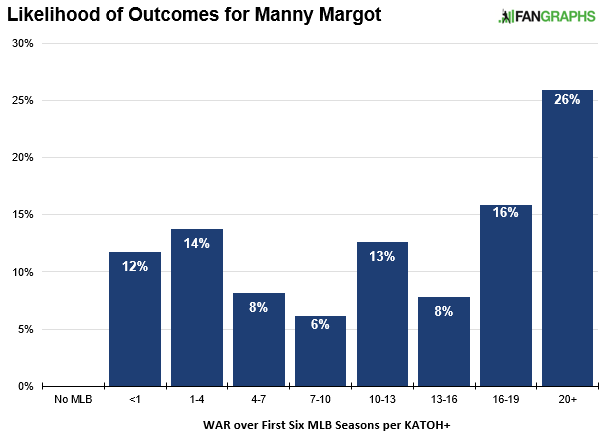
To help you visualize what his KATOH projection entails, here is a probability density function showing KATOH+’s projected distribution of outcomes for Margot’s first six seasons in the major leagues.

margot

To put some faces to Margot’s statistical profile, let’s generate some statistical comps for the speedy outfielder. I calculated a weighted Mahalanobis distance between Margot’s performance this year and every Triple-A season since 1991 in which a center fielder recorded at least 400 plate appearances. In the table below, you’ll find the 10 most similar seasons, ranked from most to least similar. The WAR totals refer to each player’s first six seasons in the major leagues. A lower “Mah Dist” reading indicates a closer comp.

Read the rest of this entry »


Projecting Oakland Call-Ups Renato Nunez and Matt Olson

On Monday, the Oakland Athletics promoted a couple of hitting prospects from Triple-A: Renato Nunez and Matt Olson. Both Nunez and Olson came off the bench on Monday to make their big-league debuts. With Billy Butler out of the picture, and Danny Valencia likely soon to follow, Nunez and Olson might see a decent chunk of playing time these next two weeks.

Olson’s numbers have trended in the wrong direction since his 37-homer season in the Cal League in 2014. He slashed .249/.388/.438 in Double-A last year and only managed to hit .235/.335/.422 in the PCL this year. Throughout his minor-league career, Olson has demonstrated good power and a willingness to draw walks. He’s also a 22-year-old with a 6-foot-5 frame, which suggests he may still have some untapped upside. But his underwhelming performance, defensive limitations and 24% strikeout rate don’t bode particularly well for his future in the show.

KATOH pegs Olson for 3.7 WAR over his first six seasons by the traditional method and 2.8 WAR by KATOH+, which integrates Baseball America’s rankings. To help you visualize what his KATOH projection entails, here is a probability density function showing KATOH+’s projected distribution of outcomes for Olson’s first six seasons in the major leagues.

Olson

To put some faces to Olson’s statistical profile, let’s generate some statistical comps for the newest Brewers prospect. I calculated a weighted Mahalanobis distance between Olson’s performance this year and every Double-A season since 1991 in which a first baseman or corner outfielder recorded at least 400 plate appearances. In the table below, you’ll find the 10 most similar seasons, ranked from most to least similar. The WAR totals refer to each player’s first six seasons in the major leagues. A lower “Mah Dist” reading indicates a closer comp.

Read the rest of this entry »


An Early Look at the Center Fielders in the 2017 Draft

This is a series of scouting thoughts on high-school prospects eligible for the 2017 MLB Draft based on observations from summer showcases. Today’s positional group is center fielders. Links to other positional groups appear below.

Previous editions: Catchers / Middle InfieldersLeft-Handed Pitchers.

Center field is a difficult position to play. It requires special straight-line speed but also the ability to read ball trajectory off the bat and hunt down said ball while making in-flight adjustments at a full sprint. As it is such a difficult position to play, not many humans are capable of it and this year’s group of high-school prospects are no different. Below are most all the prospects I’ve seen during summer showcases who I think have a prayer to remain in center field. For the uninitiated, the players who have their own sizeable sections are ranked in the order in which I’d draft them were I forced to do so today, while the players below that are just in alphabetical order.

Jordon Adell, OF, Ballard HS (KY)
Height: 6’3, Weight: 200, Commitment: Louisville

Jordon (or “Jo”) Adell has the best hit/power combination among high schoolers in the 2017 class and has a non-zero chance of playing center field. If that sounds like a player worthy of consideration in the draft’s top 5-10 picks, that’s because it is.

Read the rest of this entry »