
Counting Pitchers on My Fingers
Starting rotations have five slots.
Yes, every once in a while a team will pretend to have four or six slots, but that team must inevitably confront the truth: Starting rotations have five slots. It’s a matter of policy, preference, and just plain practicality, Mariners general manager Justin Hollander said last year in an interview with Lookout Landing.
“The unfortunate thing about the roster rules is you only get 26 spots, and you only get 13 pitchers. And when you add a sixth starter, you take away a reliever. When you add a sixth starter, sometimes your starters pitch every six days, sometimes they pitch every eight or nine days. Starting pitchers are fussy. They don’t like that. They like to stay on a regular schedule. They like to know when they’re pitching.”
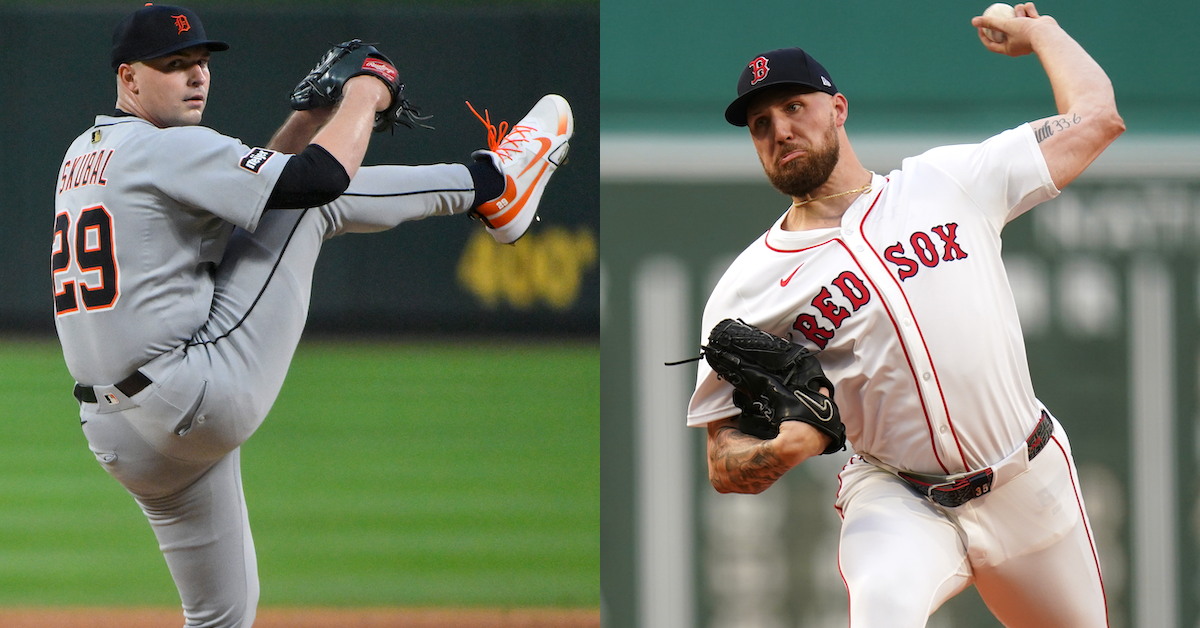
I’ve been thinking about the fixed-nature of rotations lately after reading this discussion between Eno Saris and Jen McCaffrey in The Athletic. They compare the rotations in Detroit and Boston by assigning each pitcher a label (one, two, three, four, five), sizing them up horizontally and vertically, and confronting the trade-offs in quality and depth. This reflects how many of us compare rotations in the abstract, and I wanted to see if this could be applied more broadly.
I found every pitcher in the majors projected by FanGraphs Depth Charts to make at least 10 starts in 2026, with greater than 25% of their appearances as a starter. I then ranked all the pitchers in order by projected WAR, and then filtered to include just the top five for each team.
My conclusion here is this is a bit of a sledgehammer approach to broader analysis. There isn’t anything too meaningful in the words that follow. Still, I think this is a useful illustration of how starting pitcher quality is distributed across the league, and it helps tease out the minor differences between rotations at the very top of the leaderboard.
Let’s start with the high-level takeaways:
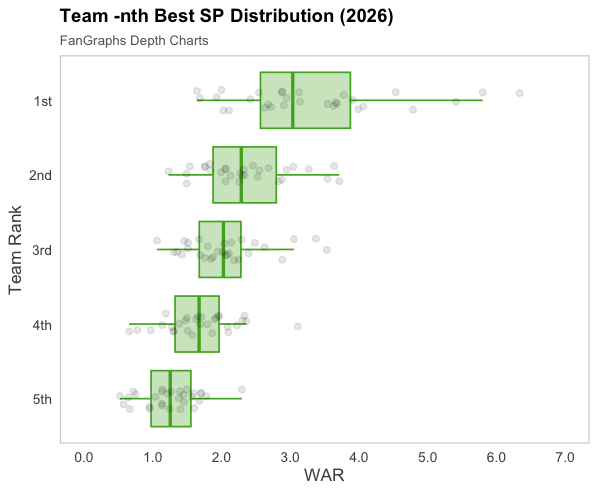
The first thing that sticks out is the distribution of “ones,” spanning nearly 5 WAR. On the high end, there are three or five pitchers separated from the pack. Tarik Skubal, Garrett Crochet, and Paul Skenes are head and shoulders above Cristopher Sánchez and Logan Webb, who are head and shoulders above everyone else. Exactly what constitutes an ace is a matter of preference, but it’s clear there exists a more exclusive tier of pitcher. On the low end, there are a handful of ones who would have long odds to crack even backend spots in deeper rotations.
The twos have a large range of projections, as well. This is somewhat important. I found the projected quality of a team’s second-best starting pitcher to hold the most signal toward that team’s year-end rotation WAR. In fact, the projection for a second starter tells us about as much as the projection for a rotation as a whole.
| Team Rank | r^2 |
|---|---|
| 1st | .248 |
| 2nd | .327 |
| 3rd | .278 |
| 4th | .165 |
| 5th | .113 |
| Top 5 | .353 |
This result is tautological more than anything. Having a solid number two (heh) means there’s at least one other great pitcher on the roster; having a weak number two (no laughing matter) means there’s at least three worse pitchers on the roster. It’s good to have more good pitchers, because having more good pitchers means there’s more good pitchers. And that’s science.
The same applies to a lesser extent with threes, but after that is where this all kind of falls apart. These slots condense and overlap and look largely indistinguishable. There simply aren’t that many starting pitchers who can stay good and healthy all season. Teams approach this uncertainty in different ways. Some turn to reliable-but-unremarkable veterans. Some turn to work-in-progress prospects. Some turn to openers and swingmen and bullpen days. Some just kind of punt. Teams often lean on each of these strategies throughout the season as attrition mounts, and such nuances aren’t easy to project.
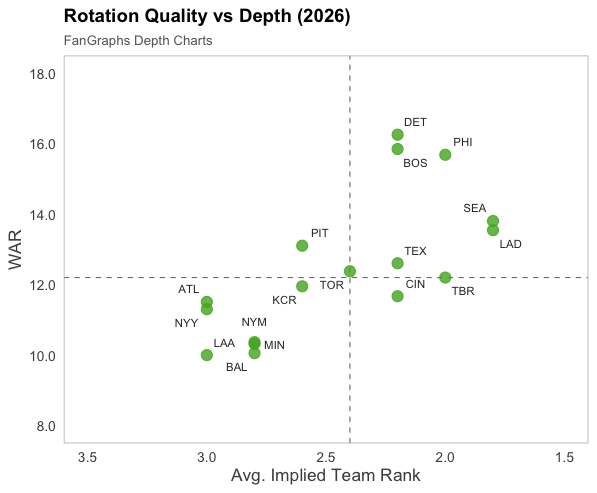
Still, some teams appear to have more depth than others. To find out who, I whipped out my trusty sledgehammer. There are five slots for each team, or 150 slots across the league; the first 30 are ones, the next 30 are twos, then threes, fours, fives, and everything after 150 is a six. The hard cutoffs make this kind of goofy — there is effectively no difference between pitcher 90 and 91 — but I do think this gives us a foot in the door on what sets the top-end rotations apart. We can see how the total projected WAR among the best quintets compare with their average implied ranking:
The Tippy Top: Tigers, Red Sox and Phillies
Yes, the Tigers and the Red Sox have the best rotations in baseball, but don’t count out the Phillies.
Skubal and Crochet are presumed to be the top pitchers in the game. We know this. But where the Tigers and Red Sox set themselves apart is in that all important second slot: Sonny Gray (10) and Framber Valdez (13) are the two best understudies in the league. There simply isn’t anything that comes close to the one-two punch in Detroit and Boston. Both teams have also done well to build out their full rotation. Ranger Suarez is essentially a third number one for the Red Sox, which gives them a narrow edge out the gate. But Jack Flaherty is a solid third option, as well, and I prefer Detroit’s duo of Casey Mize and Justin Verlander over Boston’s of Brayan Bello and Johan Oviedo. These are highly impressive rotations on paper. Well done.
| Slot | Pitcher | WAR | Ovr Rank | Implied Slot |
|---|---|---|---|---|
| 1 | Tarik Skubal | 6.3 | 1 | 1 |
| 2 | Framber Valdez | 3.6 | 13 | 1 |
| 3 | Jack Flaherty | 2.5 | 41 | 2 |
| 4 | Casey Mize | 2.1 | 63 | 3 |
| 5 | Justin Verlander | 1.7 | 92 | 4 |
| Total | Tigers | 16.2 | 42.0 | 2.2 |
| Slot | Pitcher | WAR | Ovr Rank | Implied Slot |
| 1 | Garrett Crochet | 5.8 | 2 | 1 |
| 2 | Sonny Gray | 3.7 | 10 | 1 |
| 3 | Ranger Suarez | 3.4 | 18 | 1 |
| 4 | Brayan Bello | 1.9 | 78 | 3 |
| 5 | Johan Oviedo | 1.0 | 149 | 5 |
| Total | Red Sox | 15.8 | 51.4 | 2.2 |
| Slot | Pitcher | WAR | Ovr Rank | Implied Slot |
| 1 | Christopher Sánchez | 4.8 | 4 | 1 |
| 2 | Zack Wheeler | 3.5 | 16 | 1 |
| 3 | Jesús Luzardo | 3.5 | 17 | 1 |
| 4 | Aaron Nola | 3.1 | 22 | 1 |
| 5 | Andrew Painter | 0.7 | 168 | 6 |
| Total | Phillies | 15.7 | 45.4 | 2.0 |
Still, I might take the Phillies. They aren’t too far behind the Tigers or Red Sox for third overall, this after finishing last season with by far the most starting pitcher WAR. And they have four — four! — projected ones. Cristopher Sanchez is the ace in Philadelphia these days, truly among the most prestigious monikers in baseball. His lack of track record for his age (29) limits his projection a bit, so he’s not quite in the same space as Skubal or Crochet, even if he was indeed their equal last year. Zack Wheeler will begin the season on the injured list, but he’s still assumed to be the third-best understudy in the league. The recently extended Jesús Luzardo is essentially tied with Wheeler, and former ace Aaron Nola rounds out the best top four in baseball, despite his missing a large chunk of last season and struggling when he did pitch. Now, their fifth starter is rookie Andrew Painter, who wouldn’t project in the top five for a lot of rotations, but the upside is certainly there. I’m not sure there’s a rotation with a better range of potential outcomes in 2026.
The Quality in Quantity: Dodgers and Mariners
The only other teams that could possibly have a (lesser) claim to Best Rotation in Baseball are the Dodgers and the Mariners, and for exactly opposite reasons.
The Dodgers have the top projected rotation in the majors on a per-inning basis — they just happen to be projected in the bottom five for innings from their quintet. Yoshinobu Yamamoto leads the staff as one of the 20 best pitchers in the game. His 155 projected innings pitched is on the low end among ones, which is what keeps him from being in the true ace conversation. He has proven incredibly durable since he missed nearly three months with a rotator cuff strain in 2024; he made 30 starts last year, plus another five in the postseason (and 3 2/3 relief innings). Considering this, I assume his lesser workload projection is just a touch of caution based on his limited major league track record. Depth Charts is even more cautious with what’s behind him. Shohei Ohtani, Blake Snell, and Tyler Glasnow could each lead a rotation into the postseason, but none threw 100 innings last year. Ohtani is healthy at the moment, but there’s a ceiling on his total innings projection, given his other role. Glasnow is also healthy, though the most innings he’s ever thrown in a season is the 134 he recorded in 2024, so wall-to-wall excellence would seem unlikely. And the health ship has already sailed for Snell, who will begin the season on the injured list with shoulder fatigue. Then there’s Emmet Sheehan, who was excellent in limited opportunities last year, after missing all of 2024 while recovering from Tommy John surgery. He is, by far, the best projected fifth starter in the league, and the Dodgers need him to help raise a fairly low floor.
| Slot | Pitcher | WAR | Ovr Rank | Implied Slot |
|---|---|---|---|---|
| 1 | Yoshinobu Yamamoto | 3.6 | 14 | 1 |
| 2 | Blake Snell | 2.7 | 34 | 2 |
| 3 | Tyler Glasnow | 2.6 | 37 | 2 |
| 4 | Shohei Ohtani | 2.3 | 49 | 2 |
| 5 | Emmet Sheehan | 2.3 | 51 | 2 |
| Total | Dodgers | 13.6 | 37.0 | 1.8 |
| Slot | Pitcher | WAR | Ovr Rank | Implied Slot |
| 1 | Bryan Woo | 3.5 | 15 | 1 |
| 2 | George Kirby | 3.2 | 19 | 1 |
| 3 | Logan Gilbert | 3.1 | 23 | 1 |
| 4 | Luis Castillo | 2.3 | 47 | 2 |
| 5 | Bryce Miller | 1.6 | 102 | 4 |
| Total | Mariners | 13.8 | 41.2 | 1.8 |
The Mariners are almost identically projected, with the same quintet WAR and implied slot depth as the Dodgers. But where the Dodgers model is abbreviated greatness, the Mariners are merely solid across the most projected innings pitched in the majors. Bryan Woo, George Kirby, and Logan Gilbert are each very good pitchers and viable number ones, though each are at or below the median for that distinction. They are still developing, to be fair, and it wouldn’t be surprising to see any of them individually take a step forward this year. Luis Castillo is no longer a one, but he’s settled into his 30s as steady as his nickname might suggest. And Bryce Miller could be the most talented pitcher on this roster, but the bone spurs in his arm are still there. Of course, Miller reflects the great irony with Seattle’s rotation projection: Four of the team’s top five spent significant time on the injured list last season, so this medium-quality, high-quantity strategy feels a bit precarious. But we’ve seen this exact group post a top-five season in the past, and it’s not unreasonable to think it could do it again.
The Best of the Rest: Rangers, Blue Jays, Rays, Reds, and Pirates
OK, speed round. The Rangers rotation is bizarre. They have three ones, with Jacob deGrom at the top. But deGrom and fellow one Nathan Eovaldi each come with age and injury baggage. That puts a lot of pressure on the newly acquired MacKenzie Gore, as well as former top prospects Jack Leiter and Kumar Rocker to take a step forward. The potential for this rotation to do something great is absolutely there, but the odds seem a bit longer than the teams ahead of them.
The Blue Jays rotation is much improved with Dylan Cease and Kevin Gausman leading the way. Like the Rangers, I could see this group putting together a fantastic season; Cody Ponce and Trey Yesavage could push the Toronto staff to the top of the league. But like the Rangers, the odds seem long on the backend, and I have very little faith in Max Scherzer, José Berríos or Shane Bieber to fill out whatever innings remain.
I really like the Rays rotation, and they have a lot of higher quality depth without a true ace (even if I expect Drew Rasmussen to challenge that notion). But much of their projection is coming from Shane McClanahan, who hasn’t started a big league game since 2023. I’m some weird mix of optimistic and skeptical. The return to Tropicana Field should help.
The Reds rotation is great when Hunter Greene is healthy, but he’s going to be out until July with an elbow injury. The rest project as twos, which is still quite impressive.
The Pirates have Paul Skenes.
| Team | WAR | Ovr Rank | Implied Slot |
|---|---|---|---|
| DET | 16.3 | 42.0 | 2.2 |
| BOS | 15.8 | 51.4 | 2.2 |
| PHI | 15.7 | 45.4 | 2.0 |
| SEA | 13.8 | 41.2 | 1.8 |
| LAD | 13.5 | 37.0 | 1.8 |
| PIT | 13.1 | 63.4 | 2.6 |
| TEX | 12.6 | 56.6 | 2.2 |
| TOR | 12.4 | 54.4 | 2.4 |
| TBR | 12.2 | 51.2 | 2.0 |
| KCR | 12.0 | 61.6 | 2.6 |
| CIN | 11.7 | 50.6 | 2.2 |
| ATL | 11.5 | 72.6 | 3.0 |
| NYY | 11.3 | 69.2 | 3.0 |
| NYM | 10.4 | 69.0 | 2.8 |
| MIN | 10.3 | 73.0 | 2.8 |
| BAL | 10.1 | 76.2 | 2.8 |
| LAA | 10.0 | 77.6 | 3.0 |
| SFG | 9.9 | 102.8 | 4.0 |
| MIA | 9.5 | 84.6 | 3.2 |
| ARI | 9.4 | 80.8 | 3.4 |
| HOU | 9.4 | 97.6 | 3.8 |
| CHC | 9.0 | 87.8 | 3.4 |
| SDP | 9.0 | 94.4 | 3.4 |
| MIL | 8.9 | 95.6 | 3.4 |
| CLE | 8.6 | 97.4 | 3.8 |
| ATH | 8.2 | 101.2 | 4.0 |
| STL | 7.0 | 118.4 | 4.6 |
| CHW | 6.7 | 124.6 | 4.6 |
| WSN | 6.7 | 123.2 | 4.4 |
| COL | 5.5 | 141.4 | 5.2 |
Ryan Blake is a contributor for FanGraphs and Lookout Landing.
Astros have so much depth in their rotation that I can see them being top 10 by the end of the season. True ace, Imai has ace level stuff, Burrows can be a mid-3.00 era guy, if Cristian Javier can knock off the rust then he’s a true no. 2, etcetcetcetc. Weiss has + stuff and AJ Blubaugh really showed off in September of last year. McCullers is a wild card at best and Spaghetti showed promise in the 2nd half of 2024 and just had a freak accident in 2025, so his season ended before it even got started. They should get TJ recipients back in Blanco, Walter and Wesneski by the ASB for additional depth, but again, wild cards. TLDR; A No. 1, a bunch of no. 2’s, and some 3-5’s in there.