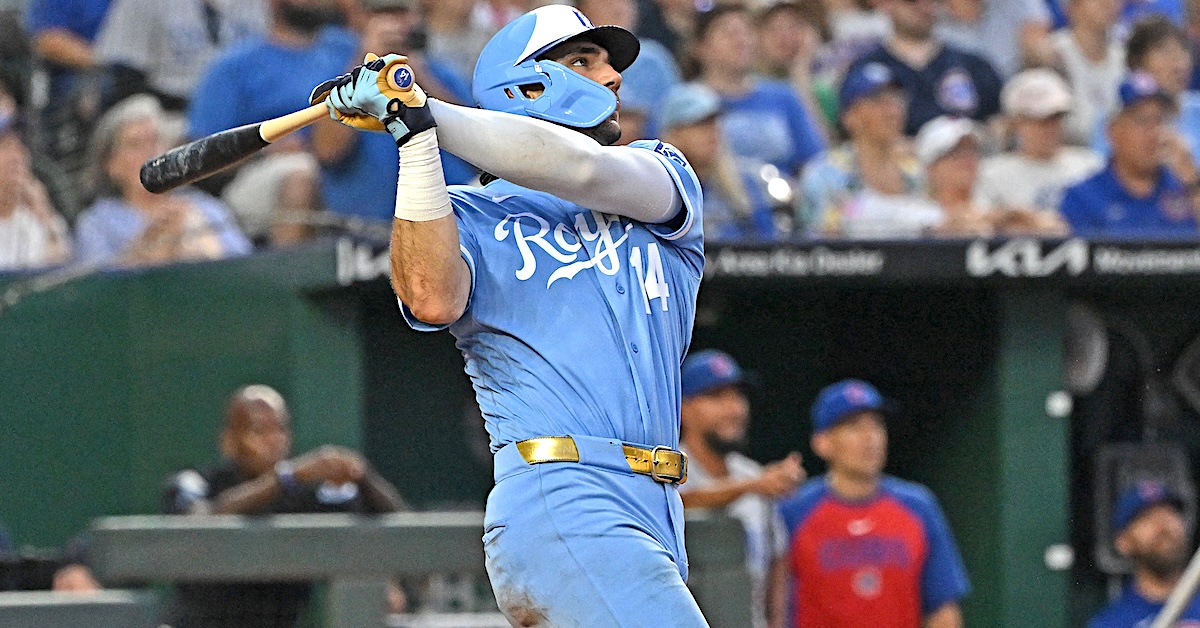
Jac Caglianone’s season doesn’t stick out. He doesn’t lead the league in any important statistics. He’s not likely to reach any significant thresholds. He hasn’t completely overhauled his profile. No, his season isn’t that much more interesting than that of any other 2-WAR batter. But for Caglianone, boring is good.
That’s unfortunately a testament to just how bad the Royals’ towering slugger was last year. He couldn’t hit, posting a 47 wRC+. He couldn’t play right field, with -7 OAA. He couldn’t stay healthy, missing about a month with a hamstring strain. He accumulated -1.6 WAR over 62 games. It was one of the worst rookie seasons of the century. Read the rest of this entry »
The hottest pitching prospect in baseball joined the coldest pitching staff in baseball over the weekend.
Mariners left-hander Kade Anderson was solid in his major league debut on Saturday. The Cubs weren’t the softest landing, entering the day as the best lineup in the majors with a 111 wRC+. But the top prospect kept the Chicago batters off balance for five innings, striking out five with minimal resistance. Manager Dan Wilson left Anderson in to face the top of the order for a third time to begin the sixth — a controversial decision, but perhaps a necessary one given Seattle’s pitching implosion over the last two months — and he was quickly slugged out of the game. It was a sour note to end an otherwise strong debut, although dogpiling with his new teammates following a walk-off home run by Randy Arozarena certainly improved the mood.
The Mariners took Anderson third overall out of LSU last year. He got his first taste of pro ball this spring and blew through the competition in Double-A, posting a 1.06 ERA, a 1.78 FIP, a 40.5% strikeout rate, and a 3.9% walk rate over 93 1/3 innings. He made it as high as third overall on our Top 100 Prospects list, definitively the best pitching prospect in baseball at the time of his debut. He might have been called up sooner, but, well, I’ll get to Seattle’s pitching mess soon enough. Read the rest of this entry »
CJ Abrams’ ambitions as a fielder have fallen short, but the future remains bright for the Nationals star.
Washington over the weekend announced Abrams will move from shortstop to second base. That’s not a surprise. Abrams has been terrible at shortstop for his career, ranking as one of the worst fielders ever recorded by Baseball Savant’s fancy player-tracking technology. What is a surprise, however, is that a minor-career update for Abrams is newsworthy enough to justify an article, a testament to his tremendous breakout at the plate in 2026.
Abrams this year has posted -17 Outs Above Average at shortstop, which is the worst mark in the majors at any position. This isn’t an outlier for him. Since his debut in 2022, Abrams has played almost exclusively shortstop, putting up OAA marks (chronologically) of -8, -9, -18, and -11 before the -17 mark so far in 2026. His career -64 OAA makes him the sixth-worst fielder — at any position — ever recorded by the system, which dates back to 2016. Read the rest of this entry »
The Dodgers are not the best team in baseball right now.
It’s been a tough go of late for the team supposedly breaking the sport. The Dodgers began August with a seven-game losing streak, and they’ve played two games below .500 since the All-Star break. They just dropped three of four to the Brewers over the weekend, ceding their standing as the top team in the majors.
Most slumping teams are slumping at the plate, and that’s certainly the case for the Dodgers. Their 93 wRC+ in the second half ranks 18th in the majors, after reaching the All-Star break with a best-in-show 115 wRC+. Their walk rate has dropped about three points, and their slugging percentage has dropped about 30 points. They’ve really struggled to get runners on, and when they do, the threat often ends in a popup or double play — sometimes even both. Read the rest of this entry »
The Padres got the second-best pitcher traded by the Tigers at the deadline.
On Monday, Casey Mize was traded from Detroit to San Diego in exchange for pitching prospects Kash Mayfield and Jackson Wolf. The Padres also got minor league infielder Gage Workman in the deal.
Mize has been exceptional in 2026… when healthy. He’s posted a 2.70 ERA and 2.58 FIP in 86 2/3 innings. His 2.9 WAR is already a career best. He’s thrown strikes, missed bats, and kept the ball in the ballpark. He looks very much like the pitcher the Tigers were hoping to get when they drafted him first overall way back in 2018.
Unfortunately, Mize has also looked like the pitcher the Tigers ultimately got — or didn’t get — since his debut. He missed a few weeks in May with an adductor strain, and a few more weeks in June with adductor inflammation. Those trips to the injured list were the fifth and sixth of his career. He missed most of 2022 and all of 2023 while recovering from Tommy John surgery, and missed time with less significant hamstring injuries in 2024 and 2025. Mize exits Detroit having thrown just 526 2/3 innings over 105 outings spread across seven years; he’ll be a free agent this offseason. Read the rest of this entry »
Taylor Ward walked his way back across the country.
In a trade on Monday ahead of the 6 PM ET deadline, the Orioles sent Ward to the Mariners in exchange for Alex Hoppe and two minor league pitchers, Brock Moore and Harrison Kreiling. Ward leads the American League in walks (second in the majors only to James Wood) and satisfies Seattle’s need for a right-handed bat to even out a lopsided lineup. Baltimore in turn gets a trio of work-in-progress arms to aid in what appears to be a bit of a reset.
Ward has completely reinvented himself at the plate in 2026 after being traded to Baltimore over the offseason. For years in Anaheim, the outfielder profiled as a three-true-outcomes hitter, mixing slug-and-whiff with a discerning eye to produce at an unspectacular, but above-average clip. Last year, he mashed 36 homers and struck out 26.4% of the time, good for a 117 wRC+.
This year, Ward has an identical 117 wRC+ but has gotten there in a fundamentally different way. His walk rate has leapt from an already strong 11.3% last year to 17.2% this year — fourth best in the majors. He also cut his strikeout rate to 20%, giving him one of the best BB/K ratios in the majors at 0.84. The tradeoff has been a massive drop in ISO, to a career-low .100. A year after slugging 36 homers, Ward is pacing for 10.
Back in June, Ben Clemens wrote a great piece outlining the how and why for Ward’s changes in 2026. The how is he’s simply stopped swinging. Ward has always had a great eye, but this year he’s combined it with an aggressive form of discipline. His 34.3% swing rate is among the lowest in the league. He doesn’t swing at balls (15.3% is the lowest in the majors), and he doesn’t swing at strikes (51.8% is second lowest). He doesn’t swing when ahead in counts or behind. He doesn’t swing at the slow and bendy stuff, and he doesn’t even swing at middle-middle fastballs. Pitchers have yet to figure out how to throw him strikes consistently, and Ward has forced them into deep counts that have generally worked in his favor.
The why is Ward is swinging much slower this year. His 68.4-mph average bat speed ranks in the bottom 10% of the majors and is down from an already-slow 69.5-mph average swing last year — one of the largest drops of 2026. As Ben notes, this slower swing has meant being later on fastballs and less likely to pull the ball in the air. That’s capped Ward’s power potential and forced him toward this new, extreme approach. It’s not all bad, though. This slower swing has kept Ward from whiffing, and his 5.9% swinging strike rate is a career low, helping him spoil pitches in those deep counts. He’s also squaring up the ball at a career-best 34.2% of swings. He’s hitting a lot more high-quality low line drives to all fields and supplementing his walks with a .310 BABIP (compared to .257 in 2025).
Ward is an ideal fit for the Mariners. Their lineup has been mediocre in 2026, with a 101 wRC+ a year after finishing second in the majors with a 113 wRC+. While they’ve hit better and worse depending on the month (definitively “worse” the last six weeks), they’ve always struggled to hit lefties. Their 91 wRC+ against southpaws is 25th in the majors. They seemed to identify this as a weakness in the offseason, bringing in one of the game’s great lefty mashers in Rob Refsnyder. But Refsnyder has a 33 wRC+ and -1.0 WAR this year while battling a pair of knee injuries. Between that performance, the cratering of Cal Raleigh, and a generally lefty-heavy lineup, the Mariners have been highly susceptible to aggressive bullpening from opposing managers. More than a few teams have reworked their pitcher schedules to force the Mariners onto the weak side of their platoon.
Enter Ward: He has a 141 wRC+ against lefties this year and a 130 wRC+ for his career. He’s walked in 20.3% of his plate appearances against lefties in 2026 while only striking out in 18.8% of them. He’s not limited to a strict platoon, with a 108 wRC+ against righties both this year and for his career. This gives the Mariners an ideal mix of an everyday bat while also someone they can slot into the top of their lineup — likely the very top of their lineup — against lefties.
It’s not quite clear where Ward will play defensively. He’s been a left fielder exclusively since 2022, but the Mariners already have Randy Arozarena playing left in the midst of a career-best season, and they have Dominic Canzone in right, also having a career year. Neither is particularly good defensively, though Ward doesn’t represent a clear upgrade himself, with -1 OAA in 2026 and -3 OAA going back to last year. My sense is Ward will do a good amount of DHing while occasionally spelling Arozarena and Canzone in the corners.
With this trade, the Mariners are signaling that the 2026 season is not lost yet, which wasn’t quite clear after they dealt starting pitcher Luis Castillo to the White Sox over the weekend. “Disappointing” is an understatement for their season to date, one they began as arguable favorites in the American League. They’ve reached the deadline at 55-58, having already fired a hitting coach and with fans clamoring for more heads to fall.
Still, they remain just three back in the league’s worst division and two back of the Wild Card. I wrote just last week that the Rangers had taken over the top odds to win the AL West, then proceeded to get swept over the weekend by the Astros, who have snatched the top odds for themselves. Neither team is too formidable, with the Astros having one of the worst pitching staffs in the league and the Rangers displaying a more general mediocrity. The Mariners have far and away the best Pythagorean record in the division at a mere +3 run differential. A week or two of hot play is all it would take to make them favorites again. That seems likelier now with Ward in the lineup.
Hoppe is the most imminently relevant pitcher in the deal. He’s posted a 5.79 ERA as a rookie out of the Seattle bullpen this year while bouncing back and forth between Triple-A. There is some clear upside, as he has a 2.88 FIP with a solid 27.6% strikeout rate, and he’s also allowing just 0.64 HR/9. He throws a four-seamer that averages 97.9 mph and an impressive, biting slider that’s generated whiffs on 41% of swings this year. At 6-foot-6 with over the top arm action, Hoppe often looks the part of a future bullpen ace, even if his command has limited him to a fringe big leaguer thus far.
Moore, 26, is a righty reliever who dominated Single-A hitters this year with a 58.2% strikeout rate and a 5.5% walk rate in 16 innings. Since being promoted to Double-A, however, his long-standing issues with command have returned, now with a less impressive 33.7% strikeout rate and a 16.3% walk rate. Brendan Gawlowski noted Moore’s boom-or-bust potential in our Mariners Top 25 Prospects List this year:
“Moore touches triple digits and his slider flashes plus, but he’s a stiff athlete with a big head whack and bigger control problems.”
Kreiling, 24, was a 17th-round pick by the Mariners out of Nebraska in 2024, and he underwent Tommy John surgery before making an appearance professionally. He returned to the field this year and has made four starts, with 16 strikeouts and one walk in 10 2/3 innings. His fastball sits between 94-96 mph from a clean, moderate-effort but repeatable delivery. He also throws a cutter, a changeup, and a projectable slider. Brendan notes that Kreiling, who went unranked on the preseason prospects list, will likely receive a 35+ grade in the future, though he profiles as a reliever going forward.
It’s an ultimately a fine deal for a decent rental bat. The Mariners help even out their lineup while dealing from their strength of fringy arms with great stuff. And the Orioles get some fringy arms who could help them now and later.
A year after a massive deadline sell, the Twins have turned into tepid buyers.
First, on Thursday, they acquired lefty reliever A.J. Minter in a swap with the Mets; then, the next night, they traded with the Orioles for righty starter Dean Kremer. Neither deal is Earth shattering on its own, but together the trades underscore Minnesota’s surprising position with two months left to play in 2026. The team enters Sunday’s rubber match against the Mariners at 56-56, just three games behind the White Sox in the AL Central and tied with the Guardians for the final Wild Card spot.
Minter gives some length to the shallow Twins bullpen. The group has a 4.87 ERA — fifth worst in the majors this year. He joins the team with a 2.35 ERA in 23 innings and figures to see plenty of medium- and high-leverage opportunities, as the lefty counterpart to righties Andrew Morris and Yoendrys Gómez in the late innings. Read the rest of this entry »
We have some movement in the race between immovable objects.
The Rangers on Monday capped a four-game, wraparound series win over the Mariners to take what feels like a commanding 2 1/2-game lead over them and a two-game lead over the Astros in the AL West. Texas followed that up by dropping a series to the AL-best Rays, while Seattle dropped a series from the NL-best Dodgers and Houston swept the Angels. Entering Friday’s action, the Rangers lead the Astros by a half game and the Mariners by 2 1/2 games. That’s how it’s gone for the league’s most languid division in 2026.
Monday’s win gave the Rangers a 7-3 record against the Mariners on the year, securing Texas the tiebreaker should that become relevant in late September. Meanwhile, the Rangers head to Houston this weekend for a three-game set with the Astros currently holding the tiebreaker, 6-4. A Texas sweep in the road series would give it the head-to-head advantage against both of its AL West rivals. If not, things could get even more interesting come the final week of the season.
Even so, our Playoff Odds aren’t expecting the Texas-Houston tiebreaker to matter too much. That’s because, for the first time in 2026, the 55-54 Rangers look like the favorites to win the division.
There’s still a chance Tarik Skubal pitches for the Detroit Tigers in the postseason this year.
Trading Skubal before the 2026 deadline makes sense for the Tigers. I think that’s pretty well established. Detroit has a losing record, less than one-in-three odds to make the playoffs per our odds, and one of the best players in the league on an expiring deal. This is the ideal trade deadline scenario.
But things have become more muddled in recent weeks. The Tigers are hot, having gone 25-16 since June 1. They finally look like the team we projected to win the AL Central before the season began. Still, they’d need to go 9-2 to even reach the deadline with a .500 record, underscoring the depth of the hole they dug early in the year. With less than two weeks before this crucial decision point, the Tigers have stumbled upon a universal truth: Being alive is complicated.
The Tigers’ season started well enough. They snuck out of April with an even 16-16 record and a positive run differential. They even began May by taking two of three from the Rangers. But on May 4, Skubal landed on the IL with loose bodies in his elbow, the latest in a string of injuries to the rotation. They lost that night and began a brutal 4-21 stretch that saw them sink to the worst record in baseball by the end of the month.
It wasn’t really the absence of Skubal that was the issue, as Jay Jaffe wrote at the time. In May, their batters posted a league-worst 69 wRC+ — nobody hit fewer homers, and only the Angels struck out more. When the offense did manage a lead, it was quickly given up by a shallow bullpen, which turned in 24 meltdowns in May. There aren’t many enjoyable brands of losing baseball, but slogging through a 1-0 game only to implode at the end is among the most frustrating. Attention understandably turned to Skubal’s return, and his seemingly inevitable departure at the deadline.
Then the calendar flipped to June. The Tigers began the month with a sweep of the first-place Rays, scoring 25 runs on 10 homers in three games, and they haven’t cooled since. Their 109 wRC+ in the last 41 games is top 10 in baseball, and their 72 homers are the most of any team. The lineup now has one of the best trios in the majors. Dillon Dingler (4.6) and Kevin McGonigle (4.0) each rank in the top 10 by WAR, and Riley Greene (2.8) ranks in the top 30. Colt Keith is on a hot streak, smacking eight homers since June 1 after going the first two months of the season without hitting any. The Tigers also just got Gleyber Torres and his 127 wRC+ back from an oblique injury on Monday. It’s suddenly a good, competitive lineup.
The bullpen has also been better of late. Their 3.19 ERA since June 1 is fifth in the majors. It’s a shallow group, and the end of games can still feel a bit dicey while closer Kenley Jansen runs a walk rate (14.7%) nearly double his career mark (7.9%). But the offense finally scoring a few runs has helped alleviate some of the pressure. In May, the Tigers bullpen faced the sixth-highest Leverage Index when entering games; since June 1, they’ve faced the lowest of any team. Again, it’s not a great bullpen, and this is likely the area the Tigers will want to address at the deadline assuming they add. But they’re asking less of them these days.
A competitive lineup and bullpen is all the Tigers should need with their rotation, which has allowed the fewest runs in the majors over this hot stretch. But that’s where the narrative of this article and the Tigers’ season recently became more complicated. Casey Mize pitched on Sunday, looking to continue his breakout season (his 2.79 ERA and 2.62 FIP would each be career bests), but he left the game early with the same groin tightness that’s landed him on the IL twice this year; he’s now day-to-day. Jack Flaherty pitched on Monday, hoping to build on a month-long hot streak (a 2.67 ERA and 3.25 FIP in seven starts since the beginning of June); he pitched poorly and was placed on the injured list with right flexor inflammation after the game. On Tuesday, Framber Valdez couldn’t make it out of the first inning in what ended up being an 11-2 blowout loss to the Cubs; he’s not known to be hurt, but he’s having the worst full season of his career, with a 4.57 ERA and 4.16 FIP in 20 starts.
Still, this has been one of the best rotations in the majors all season, even as they’ve dealt with injuries and inconsistency. They could still be that going forward… assuming Skubal remains their ace. He’s been great. He had solid numbers in seven starts before the IL stint (2.70 ERA and 2.11 FIP), he’s had solid numbers in seven starts after the IL stint (2.97 ERA and 3.66 FIP), and I assume he’ll have solid numbers the rest of the year, regardless of who he’s pitching for. He has been a little homer-prone, allowing 1.09 per nine innings, compared to 0.71 between 2022 and 2025. But his stuff and command metrics look the same as ever, and he hasn’t given up more hard contact or barrels overall. I’ll give him the benefit of the doubt and assume it’s a sample-size blip, though it’ll certainly be something teams assess ahead of the deadline.
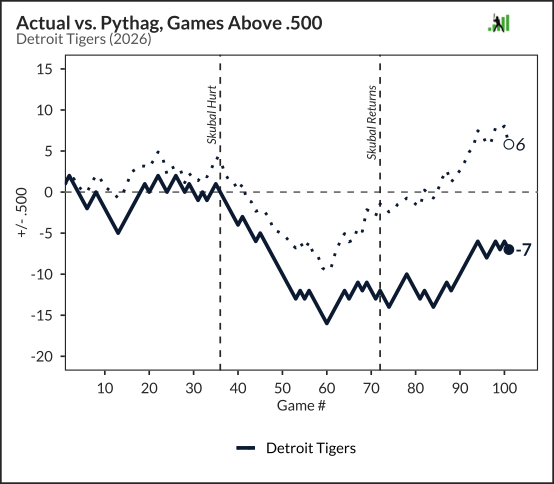
Again, while Skubal’s absence wasn’t the Tigers’ main issue in May, we can see they’ve largely played like a playoff-bound team the days he’s been on the active roster:
We can also see the Tigers have maybe been a bit unlucky to this point. They are six games under their pythagorean record — the largest discrepancy in the majors this year. That’s driven in part by a 10-17 record in one-run games. In games decided by more than one run, they’re an even 37-37 with a +31 run differential; they’re 20-12 with a +62 run differential since June 1. And so the Tigers seem to be better than their record would indicate, and they are indeed gaining ground. But at 6 1/2 back of the Guardians and White Sox in the Central, and five back of the Red Sox for the third Wild Card, they’re running out of time to make this a legitimate playoff push.
The Tigers must weigh what that long-shot postseason push is worth. They have a young, team-controlled core that could be competitive for years to come. Trading Skubal could obviously help add to their future ambitions. They also don’t technically need Skubal to get to the 2026 postseason. They’d still have an above-average rotation without him (depending on the health of Mize and Flaherty), and some of the players they’d get back in a trade could potentially help them this year. Plus, even if they do get to October with Skubal, it doesn’t guarantee they’ll advance — the Tigers lost both games he pitched in last year’s ALDS. Holding on to such a potentially valuable trade chip only to narrowly miss the postseason or suffer an early exit could generate some hard feelings and hot seats.
Still, this is a legitimate chance for the Tigers. This is the bird in the hand. It’s a fairly important bird, too. Skubal probably doesn’t have the longevity in Detroit to be considered the “best” pitcher in franchise history, but he’s the rare, era-defining player — one still largely in the prime of his career. This is the type of chance a front office typically builds toward, not away from. A late-season comeback and a deep playoff run on the shoulders of a franchise icon has to be worth something beyond long-term efficiencies in team building. And the Tigers will likely extend Skubal a qualifying offer this offseason, meaning they’d at least receive an extra draft pick should he sign elsewhere (assuming the system remains the same under the new CBA, of course). Sure, their midseason stumble raises questions about the team’s potential in 2026, but it should also raise questions about its potential in 2027 and 2028 and 2029. Nothing is guaranteed in baseball, especially when a player like Skubal walks out the door.
The first deal of the 2026 trade deadline was interesting more than it was important.
On Wednesday, the Astros sent Lance McCullers Jr., Colton Gordon, and cash considerations to the Brewers in exchange for Jadyn Fielder, the son of Prince Fielder. The Athletic’s Chandler Rome described the deal as a “salary dump” for Houston, noting that owner Jim Crane convinced McCullers to waive his no-trade clause to help the team manage its budget and roster. The Brewers were happy to oblige, adding depth and taking on a new pitcher project, parting with the son of a franchise legend to do so.
The deal marks the end of an era in Houston. The Astros drafted McCullers 41st overall in 2012, the same year they took Carlos Correa first overall. He developed right alongside the Astros as they progressed from tankers to titans, often serving as an exemplar for their forward-thinking pitching strategy. Nobody threw a higher rate of curveballs (44%) from 2015 through 2018 than McCullers, even going so far as to throw 24 straight curveballs to close out a four-inning save in Game 7 of the 2017 ALCS. Read the rest of this entry »