
FanGraphs Weekly Mailbag: February 21, 2026
The most consequential transaction (if you can call it that) in baseball this week was the resignation of Tony Clark as the executive director of the Major League Baseball Players Association. Clark, who had been the head of the union since 2013, stepped down after an internal investigation revealed that he’d had an “inappropriate relationship” with his sister-in-law, who had been hired to work for the union in 2023. The MLBPA elevated deputy executive director and lead negotiator Bruce Meyer into the top spot on an interim basis. The timing of the move is far from ideal, coming less than 10 months before the current collective bargaining agreement expires at 11:59 p.m. ET on December 1, at which point the owners are expected to promptly lock out the players for the second time this decade. Still, as Michael Baumann wrote on Tuesday, it’s an even worse time for the union to have leadership that its membership doesn’t trust. Beyond the “inappropriate relationship,” Clark is one of the subjects of a broader ongoing federal probe into both the MLBPA and the NFLPA over financial dealings related to the group licensing firm OneTeam Partners, and was the subject of a November 2024 whistleblower complaint alleging him of misusing union resources, self-dealing, and abuse of power. His departure allows the players to better coalesce around their shared priorities.
In lighter news, 12 teams played their first spring training games on Friday, providing us with a perfect opportunity to watch some of the players we covered during Prospect Week. If you tuned in to the Mariners-Padres game, for example, you would’ve seen four of our Top 100 Prospects — including shortstop Colt Emerson (no. 11), center fielder Jonny Farmelo (no. 51), right fielder Lazaro Montes (no. 66), and second baseman Michael Arroyo (no. 78) — in action, all playing for Seattle. The 21-year-old Arroyo (a 50-FV prospect) smoked a two-run homer to right center field on an 0-2 changeup that caught way too much of the plate. He doubled his next time up and finished the day 2-for-2. There are 16 games slated for this afternoon.
We have more labor talk to come in this mailbag, but that’s the last we’ll say about the start of spring training games. Instead, we’ll be answering your questions about quantifying the pitcher-catcher relationship, the looming lockout, how teams perform after significant roster turnover, and more. Before we do, though, I’d like to remind you that this mailbag is exclusive to FanGraphs Members. If you aren’t yet a Member and would like to keep reading, you can sign up for a Membership here. It’s the best way to both experience the site and support our staff, and it comes with a bunch of other great benefits. Also, if you’d like to ask a question for an upcoming mailbag, send me an email at mailbag@fangraphs.com.
Matt is the associate editor of FanGraphs. Previously, he was the baseball editor at Sports Illustrated. His work has appeared in The New York Times, Men’s Health, Baseball Prospectus, and Lindy’s Sports Magazine. Follow him on Twitter @ByMattMartell and Blue Sky @mattmartell.bsky.social.
I don’t get it why they can’t just do a 1 year memorandum of understanding to see if they can arrive at a agreement before doing a lockout. Yes a lockout puts the maximum possible pressure but it’s a blunt instrument similar to striking that both sides should seek to avoid and at the very least hammer out deals where they can be made on some items before there is a stoppage of play. For context I’ve been involved in much less complicated collective bargaining from the side of management and am currently involved with five bargaining units. Some of the agreements we would like to fundamentally rewrite for multiple reasons (one of which the base agreement is ancient) and our approach has been to offer a one year extension and see if we can negotiate on some of the minutiae and then next year do a complete rewrite though obviously keeping elements from the previous agreement. Dealing with some of the lesser issues or issues we can come to agreement on gives everyone including the unions involved a keg up on the future session which will be much more complicated and where there will likely be some stark disagreements. We’ve been clear and totally transparent with the unions about it. In the case of MLB they could do the same but also work on the more thorny issues with the players union knowing that they would face a lockout if the fail to reach an agreement for the following season.
Because the owners think they can break the union and get a cap if they threaten to cancel games. The threat of canceling games is integral to their strategy. (I don’t know if they’re willing to actually cancel games, I guess we will find out)
I don’t know for sure about the history of your side’s relationship with the unions. But it sure sounds like it is less antagonistic. MLB seems extremely reluctant to be clear and transparent with the MLBPA about anything. And although things have been way better since the 1990s the history of collusion in MLB really poisoned that relationship.
“On the positive side, a history of incompetence & collusion gets you into Cooperstown!”
~Bud Selig
His record is awful.
He and Reinsdorf led the collusion which led to them losing three different grievances.
In response, the owners tried to lock out the players to force them to accept the things they had tried to accomplish with the collusion. Fay Vincent managed to get an agreement so no games were canceled.
The owners paying paid the players $280M to settle, which is almost $700M in today’s money. Then they fired Vincent because they were mad about the failure to lock out the players.
Then they appointed Selig to be the interim commissioner, robbing them of an actual leader during the labor negotiations. Under his leadership, they introduced a totally new system and didn’t ever really come off of it. Then they deliberately failed to make a payment that was required under the CBA. They did this in the season and while the CBA was still in effect.
And because of this the players walked off the job, which nearly destroyed the finances of a few major league baseball teams and turned off an entire generation of baseball fans. The Expos franchise completely collapsed, and Selig later presided over the plan to contract the Expos and Twins, an incredibly foolish plan that was only aborted because they lost a court case because of the Twins’ lease at the metrodome.
And then after they lost the strike Selig wound up turning a blind eye to PEDs because the home run chase saved baseball from total oblivion.
And that’s not even everything. Just an incredible record of doing damage.
I think nobody really negotiates in earnest until the deadline looms, so that’s just kicking it down the road a year. I also think the owners don’t want to be “clear and totally transparent,” especially if a cap is involved since being opaque about revenues is to their advantage when determining where the cap is set.
I believe the players are dead set against a cap, but I also believe it is the owner’s number one priority and they are willing to lose games or a whole season to get it, although Baumann is obviously a lot more plugged in than I am. I also don’t believe Nutting, Fisher or any of their colleagues are really cash strapped. They are just cheap and can get by much more easily than most players with no MLB revenue coming in. According to a quick google search, Nutting has a net worth just over a billion dollars and Fisher is triple that. They aren’t going to be missing any payments on their third vacation hoses if there is no baseball in 2027.
It would be August, at the absolute earliest, before Fisher realized the A’s hadn’t played any games.
I’m not sure the owners are willing to lose an entire season – thinking about the Covid season, the owners pushed as hard as possible to reduce the number of regular season games of possible, but desperately wanted the post season to go ahead.
I might be wrong about this, but the small market owners who want the salary cap the most also seem to have the most to lose from an entire lost season – as a larger fraction of their wealth is tied up in the franchise value, and a lost season would damage that quite a lot.
(I do find it darkly amusing that the owners who are demanding a salary cap would also be (among) the first to decry if someone suggested that it might be good for the fairness of society if there was a wealth/asset cap.)
You may be right and I definitely agree with your last paragraph.
One important thing to remember is that the players make their money during the regular season and the owners make their money during the playoffs. That’s why we have lockouts instead of strikes. If the owners let the players dictate, they strike in September after they have gotten their paychecks, but before ownership rakes in the big bucks. So the owners preemptively lock out the players. This also explains why the owners bargained in bad faith in 2020. They knew that delaying and shortening the regular season was to their advantage.
“I think nobody really negotiates in earnest until the deadline looms” This is the correct answer in a contentious negotiation, especially if one side wants more than minor changes.
“being opaque about revenues is to their advantage when determining where the cap is set”
The MLBPA already receives quite a lot of club financial information. It’s covered on pages 159-161 of the CBA. The particular focus is revenue: this section of the CBA covers the revenue sharing plan. The information provided includes, though, audited financial statements of each team. Financial statements definitionally include a full income statement (revenue, expenses, net income). https://www.mlbplayers.com/_files/ugd/4d23dc_d6dfc2344d2042de973e37de62484da5.pdf
Additionally, the NFL, NHL, and NBA salary caps are all structured as % of revenue, which of course needs to be defined in detail as part of an agreement. Google “basketball-related income” for the NBA, for example. It should not be a surprise to anyone, including the owners, that confirmation/audit of revenue would be part of a salary cap/floor system.
The bigger structural issue is that I don’t see how MLB could have a workable, meaningful salary cap/floor system unless the teams make significant changes around revenue sharing and how they handle local media revenue/rights. I think change on the latter is probably coming at some point anyway, because I’d be shocked if revenue trends on RSN/local streaming are good even in large markets. Those will be complicated issues to work through, though, and it seems that financial distress hasn’t yet hit the big market RSN’s to force the issue. Plus the existing national rights deals are in place through 2028. So I don’t see the owners resolving that stuff among themselves by 2027.
This is part of why I said a one a year extension might make the most sense. It’s going to take some time for the clubs to agree internally on any proposals especially if it involves changing revenue sharing in proposals. There is going to be factions. They definitely will want a harder cap. Maybe they copy the NBAs current version that we have seen has a huge impact even though it’s not a hard cap. Maybe the copy the nfls hard cap. It would be easier to get agreement with the union on an NBA style cap. The current structure is largely copied from the previous NBA version with some twists. It seems more likely that the league wants a hard cap. (Bleeping Dodgers ). If that’s the case there needs to a salary floor and that gets into revenue sharing and that’s where the teams will struggle to come to an agreement amongst themselves. It’s hard to negotiate in a timely manner when there are significant internal disagreements on one side. I get it why it’s uncommon but there are basically two separate negotiates one with the union and the other with the various clubs. I’ve been involved in simpler negotiations where there was a lot of internal disagreements on management’s side and it’s led to drawn out negotiations because it would take a while for management to come to agreements amongst themselves and the internal vote factions would changing. Highly frustrating
I only have one vacation hose and it’s a 50-footer 🙁
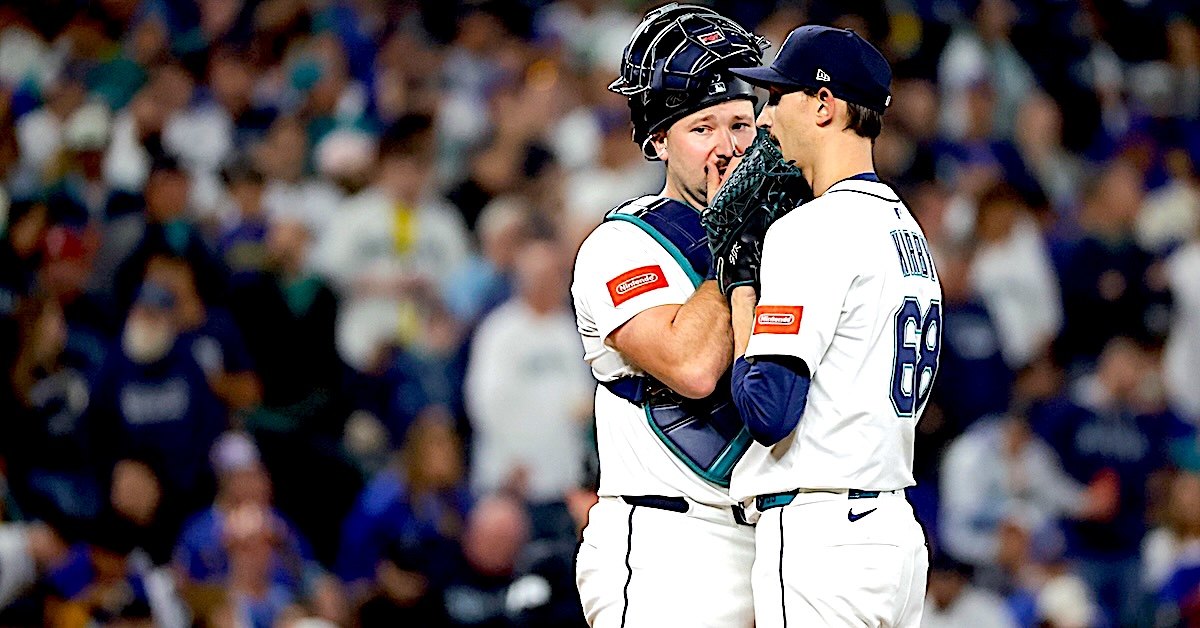
I think it would be impossible to capture metrics for a coach-free catcher-pitcher conference without succumbing to selection bias. Maybe a conference precedes a particularly difficult matchup, or the pitcher seems to need a breather, or the catcher saw a weakness they can exploit (like in the batter’s previous at-bat)… Maybe the coaching staff wants the catcher out there to kill some time for the relievers to get ready, or the pitcher initiated it…
Unless we can know what causes the meetings prior to comparing the results against expected results, it would be pretty tough to make meaningful comparisons. You could compare 2 catchers catching the same pitchers in a strict lefty-righty platoon, but even then you might be comparing unlike things.
On catchers performance sometimes there are natural experiments to compare two catchers based on either how a team employees catchers (not every catchers is Realmuto) some teams will use different catchers based on the handedness of the opposing pitcher some just go with a straight job share or a catcher gets injured resulting in the backup seeing more time. Or the starter could underperform to the point that they become the backup/sent down/cut. There could also be a trade but trading catchers in season is not as common as other positions though it does happen.
Such natural experiments for aces would be limited primarily injuries or underperformace on the part of the catcher because they typically have a personal catcher. Pitchers that have really funky stuff often have personal catchers as well.
The way to open the door to left-handed infielders is to implement my crazy idea to remove the advantage that left-handed hitters have in being closer to first base: When there is a left-handed batter, the base runners go around the bases clockwise! Any runners that were on “first” and “third” bases when a left-handed hitter comes up after a right-handed hitter will switch places, switching back when a right-handed hitter next comes up.
Seems like something the Savannah Bananas would do. I’d watch it
That is a great crazy idea – I have spent the last couple of minutes laughing at the imagined chaos this would cause when runners/fielders (or both) forget which direction they are meant to be running in.
If for some bizarre reason this were agreed to today, I would bet large sums of American monies on Gleyber Torres running the wrong way at least once before April 15th.
Question for next week: how come no team lately has copied that Earl Weaver move of starting a good hitter high in the lineup to bat in the top of the first, then replaced them with a good defender in the bottom of the first? Isn’t this kind of like the opener idea, except for position players?
4-man benches, with 1 no-hit catcher and 1 lo-hit utility infielder. You have two bullets to provide any kind of offense at all. You’re going to save those bullets for a high-leverage situation after the 6th inning, probably one where you gain a platoon advantage by using the bench bat. In the Weaver era teams had 9 or 10-man pitching staffs (and a 25-man roster). And Mark Belanger might have been the most extreme example of a solid player whose contribution was all defense in history. It was a worthwhile experiment.
Last time that I recall seeing a similar strategy was late in the 2000 season, and the decision was tied to finding use for a player limited by injury.
Mark McGwire had returned from injury at less than 100%. Couldn’t field, no DH in the NL at the time. Pretty sure he couldn’t run the bases at anything close to full speed.
In 6 road games, McGwire was in the starting lineup at 2B (4 times), SS (once), or LF (once). He hit either first or second in the batting order. He was replaced by the typical defensive starter after batting in the first. McGwire went 2-5, with 1 HR and 1 HBP in these 6 PA’s.
After those initial 6 road appearances, McGwire was exclusively used as a pinch hitter in subsequent games, whether road or home.
Roster size wasn’t an issue because these games were all played with expanded September rosters (which could include anyone on the 40-man roster at that time).
I never understood the “works well with pitchers” discussion to have anything to do with the occasional mound visit, but rather to be about off-field relationships and game planning, in-game play calling and between inning strategizing.
I was an OK HS catcher. The key for me was what a pitcher felt good about throwing at that point. That I learned, though I screwed up at least once.
I believe that McDowell move qualifies as a Waxahachie Swap.
This is just a personal thought. The vast majority of players, including the ones who have made 10s of millions, generally take the highest bid, or their desired city. That is, they don’t make a choice FOR the fans. While the greed of the owners may be of another degree, I am fairly certain the players are no more altruistic than the owners, and provided with the same opportunity as the owners, would make the same choice. That’s human nature proven over and over again. We can keep groaning about the owners, but the gap in motives isn’t as large as we seem to hint at. Proof? Do the highest 30% of players in earnings offer to restrict their salaries to help the players in the minors or in lower brackets? No. Put another way, I hate the hammers the owners use, but resist the thought the players are any more for the fans.
A couple thoughts of my own.
A) I’m pretty well sure players are far more interested in fans than owners. They’re mostly 20 somethings competing hard, and me screaming them on matters to them far more than it does to the dude I had to pay to sit in screaming distance.
B) But that’s an aside. Of course baseball players aren’t fundamentally “better” or more altruistic people than anyone else. Labor relations isn’t an individual morality test, it’s about structural power and opportunity. Owners can earn far greater sums than any player for a far longer period of time, and they functionally set the value of the players labor. They hold a monopoly on power. That differential in power is what matters to me when I’m groaning about owners.
Owners of sports teams should appear to be trying to win at all times.
I wonder what that would look like. Someone would have to finish last in each division. Some teams would still lose 100 games. Some teams would get priced out of the top free agents. Some teams would try to pivot to developing talent to compete in future years. Right?
Yeah, I don’t think you’d get 6 AL Easts — there just isn’t enough talent to go around. I think it’s less likely you get massive concentrations of talent like the Dodgers, just because there’d be more competition for each FA/big trade piece.
I think you’d see more prospect hoarding, because there’d be no guarantee you could refill an hole in your roster via FA.
My personal view on the catcher/pitcher relationship is that we are probably way off on elite and terrible catchers. I think they matter a ton towards ERA for some pitchers. I saw many games caught by Yadier Molina in my past, and have seen many games caught by the Nat’s Ruiz in recent years. There are very clear observational differences that should be someway quantifiable. I like to look at the era of longtime cardinal pitchers with Molina catching versus other guys. My observation has been that Wainwright and Mikolas both pitched much better when Molina caught them. Less so without Molina. Its more obvious with Mikolas. His era was usually well below his FIP with Molina. But after Molina retired his era has been much higher than his FIP. I know other defenders and factors come into play as well, but I’ll bet that fip to era difference has a largish R2 from Molina. Unfortunately, Mikolas is going to be caught by Ruiz some this year. If you are in the stands behind the outfield walls bring an umbrella. Sadly, I fear, It is going to be raining baseballs out there!
Thank you for acknowledging the value of qualitative research in measuring game calling/pitcher handling skills. People tend to write off data gleaned through interviewing players, coaches, opponents as mere “anecdotal evidence,” but there are scientifically validated methods for conducting good qualitative research.
As with any stat, there will be error bars and avoiding subject bias will be a constant struggle, but if a system for crediting/blaming a fair percentage of team ERA to catchers had been in place a decade ago, who knows, Cal Raleigh might have won last year’s MVP going away.
Assuming that he wasn’t detrimental to the pitchers — I’d assume otherwise, but you’d have to admit the possibility. There’s always going to be surprising results when you measure something instead of just eyeballing it.
Oh for sure, detrimental is a possibility. To my recollection, Seattle’s pitching staff has lauded Raleigh’s game calling aptitude for a few years now so my guess is he’s probably above average, but qualitative feedback from opponents would be needed to strengthen that evidence.
No doubt there would be a high degree of difficulty in obtaining reliably comparable ratings, but with the insane amount of advance scouting each team relies on these days, you’d think certain teams would noticeably outshine others in terms of pitch sequencing/location targeting, which in part could be attributable to the catcher.
As a lefty, I have thought about that question a lot. My fielding percentage would be fine in the infield, the problem would be throwing to first or second base. I can get to a ball hit between short and third but can’t plant and pivot to throw. Dan is spot on about turning a double play as well.
In the scouting scale review a while ago, the data showed that prospects were arriving in the majors in a linear way instead of on a curve. Does this account for the stories about so many 45 and 45+ FV prospects getting to the majors? Wondering about risk.
I think the path to a salary cap/floor is much different than described above. If the owners want a salary cap/floor approved by the players they have to come to the table with a new economic system that transforms how well productive, young players are paid in their first seasons in the majors. This probably means something like: (1) raising the ML minimum to $1.25 million; (2) offering a revised arbitration system that starts after one year of ML service time; (3) offering to cut years to free agency to five instead of six.
If every player gets one vote, the owners have to win over the players who are not served well by the current economic system. As it is, productive, young players have to remain healthy and productive to get through six seasons of being systematically underpaid in hopes of getting effectively overpaid once they get to free agency to make up for what they didn’t get in their first six years. The owners have an opportunity to significantly improve on that for several hundred players – several hundred votes for a new CBA.
Of course, small market teams are currently dependent on their ability to have a lot of really cheap young players. But with considerably more revenue sharing, which we know has to happen if you are going to have a floor of $130ish million anyway, the small market teams should have more resources to pay their productive, young players much better in a new economic model.