
Framber Valdez Signing Establishes the Tigers as AL Central Favorites
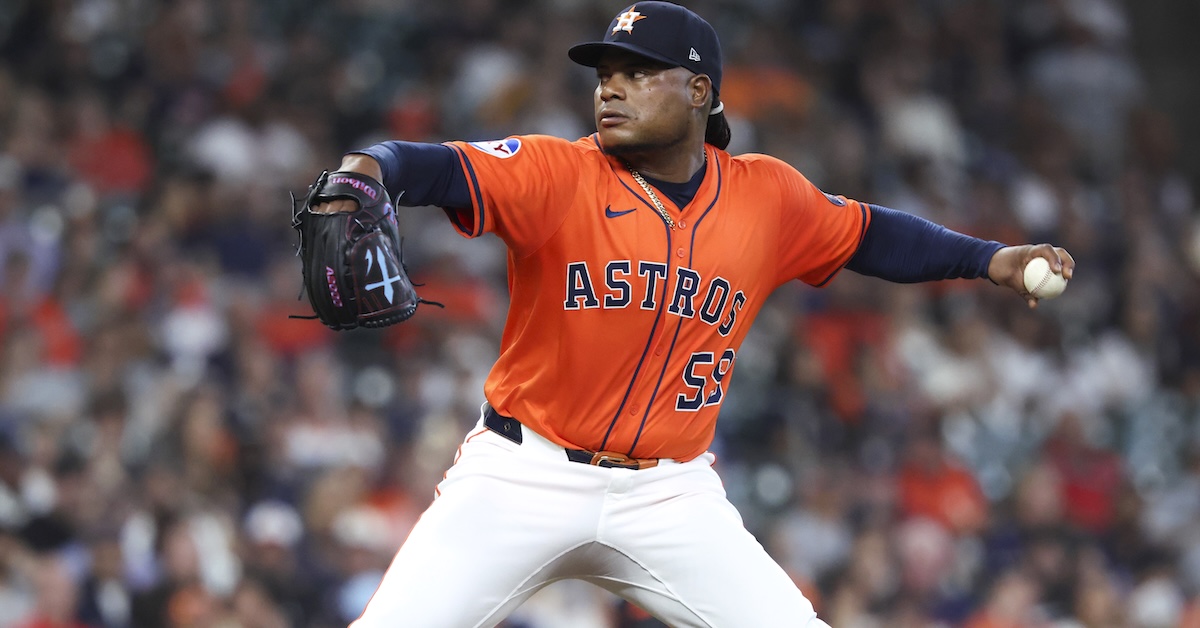
The biggest name remaining in free agency is now off the board, as Framber Valdez agreed to a three-year, $115 million contract with the Detroit Tigers on Wednesday night. The 32-year-old lefty, who ranked fourth on our Top 50 Free Agents list, hit the open market for the first time in his major league career this winter after parts of eight seasons with the Astros. In his final season in Houston, Valdez put up a 3.66 ERA and a 3.37 FIP in 31 starts over 192 innings, good enough to reach the 4.0-WAR mark for the third time in his career. His new deal with the Tigers comes with an opt out after the 2027 season, $20 million of the deal in the form of a signing bonus, and some unknown amount of deferred money, which will reduce the overall value of his contract by, well, an unknown amount.
For the Tigers, the benefits of adding Valdez to the rotation are quite clear. Of course, he would improve any team, since having too many good pitchers has been an actual problem zero times in baseball history, but he fits Detroit’s needs like a glove. The Tigers have managed to get their rotation through the season successfully over the last two years despite a lack of depth, but come playoff time, they have basically gone with a starting staff of Tarik Skubal and a trio of shrug emojis. Don’t believe me? Detroit has played 15 games across the last two postseasons, and I will now run down the full list of five-inning starts by Tigers pitchers with last names that aren’t Skubal:
[…]
[…]
Oh, sorry, I was eating tacos. There aren’t any players on that list. Signing Valdez gives the Tigers a dependable no. 2 starter, one who is better and with a better health record than Jack Flaherty. While I’m chaotic-neutral enough to get a thrill out of A.J. Hinch’s admitting in press conferences that he and the front office were basically coming up with the pitcher assignments as they went along, I’m sure that’s not an ideal scenario for making decisions.
Valdez has never had that crazy year that put him near the top of the Cy Young race — though he has received down-ballot votes in half of his seasons and placed as high as fifth in 2022 — but since his 2020 breakout campaign, he ranks sixth among pitchers in WAR and fifth in innings pitched.
| Name | W | L | IP | K/9 | BB/9 | WAR |
|---|---|---|---|---|---|---|
| Zack Wheeler | 69 | 37 | 979.0 | 10.1 | 2.0 | 28.6 |
| Kevin Gausman | 65 | 50 | 985.3 | 10.0 | 2.3 | 24.3 |
| Logan Webb | 68 | 50 | 1022.7 | 8.4 | 2.1 | 23.9 |
| Corbin Burnes | 55 | 33 | 881.0 | 10.3 | 2.5 | 22.5 |
| Aaron Nola | 56 | 54 | 944.3 | 10.0 | 2.0 | 20.6 |
| Framber Valdez | 73 | 44 | 973.0 | 8.8 | 3.0 | 20.3 |
| Dylan Cease | 61 | 51 | 942.3 | 11.0 | 3.8 | 20.3 |
| Max Fried | 73 | 30 | 854.3 | 8.6 | 2.3 | 20.2 |
| Sonny Gray | 55 | 42 | 842.0 | 10.0 | 2.6 | 19.4 |
| Tarik Skubal | 54 | 37 | 766.7 | 10.4 | 2.0 | 19.3 |
| Luis Castillo | 56 | 57 | 961.0 | 9.4 | 2.7 | 18.2 |
| Gerrit Cole | 59 | 28 | 759.0 | 10.8 | 2.2 | 17.1 |
| Pablo López | 52 | 41 | 795.0 | 9.7 | 2.3 | 16.6 |
| Nathan Eovaldi | 56 | 30 | 784.7 | 8.9 | 2.0 | 16.3 |
| Carlos Rodón | 64 | 41 | 753.0 | 10.6 | 3.0 | 16.0 |
| Zac Gallen | 63 | 46 | 927.3 | 9.4 | 2.8 | 16.0 |
| Sandy Alcantara | 44 | 50 | 835.7 | 8.0 | 2.4 | 15.9 |
| Freddy Peralta | 57 | 35 | 767.7 | 11.0 | 3.3 | 15.7 |
| Blake Snell | 43 | 34 | 652.0 | 11.8 | 4.2 | 15.4 |
| Ranger Suárez | 46 | 35 | 698.3 | 8.4 | 2.9 | 15.1 |
| Jacob deGrom | 30 | 16 | 438.0 | 12.2 | 1.6 | 15.0 |
| Max Scherzer | 51 | 28 | 673.0 | 10.7 | 2.2 | 14.9 |
| Logan Gilbert | 47 | 36 | 835.3 | 9.5 | 2.0 | 14.8 |
| Chris Bassitt | 69 | 46 | 943.3 | 8.6 | 2.7 | 14.8 |
| Clayton Kershaw | 54 | 22 | 580.7 | 9.1 | 2.1 | 14.3 |
The Tigers project to fall somewhere between 80 and 90 wins, the range where adding wins is the most valuable, so they likely will get maximum punch with the Valdez upgrade. Last week, when I put out the first run of ZiPS projected 2026 standings, the Tigers had a 50th-percentile projection of 83 wins, a 36.7% chance of winning the division, and a 49.3% shot of making the playoffs. A bump now to 85 wins may not sound impressive, but just those two wins are enough to change to those percentages to 50.1% and 66.2%. The 20th-percentile projection went up about 3 1/2 wins, as Valdez does a lot to mitigate the risk of having one pitcher, Skubal, make up a large percentage of the team’s pitching value. In the simulations where the back-to-back Cy Young winner pitches zero innings in 2026 — I won’t specify why in order to avoid jinxing him — the Tigers made the playoffs only 6% of the time. With Valdez on the team, that number increases to 14%. “It limits our downside scenarios in case of disaster” isn’t the sexiest reason to acquire a player, but it’s an important one.
As to the contract itself, while many of headlines you see will say stuff like “Highest Annual Value Ever for a Left-Handed Pitcher!” the annual value isn’t really that crucial to whether or not the contract works out. I would much rather have a record-breaking three-year contract with a pitcher than a more mundane average salary over an eight-year deal. I’d offer a three-year, $115 million pact with an opt out over an eight-year, $240 million one any day. It takes some creativity for any three-year deal that goes poorly to significantly damage a team’s long-term plans.
| Year | W | L | ERA | G | GS | IP | H | ER | HR | BB | SO | ERA+ | WAR |
|---|---|---|---|---|---|---|---|---|---|---|---|---|---|
| 2026 | 12 | 9 | 3.69 | 27 | 27 | 173.0 | 157 | 71 | 16 | 60 | 152 | 116 | 3.1 |
| 2027 | 11 | 9 | 3.83 | 25 | 25 | 157.3 | 147 | 67 | 15 | 54 | 133 | 112 | 2.5 |
| 2028 | 9 | 9 | 4.03 | 23 | 23 | 143.0 | 139 | 64 | 15 | 51 | 118 | 106 | 2.0 |
Now, ZiPS would only want to pay Valdez about $80 million, but this was basically a bidding war for the last really meaningful free agent pitcher without a major “but” attached to him. The next available starting pitcher on our Top 50 list is the 19th-ranked Zac Gallen, followed by Chris Bassitt, who came in at no. 35. This is a situation where a team like the Tigers (or the Orioles, Giants, Cubs, Astros, or any other club that was in on Valdez) shouldn’t be worried about the isolated efficiency that a mean ol’ projection system wants to see. Salary projections are general guides, not grading rubrics.
As in a number of other contracts this offseason, you can feel the looming shadow of the expiring CBA between MLB and the MLBPA. The $20 million bonus and the deferral hedge against lost games and salary in 2027, and with an opt-out decision after 2027 instead of after this year means he doesn’t have to make the decision whether to wade into an uncertain morass. The Tigers get something out of this unrelated to the CBA; not giving Valdez an opt out after 2026 keeps the rotation from becoming a smoking crater the first year after Skubal is set to hit free agency.
With Valdez, the Tigers are getting the pitcher they needed at a price they wanted, and a whole bunch of teams that could’ve used him aren’t. This is a very solid move, and as a Baltimore native, I’m rather disgruntled it wasn’t the O’s that made it.
Dan Szymborski is a senior writer for FanGraphs and the developer of the ZiPS projection system. He was a writer for ESPN.com from 2010-2018, a regular guest on a number of radio shows and podcasts, and a voting BBWAA member. He also maintains a terrible Twitter account at @DSzymborski.
Genuinely, what is Mike Elias doing?
When it comes to his pitching staff? Technically he’s doing nothing.
Bradish looked great when he returned and Elias added Shane Baz. I hated that trade, but it’s wrong to say that he did nothing.
Bradish did look great but he’s not exactly the picture of good health he was on the injured list 4-5 times between the 2022-2024 seasons.
For sure. I desperately wanted the Orioles to add Cease or Valdez in free agency, I’m just correcting the false assertion that Elias did “nothing.”
I want to once again just put the notion out there that it’s not impossible that jdbolick is secretly actually Mike Elias’s mom
raregokus, I’m surprised that you still haven’t realized how posting this same comment in one Orioles discussion after another makes you look. Not only do you come across a cringy teenager, it also makes you seem completely oblivious given how many times people have seen me criticize the Baz trade, the Ward trade, the Morton signing, etc.
I guess you’re trying to be funny, but you’re not succeeding. It’s time to try something different.
Counting on Grayson to come back healthy!
Oh, wait…
Deciding he didn’t want to spent $40M next year to put a 60% ground ball pitcher in front of Pete Alonso, Jackson Holliday, Gunnar Henderson, and Jordan Westburg.
This logic is actually quite sound if you take it in isolation. But if you keep ruling out high-performing starters based because they aren’t perfect you end up without many high-performing starters.
Going to be a lot of high scoring games in Baltimore this season.
The whole off-season has been a headscratcher outside of the Helsley signing. The ideas all sort of make sense, but together it’s like a room painted a bunch of random colors.
Ben had this article on the Mets a week or two ago and how well their offseason moves worked together. The work done on one area of the team was complemented by work done in another.
You can view the Orioles not-signing Framber Valdez as leaving the team half-built, and so it doesn’t make sense there.
You can also view a hypothetical Framber Valdez signing by the O’s a situation where the parts don’t work well together. And so that doesn’t make sense either.
I think both have a lot of merit, but there’s always a reason not to pursue a starting pitcher. Garret Crochet and Dylan Cease and Freddy Peralta cost too many prospects, Chris Sale and Michael King have been hurt a lot, Ranger Suarez doesn’t throw hard, Framber Valdez has too many ground balls, etc.
Many of these concerns seem overblown in retrospect, or they will. But it didn’t seem like it at the time / they might not be.
Of course the effect of assembling a team with a bad defense and then not wanting to sign playoff-worthy pitchers because they don’t strike out a lot of batters just means your run prevention is going to be bad.
Some front office executives are more concerned with winning every individual deal than others. It’s definitely true that the more a front office is worried about resources the more they are concerned with winning individual deals. But it’s interesting to see that the one place where the Orioles are not concerned about this is when it came to getting right handed power for the lineup.
Yes, and [incoming broken record] Elias’ dedication to half measures when it comes to starting pitching mean he put himself in a situation where his options were Framber (bad defensive fit), Ranger (declining velo), and Gallen (declining everything), and now his options are just Gallen or 5-types like Littell, Bassitt, Giolito, etc. or roll into the season against Cease/Yesavage/Crochet/Ranger/Gray/Fried/Schlittler with exactly one guy averaging 150+ IP over the last three years.
This happened because he didn’t land [2026] Cease, Framber, Peralta (extendable), [2025] Fried, Burnes, Snell, and even failed on mid-rotation types like [2025] Kikuchi, Pivetta, Holmes, Boyd, Flaherty, [2024] Gray, Imanaga, Manaea.
He traded away a boat load of prospects for Shane Baz because he traded away Grayson Rodriguez because he traded away Ramon Laureano and every RHH OF he drafted has busted.
I understand he can’t make free agents sign with Baltimore, and I suspect guys are waiting for them to offer something big before going to the team they “actually” want to play for (as was the case with Burnes). But that’s part of the job. According to RR, they’re looking at less payroll than 2025…
That is not accurate. The projected 2026 payroll is $183.9 million according to Spotrac, which is an increase over 2025’s $175.9 million.
Considering how many arb players they have, an increase of $8M is pretty pathetic. Especially when the GM publicly stated that the ownership was willing to “go into the red considerably” in regards to improving the team.
I wouldn’t use a 4.5% increase in payroll to back that up, personally.
Going above $175 million is going into the red. Post-Nationals, the Orioles are a small market team. Any team that ranks higher in payroll than they rank in revenue is to be lauded, and that applies to Baltimore. Saying that they should go even further above that to a top 10 payroll just isn’t realistic.
The Orioles payroll isn’t constrained by their operating revenue, except by choice. Their owner once blew $21m on a copy of the Magna Carta.
The Mets are the only team in baseball that far outspends their operating revenue, and that’s because Cohen is worth more than the third, fourth, and fifth wealthiest MLB owners combined.
Yes, but I think the point was that the Orioles’ new ownership has indicated a willingness to join the Mets in that regard, but for some reason Mike Elias hasn’t taken them up on that offer.
Both elements of that are wrong. The narrative that Elias for some reason refuses to spend as much as ownership will allow is nonsensical, as no GM would voluntarily choose to handicap themselves. It also ignores that Elias offered massive contracts to Burnes and others.
And while Rubenstein is willing to take losses, the Mets lose well over $100 million every single season. No other owner is going to do that because no other owner even comes close to Cohen’s wealth.
I don’t like this logic though, because even though he is a 60% ground ball pitcher, he is a good pitcher who is good at pitcher things. How many more ground balls would that actually be? Would it be enough to actually tip the scales? And even with a poor defense, ground balls still turn into outs at a high rate.
A lot. Framber induced 313 ground balls last season, which is double Cease’s 156. Keep in mind that Baltimore’s infield isn’t just projected to be “poor,” it should be dead last in the American League if Alonso is the regular starter at first base.
Holy moly, I was going to do the math before I made that point but hadn’t had my coffee yet… serves me right! Would he still provide fewer overall Balls in Play than most other pitchers though?
Not especially. His In-Play% (non-HR batted balls per plate appearance) is marginally above league average. K% and BB% are basically average and he hits slightly fewer batters and allows fewer homers than average.
League in-play% was 64 and he was at 65 last year. Valdez had 519 balls in play, a league average guy would have had 517 with the same number of batters faced.
So average rate of balls in play with 60% of those on the ground.
This is great, thank you!
I think you’re overselling the “Valdez needs great infield defense” thing. He just had a 3.66 ERA in front of a good SS and mediocre 1B/2B/3B. An enormous fraction of any pitchers results are SO/BB/HBP/HR/easy outs/certain hits. In that little margin of “balls in play that could be hits or outs” we compare his 59% ground balls to a league average 42%. Yes, it certainly matters and he’d be worth more to a team of great infielders, but the difference is small.
FGDC has him at 3.6 WAR. How much of that do you think the Orioles defense would have booted away? A few tenths of a WAR? They’re gonna boot away a couple tenths of a WAR of any SP because even flyball guys need infield defense. If the decision here was Valdez or a flyball guy of equal value then I agree with you, but that wasn’t the case. The decision was Valdez or not Valdez, and the Orioles made the wrong decision.
A full point of WAR. Alonso was the worst first baseman in the league last season while Holliday was near the bottom at second. Baltimore projects for the worst defense in the American League.
No, the decision was Valdez or Alonso and Elias chose Alonso. The projected 2026 payroll is $183.9 million according to Spotrac, which is already an increase over 2025’s $175.9 million.
Roster Resource has them $11M below last year, so I’m pretty skeptical of the idea that Alonso means they can’t buy a pitcher. But maybe I’m wrong! I often am. Then my goodness was signing Alonso a misallocation of resources.
The Astros literally had the best infield defense last year. The Tigers and Orioles project to around 25th this year. I think it is possible to overstate his dependence on infield defense but unless there is a major turnaround this is going to hurt his numbers.
I don’t understand “Astros had the best infield defense last year”. Maybe I am misunderstanding some stats (it’s happened before!) but I am looking at DRS and FRV as two measures of defense. In each case I am looking at team stats, and subtracting the “as OF” positional split from “all positions”. Seems to me that should be a measure of infield defense.
By that metric:
Astros -8 DRS (23rd in MLB), +14 FRV (11th in MLB)
Orioles -12 DRS (24th in MLB), -6 FRV (20th in MLB)
Am I missing something? Are you?
You can get team infield defense on Statcast directly. Although now that I think of it I just did it for OAA and it might not included throwing there, that could push them down a spot or two.
Given that a starting pitcher only throws every 5th game, and non-pitchers do need occasional rest, working those two constraints in tandem is not an onerous burden to place upon a team nor a manager. Every team with bad defenders has a bench guy or two to fill in when defense really matters. The notion that a GM would shy away from signing an elite SP because his batted ball distribution doesn’t align perfectly with their infield defense is … scary
I don’t exactly disagree with you. I think the logic is sound in isolation. I just don’t think it’s sound to apply this level of concern to every pitcher who costs a lot.
At some point you (and by you, I mean a front office, not you personally) wind up punting on run prevention entirely because no one single player is a major contributor to run prevention. Each starter only pitches every fifth day and you think “it’s okay, even if we sign a top pitcher it’s only 20% of games. It’s more important to make sure we have enough guys to make it through the season.” And if you do that for five starters, you have an entire rotation of guys who either have question marks or are just okay.
And then most fielders don’t see the ball on a given play. You start crunching the numbers and you say, “well, it’s fine to have a suboptimal defender at this position” and you do that individually for every position. And then you have a whole defense full of guys who are question marks.
Sure. But logic in isolation really only applies if there’s an alternative chosen. If BAL went out and signed Dylan cease or traded for Mackenzie Gore or acquired some other big-stuff strikeout guy, and the reasoning was that he would play better in front of a sketchy defense than Valdez it would be an entirely defensible position.
And I suppose you could argue that’s sort of what they did. They’re going to have a full season of Kyle Bradish (if he’s 100% and stays that way) and they added Shane Baz (who flashes things but hasn’t been great with any sort of consistency).
But there still isn’t a world where Framber Valdez doesn’t make the team significantly better. Ground balls or not.
I would also point out that the essentially premise of this entire thread is fan fiction. BAL not signing Valdez does not mean BAL did not try to sign Valdez. Let alone didn’t really want him at all.
As well in SanFrancisco. Got to downgrade Webb especially with the Giant right side infield.
The Orioles’ rotation is projected to be worth 10.4 fWAR, which is a good bit higher than the Yankees at 8.7 fWAR.
Source? The depth charts page has the Orioles at 11.6 and Yankees at 13.6. I think that deeply underestimates concerns with their depth though and assigns a lot of innings to pitchers who have struggled to stay healthy.
https://www.fangraphs.com/roster-resource/depth-charts/orioles
Ahh this makes sense, the roster resource page doesn’t have Cole or Rodon in the rotation right now because they won’t start the season healthy, but the depth charts has them coming back mid season and includes their WAR contributions.
You can’t just add up the top 5 starters for a team and tally that as their projected WAR.
“Sure you can!”
Regards,
2013 Detroit Tigers & 2004 Boston Red Sox
“What do you need five starters for?”
Best,
1966 Los Angeles Dodgers
The Spahn and Sain and pray for rain gambit…
’06 White Sox as well!