
Harrison Ba(y Area)der Signs With Giants
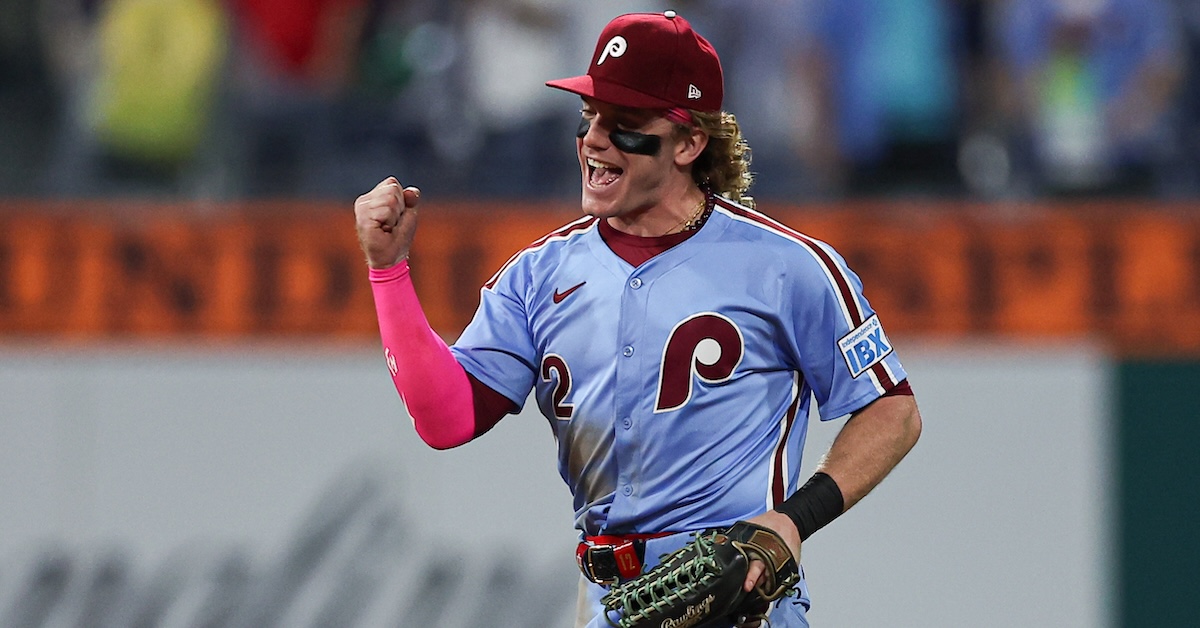
The San Francisco Giants, with their unique front office leadership and unconventional manager, have gone the traditional route. “Acquire Harrison Bader” is a tried-and-true team-building strategy for a would-be contender; the former Florida Gator is on his way to his seventh organization in the past four-and-a-half years.
The Giants, unlike Bader’s previous employers, seem interested in keeping him around long enough to unpack all his furniture: Bader’s new contract is for two years and $20.5 million.
Regardless of any analysis to follow, this move makes the Giants stronger in 2026. Bader is a legitimate center fielder who’ll relieve the defensive pressure on the freshly emancipated Jung Hoo Lee (who’s stretched in center) and Heliot Ramos (who’s stretched at any position that requires him to wield a glove). Guys who can play center field comfortably and have a clue at the plate are harder to find than you’d think — especially in free agency — and the Giants got one.
That combination of skills is why Bader has appeared in the postseason in six of the past seven seasons. But the fact that he hasn’t lasted more than a full season in any organization since the Cardinals traded him in 2022 is also instructive.
By declaring Bader a rare center fielder who can provide value on both offense and defense, I don’t mean to insinuate that he’s anything like a Pete Crow-Armstrong or a Julio Rodríguez, or even a poor man’s version of either player. There are holes in his game, and it’s important to remember that this is a speed-and-defense guy who’ll turn 32 in June. That generally doesn’t bode well for a multi-year free agent contract.
But this is, like, barely a multi-year contract. This is Bader’s third go-around in free agency; he got $10.5 million from the Mets on a one-year deal in 2024. After a poor showing in Queens, the Twins signed him to a one-year contract with $6.25 million in guaranteed money and a $10 million mutual option for 2026. The Giants got him for about the same AAV — plus a quarter million dollars — Bader would’ve made had he and the Phillies exercised a mutual option for the first time in baseball history.
That’s less than Bader wanted, and to be honest, it’s less than I thought he’d get. Our median crowdsource prediction had him signing for two years at $12 million per; the wise and estimable Ben Clemens predicted a two-year contract with a $15 million AAV. I thought it was within the realm of possibility that Bader would command a three-year contract at that salary.
That’s because Bader had a monster 2025 season, by his standards. There was a lot of noise about how well Bader played after his trade deadline move to Philadelphia: a .305/.361/.463 line, good for 1.2 WAR in just 50 games. He revitalized a Phillies lineup that had been in dire need of center field defense, an extra right-handed bat, and a little pep, which the frequently mulleted and sleeveless Bader has in abundance. Bader tweaking his hamstring in Game 1 of the NLDS, limiting him to a pair of pinch-hit appearances for the rest of the series, might’ve been the difference in a series in which Philadelphia’s three losses came by a total of four runs.
But Bader was having the best season of his career even before the trade: a .258/.339/.439 line and 118 wRC+ in 90 games for the Twins. He had a terrific walk year, and after three consecutive down offensive seasons, he needed one. Among center fielders with at least 300 plate appearances in 2025, Bader was fourth in wRC+, ahead of Wyatt Langford, Jackson Merrill, Jackson Chourio, and PCA. If he repeats that season in San Francisco, for $10.25 million, this will be one of the best signings of the offseason.
So why did it take until the end of January for someone to jump on Bader, and how did his market get this soft?
Bader, listed at 5-foot-11, 210 pounds, has always been a punch-over-power hitter. The high point of his celebrity came in the 2022 playoffs, when he homered five times in nine games for his hometown Yankees, but that two-series stretch generated about half a season’s worth of home runs by Bader’s standards. His 17 dingers in 2025 were his most ever; he averages about 14.4 homers per 500 plate appearances across his career.
He does hit the ball in profitable places for a hitter — i.e., in the air and to the pull side. Here are his home runs from 2025; it hardly paints a picture of a guy with gap-to-gap power. (Not that anyone except Barry Bonds has ever had gap-to-gap power in the Giants’ home park.)
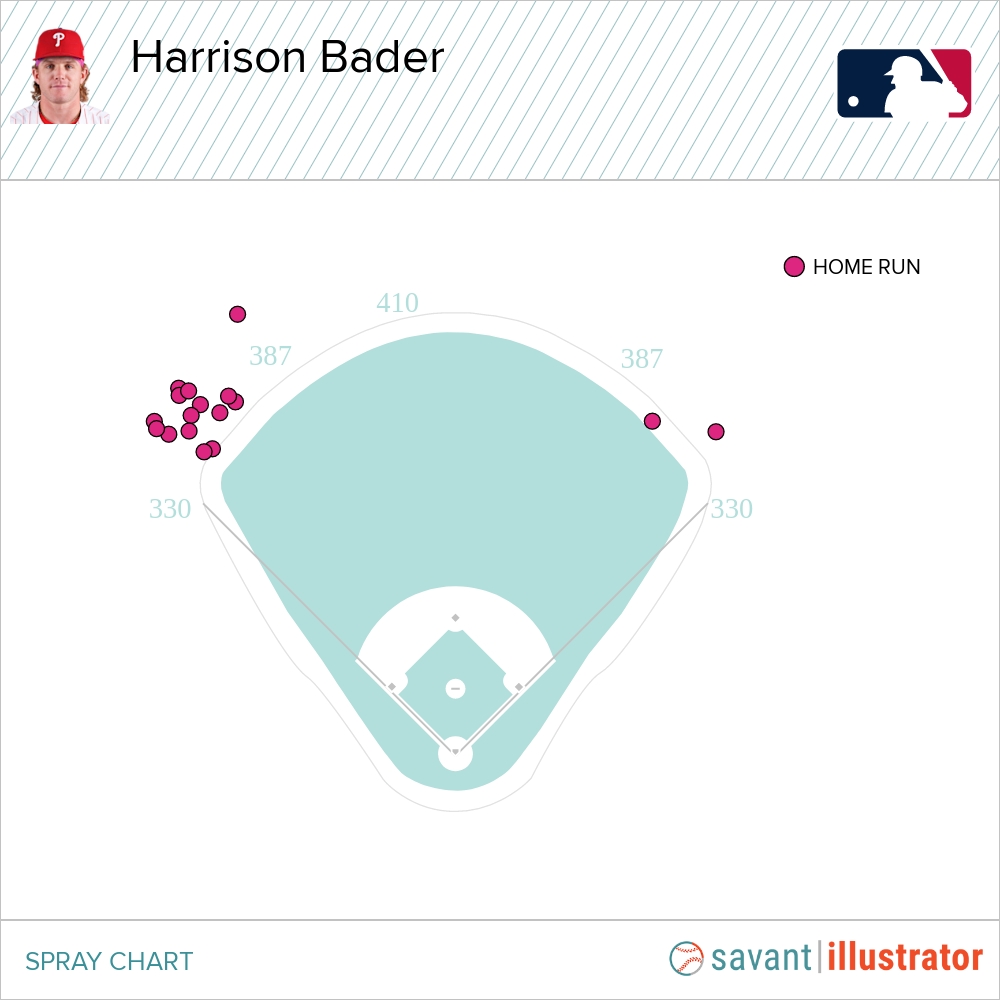
It’s good that Bader’s figured this out, but it also means there’s not really much in the way of low-hanging fruit for the Giants to exploit. Bader’s big 2025 season coincided with an increase in average bat speed from 71.2 mph to 73.5 mph; he also posted the highest barrel rate of his career (the 2020 season notwithstanding).
Even with all that taken into account, Bader’s underlying numbers are jumping off the screen waving red flags and flashing alarm bells. He outperformed his xBA by 57 points and his xSLG by 75 points — the second- and sixth-largest overperformances, respectively, of any hitter on Baseball Savant’s leaderboards. If you want to go all the way back to the fluke indicators of the late 2000s and early 2010s, here’s Bader’s BABIP year-by-year:
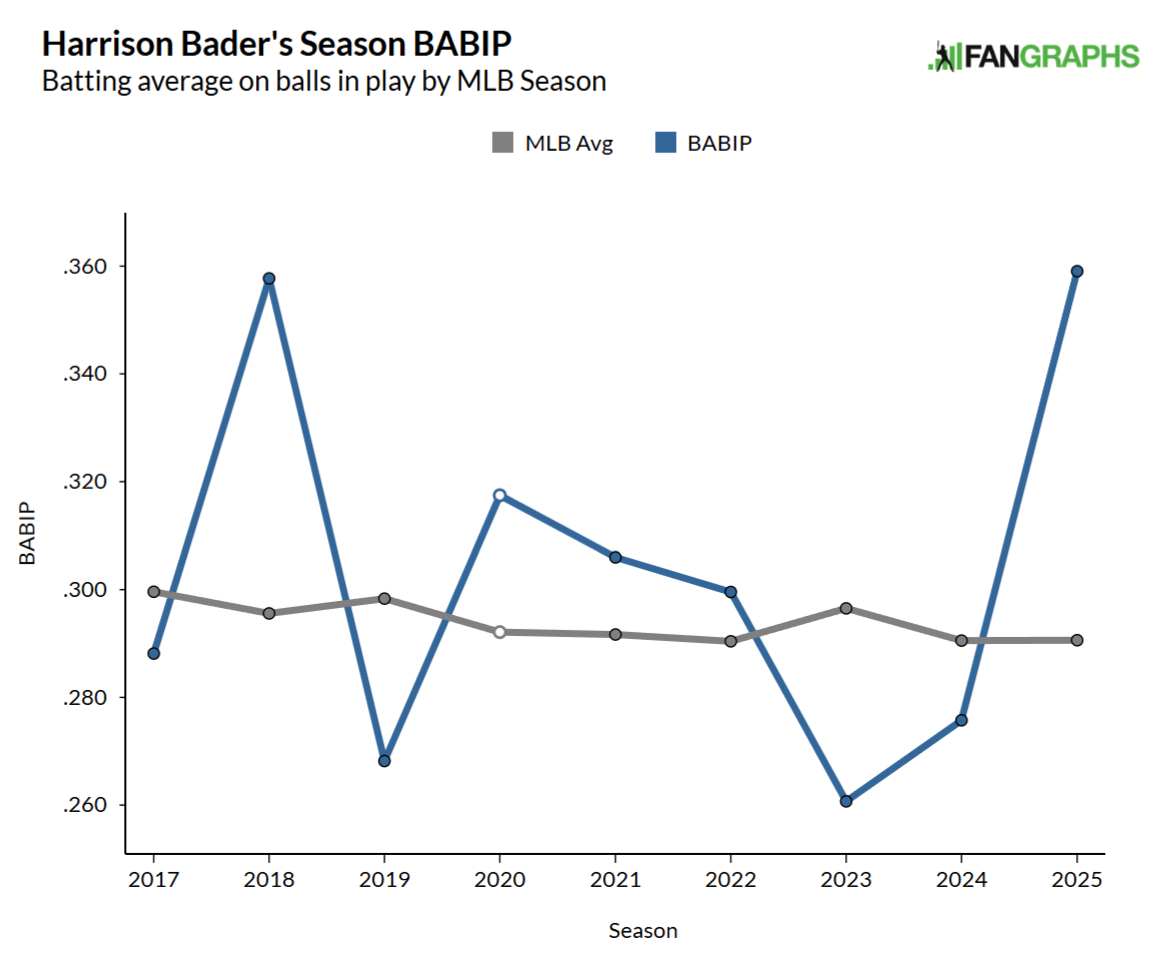
Bader has been around long enough that it’s clear this is kind of his deal. To my knowledge, no one has ever seen Bader and Nate McLouth in the same room. Sometimes Bader is Pirates Nate McLouth; sometimes he’s Braves Nate McLouth. Over his career, he has a 96 wRC+, which tells the story on the aggregate, if not on a month-by-month basis.
So, yeah, don’t expect a 122 wRC+ again; Bader is getting older, he’s always struck out more than is ideal for a hitter with his power, and his aggressive, harder-swinging style of late has come at the cost of some selectivity.
Nevertheless, I like the fit here, and the contract for the Giants. (Thus continuing the trend of San Francisco under Buster Posey making all the same moves I’d make if I were running a baseball team. As I mentioned in my writeup of the Tyler Mahle signing, that’s not necessarily a good sign.) An average hitter with Bader’s defensive profile is a steal at $10 million and change; even a platoon-and-situational center fielder isn’t a disaster at that price point.
And while I’m trying not to read too closely into squishy intangible things, Bader is exactly the kind of charismatic, balls-out player I’d expect to thrive under new manager Tony Vitello. One of my biggest concerns about Vitello in the early days of 2026 is his being reunited with one of his best-ever players from Tennessee, Drew Gilbert. Gilbert was a superstar in college, but he’s had a rocky developmental path across three professional organizations and is probably not a starter at the big league level. I worry that Vitello will lean too heavily on the guy he knows as he gets established.
Bader gives Vitello an alternative. Bader is a better player than Gilbert; he’s also what I’d describe as the neutral good to Gilbert’s chaotic evil. I’d be very surprised if he and Vitello aren’t good for each other.
This contract is interesting because of what it says about the value of the big walk year in a world where all the GMs have access to detailed data. Bader’s a good fit for San Francisco, who made an opportunistic signing in a soft market. And it puts a fun player in a position where he’ll get to play a lot for a team with playoff aspirations. You don’t find many cheap, productive players with upside in this part of the free agent market; the Giants are fortunate to land one here.
Michael is a writer at FanGraphs. Previously, he was a staff writer at The Ringer and D1Baseball, and his work has appeared at Grantland, Baseball Prospectus, The Atlantic, ESPN.com, and various ill-remembered Phillies blogs. Follow him on Twitter, if you must, @MichaelBaumann.
Fine move for SF, but the question I have is why didn’t any other should-have-been-keenly-interested teams drive up the value of Bader’s contract. Cleveland and Kansas City jump out as quasi-contenders desperate for a CF upgrade. KC even has the lefty-hitting Isbel on board to complement. Perhaps Bader was uninterested in moving to the heartland.
OK, but where the Dbacks at? They are weak at both LF and CF, Bader was an ideal roster solution. Also the Rays to a lesser extent; no front office can view both Mullins and Simpson with foolproof confidence. The Rangers have no qualms putting their trust in Evan Carter? And I haven’t even mentioned the Phillies.
Hard to understand how the Giants got off this easy.
Yeah, this makes the Garcia signing by the Phillies look terrible. Bader’s basically making the same amount Garcia is this year.
I agree. He fit a lot of rosters very well (can add the cardinals here, where victor scott is helpless vs lefties, and they have holes in right and left field and also generally need a RH hitter).
It’s strange to me that no one beat this dollar amount. Maybe Bader did want to be on the west coast? Anyway even a not great version of Bader that posts 1 to 1.5 War each year will earn this contract and if he hits like average and plays above average defense for a whole year he will make this look like one of the better signings of the offseason.
Except Garcia has more upside and only got a one year deal. Much wiser decision by Phillies.
Did you perhaps mean neutral good to Gilbert’s chaotic neutral? Demanding a prompt, public correction if so, for the honor of the entire sportswriting profession.