
Logan Webb’s Backwards Sweeper
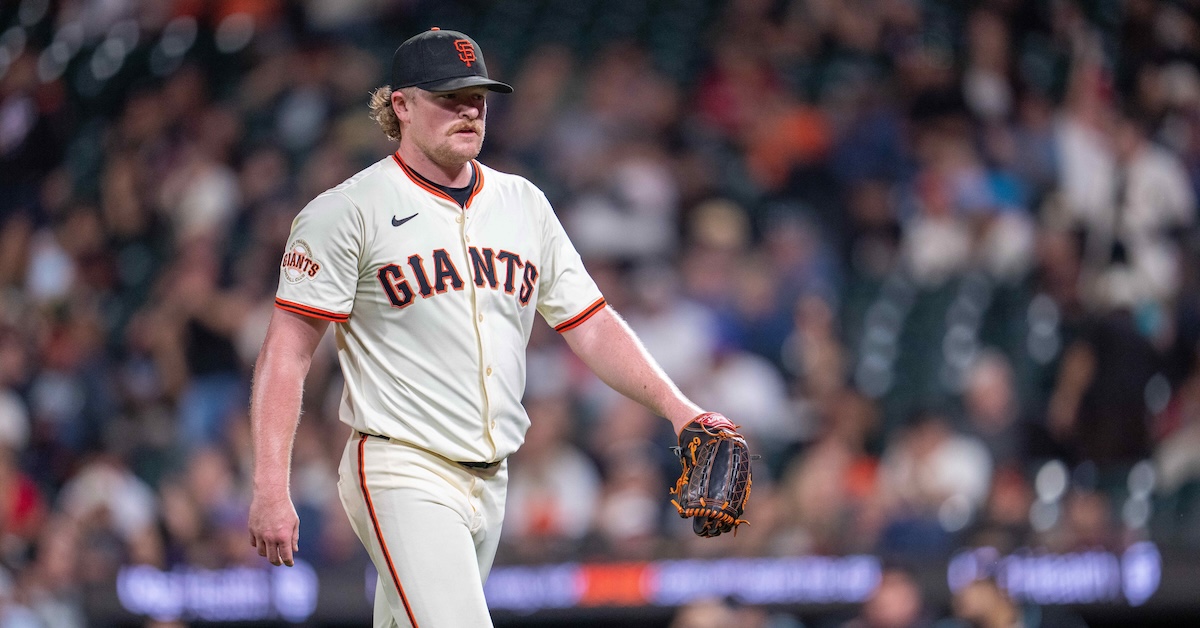
I’ve been playing around with the new FanGraphs Lab tools a lot recently. At first, it was bug testing, but it pretty quickly turned into fun. One minute, you’re making sure that sliders show up correctly. Next minute, you’re wondering about Logan Webb’s backwards slider. See, Webb throws a big-bending sweeper instead of a gyro slider, but it doesn’t behave at all how you’d expect: It’s good against lefties and bad against righties.
In 2025, Webb put up 5.5 WAR, a career-high mark and his fifth straight season of four or more wins. He used his sweeper a lot to get there. Webb was one of the most frequent right-on-left sweeper users in the majors, and also one of the best. Measured by run value added per 100 pitches, he was 11th in baseball among all righties who threw even 100 such sweepers – and he threw 400 of them. He was 15th in whiff rate for good measure. He was as effective as Paul Skenes was in this situation while going to the pitch three times as often.
But while he was lights out with the pitch against lefties, it fared quite poorly against righties. He was below average, and by a lot. Ninety-one pitchers threw 100 or more right-right sweepers; Webb finished 75th in run value added (or lost, in this case) per 100 pitches. While the league gets about 25% more whiffs with the platoon advantage, his whiff rate with his sweeper was the same against righties and lefties. This all sounds very strange. But when I dug into it, I got some answers.
Webb likes to use his sweeper to start lefties. He threw 162 of them in 0-0 counts last year:
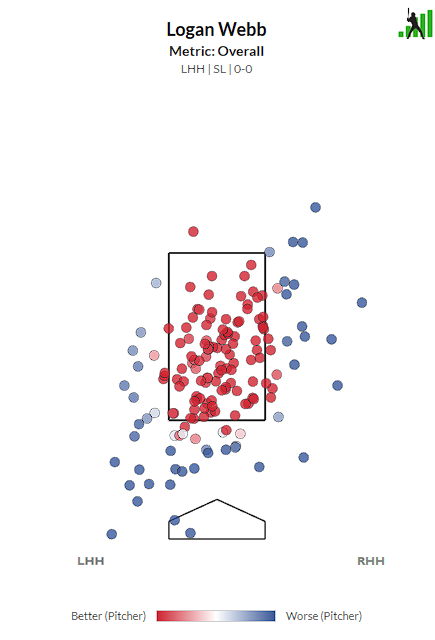
PitchingBot loved his approach, as you can see from all the dark red in the strike zone. That’s good for a 71 overall grade (on the 20-80 scale), driven by his pristine strike-throwing (73 command). The best pitch to throw early in the count is one in the strike zone, and Webb absolutely did that. When he got to two strikes, he basically stuck with the same approach:
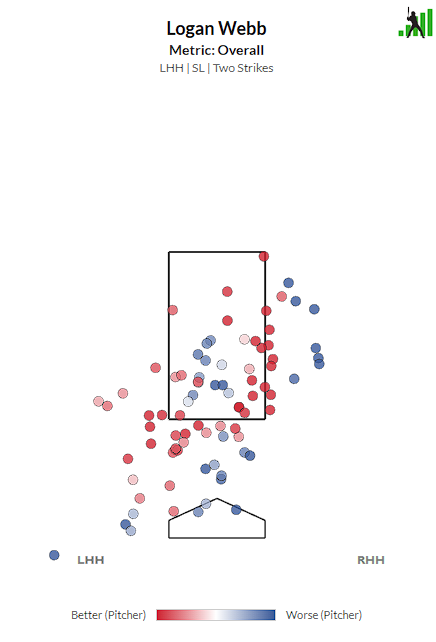
The model doesn’t like his locations here as much even though the ball is going to the same place. That’s because of the count leverage; when you’re ahead, throwing the ball down the middle becomes actively bad. But this is still a perfectly acceptable set of pitches (overall grade 57), both because Webb’s sweeper has good movement, and because being in and around the zone is still generally good.
Combine those model grades with the observed results, and you get the idea: Webb used his sweeper well against lefties, mostly to start the count and occasionally to end it. Against righties, however, he couldn’t seem to get that plan into motion. Those 0-0 locations that came so easy against lefties? They vanished when he faced righties:
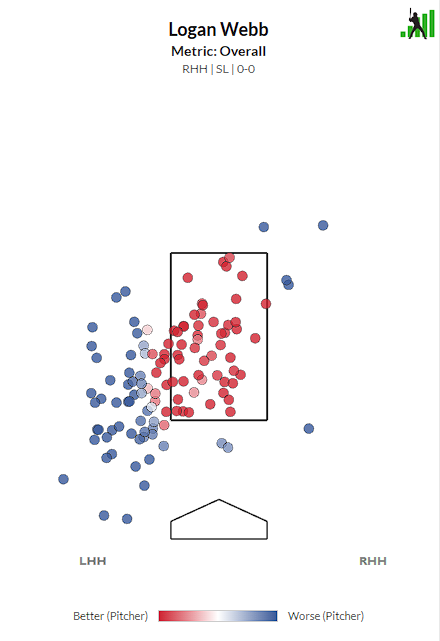
That’s a pretty ugly chart (51 overall, 46 command). It’s as though removing a person from the left-handed batter’s box gave Webb an uncontrollable compulsion to throw the ball out there. The Lab has a Waste Miss Percentage metric, which basically measures missed locations outside the strike zone that lead to bad overall pitches. That chart up above has a 47.1% waste miss percentage, a horrid number. Against lefties, Webb’s WM% was a mere 29%. And lefties are supposed to be the tougher matchup, not the easier one.
When Webb got to two strikes against righties, he kept fishing off the edge. That works slightly better with two strikes, but on the other hand, he moved his locations off the plate even more:
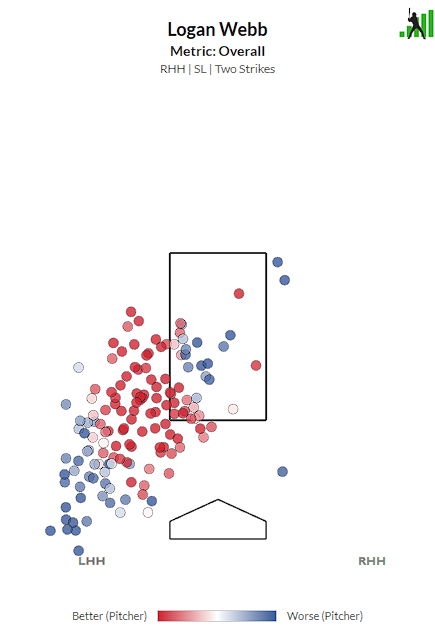
That’s a picture of poor location (40 command grade) saved by elite stuff, resulting in a 54 overall grade. But that’s still bad! And in fact, Webb induced a career-low swinging strike rate against righties with his sweeper last year.
Some of this is just the effect of splitting stuff up into small samples. In 2024, Webb managed a bit more precision with two strikes and did considerably better:
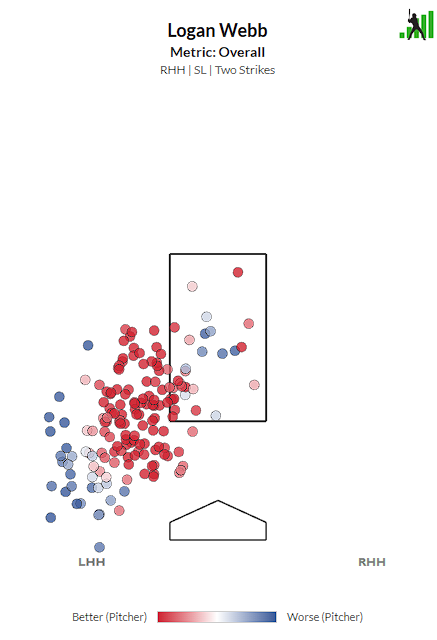
That’s fewer waste pitches and also fewer meatballs, an excellent combination. But when he lost just a bit of that sharpness, the results plummeted. Perhaps it was the result of throwing a wider pitch mix in 2025, as some pitchers have noted a loss of feel on some breaking pitches when they add cutters. Perhaps it was just random chance. Whatever you want to pin it on, though, Webb really did struggle with his sweeper against righties in 2025, and he really did excel with it against lefties, particularly to open the count.
That’s the end of the story, right? Well, not so fast, my friend. Because Webb did terribly against lefties in 2025! He was as bad as he’s been at any point since turning into an ace. Platoon splits are notoriously noisy, but it gets a lot more confusing when you add in the fact that his best secondary pitch had big splits in the opposite direction of his overall numbers.
Some of it can be explained with another dip back into the Lab. Webb throws a lot of sweepers early in the count to lefties, but he goes to other options when he gets deep in the count. His normal two-strike option is a changeup. But unfortunately, Webb just didn’t execute that pitch well in 2025. I’m going to switch to command grades here to illustrate. See, in 2023, the first year he threw a changeup that looks roughly like the current model, he pounded the bottom of the zone with two strikes:
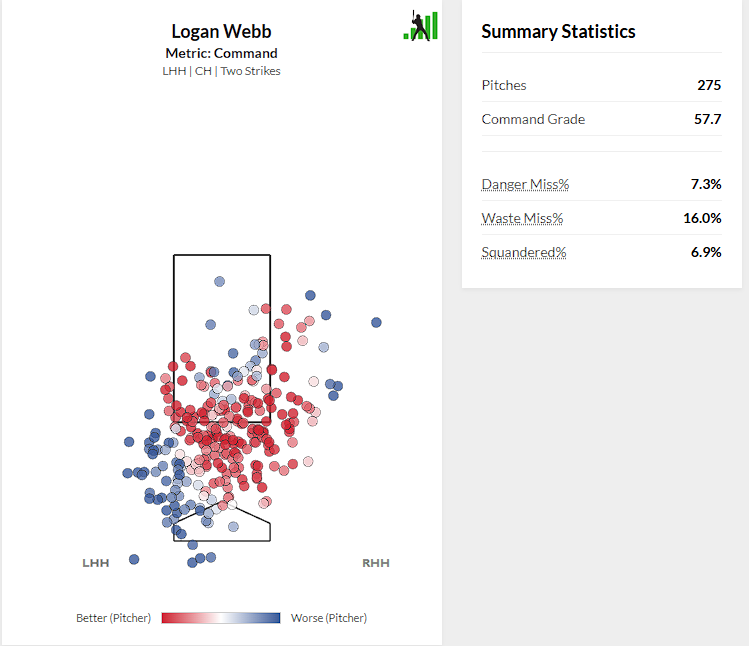
I introduced you to Waste Miss Percentage earlier. Danger Miss Percentage is the opposite: bad pitches that are bad because they missed over the heart of the plate. Squandered Percentage is the percentage of pitches that have great stuff but very poor locations. In 2023, Webb didn’t leave many in danger, didn’t waste many, and didn’t squander many. Pretty, pretty good. In 2024, it was more of the same:
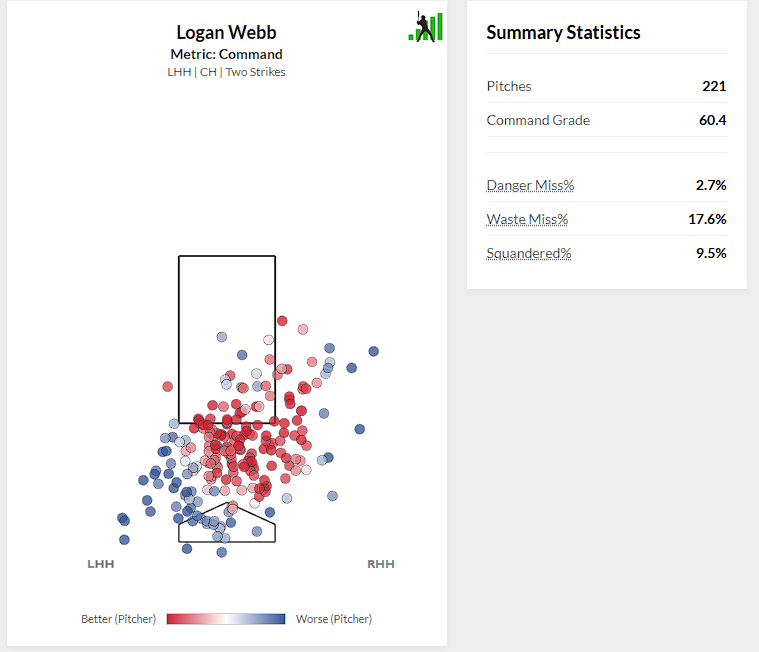
But in 2025, he couldn’t keep that tight cluster of pitches right below the zone. His changeup leaked a little bit further out of the zone, and he got fewer chases as a result:
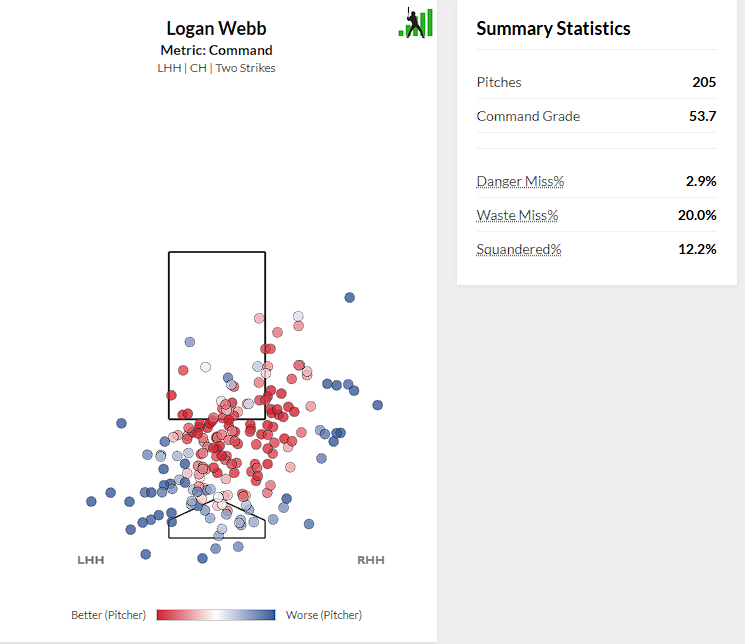
It’s not so much that he turned his changeup into a bad pitch. He just didn’t get the putaways he’s used to from it, and that put a ton of pressure on the rest of his game. Webb is a surgeon with his sinker, but it’s meaningfully worse against lefties, and also meaningfully worse at missing bats, so he went to four-seamers and cutters when he needed other options in two-strike counts.
Webb’s four-seamer is not a good pitch. He obviously knows that – he throws it sparingly and mostly in spots his sinker is abysmally suited for – but that doesn’t change the fact that this wasn’t getting it done:
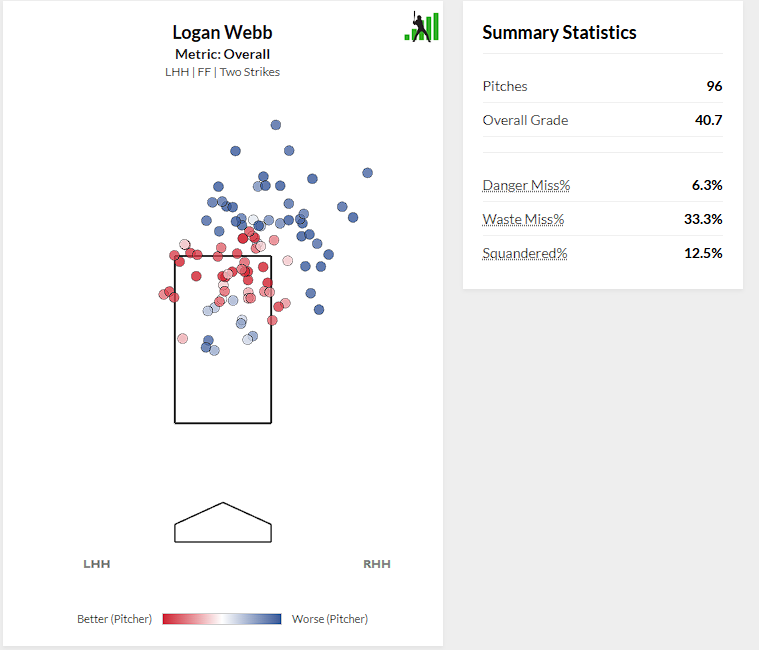
Combine a meh location with a meh shape, and you get a poor pitch overall. Webb just doesn’t have the right kind of four-seamer to draw whiffs above the top of the zone. His cutter was a smidge better, but it’s more of a setup pitch than a hammer. He threw 148 in early counts and only 31 with two strikes. Without a steady diet of perfect changeups, he simply had to lean on the four-seamer too much.
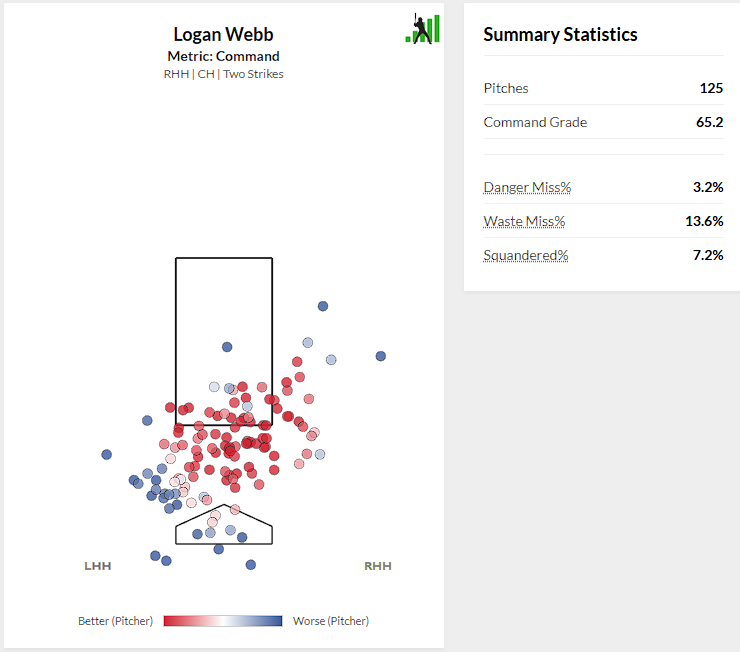
Meanwhile, even poor two-strike sweeper locations couldn’t slow Webb down against righties. He had his changeup – devastatingly effective even against same-handed batters – on a string against righties even while he struggled to place it against lefties:
He wasn’t afraid to pump sinkers in the zone, either:
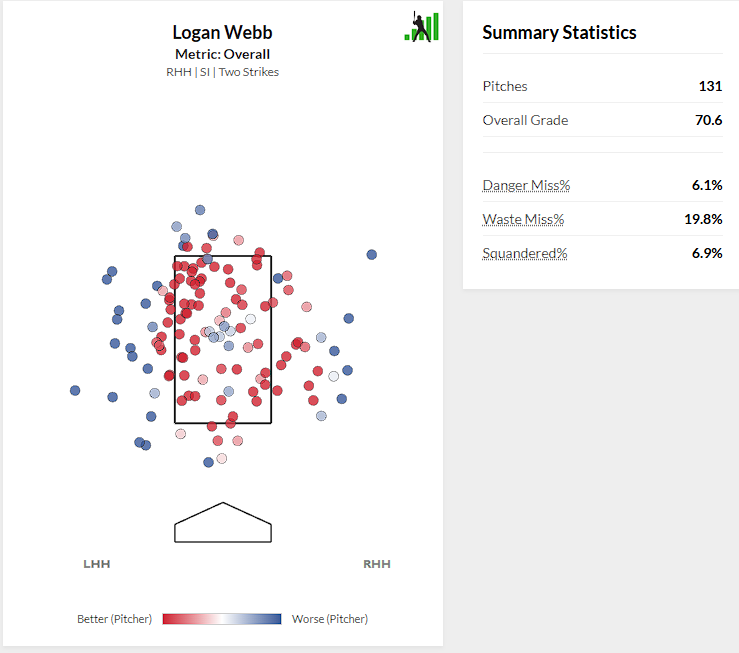
The end result was that even though he kept missing wide with his sweeper, it didn’t matter. He just came back and got the hitter on the next pitch more often than not, thanks to his expansive arsenal. It was just the opposite with his lefty sweeper: It got him into a lot of advantageous counts, but his subsequent pitches squandered those counts. Put it together, and you get a big platoon split, and a big reverse platoon split on the sweeper in particular.
One takeaway of this is that pitch-and-count splits are noisy. In 2025, Webb had great changeup command against righties and so-so changeup command against lefties even though he was aiming at the same spot against both, not a pattern I’d bet on continuing. Another takeaway: The grades really do drive results. You can see the graphical evidence; in years where Webb’s command has been less sharp, his grades and results have suffered. And one player-specific takeaway: Webb’s right-on-left sweeper is a gem of a pitch, one that I wouldn’t have discovered without taking a long look at what our model thinks about his command and stuff.
That pitch didn’t help Webb too much in 2025, because he couldn’t get lefties out anyway. But he got ahead in the count against lefties at a career-high rate, and if he regains the feel for his changeup in two-strike counts, it’s not hard to imagine a very different result against lefties next year. Heck, if I were Webb, I’d mix in more sinkers too – lefties aren’t that great against them, even though they’re far less helpless than righties.
The pitch model can’t explain baseball in its entirety, but it can provide a lot of helpful context. Why did Webb post great results against lefties with his sweeper in 2025? He located it well and used it in smart counts. Why did he post poor results against lefties overall in 2025? Because he couldn’t win after he got ahead. Likewise, why did he struggle to retire righties with his sweeper last year? It was a location thing. But it didn’t matter, because his other pitches were just too good. That’s how you can get the weird divergence of pitch-level and pitcher-level splits – and it doesn’t hurt that it’s also pretty to look at.
Ben is a writer at FanGraphs. He can be found on Bluesky @benclemens.
Part of me wonders if the sweeper out of the zone against righties made the change-up play up, and change-ups out of the zone made the sweeper play up against lefties