Los Angeles Angels Top 36 Prospects

Brett Davis-Imagn Images

Below is an analysis of the prospects in the farm system of the Los Angeles Angels. Scouting reports were compiled with information provided by industry sources as well as my own observations. This is the sixth year we’re delineating between two anticipated relief roles, the abbreviations for which you’ll see in the “position” column below: MIRP for multi-inning relief pitchers, and SIRP for single-inning relief pitchers. The ETAs listed generally correspond to the year a player has to be added to the 40-man roster to avoid being made eligible for the Rule 5 draft. Manual adjustments are made where they seem appropriate, but we use that as a rule of thumb.

A quick overview of what FV (Future Value) means can be found here. A much deeper overview can be found here.

All of the ranked prospects below also appear on The Board, a resource the site offers featuring sortable scouting information for every organization. It has more details (and updated TrackMan data from various sources) than this article and integrates every team’s list so readers can compare prospects across farm systems. It can be found here.

Angels Top Prospects
Rk Name Age Highest Level Position ETA FV
1 Tyler Bremner 21.8 R SP 2026 50
2 George Klassen 24.0 AAA SP 2026 50
3 Trey Gregory-Alford 21.7 A SP 2028 45+
4 Hayden Alvarez 18.9 A CF 2029 45+
5 Nelson Rada 20.4 AAA CF 2026 45
6 Denzer Guzman 22.0 MLB SS 2026 45
7 Ryan Johnson 23.5 MLB MIRP 2026 45
8 Juan Flores 20.0 A+ C 2028 45
9 Johnny Slawinski 18.9 R SP 2030 40+
10 Joel Hurtado 25.0 AAA SP 2026 40+
11 Marlon Quintero 19.2 A C 2029 40+
12 Joswa Lugo 19.0 R SS 2030 40+
13 Yilver De Paula 18.0 R SS 2031 40+
14 Chris Cortez 23.3 A+ SIRP 2026 40
15 Chase Shores 21.7 R SIRP 2026 40
16 Raudi Rodriguez 22.6 A CF 2029 40
17 Sam Aldegheri 24.4 MLB SP 2026 40
18 CJ Gray 19.0 R SP 2031 40
19 Gabriel Davalillo 18.2 R 1B 2031 40
20 Dylan Jordan 20.3 A SP 2028 40
21 Samy Natera Jr. 26.2 AAA SIRP 2027 40
22 Keythel Key 22.3 AA SIRP 2027 40
23 Walbert Urena 22.0 AAA SIRP 2027 40
24 Capri Ortiz 20.8 A+ SS 2027 40
25 Peyton Olejnik 23.2 A SIRP 2029 40
26 Barrett Kent 21.3 A SP 2029 40
27 Talon Haley 20.0 R SP 2030 40
28 Jeyson Horton 16.9 R SS 2031 40
29 Yeferson Vargas 21.5 A+ SIRP 2029 35+
30 Cody Laweryson 27.7 MLB SIRP 2026 35+
31 Camden Minacci 24.0 AA SIRP 2026 35+
32 Ubaldo Soto 19.5 A SP 2030 35+
33 Junior Suriel 17.4 R RF 2031 35+
34 Jhon Almonte 19.2 R MIRP 2030 35+
35 Carlos Castillo 17.3 R OF 2031 35+
36 Kendri Fana 17.0 R RHP 2031 35+
Reading Options
Detail Level
Data Only
Full
Position Filter
All

50 FV Prospects

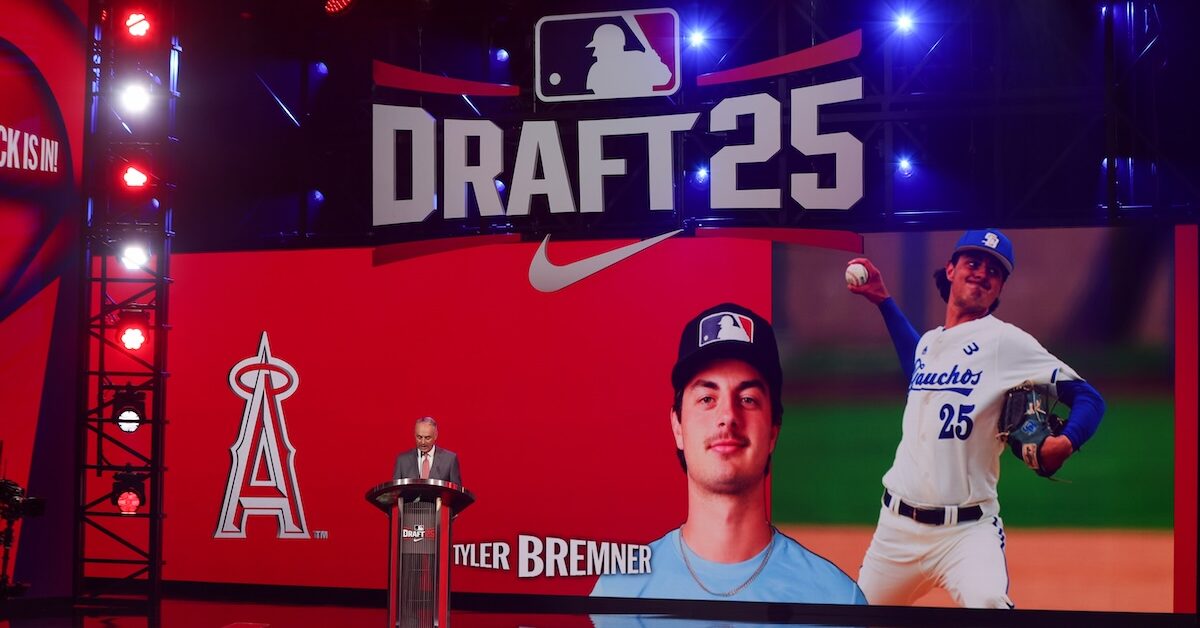
1. Tyler Bremner, SP

Drafted: 1st Round, 2025 from UC Santa Barbara (LAA)
Age 21.8 Height 6′ 2″ Weight 190 Bat / Thr R / R FV 50
Tool Grades (Present/Future)
Fastball Slider Changeup Command Sits/Tops
55/55 45/55 65/70 40/55 93-97 / 98

The Angels held the draft’s second overall pick in a year characterized by a lack of consensus at the top. True to form, they passed on the higher-ceiling talents expected to go within the first few picks in order to take the draft’s most big league-ready player in Bremner. Were this the NFL, they likely could have traded down to do this. They did manage to sign the former Gaucho for $2.5 million under slot and were able to spread the savings throughout the rest of their draft. Still, consensus was that this was a bit of an overdraft.

Setting aside your and my opinion on the wisdom of the Angels’ draft strategy — see the System Overview for more on that subject — Bremner is a very good pitching prospect. He’s an above-average athlete with an innings-eater’s frame and a long history of peppering the strike zone. His walk rate across three seasons of college baseball was under 2.5 per nine, and he missed a ton of bats alongside. Most of that is due to his 70-grade changeup, a pitch that stands out immediately for its devastating sink, late depth that works against both lefties and righties. He also misses bats with his sinker, which is a little strange, but it works in part because the separation between it and the change has hitters guessing. Finding a better slider is the big developmental goal here, as Bremner’s flashes, but its shape is inconsistent and, uncharacteristically, so is his feel for it.

The big question here is how much learning on the job the Angels will prescribe for Bremner. Each of L.A.’s last three first-round picks boat raced to the big leagues in less than a year, an aggressive timeline that reflects the organization’s tendency to push talented farmhands quickly. Bremner has been invited to big league camp, and while you wouldn’t think he’s likely to crack the club out of spring training, the Angels did that very thing with last year’s second-round pick, Ryan Johnson, who was even greener. Bremner’s control, command, and out pitch would make him a candidate to move quickly in any organization, but my instinct is that it wouldn’t be the worst thing for him to sharpen his slider in a developmentally-appropriate environment. We’ll see if the Angels think overwise.

You Aren't a FanGraphs Member
It looks like you aren't yet a FanGraphs Member (or aren't logged in). We aren't mad, just disappointed.
We get it. You want to read this article. But before we let you get back to it, we'd like to point out a few of the good reasons why you should become a Member.
1. Ad Free viewing! We won't bug you with this ad, or any other.
2. Unlimited articles! Non-Members only get to read 10 free articles a month. Members never get cut off.
3. Dark mode and Classic mode!
4. Custom player page dashboards! Choose the player cards you want, in the order you want them.
5. One-click data exports! Export our projections and leaderboards for your personal projects.
6. Remove the photos on the home page! (Honestly, this doesn't sound so great to us, but some people wanted it, and we like to give our Members what they want.)
7. Even more Steamer projections! We have handedness, percentile, and context neutral projections available for Members only.
8. Get FanGraphs Walk-Off, a customized year end review! Find out exactly how you used FanGraphs this year, and how that compares to other Members. Don't be a victim of FOMO.
9. A weekly mailbag column, exclusively for Members.
10. Help support FanGraphs and our entire staff! Our Members provide us with critical resources to improve the site and deliver new features!
We hope you'll consider a Membership today, for yourself or as a gift! And we realize this has been an awfully long sales pitch, so we've also removed all the other ads in this article. We didn't want to overdo it.
Drafted: 6th Round, 2023 from Minnesota (PHI)
Age 24.0 Height 6′ 2″ Weight 170 Bat / Thr R / R FV 50
Tool Grades (Present/Future)
Fastball Slider Changeup Cutter Command Sits/Tops
55/60 55/60 40/40 60/60 35/40 96-98 / 101

Drafted as a wild card — emphasis on the wild — with a strong arm, Klassen’s feel for the strike zone improved right away in pro ball. He made just 14 starts in the Phillies system before the Angels acquired him as the headline return in the Carlos Estévez trade (Samuel Aldegheri was the other player) back in 2024. He shaved another two percentage points off his walk rate in 2025, a season in which he had trouble preventing runs but otherwise performed well: He notched a 3.21 FIP and struck out more than 11 batters per nine. After a rough month of June, he shoved down the stretch at Double-A and was promoted to Salt Lake for his final start of the season.

Klassen has some of the best stuff in the system. His fastball sits in the upper 90s, hard enough to play despite less than ideal shape. His cutter and slider are both monsters, plus pitches with nasty late break and miss rates north of 40%. The cutter looks like a tight slider and the slider like a sharp power curve. Regardless of what he calls them, they’re good enough to work against lefties, a necessity for him given his change. He has one, and the arm speed on it is fine, but his feel for it lags, as it doesn’t move a whole lot and isn’t often in enticing locations. On stuff, he’s nearly a finished product, unless you want to put a ton of work into the change. The slower of his breaking balls can spin out on him, but he’s otherwise got weapons that will work reliably right now.

Even as he’s progressed as a strike-thrower, Klassen’s command remains below average. He’s athletic and flexible, with enviable hip and shoulder separation, but there are markers in his delivery that suggest his feel for location will likely remain crude. He has the dreaded inverted W arm action and a long path to go with it, both of which make it difficult for him to time his delivery consistently. He’s also a heel grinder with a high-effort finish. It’s not so violent that he can’t throw strikes, but he is on the starter/reliever line.

A team in the Angels’ situation has every incentive to keep Klassen stretched out and hope for the best, which in our estimation would be a no. 3 with strong production, if without much length. And even though he’s barely averaged four innings per start as a minor leaguer — and threw 108.2 innings in 25 starts last year — there are reasons to think he can get there. The stuff speaks for itself, and the trendline on length is positive: After a rough beginning to the season, Klassen completed at least five frames in 11 of his last 12 outings, including a seven-inning, 109-pitch performance in his final Double-A start. That’s a starter’s workload in modern baseball, and there’s no reason to pull the plug now. Klassen has high-leverage relief as a fall back if it doesn’t work out, with legitimate closer upside in short stints.

45+ FV Prospects

Drafted: 11th Round, 2024 from Coronado HS (CO) (LAA)
Age 21.7 Height 6′ 5″ Weight 235 Bat / Thr R / R FV 45+
Tool Grades (Present/Future)
Fastball Slider Curveball Changeup Command Sits/Tops
50/60 45/55 40/45 45/55 40/50 96-99 / 101

Gregory-Alford is a strapping young righty with a fast arm and a frontline starter’s frame. A somewhat late-blooming high school prospect, he gained a ton of arm strength late in his amateur career, and was seen as a first- or second-round talent in the 2024 draft. The Angels selected him in the 11th and gave him the second-largest bonus in their draft class, nearly $2 million.

Gregory-Alford sits in the upper 90s and touches 101. It doesn’t come with a lot of extension or vertical break, and his open stride limits how deceptive he is, but this is a situation where we don’t need to get cute: Fastballs this hard tend to play, and so far TGA’s has. He shows nascent feel for moving it around the plate, and opponents have mostly just beat it into the ground so far. It’s a plus pitch. Both his slider and change project above average. The runway isn’t short on those — his slider can get cutterish, and the shape of his change isn’t yet consistent — but they flash often enough to stay on them. He also has a curve, which looks soft and not terribly effective to my eye; he doesn’t use it a whole lot anyway.

Gregory-Alford is an Angels type of pitcher. The org likes guys who throw hard, they teach their pitchers to establish the fastball, and they don’t seem to place much emphasis on shapes and angles relative to the rest of the league. It doesn’t always work; Jack Kochanowicz had a similar profile and he can’t miss bats at all. We’ll run into this pattern over and over again on this list, and it’s part of the reason that some of their pitching prospects have stagnated over the years. To twist the analogy a bit, it’s sort of like every pitcher in this system must be a hammer because they’re all banging away at nails.

Gregory-Alford is at least a massive, powerful hammer. He’s not the worst fit for Los Angeles’ development system, either, as the limitations posed by his fastball shape and lack of deception will require him to command his heater; he’ll get plenty of practice. He was close to making our Top 100 this cycle, and any improvement in his secondaries will almost certainly earn him a spot on the next edition.

Signed: International Signing Period, 2024 from Dominican Republic (LAA)
Age 18.9 Height 6′ 3″ Weight 190 Bat / Thr R / R FV 45+
Tool Grades (Present/Future)
Hit Raw Power Game Power Run Fielding Throw
30/50 45/55 30/50 55/55 40/50 50

Alvarez signed for $685,000 in the 2024 international class and has quietly blossomed into one of the top prospects in the system. His introduction to stateside ball was a smashing success. He hit .335/.427/.429 on the complex and then similarly battered Cal League arms for a few weeks following an August promotion. A plus athlete and above-average runner, Alvarez has the physical foundation to develop into a five-tool player.

Alvarez is one of those players who stands out just walking off the bus. He’s high-waisted, obviously athletic, and clearly projectable. At the plate, he loads slowly and then accelerates with a controlled violence on his A-swings. There’s both contact feel and barrel manipulation here: He’ll show you a lofted swing on balls low and bending away from him, then turn around and flatten the bat on a fastball up a pitch later. While you can beat him with well-executed spin and he’s not yet consistently mashing fastballs like I think he’ll be capable of doing, he’s performing very well for his age and has the look of a well-rounded hitter without an obvious, hugely exploitable flaw. Under the statistical hood, things look promising as well. His contact rate last year was north of 80%, and while his hard-hit rate was just okay, his 90th-percentile exit velocities are nearly big league average. He doesn’t swing a whole lot, which is somewhat unusual, though not necessarily problematic for an international signee. He’s also a high motor player who plays hard and takes all the extra bases available to him.

Defensively, Alvarez’s speed should allow him to develop into an average center fielder. He isn’t a finished product, and there’s some chance he’ll fit better as a good corner guy depending on how he matures physically. If there’s a knock here, it’s that Alvarez’s well-rounded game is light on carrying tools. He has the look of a good hitter, but not a great one. He should grow into power, but he might not. He’s a possible center fielder, but not a sure thing. Regardless, he’s a highly interesting prospect, a toolsy athlete who projects as a regular in some capacity. Were I scouting for a team, I’d put an everyday grade on him while distributing my outcome bets in a way that reflects the inherent volatility of a teenager barely out of the complex. For us, he slides here, a high-priority follow this spring and summer, and an obvious Pick to Click for next year’s Top 100.

45 FV Prospects

5. Nelson Rada, CF

Signed: International Signing Period, 2022 from Venezuela (LAA)
Age 20.4 Height 5′ 8″ Weight 160 Bat / Thr L / L FV 45
Tool Grades (Present/Future)
Hit Raw Power Game Power Run Fielding Throw
40/55 30/35 20/30 60/60 55/60 30

The Angels are not afraid to throw their minor leaguers into the deep end, and nobody in recent memory has been dealt a tougher assignment than Rada. Fresh off of conquering the Cal League as a 17-year-old in 2023, the team challenged its top position player prospect with a two-level jump to Double-A. Physically overmatched, Rada struggled mightily in the first half and had to battle his way to a .600 OPS by season’s end; the whole episode ignited a debate about the risks and merits of putting your best farmhands through a trial by fire. Fortunately, Rada seems to have emerged no worse for wear. He hit his way out of Rocket City last summer and then notched a very impressive .323/.433/.416 line across 42 games in Salt Lake. Just 20 years old now, Rada is on the cusp of the big leagues and could debut as soon as this spring.

Rada’s game is simultaneously mature and underbaked. Physically, he’s undersized for his surroundings, and his 90th-percentile exit velos are on the 20/30 line. Even if he finds his way to a little more juice, he’s going to be a singles hitter. His approach and the quality of his at-bats belie his young age, though. His 75% contact rate isn’t great on its own, but it’s more than acceptable in context, and both visually and statistically, his swing decisions reflect a seasoned approach and advanced feel for the strike zone. His bat isn’t particularly fast and I have reservations about how long the path is, but it’s otherwise a connected swing, and he’s making enough contact to get the benefit of the doubt for now.

Defensively, Rada is a plus runner and defender who has been making highlight-reel plays in the outfield since he came stateside. He will occasionally misplay a ball in a way that reminds you “oh yeah, he’s still 19,” but in general his breaks off the bat and his ball-tracking skills are what you look for in a plus center fielder. The only long-term concern is his size, as Rada has matured early and he’s a little thicker than your typical plus runner. That doesn’t mean he can’t sustain his wheels over the long haul, but it is something to keep in mind.

One other aspect to monitor: his baserunning. Rada runs early and often, and again swiped more than 50 bags last season. He’s more of a prolific thief than a proficient one, however, as he again was caught about a quarter of the time, south of the break-even point. It would be a real boon for his game if he can find a way to maintain something near that volume while cutting down on the number of outs.

The lack of power here likely makes Rada more of a fourth outfielder or second-division starter than a contender’s regular. It’s possible to play productively every day with 30 power, but it’s increasingly difficult in today’s game. That would look something like hitting .270 and taking a few walks while playing plus defense — in the realm of possibility, if tricky to maintain year over year. I’d bump Rada to a 50 if I felt more confident that he had a path to 40 raw, but he looks pretty close to physically maxed out to me. If he exceeds this projection, there’s a good chance it’s because I’m wrong about that last point.

Signed: International Signing Period, 2021 from Dominican Republic (LAA)
Age 22.0 Height 6′ 1″ Weight 180 Bat / Thr R / R FV 45
Tool Grades (Present/Future)
Hit Raw Power Game Power Run Fielding Throw
20/30 45/55 40/45 60/60 50/60 60

After years of aggressive promotions and just trying to tread water at the plate, Guzman finally got to repeat a level in 2025 and produced his best offensive season to date. In 93 Double-A games, he posted a 126 wRC+ while notching the lowest strikeout rate of his career. A newfound power stroke explains the production, as the 11 homers he hit in Rocket City nearly equaled his dinger total for 2023 and 2024 combined; he hit 19 on the season, including two during his September big league debut.

Guzman’s feel to hit remains crude. He has a quick bat but also a grooved, uppercut swing. He needs to get his arms extended to drive the ball and is vulnerable in on his hands as well as up; he’ll also chase spin down and away. Some of this will get better as Guzman acclimates to age-appropriate competition, but this is a guy who has always struck out a lot, and that figures to remain part of the equation.

Guzman is a plus defender at short. It can sneak up on you, as his long strides give him a knack for covering ground deceptively quickly, and his powerful arm allows him to make plays deep in the six hole. He could be a regular if he can keep the strikeouts in check and reliably tap into his power; a peak like this could resemble Paul DeJong’s. More likely, he plays a long time as a utility infielder with enough pop to be dangerous but too much swing-and-miss to play every day.

7. Ryan Johnson, MIRP

Drafted: 2nd Round, 2024 from Dallas Baptist (LAA)
Age 23.5 Height 6′ 6″ Weight 215 Bat / Thr S / R FV 45
Tool Grades (Present/Future)
Fastball Slider Changeup Cutter Command Sits/Tops
50/50 55/55 35/45 50/50 45/60 92-94 / 98

Johnson was a second-round comp pick in the 2024 draft. He didn’t throw that summer, so when he broke camp in the Angels bullpen in 2025, he became the first player since Garrett Crochet to skip the minor leagues entirely. In the bigs, Johnson missed bats but also took his lumps when hitters did connect. After a rough month and a half, the Angels pulled the plug. The cultural transition from Los Angeles to Pasco is jarring, but he nonetheless thrived in High-A, posting a 1.88 ERA with 65 strikeouts and just 10 walks in 57.1 innings.

Johnson is a great watch. To say that he’s deceptive with a low slot and variable timing to the plate is true, but doesn’t really do him justice. He has an old school, hand-over-the-head delivery and, like a penalty taker reading a goalie, it’s almost looks like he’s eyeing the hitter to see how quickly he should accelerate toward the plate from there. You can kind of see why the Angels pushed him: He utterly overwhelmed college hitters (and wound up doing the same at High-A), and perhaps it was worth a shot to see if the funk translated to the highest level.

That it didn’t in the short run doesn’t mean it won’t down the line. Johnson isn’t just an oddball with deception, he’s got real stuff. His cutter and sinker touch 96 and 97, respectively, and diverge in a way that makes him unpredictable. His sweeping slider misses a ton of bats, and while the change is a work in progress — his best have decent arm speed and sink, but his execution lags — it too flashes average. And he’s doing this with the pitchability you’d expect, adding and subtracting while peppering the edges. He projects as a backend starter, and could work in either short relief or a hybrid role if big leaguers don’t let him get away with his bag of tricks multiple times through the order.

8. Juan Flores, C

Signed: International Signing Period, 2023 from Venezuela (LAA)
Age 20.0 Height 5′ 10″ Weight 180 Bat / Thr R / R FV 45
Tool Grades (Present/Future)
Hit Raw Power Game Power Run Fielding Throw
20/30 40/50 20/35 30/20 55/70 60

Flores is one of the best defensive catchers in the minor leagues. Everything from his athleticism behind the plate to his receiving ability and arm strength to his intangibles — he’s bilingual and was reportedly very well liked by the pitching staff in Tri-Cities last year — is top notch, even though the Venezuela-native is only 19 years old. The scale is only good if you use all of it, and this is the best minor league defender I ran into in my time as a scout. Angels PD folks would tell you he’s been good enough to catch in the big leagues for a couple years now, and I agree.

The question here is whether Flores will hit enough to hit in the back of a lineup or if he’s destined for a reserve role. It’s important to be patient. Catchers develop slowly as hitters generally, and in Flores’s case, the quality of his glove and his employer’s development philosophy have led him further up the minor league ladder faster than his bat warrants. He looked stronger year-over-year, a positive for a kid who’s not all that big. I see a path to average raw and a swing that lets him yank fastballs inside-out to left. It’s the foundation of an offensive profile that could get him in the lineup some day.

The rest of his game lags, though. Partially in response to trying to tread water against older pitchers, Flores has adopted an extremely aggressive approach. He’s often on his front foot and tends to make soft contact on pitches he should leave. If you want to look on the bright side, Flores hit nearly .270, with eight of his 10 homers coming in the season’s final two months, and then performed well in the Fall League. It didn’t come with a better approach, but for a guy who had gotten carved in his first four months of High-A, any positives will do.

You can argue for a 50 FV here. Seventy-grade catchers are rare and extremely valuable if there’s any kind of offense to go with it. Even when there’s not, Martín Maldonado’s career demonstrates what teams are willing to stomach on offense if they think their backstop is putting his pitchers in a position to succeed. Flores has a chance to be that kind of guy, and he’s correspondingly valued here despite my serious reservations about his bat.

40+ FV Prospects

Drafted: 3rd Round, 2025 from Johnson City HS (TX) (LAA)
Age 18.9 Height 6′ 3″ Weight 180 Bat / Thr L / L FV 40+
Tool Grades (Present/Future)
Fastball Slider Changeup Command Sits/Tops
40/50 45/50 45/55 30/60 90-93 / 95

Slawinski became the first player ever selected out of his high school when the Angels popped him in the third round. He’s a low-to-the-ground lefty with precocious fastball command and intriguing projectability. He looked a lot looser and more athletic as a senior than he did the year before, and alongside, his velo ticked up from the upper 80s into the low 90s, a breakout that netted him a $2.5 million bonus. A flat angle and good ride help his heater play ahead of the number, as does Slawinski’s command. His mechanics vary when he throws his changeup (tailing action and fade, flashes above average) and breaking pitches (more head whack), but his feel for locating them is good. He’s an interesting pitchability prospect and a bit of a departure from the profile the Angels normally target in the draft.

10. Joel Hurtado, SP

Signed: International Signing Period, 2022 from Dominican Republic (LAA)
Age 25.0 Height 6′ 2″ Weight 220 Bat / Thr R / R FV 40+
Tool Grades (Present/Future)
Fastball Slider Changeup Command Sits/Tops
55/55 55/60 45/55 40/45 93-97 / 98

Hurtado has long been a personal favorite, a live-armed righty with a good slider who signed for peanuts as a very old international amateur back in 2022. He touches the upper 90s and sits in the mid-90s with his fastballs (he throws both a two- and four-seamer), and has tended to lean on the gas even though both his slider and change are far better at generating swing-and-miss or weak contact.

His other historical bugaboo has been control. Hurtado posted a BB/9 over five in 2024, and both his command and velo tended to slip in the later innings. But he managed to halve his walk rate at Double-A last year, down to 2.8 per nine, and did so even before he spent most of August and September working in shorter stints following a couple months on the shelf. It came alongside his lowest strikeout totals to date, but on the whole, he looks more likely to start than he did a year ago.

Hurtado should probably stop throwing his four-seamer, which has some of the worst mix of traits and opponent performance in the system. Even in the upper 90s it never misses bats, and hitters posted an xwOBA north of .400 against the pitch, a bad combination in any case, and a brutal one for him given the viable alternatives. Leaning on the sinker — which at least generates groundballs — and using his change and slider to miss bats (they ran a 45% and 31% miss rate respectively, per Synergy) seems like the tonic. He may simply lack the deception to stick as a starter in the long run, but a change in his mix will suit him in either role, and it’s a plausible path forward.

I still see a chance for Hurtado to profile as a no. 4. Among other things, he’s one of the few minor leaguers in all of baseball with experience throwing 100 pitches and working into the seventh. To get there would require an adjustment in how he attacks, and it’s perhaps more reasonable to expect a backend starter or middle relief outcome.

Signed: International Signing Period, 2024 from Panama (LAA)
Age 19.2 Height 5′ 9″ Weight 175 Bat / Thr R / R FV 40+
Tool Grades (Present/Future)
Hit Raw Power Game Power Run Fielding Throw
30/50 35/45 20/40 45/40 45/60 70

Another catcher, another 70 tool. Quintero was a slick find by Los Angeles’ international group, a $25,000 signee from Panama in the 2024 international class who has already reached Low-A. Between his feel for contact and his defensive chops, he’s got a chance to develop into a contributor on both sides of the ball.

Quintero’s work behind the plate is his calling card, and I worry that I haven’t graded his arm aggressively enough. He has the trifecta: a quick windup and release, remarkable accuracy, and a cannon for an arm. He regularly produces pop times in the low-1.80s and in a “God loves all his children” sense, it’s tough to pick my favorite one of his throws. I’ll go with the time a runner broke for third, got a good jump, picked a decent pitch to run on and was still out by eight feet, dead to rights before his butt hit the dirt on a throw Quintero made from his knees. For some reason, 37 runners tried to steal on him in just 18 Low-A games, and he threw 49% of them out. He’s doing this out of the crouch, instead of a one-knee setup, which should be just fine given the new ABS rules. He’s not much of a framer yet — he’s hardly trying — but to the extent that matters in this new environment, it’s a skill he can develop in time.

There’s a projectable hit tool here, too. Quintero tracks pitches well. He’s good at putting the bat on the ball — his contact rate was 80% and he didn’t strike out much at either level — and shows some ability to adjust off the fastball. His bat isn’t fast, but it isn’t slow either. He keeps his head on the ball and while he’ll sometimes cut off his front side, at others he’s beautifully connected. He’s not hitting for a whole lot of power now, and isn’t especially projectable. The bigger concern is his proclivity to expand the zone. He’s easily lured out of it, particularly on spin, which he’ll often chase into the next county.

The hope here is that Quintero sands the edges on his approach enough to let the hit tool play to its potential, but the defensive side of his game gives him a high floor even if he never develops a lot of thump. The broad outline is similar to Flores, and like his barely-elder teammate, Quintero has the upside of a glove-first regular.

12. Joswa Lugo, SS

Signed: International Signing Period, 2024 from Dominican Republic (LAA)
Age 19.0 Height 6′ 2″ Weight 175 Bat / Thr R / R FV 40+
Tool Grades (Present/Future)
Hit Raw Power Game Power Run Fielding Throw
20/40 40/60 20/55 60/60 40/50 60

Lugo is a toolshed who signed for $2.3 million in the 2024 international window. He has three plus tools on the card already, and he’s way ahead of schedule in the power department. His 90th-percentile exit velos were the fourth highest in the org, sandwiched between Jorge Soler and some guy named Mike Trout. It comes with a fair amount of swing and miss, particularly on spin, but not so much that we’re already out on his chance to hit.

If anything, the looming problem isn’t how often he hits it, but where. He has bat speed but also a downhill swing plane, and despite all that pop, he homered just twice in 35 games on the complex. He hits the ball hard enough to be productive anyway, but there are some looming choices and tradeoffs to monitor at the plate. Defensively, Lugo has remained spry enough to play short exclusively, where he’s off to a somewhat error-prone start. The result is little change to last year’s high-variance forecast.

13. Yilver De Paula, SS

Signed: July 2nd Period, 2025 from Dominican Republic (LAA)
Age 18.0 Height 5′ 11″ Weight 180 Bat / Thr R / R FV 40+
Tool Grades (Present/Future)
Hit Raw Power Game Power Run Fielding Throw
30/55 35/50 20/50 55/55 35/50 50

De Paula signed for $900,000 in the 2025 international class and may prove to be the best prospect from the Angels’ group. He’s a twitchy athlete, an above-average runner with a quick bat and a controlled, somewhat flat swing. He only played 10 games in the DSL before a shoulder injury knocked him out for the year, but what a 10 games they were: He hit .387/.525/.484 with a homer, seven walks, and just six punchouts in 40 plate appearances. He got the bat and the barrel on just about everything, and while I’m leery of getting too excited about a guy with basically no pro experience and precious little available on video, what little info we have is all very positive. He’s a sleeper and one of the guys I’m most excited to see play this spring.

40 FV Prospects

14. Chris Cortez, SIRP

Drafted: 2nd Round, 2024 from Texas A&M (LAA)
Age 23.3 Height 6′ 1″ Weight 205 Bat / Thr R / R FV 40
Tool Grades (Present/Future)
Fastball Slider Changeup Command Sits/Tops
55/60 50/60 40/45 35/45 97-99 / 101

Cortez was the Angels’ second-round pick in 2024, signing for nearly $1.6 million. After working primarily as a reliever in school, he started all 26 of his outings in High-A last season. There, he struck out a batter per inning and rolled up a 61.8% groundball rate, but also walked more than 16% of hitters. Between his heel grind, a big head whack, and a grunty, high-effort delivery, he’s a high-probability reliever.

He’ll be a somewhat non-traditional reliever too, considering how his stuff works. His two-seamer has a good blend of sink and tail, and given the way he was able to live in the mid-to-upper 90s as a starter, you’d think he’ll touch triple digits in shorter stints. He pairs the pitch with a tight, two-plane slider that flashes plus, and a change that looks like a softer version of the sinker.

Cortez’s control and command are a little tricky to peg. On the one hand, there are all the walks. He’s often not in the zone and he tends to pull the slider down and glove side, sometimes pretty wide of the mark. On the other hand, his pitch plot is remarkably well defined, with barely any dots at all in the upper third of the zone. That’s evidence of intent, and the forecast here is for command and control ahead of what you might expect given all the free passes. There’s high-leverage upside if he can more reliably turn that feel for a region into strikes, and with his ability to throw multiple frames and generate grounders, a fully-formed Cortez could give managers a lot of flexibility to pick and choose their spots with him. Ultimately, he’s a reliever, but he could be a pretty interesting one.

15. Chase Shores, SIRP

Drafted: 2nd Round, 2025 from LSU (LAA)
Age 21.7 Height 6′ 8″ Weight 245 Bat / Thr R / R FV 40
Tool Grades (Present/Future)
Fastball Slider Changeup Command Sits/Tops
55/60 45/55 40/50 30/50 95-98 / 100

Shores finished his injury-plagued college career at LSU on the highest possible note, racking up a 2.2 inning save to close out the College World Series. It’s easy to imagine him working in a similar role professionally, as Shores has big arm strength, a projectable breaking ball, and a few other traits that suggest a relief or hybrid fit.

Like the club’s first pick of last year’s draft, Shores was taken a bit ahead of where most had him projected. And as with many Angels prospects, he throws hard with round-down traits on his fastball. A huge guy, his heaters have downhill angle even though he throws out of a lower slot. That and very little vertical break makes the four-seamer in particular very reliant on velo to miss barrels. His hard slider is the chase pitch, a sweeping breaking ball that flashes plus when he runs it off the plate glove side, but that’s also prone to backing up on him. He also has a fading change that was lightly used in college.

Between rust — the righty blew out in 2023 and missed most of two seasons — and his immense stature, it’s not surprising that Shores has trouble throwing strikes and hitting spots. What we don’t know is how well he’ll be able to grow in that regard as his career progresses. On the one hand, he’s a solid-average athlete with pretty good body control for his size and a frame that often requires a little patience. This presents paths to a starting role. Perhaps he’s better able to locate his sinker as he gets further away from surgery. Maybe his change, which moves plenty, ticks up with reps. It’s enough to warrant development as a starter, even if the strike-throwing, fastball shape, inconsistency, and shallow arsenal seem like a ticket for the ‘pen. Were I scouting for a team, I’d recommend exhausting Shores as a starter while turning him in as a 70-30 or 80-20 to wind up in relief.

16. Raudi Rodriguez, CF

Drafted: 19th Round, 2023 from Georgia Premier Academy (GA) (LAA)
Age 22.6 Height 6′ 0″ Weight 190 Bat / Thr R / R FV 40
Tool Grades (Present/Future)
Hit Raw Power Game Power Run Fielding Throw
30/40 50/60 35/50 55/55 40/50 55

Rodriguez was a late-round flier out of a Georgia high school in 2023, a $100,000 dart throw to see if a toolsy kid could play baseball. Turns out this one can. After two inconsistent years on the complex, Rodriguez broke out in the Cal League and then exploded in the AFL, where he hit .433/.514/.650 in 18 games. He’s on the prospect map now, and his blend of plus power and ability to play center field arguably gives him the highest ceiling among the position players in the system.

If you’re ever in need of a refresher on what plus bat speed looks like, give Rodriguez a look. His swing is ferocious, and despite the effort involved, he’s capable of making mid-flight adjustments on spin and soft stuff. His 90th-percentile exit velos were 106.6 mph last year, which is encroaching on plus-plus territory — it’s less than half a tick behind Jorge Soler, for reference — and he did that while driving balls out from line to line.

We need to see if he can hit better pitching before jumping all in. Rodriguez is an aggressive hitter. He’s looking to drive the ball, and the steepness in his bat path and his tendency to chase make him vulnerable to elevated heat and spin breaking away from him, respectively. His setup isn’t helping with that last part. He starts open and strides further off the plate, which will limit his ability to handle pitches on the outer half. All of this led to a 68% contact rate in 2025, scary for a guy this far away, and all the more so because the quality of pitching in the Cal League last year was not good.

The tools give him a shot anyway. You can tweak a setup and a stride if need be, and while the swing-and-miss is concerning, this is a guy to stay patient with. Remember, Rodriguez just notched a 130 wRC+ in A-ball after seeing very little high-level pitching in his life prior to last year. When in doubt, bet on the athletes. That’s Rodriguez, and even if the hit tool winds up a little light for everyday duty, the power and projectability in center give him a shot to have a career as a fourth outfielder.

17. Sam Aldegheri, SP

Signed: July 2nd Period, 2019 from Italy (PHI)
Age 24.4 Height 6′ 1″ Weight 180 Bat / Thr L / L FV 40
Tool Grades (Present/Future)
Fastball Slider Curveball Changeup Command Sits/Tops
40/45 50/50 40/45 50/55 45/50 89-92 / 94

After a cup of coffee in 2024, Aldegheri found himself back in Double-A for most of the 2025 season. There, amidst a decrease in his average velocity and the vertical break on his fastball, the Italian’s strikeout rate plummeted from 33.5% to 19.9%. His velo had recovered somewhat by the end of the year, when he was again summoned to Anaheim for a couple of starts. The margins are very tight for command-oriented arms without big stuff, so it’ll be important for Aldegheri to maintain what he has over the long haul.

Aldegheri likes to get ahead with his fastball and then lure hitters off the plate with his secondaries. When the slider and change are above average, he can make it work. Even though he’s a loose athlete who can throw strikes, he’s not particularly precise with his command, and is prone to leaving pitches in vulnerable spots. Between that and the velo oscillation, I see him as more of a backend starter than a no. 4.

18. CJ Gray, SP

Drafted: 5th Round, 2025 from A.L. Brown HS (NC) (LAA)
Age 19.0 Height 6′ 2″ Weight 205 Bat / Thr R / R FV 40
Tool Grades (Present/Future)
Fastball Slider Command Sits/Tops
45/55 50/60 20/45 94-96 / 97

Haircuts at the top of the draft allowed the Angels to spread seven-figure bonuses to a few mid-round picks, including Gray. He’s dynamic and twitchy — he had a couple of D1 scholarship offers as a quarterback — with a strong frame and a quick arm. He sits in the mid-90s and touches higher, and has a slider that flashed plus for Eric at the Draft Combine. Gray is a bit of a project: There are a lot of moving parts in his delivery, and his feel and secondaries are rawer than most guys in his draft orbit. But what he lacks in polish, he compensates for in projection, as he’s a good athlete with paths to cleaning up his delivery and throwing harder. He’s a sleeper and one of the guys in Angels camp I’ll be most excited to see this spring.

Signed: International Signing Period, 2025 from Venezuela (LAA)
Age 18.2 Height 5′ 11″ Weight 200 Bat / Thr R / R FV 40
Tool Grades (Present/Future)
Hit Raw Power Game Power Run Fielding Throw
35/55 50/60 30/55 20/20 20/35 60

Davalillo received the Angels’ largest bonus in the 2025 signing period, inking a deal for $2 million. He has big league bloodlines: Grandpa Vic played 16 years in the majors and was an All-Star in 1965. His great uncle had a cup of coffee as well, while his dad spent five years in the minors and his brother David should feature prominently on our Rangers list.

Another thing Davalillo has: power. His exit velocities are already average or a tick better, and he’s able to generate that impact without selling out. He’s a big kid with a fast bat, and while he has some length to the path stemming from a bat wrap, his bat speed is more than enough to compensate. He’s showing hit skill to go with it too, as both his measurable contact rates and the visual evaluation of his approach and pitch recognition skills are very promising. He hit .302/.408/.518, good for a 136 wRC+, in the DSL last year, with more walks than strikeouts. This is an exciting bat.

This isn’t a fun thing to write about anyone, much less a teenager, but there’s no getting around it: Davalillo’s size is a looming problem. Listed at 5-foot-11 and 210 pounds, the latter figure already looks out of date and he’s started moving down the defensive spectrum. Signed as a catcher, he saw time at third during instructs because he lacks the mobility to hang behind the plate, but I’d be surprised if third works either because, again, he’s big. It’s going to be a maintenance body, and his speed might prove an impediment at first, much less the hot corner. Maybe he’s done growing, and it’s certainly possible to play productively in the big leagues with this kind of frame, but he’ll have to work to keep it in check. Provided he can, he’ll go as far as the bat takes him. And even at this young age, “the big leagues” seems like a reasonable forecast.

20. Dylan Jordan, SP

Drafted: 5th Round, 2024 from Viera HS (FL) (LAA)
Age 20.3 Height 6′ 3″ Weight 210 Bat / Thr R / R FV 40
Tool Grades (Present/Future)
Fastball Slider Changeup Command Sits/Tops
45/55 40/45 50/55 35/50 91-94 / 96

Jordan was a high school draftee out of Florida who signed for second-round money. He had a great first year in pro ball, during which he posted a 3.21 ERA over 12 complex outings, then barely allowed a baserunner while striking out a batter per inning in seven starts in the Cal League.

In ways good and not, Jordan is advanced for his age. He’s a strike-thrower who is starting to harness his sinker, which isn’t as easy as it sounds given the pitch’s late, plus movement. He’ll show feel for both lanes on the right night, and he’s thus far been able to induce a ton of soft contact on the ground. His above-average fading change plays well off the sinker, though he slows his arm on it. His breaking ball is fringy, tight but not sharp. It played fine last season, but to my eye, it doesn’t seem like a bat-misser against better hitters. His feel to spin the ball is just okay, so while there may be a way to get him to an average slider, it’s hard to project much more than that.

There isn’t a whole lot of projection elsewhere, either. Jordan has good size, but he’s already nearly physically mature. His arm strength — he sits in the low-to-mid 90s and has touched 96 — is fine but not special, and he produced those readings while working just four innings per start. He’s poised to continue honing his command and get better at executing his secondaries, refinements that feed a backend starter projection.

Drafted: 17th Round, 2022 from New Mexico State (LAA)
Age 26.2 Height 6′ 4″ Weight 225 Bat / Thr L / L FV 40
Tool Grades (Present/Future)
Fastball Slider Command Sits/Tops
50/55 50/60 30/40 93-95 / 97

Natera has good stuff. He sits in the mid-90s and touches 97 with his fastball, a pitch that also has 19 inches of vertical break. He pairs it with an above-average slider that flashes plus, and both offerings miss bats. But Natera is wild and inconsistent. A long arm path and head whack at finish are both markers of substandard location, and help explain a career walks per nine north of five.

Oddly, Natera’s control and walk rates backed up in a switch to relief last season. He mostly kept runs off the board and still struck out his usual high volume of hitters, but the list of guys who are effective big leaguers while walking this many batters is pretty short. Although Natera is 26 now, he’s still somewhat new to pitching, as he was more of a basketball player in high school and then missed time with an elbow issue as a professional. Perhaps that gives him a little more runway to find the strike zone than your average bear. The stuff is good enough to stay patient as he tries, and he projects as a middle reliever with a path to more if he can find a way to hit the box more reliably.

22. Keythel Key, SIRP

Signed: International Signing Period, 2021 from Venezuela (LAA)
Age 22.3 Height 6′ 3″ Weight 180 Bat / Thr R / R FV 40
Tool Grades (Present/Future)
Fastball Slider Changeup Command Sits/Tops
50/60 50/60 35/55 20/40 93-97 / 99

Key has lurked in the lower levels of this system for a while now. He has a live arm, a plus slider, and a projectable change. More pertinently, there’s a massive gap between the quality of his ingredients and how he’s performed statistically, and in some ways, he’s an avatar for all the ways in which the team’s pitching development leaves meat on the bone.

Let’s start with the fastball. Key touches 99 and comfortably holds 95-97 in starts. His Trackman readings vary considerably from pitch to pitch, with some registering upwards of 20 inches of vertical break and others significantly less. Everyone has some level of pitch-to-pitch variance, but Key’s range is notably wide and I don’t have a satisfying explanation as to why. He also doesn’t have a lot of feel for where it’s going, in part because he’s under-developed physically and can’t properly decelerate at foot strike. A lot of Angels pitchers have this problem, but it’s especially stark in Key’s case, both due to how bent his front leg looks through release and how much his command stands to improve if he gets stronger.

The pattern continues with his secondaries, which need refinement but don’t get a lot of run because he’s throwing his fastball more than 60% of the time. The stuff is good enough to start, and Los Angeles is making the right call developing him in longer stints even if he’s a bullpen arm in the end. But everything from his pitch shapes to his usage rates to his physicality suggests that there’s more that can be done here. To say the least, Key is an interesting change-of-scenery candidate.

23. Walbert Urena, SIRP

Signed: International Signing Period, 2021 from Dominican Republic (LAA)
Age 22.0 Height 6′ 0″ Weight 170 Bat / Thr R / R FV 40
Tool Grades (Present/Future)
Fastball Slider Changeup Command Sits/Tops
60/60 40/50 50/60 20/30 94-99 / 101

Urena throws some of the easiest-looking 101-mph heaters you’ll ever see, but he can’t buy a missed bat with the pitch. It’s the starting point for a profile defined by paradoxes. He throws gas, but he can’t strike people out. He has a shallow arsenal, but most of his pitches are underbaked. He has a relatively clean and short delivery, but he doesn’t throw strikes. He has great raw ingredients, but also a 4.60 career ERA and a walk rate north of five per nine. He’s been one of the club’s top pitching prospects for years now and we’re no closer to knowing if he can start, or even work in high-leverage relief.

By this point of the list, you’ve probably caught on to the patterns at work: Both Urena’s two- and four-seam fastballs lack the spin or vertical break that tends to miss bats up top, and both his extension and release height are round-down traits as well. As has been the case throughout his minor league career, opponents had no trouble smacking the fastball all over the ballpark. They were aided by the knowledge that he was probably going to throw it, as he used the gas or his cutter more than 75% of the time last year. Urena has a plus change and a progressing slider, the latter of which is crying out for reps. He has good raw spin, but the pitch often comes in 15 ticks slower than the fastball, and he has trouble finishing it consistently. He’s only throwing it 10% of the time; it might help to work on it a little more often.

I’m hedging with this ranking. Urena has the traits to work high-leverage innings, and would instantly become a high-interest name to monitor if either a change of scenery or a tweak in how he throws his fastballs or slider comes to pass. But he has also never performed, and we have to acknowledge that, for all the good here, to this point he’s been more of a thrower than a pitcher.

24. Capri Ortiz, SS

Signed: International Signing Period, 2022 from Dominican Republic (LAA)
Age 20.8 Height 6′ 0″ Weight 160 Bat / Thr S / R FV 40
Tool Grades (Present/Future)
Hit Raw Power Game Power Run Fielding Throw
30/40 30/35 20/30 70/70 55/60 60

Ortiz is a profile of extremes. Rail thin and narrow-boned, the switch-hitter lacks the requisite strength to reliably make hard contact. It isn’t for any lack of trying, as few hitters in the system swing more often. He’s not really the guy you want to see turning it loose, but he’s always been aggressive, and to my eye, seems like a reactive hitter unlikely to develop significantly more patience. The positive here is that he trimmed his strikeout rate to nearly 20%, a necessary step forward that gives him a path to a viable, if below-average, hit tool.

But while Ortiz isn’t much of a threat in the box, he’s a standout defender. His plus-plus wheels give him huge range in all directions and his powerful arm helps him turn surefire singles into outs. He’s particularly exciting on balls in the six-hole, where I’ve seen him make multiple plays of Gold Glove-quality from short left field. It’s a good enough glove for him to stick as a reserve even if he’s one of the feeblest hitters in the league. He projects as a 40-FV prospect with a low ceiling.

25. Peyton Olejnik, SIRP

Drafted: 6th Round, 2024 from Miami University (OH) (LAA)
Age 23.2 Height 6′ 11″ Weight 210 Bat / Thr L / R FV 40
Tool Grades (Present/Future)
Fastball Slider Changeup Command Sits/Tops
45/55 45/55 50/55 30/40 91-94 / 96

Olejnik is one of the tallest players in baseball history. In his case, that comes with a few positives, including good extension and an unusual release angle. But tall, long-levered guys like this often warrant a long developmental runway because even decent athletes like Olejnik need a lot of reps to get their timing under control. When you’re this size, even small misalignments in your delivery can have a big impact on location and execution. Olejnik’s command and control should be evaluated in this context. He generally works arm side, especially with his tailing fastball and change, but both that tendency and his fringy present control bother me less than they might otherwise in a smaller pitcher. The 23-year-old repeats his delivery pretty well given the amount of limb he has to work with and shows sporadic feel for hitting both sides of the plate. We can project a little here.

The stuff itself is worth staying with. Out of the rotation, Olejnik has touched 96 and flashed an above-average change and slider. The latter two pitches feature big side-to-side movement and pair well with each other. The change in particular has bat-missing tail, which has not only helped him limit the damage against lefties, but has actually led to a stark reverse platoon split thus far.

It’s worth continuing to develop Olejnik in the rotation because he needs reps more than most. But while I’m a little skeptical he’ll develop enough control for everything to work in the rotation, it’s worth noting that after a somewhat wild start to the season, he walked just 19 hitters in his last 60 innings down the stretch. Guys with outlier traits tend to come with a lot of variance, and there’s a chance Olejnik is just scratching the surface of what he can do. He’s thus something of a sleeper in this system.

Drafted: 8th Round, 2023 from Pottsboro HS (TX) (LAA)
Age 21.3 Height 6′ 4″ Weight 215 Bat / Thr R / R FV 40
Tool Grades (Present/Future)
Fastball Slider Changeup Command Sits/Tops
45/50 50/60 40/50 30/45 92-95 / 97

Kent is the kind of pitcher the Angels have tended to favor more than the rest of the league, a hard thrower with round-down pitch data. Arm strength and projectable secondaries were enough to get him an over-slot bonus of almost $1 million in 2023, but a fastball-heavy approach led to a rough ride in Low-A. Over a year and change in Inland Empire, he struggled to miss bats and piled up the walks. Then, amidst an injury-plagued 2025 campaign, Kent’s elbow barked and he underwent Tommy John surgery at the end of the season.

When he returns, Kent needs a new plan. He has projectable stuff, but the shapes in his arsenal aren’t a good match for his arm slot and release angle, and his fastball-heavy diet was limiting his opportunities to develop his secondaries. He has the build, arm strength, and feel for spin to develop into a sinker/slider no. 4, but it’ll require a significant change in how he goes about his business.

27. Talon Haley, SP

Drafted: 12th Round, 2025 from Lewisburg HS (MS) (LAA)
Age 20.0 Height 6′ 2″ Weight 200 Bat / Thr R / L FV 40
Tool Grades (Present/Future)
Fastball Slider Changeup Command Sits/Tops
45/55 50/60 20/40 20/40 91-94 / 97

Haley is an explosive lefty with arm strength, feel to spin the ball, and a bad ass first name. That last point may or may not have been part of the equation when the Angels selected him in last summer’s draft and signed him for just under $900,000. As an amatuer, he packed a lifetime’s worth of hospital visits into a few short years. He had Tommy John surgery before his high school career started and then underwent an internal brace procedure a couple years later following a second UCL tear. More seriously, he also had non-Hodgkin lymphoma as an underclassman; happily he’s been cancer free for a few years now.

On the mound, Haley touches 97 and flashes a plus slider with long, hard break. He’s a traits bet at this point because he doesn’t have a third pitch, and there are enough ways to play with his ability to spin it to think that the final form of his breaking ball(s) could look pretty different down the line. The risk here is off the charts, but this is an interesting arm from the left side.

28. Jeyson Horton, SS

Signed: International Signing Period, 2026 from Dominican Republic (LAA)
Age 16.9 Height 5′ 10″ Weight 170 Bat / Thr L / R FV 40
Tool Grades (Present/Future)
Hit Raw Power Game Power Run Fielding Throw
20/40 45/50 20/40 60/60 40/60 55

This one is from Eric’s overview of the 2026 international class: Horton had a $2.5 million deal with the Yankees that was broken in February of 2025, and he ended up getting $2 million from the Angels. He is an amazing little athlete with a chance to be a special infield defender. He swings hard for someone his size, which makes scouts apprehensive about projecting on his contact ability.

35+ FV Prospects

29. Yeferson Vargas, SIRP

Signed: International Signing Period, 2023 from Dominican Republic (BOS)
Age 21.5 Height 5′ 10″ Weight 177 Bat / Thr R / R FV 35+
Tool Grades (Present/Future)
Fastball Slider Changeup Command Sits/Tops
45/50 55/60 45/50 30/40 93-96 / 98

Vargas came to the Angels in the Luis García trade. A starter in all 26 of his outings across both A-ball levels last year, the righty is a fringy athlete and has the look of a reliever. His low-to-mid-90s fastball doesn’t miss bats, and plays beneath the number due to its shape and a lack of extension and deception in his delivery. He’s also got a pronounced head whack at finish, part of the reason he’s so scattered. His slider flashes plus though, and his change took a step forward last year, so he’s not without weapons. It might be worth developing him as a starter for another year to fully consolidate the gains he’s made with his secondaries, even if he’s ultimately destined for the bullpen.

30. Cody Laweryson, SIRP

Drafted: 14th Round, 2019 from University of Maine – Orono (MIN)
Age 27.7 Height 6′ 4″ Weight 205 Bat / Thr R / R FV 35+
Tool Grades (Present/Future)
Fastball Slider Changeup Command Sits/Tops
55/55 45/45 50/50 50/55 92-94 / 95

Laweryson debuted for the Twins last September and came to the Angels as a waiver claim amidst Minnesota’s ongoing roster renovation. He’s the kind of fungible reliever who tends to change addresses frequently, as his blend of traits and performance is interesting enough to be worth a flier, but his dearth of arm strength and lack of an out pitch will always feel tenuous. He’s a deceptive righty with a carrying fastball, an average sinking change, and a tight slider that doesn’t really seem to entice righties off the plate. His heater sits 92-94 but plays up due to carry and the aforementioned deception. About that last part: Laweryson’s delivery is weird. He’s an equal-and-opposite guy who throws his glove, spreads his arms very wide, and drives furiously toward the plate. Unlike most guys with a big head whack at finish, his command is pretty good, and he tends to avoid the middle of the plate. It all looks a little awkward, but it has worked at every level, including in his big league cameo last season.

31. Camden Minacci, SIRP

Drafted: 6th Round, 2023 from Wake Forest (LAA)
Age 24.0 Height 6′ 3″ Weight 215 Bat / Thr R / R FV 35+
Tool Grades (Present/Future)
Fastball Slider Changeup Command Sits/Tops
55/55 55/60 35/40 30/35 94-96 / 98

“Minacci” translates to “threats” in Italian, and that’s just so cool for a reliever with high-octane stuff. There’s nothing subtle about the way Minacci pitches. He ramped up his already high-effort motion another notch last year, and it’s an appropriate delivery for his upper-90s fastball and a power slider. He didn’t miss as many bats in 2025 as he had previously, which lends credence to our long-standing suspicion that he’s going to be more of a middle reliever or lower-leverage arm than a setup guy. He’ll be a, uh, threat to make his debut early in 2026.

32. Ubaldo Soto, SP

Signed: International Signing Period, 2023 from Dominican Republic (LAA)
Age 19.5 Height 6′ 2″ Weight 185 Bat / Thr R / R FV 35+
Tool Grades (Present/Future)
Fastball Curveball Changeup Command Sits/Tops
45/55 45/50 40/45 39/45 91-94 / 97

Soto is a young, physically mature righty with a starter’s build. Working out of the rotation, he tends to come out of the gate hot and can show you a couple 97s before he loses steam and settles into the low 90s. He’s still figuring out how to locate. A deep stroke and head movement at finish don’t help with his precision, but he’ll have stretches of starter-quality control. He’s also prone to missing badly and spikes more fastballs than most guys, which seems like the kind of release point issue that can be fixed with time and patience. The real question here is whether he’ll develop good enough secondaries to start. Both his change and curve are inconsistent, though the latter flashes above average often enough to remain intriguing. He’s young enough to monitor, and should stay in the rotation for now, but the long-term forecast here is for a reliever, possibly with a very different breaking ball than the 12-6 hook Soto has now.

33. Junior Suriel, RF

Signed: International Signing Period, 2025 from Dominican Republic (LAA)
Age 17.4 Height 6′ 0″ Weight 160 Bat / Thr R / R FV 35+
Tool Grades (Present/Future)
Hit Raw Power Game Power Run Fielding Throw
20/55 30/50 20/45 40/40 30/50 40

A $300,000 international signee in the 2025 class, Suriel was one of the youngest players in the DSL last summer. He held his own, hitting .289/.348/.413, a league-average line despite playing most of the season at the ripe old age of 16. The visual evaluation is encouraging. He has a wonderfully balanced and low-maintenance swing, with projectable bat speed and a knack for keeping his hands back and adjusting to spin. There’s loft in his bat path, and he’s able to manipulate his hands in a way that allows him to effortlessly make contact with high heat. The data is encouraging as well: An 82% contact rate — 93% in zone! — is great for anyone; at his age, it’s remarkable.

The question here is how much growth Suriel has ahead of him. While he isn’t undersized or weak, the D.R.-native understandably lacks a big leaguer’s physicality, and his measurable power is 30-grade at best right now. He’ll get stronger as he develops physically, but his frame isn’t large and he’s not one of those really narrow DSL kids who clearly is going to add a couple dozen pounds. Between that and a corner outfield defensive home, I’m restraining my enthusiasm on Suriel’s long-term projection even though I really like the bat. Things could get very interesting here if that physical assessment proves wrong — a distinct possibility given his age and the limitations of the tools at my disposal. He’s one for me to follow up on sooner rather than later.

34. Jhon Almonte, MIRP

Signed: International Signing Period, 2025 from Dominican Republic (LAA)
Age 19.2 Height 6′ 3″ Weight 185 Bat / Thr R / R FV 35+
Tool Grades (Present/Future)
Fastball Slider Curveball Changeup Command Sits/Tops
45/55 40/50 45/50 40/55 20/40 93-96 / 97

An older international signee, Almonte stood out on the Dominican complex for his size and arm strength. The 19-year-old is clearly more physical than a lot of his teammates, and even though he still has room to make productive weight and strength gains, what he has currently is helping him touch 97 mph without too much effort. Alongside, he has a couple of projectable secondaries, and his loose arm swing suggests he’ll throw enough strikes to develop as a starter.

Almonte has work ahead. His secondaries are inconsistent, and the shape/angle here has not been optimized or even touched necessarily. At this level, that’s pretty common, and while it’s relevant in the long-term, we should stick with the basics for now. Almonte has good arm strength and a clean arm action, he throws strikes, and he has paths forward in all facets. He’s an interesting prospect, even if he’s both geographically and metaphorically quite far from Anaheim.

35. Carlos Castillo, OF

Signed: International Signing Period, 2026 from Dominican Republic (LAA)
Age 17.3 Height 6′ 1″ Weight 180 Bat / Thr L / L FV 35+
Tool Grades (Present/Future)
Hit Raw Power Game Power Run Fielding Throw
25/55 40/50 20/45 40/40 30/50 45

Another write-up from Eric’s 2026 international overview: Castillo signed for $1 million in the 2026 class. He is a projectable, lefty-hitting corner outfield prospect with advanced feel for contact and modest present physicality.

36. Kendri Fana, RHP

Signed: International Signing Period, 2026 from Dominican Republic (LAA)
Age 17.0 Height 6′ 2″ Weight 180 Bat / Thr R / R FV 35+
Tool Grades (Present/Future)
Fastball Slider Changeup Command Sits/Tops
35/55 40/45 45/60 20/50 89-91 / 92

One last write-up from Eric’s 2026 international overview: Fana has a gorgeous arm action and a sturdy enough frame to give him a shot to be a starter long-term. His fastball sits about 90 mph right now, but based on his pure arm speed, that will probably improve as he matures.

Other Prospects of Note

Grouped by type and listed in order of preference within each category.

Rio Foster
Rio Foster, LF

Early last September, the Northwest League named Foster as its Player of the Month. That same day, he was involved in a devastating car wreck. Sitting in the passenger sit of a vehicle piloted by a drunk driver, Foster flew through the window after the car veered off the road, slammed into a power pole, and flipped over. He suffered debilitating brain injuries that have left him unable to walk, eat on his own, or hold a conversation. His career is almost certainly over, and the hope now is that he can someday recover and lead a normal life. The Angels have committed to insuring Foster and paying his salary through 2026, but the financial and logistical challenges in managing the 22-year-old’s care remain significant. It’s been heartening to see teammates, opponents, and several Angels big leaguers make significant contributions to the GoFundMe set up by his mother. Here at FanGraphs, we wish him nothing but the best.

DSL Crew
Yojancel Cabrera, RF
Anthony Santa Cruz de Oviedo, 1B
Greylin De La Paz, 3B
Yelinson Betances, CF
Liordanys Menendez, 2B
Jhostin Betances, RHP

The Angels’ DSL group, particularly on the position player side, is an interesting bunch. Several made the main part of the list, and while there are no guarantees when you’re this far away, a year in, the 2025 class looks strong. Cabrera has a simple set up and decent barrel feel, a good hit-tool starter kit. There’s long-term power projection and main-section upside to go with it, but neither his athleticism nor the data under the hood stood out enough to push him. A $200,000 Cuban signee, Santa Cruz de Oviedo has a little pop and some hit skill, though given the heuristics — he’s already 18 and playing exclusively first base — you’d like either the data or the visual eval to stand out a little more than it does. De La Paz repeated the DSL and performed this time. He has above-average power and a strong arm, but breaking balls tie him in knots.

Yelinson Betances is athletic, with a quick bat and a path to average power, but the swing’s a little messy and gives him no chance on breaking balls presently. I have an eye on him, but he’ll need to make significant adjustments. Menendez needs to get stronger, but his connected swing, manipulable barrel, eye, and ability to play up the middle give him a foundation if he can. Jhostin Betances has a clean arm swing, he sits in the low 90s and touches 95 out of the rotation, and he flashes an above-average slider. Once skeletal, he looked stronger year over year, and similar physical growth in 2026 could propel him to the kind of arm strength that gets him to the main section of the list.

Upper-Level Length Arms
Ryan Costeiu, RHP
Mitch Farris, LHP
Austin Gordon, RHP
Jose Gonzalez, RHP

Costeiu is a good athlete who will show you four average or better pitches. He’s never put it all together, though, and the optimism I once had for significant command growth is fading fast. Farris has a plus Bugs Bunny change that misses bats. It’s vulnerable if he hangs it, though, and everything else in the holster is fringy. He’s a spot starter. Gordon is a big guy with decent body control. He throws strikes with a deep mix of fringy and average pitches, and could be a spot starter; perhaps it’s worth seeing if he can pick up a lot of velo in short bursts and if there’s a path to a 55 breaking ball along with it. Gonzalez signed as a minor league free agent this winter. He has plus command of mostly fringy stuff and projects as an up-down length arm.

Tweener Bats, Upper-Level Edition
Rubel Cespedes, INF
Anthony Scull, CF
Adrian Placencia, 2B
Jorge Ruiz, OF
David Mershon, Util
Joe Redfield, CF
J.J. D’Orazio, C

Cespedes at one point garnered Top 100 consideration at this site. He has plus feel for contact, a 70 arm, and above-average power, but poor swing decisions and a tendency to expand the zone have stalled his offensive game. Scull’s dreadful approach undermines his average power and defense in center. Placencia has gotten stronger and now has above-average impact. His production over the last year-and-a-half has breathed life into a guy who once seemed like a release candidate. His glove and contact skill look like they’ll mature south of what you’d like in a utility player. Still, I can’t help but wonder if a change of scenery would do him a lot of good, and I don’t think a late-blooming, Andy Ibáñez-like career is entirely out of the question.

Ruiz is a corner outfielder who can hit, but he has no power. The Angels drafted Mershon in the 18th round in 2024. He was seen as a speed-and-defense guy with positional versatility and a light bat. Rather than build the bat up slowly, the Angels immediately sent him to Double-A, where he’s hit .189/.313/.236. Redfield reached Double-A last year. A competent hitter who can stand in center, he lacks a carrying tool. D’Orazio signed as a minor league free agent. At times in Arizona’s system, he looked like a backup catcher who could help on both sides.

Tweener Bats, Lower-Level Edition
Kevyn Castillo, OF
Dario Laverde, C
Felix Morrobel, SS
Anyelo Marquez, 2B

Castillo fell awkwardly as he tripped over first base while legging out an infield single in May and missed the rest of the year. It’s a shame for many reasons, not least of which is that he might’ve been promoted not long after. He’s hitterish and young, with short levers and a pretty good approach. He has a collection of fringy tools otherwise, and projects as an up-down guy or fifth outfielder. Laverde’s swing looked worse last year. He’s pulling off the plate more, his bat path isn’t covering the zone as well as it used to, and he hasn’t grown into any more power. There’s enough bat-to-ball skill to stay on him, but for a guy who’s already fringy behind the plate, 2025 was a lost year. Already old for the level, Morrobel’s second spin on the complex didn’t go very well. He has bat speed and projectable power, along with a big arm, but the lack of progress at the plate pushes him down into this section. Marquez had a little helium entering 2025, but the hit/power blend didn’t translate well stateside. He may lack a carrying tool.

2025 Draft Guys
Nate Snead, RHP
Xavier Mitchell, LHP
Alton Davis II, LHP
Slate Alford, 3B

Snead was taken in the third round. He regularly hits triple digits, but between his fastball’s round-down shape and a lack of deception, he didn’t miss bats with it. He’s a relief prospect who could use a sharper breaking ball. Mitchell signed for nearly $900,000. He is a projectable lefty with a carrying fastball, interesting secondary shapes, and a nice delivery. The right strength program could be a real boon here. The long-levered Davis works on the first base side and has a couple markers in his release and delivery that look like they could be deceptive, but he was hit hard in college. He has a chance for an above-average fastball/slider mix and, like any lefty with traits, is worth staying patient with. A low-dollar senior sign, Alford has average pop and can play a decent third base. The former Georgia Bulldog saw time at second base in his Athens days, and his best path to value is likely in some kind of multi-positional role.

Reliever Matterhorn
Najer Victor, RHP
Carlos Espinosa, RHP
Luke Murphy, RHP
Brady Choban, RHP
Benny Thompson, RHP
Victor Garcia, RHP
Bridger Holmes, RHP
Fulton Lockhart, RHP
Jared Southard, RHP

Victor will show a plus fastball and an above-average slider. He’s been sneaky hittable dating back to his time in college, with too many pitches either in dangerous locations or nowhere near the plate. He has a middle reliever’s ceiling but needs a lot of polish. Espinosa is a fringy athlete with a good arm. He projects to have 40 control of two above-average pitches, and has a path to middle relief work. Murphy had a disastrous 2025 in Salt Lake, but his upper-90s fastball and average slider should be enough to at least work an up-down role. Choban’s mid-90s power sinker helped him run a groundball rate north of 60% across the upper levels last year. He doesn’t miss many bats, but the way he lives down in the zone presents a nice contrast to most relievers and could find a place in the right bullpen.

Thompson lacks physical projection but has interesting pitch data, an unusual combination in this system. His blend of average velo and 20 inches of vertical break plays down due to other traits. He has a middle reliever’s secondaries but also 20 present control. Garcia is of smaller stature with fringy arm strength and below-average extension, but he throws strikes and has good secondaries. A sidearmer with big run on his fastball and break on his slider, Holmes misses a lot of bats. He’s been wild thus far and got hit in High-A after a promotion. Lockhart throws 102 with a sharp slider and has redefined what “maximum effort” looks like for me. He’s also walked 48 hitters in 40 career innings. There’s an obvious adjustment opportunity here. Southard had good numbers as a reliever at the upper levels. He throws strikes with average stuff.

System Overview

This is a below-average system. In part, that’s because the org keeps accelerating its first-round picks through the minors very quickly. Things would look better, if still below average, if Christian Moore remained eligible, and we could’ve said the same this time last year with respect to Nolan Schanuel. But there are other structural reasons that help explain why the Angels perennially finish near the back of our farm system rankings.

The team’s player development apparatus has a distinctly old school flavor. A lot of the coaches and staff are former big leaguers, and plenty of them have been there for years. There are real advantages to that perspective and continuity. But there are also potential drawbacks, and it’s the latter that was top of mind as I evaluated this system.

To put it bluntly: As a group, relative to peers throughout the league, Angels farmhands haven’t progressed well in recent years. Guys with swing-and-miss issues when they enter the org tend to have the same problem down the line. Undersized players don’t seem to get a whole lot stronger. You don’t see a lot of pitchers make big gains with their secondaries or their fastball shapes. There are exceptions — you can find a couple pretty darn good defensive catchers here — but Angels players tend to get better mostly in the areas shored up by reps and experience playing the game, things like more reliable glovework and better throwing accuracy.

There is a plan at work here. On the pitching side, the org values velocity. The Angels have a bunch of pitchers who throw gas, some of whom work with a cartoonish and impractical level of effort. The org is often all over the guys who slip in the draft due to things like extension, pitch shape, and release angles. It’s a perfectly fine lane to choose — if you think you can do something to tweak those secondary traits, or build a dev plan for those guys around their secondaries.

The Angels, for the most part, have not done this. Instead, it’s more common to see high-velo/low-command pitchers with underbaked secondaries scatter fastball after fastball. There seems to be some level of organizational tension about this: On one occasion, one of their personnel turned to me during a game and asked, “Does it seem like we throw way too many fastballs?” But the pattern endures.

You can perhaps sell out too hard in the other direction — Davy Andrews recently wrote a really interesting article about the decreasing correlation between stuff modeling metrics and results, to provide just one tiny example of how a hyper-modern dev strategy has its own pitfalls to navigate — but a fresh coat of paint could do some good here. Jared Hughes was recently promoted to director of minor league pitching, and sources within the org have expressed excitement and optimism about his vision. With so many pitchers both ranked highly here and in need of dev work, the stakes are high.

The developmental issues at play can be compounded by the breakneck pace at which the Angels are willing to accelerate prospects through the system. Maybe guys like Arol Vera, Adrian Placencia, and Cole Fontenelle were simply never going to hack it, but aggressive promotions in excess of what most other orgs would consider didn’t do them any favors. Some players have thrived in this environment and others, like Nelson Rada, have bounced back just fine after initially looking overwhelmed following a big promotion. But you need a lot of mental toughness to face these challenges, and this is the last place you’d think to send a guy in need of a big overhaul.

To leave on a positive note, I do think that the Angels found something with their approach to the early rounds of the draft. They hit huge on Zach Neto, who has already accumulated nearly 10 WAR more than any other first rounder that year, and I’m optimistic about Tyler Bremner and Moore, their top picks over the last two drafts. Even if Schanuel settles in as more of a 45 than a true difference-maker, he too will be providing the org with something approximating median value for his draft orbit, with no lag at all between draft day and on-field production. In an era where college players leave school with less developmental work needed than ever, targeting the most mature guy in the cohort seems like an effective approach.


Brendan covers prospects and the minor leagues for FanGraphs. Previously he worked as a Pro Scout for the Pittsburgh Pirates.

3 Comments
Oldest
Newest Most Voted
Inline Feedbacks
View all comments
mattMember since 2023
9 minutes ago

Even 30 future game power for Rada to me feels like a stretch. Beyond his awful average exit velo in AAA (83.4), he hit 7 of 122 bip at 100+, he hit 2 at 105+