
Luis Arraez Belongs on the Mountaintop
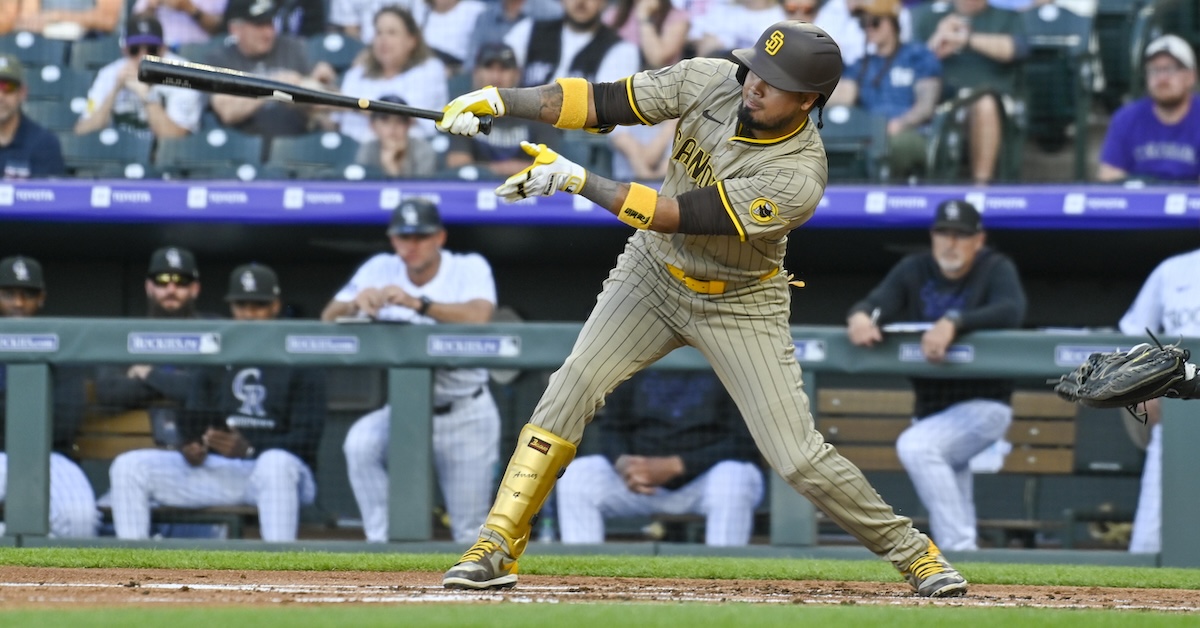
In early November, MLB Trade Rumors and Baseball Prospectus released their top 50 free agents lists, which included guesses about where each player would end up. Our focus in this article is on Luis Arraez, and in those two lists, seven very smart people and one random number generator made their best estimations about his likeliest destination. Only two of those experts picked the same team for him. The next week, MLB.com’s Mike Petriello broke down a whopping seven potential landing spots for Arraez. Only one of those teams was on either of the two previous lists. Lastly, just this weekend, a Fox Sports article with no byline explained why three teams would make the best fit for Arraez, and only one of those teams had any overlap with the previous three articles. By my count, that’s eight different experts, one robot, and one I-don’t-know-what making a total of 18 predictions. Somehow, those 18 predictions included 15 different landing spots for Arraez. That’s half the league! Only three teams got multiple votes, and no team got more than two. We’ve got a genuine mystery on our hands.
To some degree, all of this is understandable. Most projections have Arraez signing for either one year or two with an average annual value of $11 or $12 million. That means even the stingiest teams can afford him. And although Arraez is a poor defender who only projects for roughly 1.5 WAR (depending on your projection system), he’s never once put up a below-average season on offense. With the possible exception of the Dodgers, there is no such thing as a team that couldn’t find a spot for a hitter of Arraez’s caliber. ZiPS is slightly higher on Arraez than most systems, projecting him for 1.8 WAR in 2026. That’s more than we have projected in our Depth Charts either at first base, DH, or both for 21 different teams. Everybody can afford him. Almost everybody could use him. He really could end up anywhere.
While I don’t have any special insight about where Arraez will end up, I do have a strong preference. I want him to sign with the Rockies, and I want this for a very simple reason. I want to see Luis Arraez be the most Luis Arraez he can be. His skill set is unique in today’s game, and Coors Field is the perfect environment to let him flourish.
Let’s get the fit part out of the way early. Unsurprisingly, the Rockies have room on their roster for Arraez. After DFA’ing Michael Toglia, our Depth Charts expect them to get a nice round 0.0 WAR at first base from a combination of Troy Johnston, Blaine Crim, Charlie Condon, and the injured Kris Bryant. Likewise, the Rockies are projected to get 0.1 WAR from the DH position. Both marks are the worst in baseball. Even at his worst, Arraez represents a big upgrade from the replacement-level-by-committee the Rockies are currently set to roll out at those two spots.
I’m sure you already know Arraez’s résumé well, so I will stick to the highlights here. He won three consecutive batting titles from 2022-24, and last year, his .292 average ranked fourth in the NL. He has led his league in hits twice. He has posted the game’s lowest strikeout rate in each of the past four seasons. Year in and year out, he’s at the very bottom of the game in bat speed, exit velocity, and hard-hit rate, and right at the very top in contact rate, squared-up rate, and batting average. He does this by staying back, shortening up, and slapping the ball the other way. His average attack angle of six degrees – which just about perfectly matches the incoming angle of the average pitch – allows him to smack line drive after line drive into left field. Sports Info Solutions has been tracking line drive rate since 2002, and Arraez’s career line drive rate of 26.9% is the third highest over that period.
Arraez’s contact-above-all approach carries two main drawbacks. The first is that when you’re capable of hitting anything, you tend to swing at everything. Arraez has grown more and more chase-happy in recent years, and he’s finished in the bottom 20 in walk rate among qualified players in each of the last three seasons. The second drawback is that this approach precludes any chance for slugging.
Put those two factors together, and you find that the path to success is narrow, and it’s paved with so, so many singles. For most of Arraez’s career, that has worked out just fine. He has led baseball in singles in each of the past three seasons. In fact, he leads all hitters with 805 singles since his debut in 2019, even though he didn’t play anything approaching a full season until 2022. And he’s not just leading — he’s way, way in front. With 734 singles, Trea Turner is the only player who is within even 100 of Arraez. His entire game revolves around dumping the ball over the left side of the infield. Cal Raleigh may be the biggest dumper, but Arraez is the most prolific.
From 2019 to 2023, Arraez ran a combined 123 wRC+ with a .326 batting average, but more recently, the singles have dried up just a bit. He put up a 109 wRC+ in 2024 thanks to a career-low .078 ISO. In 2025, his hard-hit rate dropped to a minuscule 16.7%, the second-worst mark from a qualified hitter this decade. Accordingly, his BABIP dropped to .289, and he ended with a career-worst 104 wRC+. It’s worth noting that Arraez played through a painful thumb injury for much of 2024, got surgery last offseason, and then suffered a concussion early in the 2025 campaign. It’s hard to say how much time he has spent at or near 100% over the last two years. He is only 28, and it’s at least conceivable that, if fully healthy, he could go right back to winning batting titles in 2026. But even in his ugly 2025 season, he posted the best contact, whiff, and squared-up rates in baseball, hit more line drives than anybody else, and finished as an above-average contributor at the plate.
Part of the problem is that defenses are on to Arraez. Over the past several years, as outfielders across the league have played deeper and deeper in order to gobble up extra-base hits, they’ve been playing Arraez shallower and shallower. For the first five years of his career, left fielders played either 282 or 283 feet deep when Arraez was at the plate on the road. In 2024, that dropped to 280. In 2025, it dropped a whopping six feet, to 274. That was the second-shortest mark in baseball, behind only Chandler Simpson at 273. Not coincidentally, since his debut in 2019, Arraez leads all of baseball with 102 outs on balls that traveled between 235 and 260 feet. These are balls that just fail to drop in front of the outfielder. Year after year, Arraez hits more balls within this distance than anybody else in the league, and since 2022, only Steven Kwan has hit into more outs on these batted balls than Arraez, presumably because Kwan plays his home games at Progressive Field.
So Arraez is coming off a down season, he’s always going to be BABIP dependent, and outfielders are now playing him absurdly shallow because they know he’s not even interested in hitting it over their heads. You know what would be great? If we could deposit him gently into a ballpark that’s known for high BABIPs. A ballpark with an outfield so big that the fielders have to play deep, lest a ball in the gap or down the line sneak past them and turn into a triple. A ballpark where all those deep outfielders create the biggest dumping ground for singles the mind can imagine. Am I ringing any bells here?
Welcome to Coors Field, where the powers that be have pushed the fences way back in order to accommodate the would-be home run balls floating drag-free through the thin air. Coors is the best offensive park in the league. More specifically, with a park factor of 116, it’s the most singles-friendly park in the league. No other stadium has a mark above 108. That gap of eight points between first and second place is the largest of any type of base hit. Over the past three years, visiting left fielders have positioned themselves at an average depth of 308 feet at Coors Field, tied with Truist Park for the deepest in the league. (I excluded home teams from this because they play so many games at their own ballpark that if they have any particular tendencies, they’ll skew the results.)
During that same period, line drives between 230 and 260 feet to left field have a .993 batting average at Coors, compared to .854 at Petco Park, Arraez’s home for most of the last two seasons following his trade from the Marlins to the Padres in early May 2024. That’s a difference of 139 points! No one has hit more balls that fit those exact parameters over the past three seasons than Arraez, either in total or on a rate basis. If we narrow our search to line drives to left between 250 and 270 feet, Arraez leads the majors with 24 outs. That may sound like a small difference, but we’re talking about something like 13 points of batting average in a season. And keep in mind that if fielders decide to keep playing Arraez so shallow in that spacious Coors outfield, then they’re likely to let a few more balls skip past them, and those balls will keep on rolling while Arraez rounds the bases and pads his slim slugging percentage.
Coors also suppresses strikeouts, and back in November, Petriello pointed out that over 53 plate appearances in Denver, Arraez has never once struck out. Not once. When I raised the possibility of a mountain-dwelling Arraez, Dan Szymborski ran the numbers. That 1.8 projected WAR from ZiPS that I mentioned earlier assumed a neutral ballpark. During Arraez’s career-worst 2025 season, he called Petco Park his home. With a park factor of 97, Petco suppresses singles. Move Arraez from a neutral park to Coors, and ZiPS ups his projections from a 110 OPS+ to 117 and 1.8 WAR to 2.1. All of a sudden, Arraez projects as not just a major upgrade, but also as an above-average regular. And if it turns out that injuries were holding him back over the past two seasons, and he’s now back to his three-straight-batting-crowns form, who knows what kind of crazy batting average he could post in Colorado?
Davy Andrews is a Brooklyn-based musician and a writer at FanGraphs. He can be found on Bluesky @davyandrewsdavy.bsky.social.
Could Arraez hit .400 in Colorado and still have a 99 wRC+?
No, lol. 2017 DJ LeMahieu hit .310/.374/.409 for a 94 wRC+. Arraez actually has almost the same ISO as Coors LeMahieu (.096 vs .109) so let’s give .400 Arraez a .400/.440/.510 line.
2016 LeMahieu hit .348/.416/.495 and scored a 130 wRC+, so I’m comfortable saying .400 Arraez is at least in the 150 range.
.400+ OBPs are valuable even at Coors, it turns out.
Using an online wOBA calculator that’s probably not up to date weights-wise but is close enough, if Arraez hits .400/.400/.400, reaching base only on singles, that puts him at a .352 wOBA. That’s exactly what Blaine Crim put up for the Rockies in 61 PAs last year and he had a 110 wRC+.
Roughly anything .375 or over guarantees an average line even at Coors with a .000 ISO and no walks.
but if he hits 50 sac flies…
(kidding, no one will be on third base)
(this is unfair as the Rockies’ offense was much better than their pitching, even adjusting for park, and also I am a Pirates fan and in no position to talk smack. wait no their offense was worse. hm)
Rockies 2025 team batting WAR: -3.7
Rockies 2025 team pitching WAR: 1.0
Say again?
you may have caught me in between edits
Not even in the pre-humidor Coors era would this happen. In 1998, Derrick Gibson hit .429 with an ISO of .048 and had a wRC+ of 140. And the Colorado-in-1998 park factor is probably closest to the biggest stadium-by-era adjustment that occurred in recent memory.