
Matt Manning Is Going to Korea
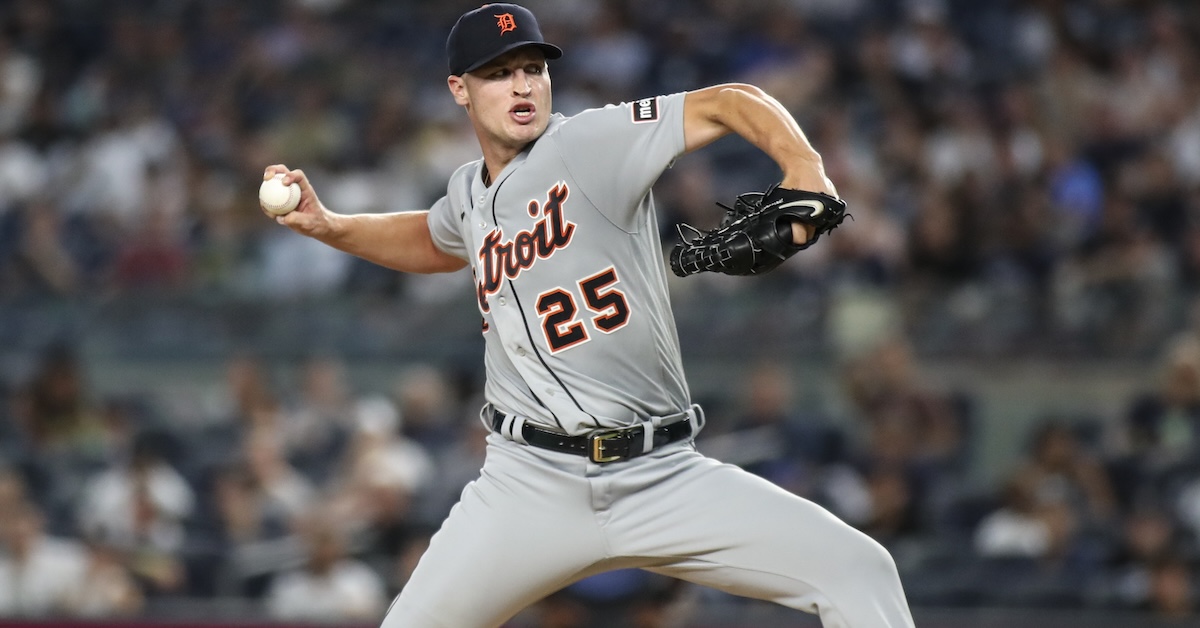
The Samsung Lions of Daegu, South Korea, have entered the free agent market, scooping up former Detroit Tigers prospect Matt Manning on a one-year, $1 million deal. All Manning needs to do now is find a team called the Bears, and he’ll have the whole set.
Manning, 27, has a career 4.43 ERA in 50 starts in the majors, none since 2024. But he’s more famous than most players with those credentials, on account of being Detroit’s no. 1 pitching prospect for multiple years. Being a team’s no. 1 pitching prospect is not always as impressive as it sounds; at the moment, there are multiple teams without any minor league pitchers with a future value grade over 45 on The Board.
But for the Tigers, in the early 2020s, being no. 1 was a big deal. On the 2020 list, Manning was the no. 12 prospect in all of baseball, followed by Casey Mize, Riley Greene, Tarik Skubal, and Isaac Paredes in Detroit’s system. In 2021, Manning fell behind the previous year’s top draft pick, Spencer Torkelson, but still rated ahead of Skubal and Mize, in that order.
“A large part of the reason Manning ranked first on last year’s Tigers list was because he had neither Casey Mize’s injury red flags nor Tarik Skubal’s relief risk,” began Eric Longenhagen and Kevin Goldstein’s 2021 writeup of Manning. What follows makes it clear why they weren’t the only evaluators who loved the imposing young right-hander: plus fastball and curveball, developing changeup, and better athleticism and feel to pitch than you’d usually see out of a 6-foot-6 power righty.
When a guy like that doesn’t pan out, it’s usually because of injuries. To the extent that this is true for Manning, it’s happened in a weird way. Manning has gone on the shelf with forearm strains a couple times, but he’s never had Tommy John surgery. He missed three months in 2022 with shoulder inflammation, but he’s never torn a rotator cuff or blown a capsule.
All things considered, Manning was pitching fairly well in 2023, his last full season in the majors. But he took two comebackers off the same foot, five months apart, each leading to multiple-month absences. One bone-breaking line drive and you start questioning the existence of God. Two in the same season is good evidence that God is real, and he’s pissed at you in particular.
But this is not a Brady Aiken or Brendan McKay situation, where medical issues prevented Manning from even getting off the ground. He’s pitched plenty in the majors — he just hasn’t been very good.
Manning’s average fastball velocity was in the 93-mph range in all four of his partial major league seasons, but the league is throwing harder now. Average four-seamer velocity is up 1.8 mph from his draft year, 2016. Manning has tinkered with his secondary pitches constantly, going from a hard slider to a slow sweeper. He’s added a sinker and then dumped it, dropped his arm angle, and gone away from his changeup. In 2025, he threw mostly the four-seamer and two breaking balls in Triple-A, but he toyed with a high-80s cutter, as well.
The big problem is that Manning hasn’t been able to get whiffs at any point in the majors. After going through the minors with strikeout rates in the high 20s, he has struck out just 16.4% of opponents, while walking 7.8%, in his major league tenure.
The last time before this that Manning was a featured subject of a non-RotoGraphs article here was in 2024, when Dan Szymborski pegged him as a bust during spring training. Dan suggested that Manning learn a splitter.
Which is interesting, for three reasons. First, as I mentioned above: Manning did at least try to learn a splitter and it didn’t work. Second: That Manning should add a splitter was also my first thought. His fastball and two breakers clearly aren’t getting whiffs, so he needs a pitch with arm-side movement that’ll keep opponents off his heater and help him generate weak contact. Third: Doesn’t everyone overseas throw a splitter?
For the record, I love that Manning is going to play in the KBO. For starters, it’s good for the soul to see the world. If I were an athlete in a sport like basketball or baseball, where there are thriving professional leagues across the sea, I’d be sure to spend a year abroad at the beginning or end of my career, just to have the experience.
And the KBO has been fertile ground for lots of players, like Manning, who have succeeded in the high minors but fallen flat in the big leagues. It’s the mythical Quadruple-A league, and it’s done hitters (Eric Thames, Darin Ruf) and pitchers (Erick Fedde, Merrill Kelly) alike a world of good developmentally.
The American returning from a sabbatical abroad has become a pretty common free agent archetype. We’ve got three in this year’s free agent class: Cody Ponce from the KBO, and Foster Griffin and Anthony Kay from NPB.
But Japan is where you go to learn a splitter, not South Korea. Since 2020, 17 pitchers born in Japan have appeared in at least one major league game. That obviously includes guys like Yu Darvish and Yoshinobu Yamamoto, who throw a little of everything, but they and 13 of the 15 other Japanese pitchers in MLB threw a splitter or a forkball regularly. (That’s everyone except Yusei Kikuchi and Shinnosuke Ogasawara.)
By contrast, I was unable to find a single instance of a Korean-born pitcher throwing even one splitter in the majors during the pitch-tracking era. It’s possible that during the days of PITCHf/x, some pitches were classified as changeups but would be considered splitters now. But from Hyun Jin Ryu on down, pitchers who trained in the KBO came to the U.S. with more American-style repertoires: fastball, changeup, curveball.
The success of certain re-imported starting pitchers (mostly Kelly, but also Nick Martinez and a few others) has also made the KBO/NPB sabbatical look like a more common path back to mid-rotation competence than it actually is.
The path Manning is presumably trying to travel — major leagues to Asia and then back to the majors, armed with a new killer out pitch — is actually pretty lonely. RosterResource’s archive goes back to 2020; in six offseasons, that career path describes just 10 free agent starting pitchers who were born and trained in the Americas.
| Player | Class | Fgn. League | New Team | Post-Return Seasons | Innings | WAR |
|---|---|---|---|---|---|---|
| Josh Lindblom | 2020 | KBO | MIL | 2 | 62 | 0.5 |
| Chris Flexen | 2021 | KBO | CHC | 5 | 623 1/3 | 4.1 |
| Matt Moore | 2021 | NPB | PHI | 4 | 248 | 1.0 |
| Dan Straily | 2022 | KBO | ARI | 0 | 0 | 0.0 |
| Nick Martinez | 2022 | NPB | SDP | 4 | 524 2/3 | 7.3 |
| Drew Rucinski | 2023 | KBO | OAK | 1 | 18 | -0.6 |
| Wilmer Font | 2023 | KBO | SDP | 0 | 0 | 0.0 |
| Erick Fedde | 2024 | KBO | CHW | 2 | 318 1/3 | 3.2 |
| Adam Plutko | 2024 | KBO | MIN | 0 | 0 | 0.0 |
| Kyle Hart | 2025 | KBO | SDP | 1 | 43 | -0.2 |
Red: Has not pitched in the affiliated minors or major leagues since return
Kelly came back early enough that he falls outside this sample (both in terms of time and by virtue of not having pitched in the majors before he left for Korea), so adjust your expectations accordingly. But only about half of these pitchers can be considered even qualified successes. Lindblom’s second trip to Korea saw him dominate the KBO. After he returned to the majors, he was OK (good FIP, terrible ERA) in the shortened 2020 season, and a non-factor since.
Moore was godawful in his first season back in the U.S. as a starter, and then excellent in relief for the Rangers in 2022 and three teams in 2023. Fedde was great in high volume for the White Sox and Cardinals in 2024, and replacement-level in 2025. On balance, Flexen’s been decent. But he also had a huge drop-off after a strong first season back, and while he posted a 3.09 ERA in 2025, he did so with appalling peripherals after a move to the bullpen.
The only durable success since Kelly, then, has been Martinez, who has had his ups and downs, for sure, and has drifted from rotation to bullpen and back. But as a young Texas Ranger, Martinez’s strikeout problems were even worse than Manning’s, and he’s been a million times better over the past four seasons than he was during his first major league stint. If you told Manning now that he’d come back to the U.S. and pitch well enough to earn a qualifying offer at any point down the line, he’d probably take that future without asking for any other details.
Is there anything in these previous success stories for him to emulate? I don’t know if there’s anything specific. He doesn’t come over to the KBO as an unprecedented talent; Fedde was a big deal as a prospect, while Moore was a bigger deal than both Fedde and Manning put together. Manning is not going to go out there and blow everyone away on pure ability.
And the pitchers who returned from the KBO and NPB with a new lease on life (Martinez, and Year 1 of both Flexen and Fedde) didn’t come back as different pitchers. Their pitch mixes didn’t change much; they just became better versions of themselves.
Fedde ditched an upper-70s curveball with big horizontal movement but not much drop, and replaced it with a sweeper that had similar movement but about 5 mph more velo. Martinez maintained his five-pitch mix: four-seamer, sinker, cutter, curveball, and changeup. But after four years in Japan, he was throwing slightly harder, put more drop on his curve, and sorted out more distinct movement patterns for his three fastballs and changeup. The change in particular left the country in 2017 as a mid-80s liability and came back as an upper-70s weapon.
Assuming that Manning wants to come back as the pitcher he was always meant to be — which he might not; it’s possible he’ll have the time of his life in Daegu and never want to leave — that’s the kind of progress he’ll be looking for. Not reinvention, but rediscovery.
Michael is a writer at FanGraphs. Previously, he was a staff writer at The Ringer and D1Baseball, and his work has appeared at Grantland, Baseball Prospectus, The Atlantic, ESPN.com, and various ill-remembered Phillies blogs. Follow him on Twitter, if you must, @MichaelBaumann.
This hasn’t really been reported anywhere, but I have heard from a trusted source that he got covid in 2020 and lost a loooot of weight. Like 30+ pounds. He wasn’t quite ever the same after that. I really hope he can reboot in Korea and will be rooting for him.
Not saying I don’t believe you, and you don’t have to name names, but can you vouch for the credibility of the trusted source? Do they work in Baseball in some capacity? Do they know Matt Manning personally?