
Mitch Garver Returns to Seattle
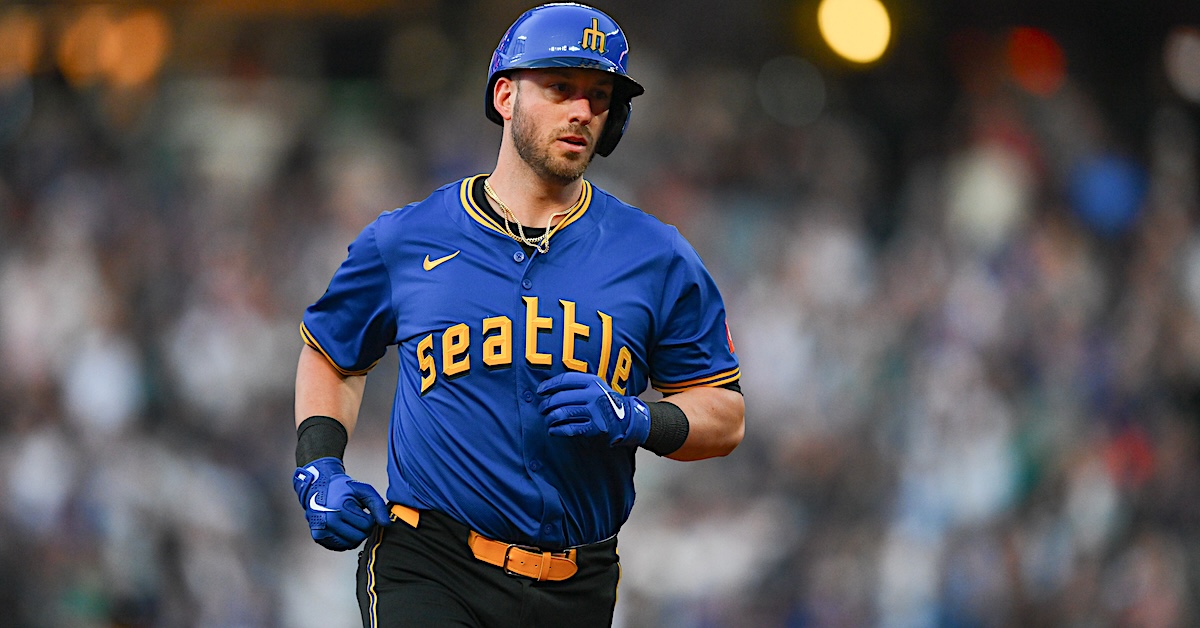
On Wednesday, catcher Mitch Garver agreed to a minor league deal to remain with the Mariners in 2026. He reported to camp for a physical on Thursday, and should he make the major league roster, he’ll earn a prorated $2.55 million for any time he spends with the big club. Because of his veteran status, Garver will have the ability to opt out and look for a job elsewhere, in late March, on May 1, or June 1 if he remains in the minors. We don’t often devote entire articles to minor league deals, but I wanted to highlight this one, because the 35-year-old Garver has had such an interesting career and such a dramatic turnaround over the past two years.
A bit over two years ago, Garver signed a very different contract with Seattle. It was a two-year deal for $24 million, nearly five times as much per year as his new one. He was coming off a 2023 season in which he launched 19 home runs and finished with a 142 wRC+ despite an April knee sprain that knocked him out for more than two months. It was just the 18th time this century a catcher that had put up such a good offensive line over at least 300 plate appearances, and it wasn’t even Garver’s best season. He debuted at age 26 in 2017, and over the first seven years of his career, he ran a 124 wRC+. If you go to our leaderboards and rank catchers through their age-32 seasons, that mark ties him with Hall of Famer Gary Carter and Mickey Tettleton for 32nd all-time (just behind his teammate Cal Raleigh’s 126).
That’s not to say that Garver was on pace to be one of the best catchers ever. Thanks to a wide variety of injuries, he’d only reached 80 games played in a season three times. And because of both the injuries and his very poor defense, he’d spent more than 40% of his time at first base or DH. Despite being one of the best hitting catchers in the game, he had just 8.3 WAR to his name. Still, the bat was so undeniable that he became the first non-pitcher Jerry Dipoto had ever signed to a multi-year contract while leading the Mariners. The move carried risk, but that risk was about whether Garver would stay healthy, about whether his bat would play up enough if, as expected, he spent the vast majority of his time as a DH.
You know what happened next. Garver stayed healthy, avoiding the IL in both 2024 and 2025. He appeared in 201 games, tied for the most of any two-season stretch in his entire career. But the bat completely disappeared. This wasn’t necessarily the risk we were worried about. Garver batted a combined .187 and put up an 88 wRC+ and -0.4 WAR. Specifically, his ability to hit right-handed pitching just evaporated. He posted a 66 wRC+ against righties across those two seasons and was relegated to platoon duty by mid-July 2024.
So what on earth went wrong? Garver’s 90th-percentile exit velocity fell from 106.6 mph in 2023 to 104.4 over the last two seasons. He started chasing a little more, and his contact ability took a nosedive, which drove his strikeout rate up. Sounds like it could just be a guy getting older, right? The thing is, all of this had happened before at one time or another. Garver’s EV90 was a career-worst 103.9 mph in 2022. His chase rate was the same or worse in 2021 and 2022. His zone contact rate was lower over the two-season span of 2020 and 2021 than it was across the past two years. So while those are all bad things, they’re also bad things that Garver has successfully fought through before and put up good numbers anyway.
Let me throw one more theory in the mix, and I need to acknowledge up front that I can’t prove it. We all remember how Teoscar Hernández struggled with T-Mobile Park. Garver didn’t come into the 2024 season with a huge track record in Seattle. He’d made just 33 plate appearances there. However, within those 33 times up, he was abysmal. He had a .042 wOBA and .129 xwOBA, his worst marks of any ballpark. His exit velocity and hard-hit rate were his third lowest of any ballpark (above only Citizens Bank Park in Philadelphia and Nationals Park, where he’d taken a combined 15 plate appearances). Is it possible that Garver just really struggles at T-Mobile and that messed him up?
The argument that I’ve been not-so-subtly building here is simple enough. Maybe Garver just had a bad couple of years. Maybe he was out of sorts and had some bad luck or whatever it might be, but he’s been roughly the same guy underneath it all, and if he gets a chance, he may he’ll hit well again in 2026.
As much as I’d like to, I don’t think I really buy this argument. Two bad years is much more telling than one, and Garver’s production has cratered against fastballs in particular, which is always worrisome. When you combine that with worse swing decisions, worse contact ability, and weaker contact, it certainly starts to sound like he’s just having trouble keeping up. Moreover, even if all of that were true and Garver really has been the same guy underneath it all, well, he’s a 35-year-old catcher who’s undergone enough injuries for two full careers. He’d be due to slow down any time now anyway.
That brings us to bat speed. About a year ago, Tom Tango published some preliminary aging curve data indicating that swing speed starts dropping at age 32. At first blush, Garver’s bat tracking data doesn’t look particularly damning. Statcast started collecting it in the second half of the 2023, and the overall numbers say Garver’s bat has actually gotten faster in the last two years: 70.28 mph in 2023, 71.2 in 2024, and 71.8 in 2025. That’s certainly encouraging! It’s a bit better than league average, and when you compare apples to apples, say looking only at fastballs over the heart of the plate, or only at hard-hit balls, the numbers are nearly identical. But before we decide Garver didn’t suddenly lose his bat speed when he hit his mid-30s, we need to look at his average contact point. As you likely know by now, bat speed increases throughout the swing, and Statcast measures it at the point of contact.
| Year | Bat Speed (mph) | Intercept (inches) |
|---|---|---|
| 2023 | 72.7 | 28.2 |
| 2024 | 72.7 | 30.7 |
| 2025 | 72.6 | 31.2 |
The chart above shows Garver’s bat speed and intercept point (relative to his center of mass), only on hard-hit fastballs over the heart of the plate. Basically, it shows his numbers when everything’s going right. Over the past two years, Garver’s intercept point has slid forward by three full inches. To put that in perspective, in 2025, moving from an intercept point of 28.2 to 31.2 would move you from the 51st percentile to the 80th percentile. It’s a really big shift, and if his actual swing speed were staying the same, we would have seen a commensurate increase in measured swing speed. That didn’t happen, so we have to conclude that the swing is slowing down. Additionally, in order to meet the ball way out front, he is forced to start his swing earlier. Combine that with the trouble hitting fastballs, the higher chase rate, and the lower zone contact rate, and we have a tidy, depressive narrative going.
Garver’s bat is slowing down, so he’s doing what older players do: getting started early to compensate for it. Normally, those older players start pulling the ball more when they execute this move, making up for the extra whiffs with extra power. But that’s not happening for Garver. He already pulled the ball about as much as is possible. From 2019 to 2022, his 54% pull rate was the highest in baseball. So even though he’s getting started earlier and meeting the ball farther out in front, his pull rate has dropped some. And because he can’t afford to stay back anymore, his already low opposite-field rate has dropped even further. He’s hitting more balls to the middle of the field, where they’re less valuable, which is one of the reasons he’s been running low BABIPs and slightly underperforming his expected stats.
Despite all of this, Garver was still serviceable against lefties, and it’s not completely out of the question that he’ll bounce back some in 2026. Even the projections, which factor in age-related decline, expect a very modest rebound to a wRC+ around 90. This contract doesn’t carry much risk for the Mariners. In fact, because they have Andrew Knizner signed to a major league deal for a mere $1 million, less than half of what they would pay Garver if he makes the big league roster, Knizner has a leg up on the backup catcher spot anyway. I’ll be rooting for Garver to get another shot in Seattle or elsewhere and to make the most of it. His defensive shortcomings and trouble staying on the field made it a little too easy to look past his offensive abilities, but he had serious talent and got to take full advantage of it all too rarely.
Davy Andrews is a Brooklyn-based musician and a writer at FanGraphs. He can be found on Bluesky @davyandrewsdavy.bsky.social.
Boy, I thought Mitch Garver was a good signing when they brought him on board a couple years ago. Good on base percentage, good power. Would love to see if work out this year, even if he only hits against lefties.
I just don’t see it. And the late minor league deal w/invite suggests nobody else does either.
I like him more than Knizner as the back up if only because we know that Garver can at least do one thing well (hit lefties). The defensive metrics on Knizner aren’t any better than Garver’s and Knizner’s offensive track record is pretty poor.