
Nick Kurtz Is Baseball’s Premier Opposite-Field Blaster
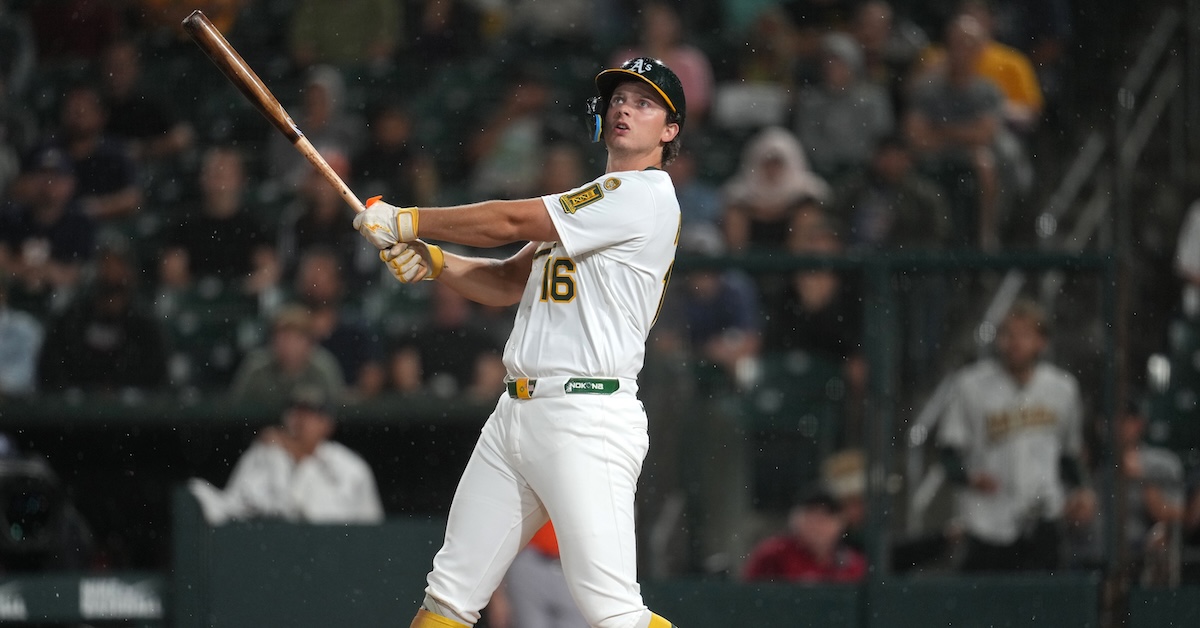
Since the release of Statcast’s bat tracking metrics, I’ve been on a journey to try to marry the old school concept of reading swings with the new school insight that comes from swing data. I peruse leaderboards, oftentimes looking to the extreme leaders and laggards, to understand how my perception of a hitter’s swing aligns with his metrics. Starting at the extremes is fascinating because sometimes a hitter’s swing is extreme in a risky way, while at others, its outlier characteristics are part of what makes it effective. Sometimes, both are true!
For instance, Eugenio Suárez has the steepest attack angle in baseball, leaving him vulnerable at the top of the zone, but also propelling his power profile. Brice Turang has the most inside-out attack direction in the majors, which helps him make consistent contact against any type of pitcher, but also limits his ability to pull. Isaac Paredes makes contact farther out in front of the plate than anybody else, leading to the most aggressive pull swing in the game. And I could keep going! Vladimir Guerrero Jr.’s bottom-of-the-league attack angle allows him to pair contact with a gap-to-gap approach unlike any other hitter. Meanwhile, Freddie Freeman’s steep shoulders and chicken wing arms allow him to get his bat on plane for optimal contact at any height in the zone.
And then there’s Nick Kurtz. His entire swing profile is unique. For most hitters, it’s easy to see how their individual attributes and swing components lead to their overall output. With Kurtz, though, it takes much more digging to understand how his traits harmonize with one another to create the Rookie of the Year-winning performance we saw this year. So how does he do it? Let’s find out.
Kurtz’s swing is geared toward the opposite field. He has one of the steepest swing tilts in the league at 39 degrees, and he stands farther back in the box than almost anyone in baseball, with an average depth in the box of 23.4 feet. Having both a steep swing and a deep point of contact might seem counterintuitive. To get to a positive attack angle and highly positive swing tilt, you need distance and time for the barrel to start sloping upwards. And sure enough, the first move in Kurtz’s swing is to immediately separate his hips and shoulders, giving his barrel space to get on plane. The clip below comes from Baseball Savant’s Swing Path Leaderboard. There are dots on key joints that tell us how a player’s body is moving. I’ve clipped a specific part of the video that highlights the progression of Kurtz’s attack angle:
As an aside, this is my favorite Savant feature. Seeing how hitters set up their bodies to get on plane is a massive piece of the puzzle in understanding how their swing paths lead to their batted ball profiles, and this tool makes that so easy to visualize.
The separation Kurtz creates is clear as day. He accomplishes this by shifting his center of mass from the midpoint of his body at the beginning of his swing to being over his back hip as he progresses through the rest. If you focus on his two shoulder points, you can see how they shift behind his two hip points. This gives his barrel enough space behind the plate to get to a positive attack angle very deep relative to both the plate and his center of mass:
Kurtz can get beat by a fastball and still be in a position to launch it to the opposite field since his bat angle is sloping up so early on. The only other players I can think of who do this consistently are Juan Soto, Shohei Ohtani and Aaron Judge. Like Kurtz, they all have elite bat speed, but of that group, only Soto has a similar average intercept point. That’s where the similarity ends, though, because Soto’s bat is much flatter. Here is how Kurtz’s swing looks from the start to finish:
In a league where so many hitters focus on launching to the pull side, Kurtz being an opposite field masher presents a really interesting profile, and it’s exactly why I love perusing the extreme ends of leaderboards. His deep contact point makes sense when you connect the dots of his swing. This is the perfect spot to highlight Ben Clemens’ work from before Thanksgiving exploring the idea of every hitter having their own unique optimal contact depth. When we normalize against a hitter’s own distribution of contact points, we can better understand where they are best, regardless of where they make contact relative to the rest of the league. Kurtz has the most success in the middle of his contact point distribution. So even though it seems like he could be late relative to the rest of the league because of his opposite field contact, more often than not, he is in the center of his own distribution. Or put more simply, these are swings where he is on time relative to himself. Interestingly, he has the least success when he is early (a -.143 wOBA-xwOBA differential).
This helps explain his standing against the rest of the league when it comes to success with deep contact. But remember, this piece is about how all the pieces of his swing connect together. He blends his deep contact with a high swing tilt and an attack direction that works at that depth in the zone. Those three things harmonize to a sweet spot that sets him apart from other hitters who have slugging success to the opposite field. Filtering on batted balls to the opposite field with at least a two-degree attack direction (the more positive, the more toward the opposite field), Kurtz had more home runs than anybody else in 2025 in far fewer opportunities:
| Player | Home Runs | Attack Direction (deg) | Contact Point (in) | Swing Tilt (deg) |
|---|---|---|---|---|
| Nick Kurtz | 15 | 12 | 21.3 | 39 |
| Yandy Díaz | 13 | 15 | 27.4 | 24 |
| Christian Yelich | 11 | 12 | 24.9 | 35 |
| James Wood | 9 | 10 | 27.8 | 36 |
| Junior Caminero | 9 | 13 | 25.6 | 22 |
| Pete Alonso | 9 | 9 | 24.6 | 34 |
| Rafael Devers | 9 | 12 | 25.5 | 28 |
| Aaron Judge | 9 | 9 | 23 | 35 |
| Shohei Ohtani | 9 | 13 | 17.7 | 32 |
Here I’ll note that, perhaps a bit counterintuitively, a lower number in the Contact Point column corresponds with a deeper point of contact. Basically, the midpoint of a batter’s body is 0, with the value increasing the closer the balls gets to the pitcher. Other than Ohtani, nobody makes deeper contact relative to his body than Kurtz. But unlike Ohtani, or any other hitter in this table, Kurtz is already extremely steep by the time he gets to his deep point of contact. That right there is his unicorn trait. On average, he is far steeper at this deep point in the zone, which we know is driven by his ability to separate his hips and shoulders so early in his swing process.
This approach of making extremely deep contact with a bat angled toward the opposite field is basically the reverse Isaac Paredes. And like Paredes, Kurtz has a large split between his wOBA and xwOBA (.419 versus .371), suggesting he might have benefited from some favorable luck. But if we zoom in on Kurtz’s opposite field fly balls like we would with Paredes’ pulled fly balls, we see why it might be more sustainable than you’d think. Kurtz’s .862 wOBA on fly balls to the opposite field is the result of how well his swing aligns in this direction, much like Paredes’ success on pulled flies. Since xwOBA doesn’t account for spray angle, and Kurtz is one of the best opposite fly ball hitters in the league, that wOBA/xwOBA gap lacks needed context.
And without the additional context of his swing, it’s hard to conceptualize how Kurtz achieved this level of success. From a mechanical perspective, pretty much everything about him has to be unorthodox to pull this off. My assumption was that he is striding extremely open to achieve this, à la Cody Bellinger, but he isn’t!
Kurtz actually strides closed before rotating open, then lands in a more neutral position rather than an extremely open one. The way he tilts his torso, so that his hands and barrel get far behind his body, helps create that elite level of separation:
The straight-on angle allows you to appreciate how mobile Kurtz is in his upper body. You can see his left scapula pulling his elbow farther behind his body, leading to that opening for his barrel to begin its process of entering the hitting zone. Between that, his stride, and his shoulder tilt, he does more than enough to put his body in a position to operate with extreme success at the back of the hitting zone. Looking at one of these traits in isolation may make you question how it works. But after connecting the dots, it makes sense. Traits that are all quite extreme relative to his peers result in a batted ball profile that sets him apart from the rest of the league.
Kurtz’s approach and swing are fascinating to watch. For a solid chunk of the season, he was the most productive hitter in the sport. His swing is geared toward consistently punishing fastballs and right-handed pitching. Even as pitchers adjust to him, he’s always going to have that in his back pocket. Time will tell how well he can sustain this performance, but I’m very excited to watch him try over a full season.
Esteban is a contributing writer at FanGraphs. One of his main hobbies is taking dry hacks every time he sees a bat.
As an lifelong A’s fan, I love seeing articles like this that focus on the young exciting talent.
Note: I think the depth in box should be 23.4 inches, not feet.
I would have some chance at making contact on a Chapman fastball if I could position myself 23.4 feet deep in the box.
So the depth and late swings helps him lay off breaking pitches outside the zone. Cool.