
No, James, Luis Arraez Shouldn’t Take More 3-1 Pitches
Last week, we got a mailbag question from James, whose glimpses of Luis Arraez during the World Baseball Classic left him looking for one weird trick to vault the three-time batting champion back up to his previous heights. I had so much fun answering the question that its word count moved it out of mailbag territory (non-Jay Jaffe division, anyway) and into regular article territory. The question was on the longer side, but here’s an abridged version:
If [Arraez] could wear a ribbon on his wrist to deter a bad hitting habit, would he be able to avoid something that drags him down?
My first idea was swinging on 3-1 counts… If he spit on 3-1 pitches habitually, until opposing pitchers caught on, what percentage of them would have landed him on first? What impact would that have on his OPS & WAR, and how would that impact his value and employability?
Could there be other commonplace opportunities that may be similarly exploited?
I realize James is asking for a more specific answer here, but I want to start with the overview, because at this point, I think people may have forgotten that once upon a time, Arraez actually had great plate discipline. From 2019 to 2022 he ran a 24% chase rate and a 9% walk rate. That walk rate was 5% higher than the league average. From 2023 to 2025, he had a 34% chase rate and a 4% walk rate. That walk rate is now a staggering 45% below the league average! Over the same period, Arraez’s swing rate on pitches inside the zone fell from 65% to 62%. He wasn’t just chasing more; he was making worse swing decisions all around. That’s a lot of shifts in the wrong direction, and even though Arraez also cut his strikeout rate nearly in half, his wRC+ dropped from 123 to 109.
As we all know, Arraez swings at everything because there’s nothing he can’t hit, but that doesn’t mean it’s the right call. When he puts the ball in play, his wOBA is .343 on pitches in the zone and .311 on pitches outside it. It’d be tempting to make that wristband say, “JUST SWING AT STRIKES LIKE YOU USED TO, BUDDY.”
With that in mind, I started by looking at heatmaps. I was curious about whether Arraez had gotten less swing-happy in any particular part of the zone. Was he just making worse swing decisions in a vacuum? Was he looking for one specific pitch more often? I did find a notable shift. If you look at a heatmap of Arraez’s batting average in 2025, you’ll see that he was much better on pitches out over the plate than he was on inside pitches. Then I looked at Arraez’s heatmaps from previous seasons. The Baseball Savant heatmaps below show Arraez’s BABIP. He was great on the inner third in 2024, but that flipped in 2025.
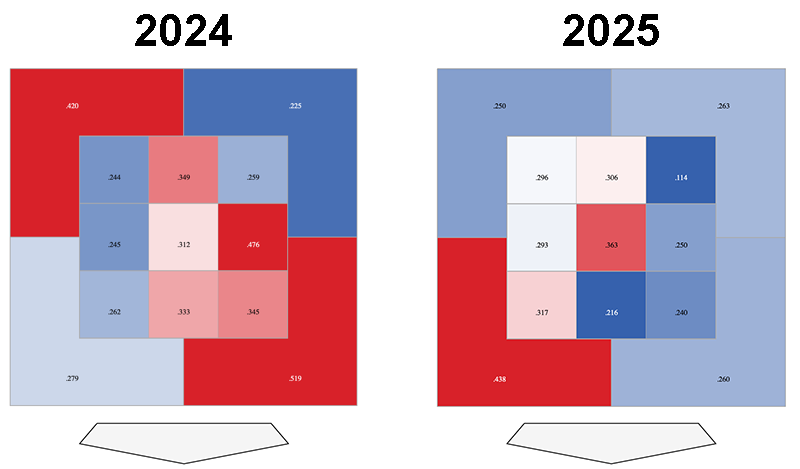
The 2025 season was a complete about face. The heatmaps for his swing rate show a similar trend; Arraez was less likely to swing at inside pitches last year. He was worse all over the zone, but the numbers are particularly stark on the inner third. His swing rate and hard-hit rate dropped the most, and when he put the ball in play, his batting average fell by more than 200 points!
| Inside | Swing% | BABIP | HH% |
|---|---|---|---|
| 2022-24 | 69 | .406 | 27 |
| 2025 | 62 | .198 | 16 |
| Outside | Swing% | BABIP | HH% |
| 2022-24 | 58 | .315 | 30 |
| 2025 | 56 | .302 | 20 |
| Middle | Swing% | BABIP | HH% |
| 2022-24 | 68 | .324 | 37 |
| 2025 | 68 | .299 | 22 |
It’s tempting to say that we should put that on the wristband; tell Arraez to ignore the inside pitch because he’s so bad with it. However, I think that would be a mistake. As recently as 2024, he was great at handling the inside pitch. I think the reduced swing rate is telling, though it’s hard to tell what came first. Did Arraez perform worse against inside pitches because he was trying to swing at them less, so when he did swing it was a mistake? Or did he cut down his swing rate against inside pitches because he was doing so badly against them? Either way, he clearly changed his approach. It just didn’t work. Seeing all that, I don’t think whatever goes on Arraez’s wristband will necessarily be about a particular portion of the strike zone.
With that out of the way, I broke down Arraez’s 2025 swing rates depending on the count, just like James suggested. It was eye-opening. The rows are for balls, and the columns are for strikes.
| . | 0 | 1 | 2 |
|---|---|---|---|
| 0 | 20% | 59% | 66% |
| 1 | 36% | 66% | 73% |
| 2 | 32% | 68% | 80% |
| 3 | 0% | 24% | 90% |
This is a bit hard to interpret, especially because everybody changes their approach depending on the count. To make it clearer, the next table takes Arraez’s swings rate and shows its percentile rank across the league, to reflect how he stacks up against other batters. As you can see, he’s almost always at the extreme end of the spectrum. This table contains 12 cells, and Arraez is in the top or bottom decile in nine of them.
| . | 0 | 1 | 2 |
|---|---|---|---|
| 0 | 9th | 90th | 97th |
| 1 | 23rd | 93rd | 99th |
| 2 | 24th | 86th | 99rd |
| 3 | 0 | 0 | 100th |
When Arraez doesn’t have any strikes on him, he’s one of the more patient hitters in the game. He never swung once at a 3-0 pitch. When he’s ahead 3-1, he’s very nearly the most patient hitter in the entire game. So the wristband definitely doesn’t need to remind him to lay off the 3-1 pitch. He’s laying off way too many 3-1 pitches! He’s also laying off the first pitch way too much.
As soon as Arraez gets a strike on him, though, he goes into swing-at-everything mode. Any time he has one or two strikes (except in 3-1 counts), he swings over 68% of the time, more than any other qualified player in 2025. Somehow he’s the most patient player in baseball when it’s 3-0, and the least patient player in baseball when it’s 3-2.
Two obvious conclusions jump out from this table. The first is that a fear of strikeouts is holding Arraez back. He’s the best contact hitter in the game. No one on earth should be more comfortable when they’re behind in the count than Arraez. With one strike on him, he can afford to be choosier than anyone in baseball, because he knows that even if he gets two strikes on him, he can still put the ball in play and avoid a strikeout. Last year, when he got to a two-strike count, he struck out just 7.4% of the time. Only Steven Kwan was within 10 percentage points of him. He could have been so, so much choosier and still run the lowest two-strike strikeout rate in the game.
The second conclusion is that Arraez is trying to fix the problem, but he’s not going about it in the right way. His swing rates with no count or when he’s ahead are artificially low. He knows he needs to be more patient, so he just waits and takes a strike, then flips the switch. It seems like a really disconnected, uncomfortable approach. He can’t swing early because he won’t see enough pitches, and he can’t take late because he might strike out. The result is that Arraez ignores a lot of good pitches early in the count and he chases a lot of bad pitches later. It’s the worst of both worlds. His rare gift for contact should give him more options, letting him pick a game plan and stick to it regardless of the count. Somehow, it’s left him feeling more constrained than any other player, letting the count completely dictate his approach.
For that reason, I think that James is right about the wristband idea. Arraez is clearly getting feedback about what he needs to do better, but it’s not helping him make good decisions. It may well be worsening his decisions. So what do we put on the wristband? Arraez needs to be willing to take more pitches when he’s behind in the count – even if it means striking out a little bit more – and he could stand to be more aggressive when he’s ahead. He needs to focus less on contact and more on attacking pitches that he can turn into his signature line drives. Maybe you could put “YOU CAN STRIKE OUT SOMETIMES” on a wristband, or “LINE DRIVE OR BUST!” You could try telling Arraez that he gets to swing at two 0-0 pitches per game and see what that does to his swing decisions on the first pitch. The first thing I’d try, though, is to get the constraints of the count out of his head altogether. Everything about those numbers says that worrying about the count is hurting his swing decisions, so try putting “IGNORE THE COUNT” on a wristband and see what happens. Maybe it means he starts swinging at the first pitch in 85% of his plate appearances, in which case you need a whole new plan, but it’s worth a shot.
Davy Andrews is a Brooklyn-based musician and a writer at FanGraphs. He can be found on Bluesky @davyandrewsdavy.bsky.social.
I love the wristband idea. I think “embrace the chaos” would be a good message.
I’m sure someone has done research on this, but I think teams are so good with data nowadays that the best thing you can do is be unpredictable. I am sure every pitcher knows, he is not swinging at a 3-0 pitch, so there’s no reason not to toss a meatball down the middle. Those might be the best pitch he is going to see during the at bat, but there’s no shot that he’s swinging at it. I wonder if there are players who are super chaotic and if that’s an advantage?
I remember hearing something about Bob Gibson, here’s what I could find:
“Sometimes you give [a hitter] something he can handle so you can get him later.” Also, Greg Maddux talked about wasting pitches to see how hitters react.
Maybe Luis can save that surprise 3-0 swing for the 9th inning of a tie game with a man on second.
Or maybe, Luis just doesn’t want to get fined in the clubhouse in the kangaroo court? (Do players still have a kangaroo court?)