
Nol Country for Old Men: Diamondbacks Trade for Arenado
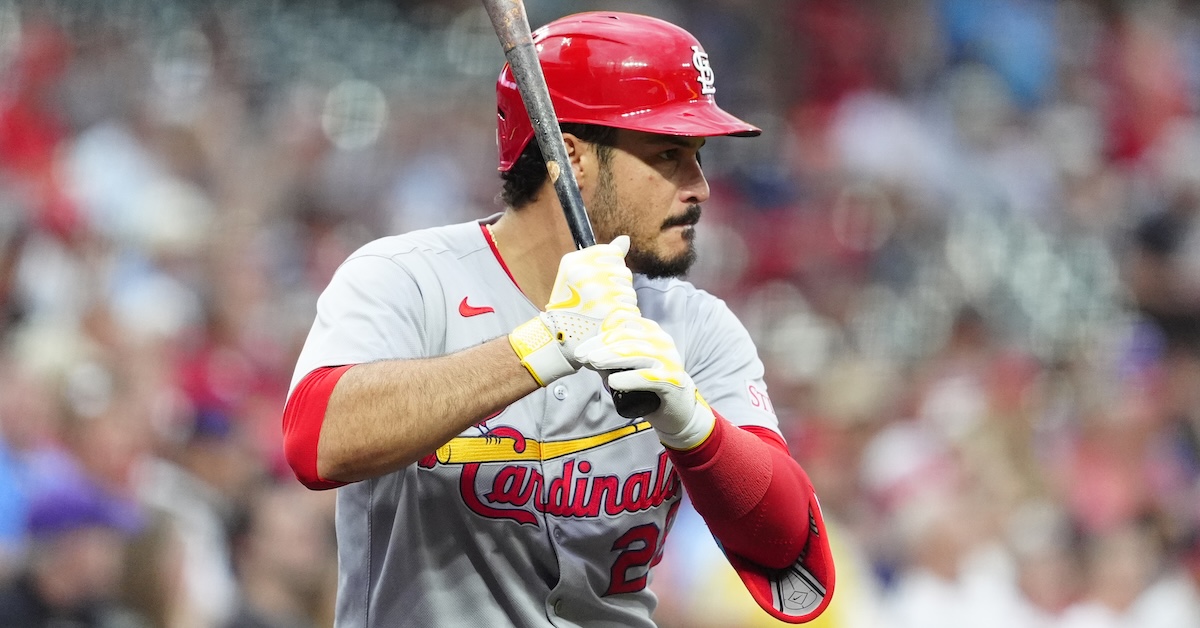
The St. Louis Cardinals, or what’s left of them, have traded third baseman Nolan Arenado and cash to the Arizona Diamondbacks for right-handed pitcher Jack Martinez.
Arenado was one of the best players of the 2010s, a three-time National League home run champ and an elite defensive third baseman. In eight seasons with the Rockies, Arenado made five All-Star teams and finished in the top eight in MVP voting five times. He made the All-Star team and pulled off the Gold Glove-Silver Slugger double every season from 2015 to 2018.
On the strength of those performances, the Rockies signed Arenado to one of the richest contracts in baseball history — nine years, $275 million. After two years, they shipped him to St. Louis, where the Cardinals lived out the bargain of the quarter-billion-dollar extension: A couple great seasons, followed by gradual decline and now decrepitude, all before the deal runs out.
The Cardinals have been trying to ship Arenado off for so long I actually wrote about his decline 13 months ago. Arenado averaged a 130 wRC+ and 6.0 WAR per season with the Rockies from 2016 to 2019, then a 131 wRC+ and 5.8 WAR per season in 2021 and 2022, his first two seasons in St. Louis. But after his last great season in 2022, Arenado started losing power, bleeding walks, and shrinking his defensive radius. In 2023 and 2024, he averaged 104 wRC+ and 2.9 WAR.
Which is still just fine! When future Hall of Famers get old, they often turn into solid-but-not-great players. Unfortunately, the next step often involves going off a cliff, which is what happened to Arenado in 2025: 84 wRC+, 0.9 WAR in 107 games.
Congratulations, we’ve discovered the world’s most expensive Jared Triolo.
And yet, Arenado is due $27 million this coming season and $15 million in 2027.
That incongruity between salary, production, and projection is common at the back end of long contracts like Arenado’s. So it is with great surprise that I offer the following analysis: I don’t hate this trade for anyone.
Well, I hate this trade because it well and truly kills the “National Arenadics and Space Administration” joke I had teed up when Arenado vetoed a trade to Houston last winter. But that’s a petty, personal opinion. The Cardinals and Diamondbacks both did OK here.
On our player pages, we have a little widget up in the top right-hand corner for news, including links to recent FanGraphs articles where the player in question has been tagged, as well as snippets from Rotowire. I believe the best summation of Arenado’s situation in St. Louis can be found there.
Before the Arenado trade broke on Tuesday, the most recent Rotowire blurb read: “Cardinals president of baseball operations Chaim Bloom said Tuesday that releasing Arenado is ‘not an option,’ Jeff Jones of the Belleville News-Democrat reports.”
It’s never a good sign when a POBO has to answer questions about whether he’s going to release his most expensive player.
And that’s the baseline the Cardinals were working from: Arenado is declining to replacement level, and the Cardinals owed him $37 million over the next two seasons no matter what. (That’s $42 million, less the $5 million Colorado was already due to pay down.) The question facing Bloom was whether Arenado was doing more harm than good in the lineup. Again, not an enviable position.
The Cardinals are paying Arenado’s salary down to $5 million in 2026 and $6 million in 2027, which means they’re on the hook for $26 million in dead money, again, accounting for what they’re receiving from Colorado. But that’s less than $37 million. A lot less.
As an aside, three different teams are going to pay Arenado at least $5 million this coming season, which has to be some kind of record. Allow me to present the following humorous table:
| Player | Salary |
|---|---|
| Nolan Arenado (Cardinals’ Portion) | $17,000,000 |
| Dustin May | $12,000,000 |
| Brendan Donovan | $5,800,000 |
| Lars Nootbaar | $5,350,000 |
| Nolan Arenado (Rockies’ Portion) | $5,000,000 |
| Nolan Arenado (Diamondbacks’ Portion) | $5,000,000 |
| JoJo Romero | $4,260,000 |
| Andre Pallante | $4,000,000 |
| Ryne Stanek | $3,500,000 |
| Alec Burleson | $3,300,000 |
| Nolan Gorman | $2,655,000 |
| Matthew Liberatore | $2,260,000 |
The prospect the Cardinals are getting, Jack Martinez, didn’t get a mention in our recent Diamondbacks prospect list, which went 56 deep, plus honorable mentions. That’s instructive, but according to Eric Longenhagen, Martinez isn’t nothing. Says Eric:
Martinez spent two years at Trinity University in Texas, one at UL-Lafayette (mostly as a reliever) and then his senior year at Arizona State, where his delivery changed; he posted good peripheral stats (most notably a 32.3% strikeout rate in 15 starts over 77.1 innings) but a bloated ERA. The Diamondbacks drafted him in the eighth round, and signed Martinez for a little over $167,000, which is a meaningful bonus for a senior sign, indicating that Arizona thought he was among that demographic’s best prospects. He didn’t pitch at an affiliate after the draft.
Martinez’s fastball sits 93 mph with some natural cut action and tends to finish on the glove side of the plate. This pairs nicely with his tailing changeup, which often freezes left-handed hitters as it runs back over the inside corner. Martinez opens his hips up really big on his stride home, and his plant foot lands way toward the first base side of the mound. It’s jarring for the hitter at first, and also helps create effective angles with his heater and cambio. The tweaks ASU made to his delivery (Martinez was getting deeper into his legs last year and his arm slot came down) accentuated this even further, and his changeup played like a plus-plus pitch in 2025. But the lower slot also robbed him of some breaking ball depth, and that pitch generated below-average miss and was relegated to strike-getting duty. Overall, Martinez has been a fair strike-thrower who definitely belonged in a college rotation, but he’s more on the reliever/swingman fringe in that regard as a pro prospect.
Martinez was a nice senior sign by Arizona and is a fine sleeper pro prospect who has a non-zero chance of being a big league starter. He has a real weapon in that changeup, and has some markers that one might associate with late-bloomers: He spent years at small programs and got better as soon as he left, he’s made tangible mechanical changes, and he did so while his role expanded to ASU’s weekend rotation. All this was true before Martinez received pro instruction, and that’s exciting. But also, Martinez was an eighth round senior sign just a couple of months ago, and his more likely outcomes are in the swingman/long relief area unless his breaking ball effectiveness or command takes a meaningful step forward. This is the sort of player who you could have in the Others of Note section of a list as a player to monitor.
You can see a little bit of Martinez here:
So yeah, this is a senior sign who’ll be 23 when he makes his professional debut this spring, but a good prospect within those highly restrictive parameters.
Real talk: The Cardinals got $11 million in salary relief and a human man with four limbs and a head for a guy they were probably going to have to cut. They also clear a full-time spot at third base that they can use to find out once and for all if Gorman’s any good. And as trade rumors continue to follow Brendan Donovan like an imaginary friend, the Cardinals’ infield could be even more different come Opening Day. Hello, JJ Wetherholt.
If this trade is a good piece of business for St. Louis, doesn’t that logically make it an overpay for the Diamondbacks?
To an extent. The Diamondbacks have, in fairness, needed a third baseman since they traded Eugenio Suárez in July. Jordan Lawlar seemed to have the inside track on that position; Lawlar had been the Diamondbacks’ top prospect for so long I think he was in the same draft class as Junior Spivey. But a combination of injuries and the emergence of Geraldo Perdomo as a star has kept Lawlar merely on the verge of a regular major league job. And he didn’t help himself by hitting .182 with 26 strikeouts in 74 big league plate appearances in 2025.
Maybe Lawlar, for whatever reason, isn’t the answer. The Diamondbacks are apparently going to give him a run in center field, another position of need. Arizona could also turn to 2023 first-round pick Tommy Troy, who made it to Triple A last season, but Troy didn’t exactly set the world on fire there. He probably isn’t ready.
Arizona had been linked to Alex Bregman, but that rumor seemed to be predicated on the Diamondbacks trading Ketel Marte, who’ll make $15 million in 2026 and is signed through 2030 with a player option for 2031. If he’s on the team, apparently Arizona needed to look down a shelf or two for help at third base.
Thanks to the Cardinals’ largesse (or desperation, depending on how charitable you want to be), Arenado is cheap for the first time in about 10 years. Though again, it’s fair to wonder how helpful he can actually be at this point in his career.
I think Arenado’s cooked, but it’s fair to bake in some uncertainty about the extent to which he’s cooked. Surely Arenado’s no more cooked now than Evan Longoria was when he and the Diamondbacks went to the World Series in 2023. Remember, the Rockies traded Arenado after an even worse season than this one, in 2020, and he bounced back. And if we want to narrow the sample to Cardinals corner infielders, nobody in the history of baseball has ever been more cooked than late-career Albert Pujols, who signed off with an unlikely 22-dinger, 148 wRC+ season at age 42.
Obviously, Arenado is five years older now than he was in 2021, so I’m not saying there’s even a remote chance he rebounds to the level he was at in 2022. But if he goes back to being a league-average hitter rather than a mid-80s wRC+ guy? He could be OK. And instead of playing for a team that’s going nowhere, he’ll be lining up alongside the best middle-infield duo in the league, on a club that’s got a little juice. And if you think — as I do — that Arenado was kind of overrated at his peak due to playing in Colorado, well, Arizona has the second-highest elevation of any ballpark in the league.
If Arenado is a 2.0 WAR player, $5 million is a bargain. On the free agent market, $5 million is barely enough to buy you Austin Hedges, who hasn’t hit .200 since 2018. It’s nothing. And with all due respect to Martinez, so is the prospect Arizona gave up. If Martinez turns into a stud, it’ll be because of some radical transformation he undergoes in St. Louis, not a failure of self-scouting on Arizona’s part. And at the risk of being unsentimental, the most likely outcome is that none of you reading this are ever going to think about this guy again.
The name and the contract involved here make this sound like a big trade on the surface, but both Arenado (and his compensation) have been diminished to the point where the on-field impact of this move will probably be insignificant for anyone. The Cardinals saved a few bucks, and the Diamondbacks have a low-risk, low-reward shot at extracting the last drops of talent from a star on the wane. Let’s see if it makes a difference.
Michael is a writer at FanGraphs. Previously, he was a staff writer at The Ringer and D1Baseball, and his work has appeared at Grantland, Baseball Prospectus, The Atlantic, ESPN.com, and various ill-remembered Phillies blogs. Follow him on Twitter, if you must, @MichaelBaumann.
First of all, I absolutely love how Arenado’s seasons played per team on his extension is going to be a perfectly normal distribution. 2 years with the Rockies, 5 years with the Cardinals, 2 years with the Diamondbacks.
As far as the actual trade, it’s fine. The best alternative for the Cardinals was releasing him, so I don’t see any reason to complain on their end. For the Diamondbacks, they’re paying him so little that there’s barely any downside if you need to cut him, and you aren’t getting a 1-2 WAR third baseman in free agency.
Also, you could have made the table even funnier if you included the actual highest-paid Cardinal, Sonny Gray of the Boston Red Sox.
That’s assuming the Diamondbacks don’t trade him again, or that he’s so bad this season they just decide to cut him.
If the Cardinals had kept him, they would’ve simply played him. Now that’s he’s healthy again, he’d still easily be their best option at 3B save for a huge unexpected breakout by Gorman.