
One-Year Outfield Deals: Lane Thomas to the Royals, Akil Baddoo to the Brewers
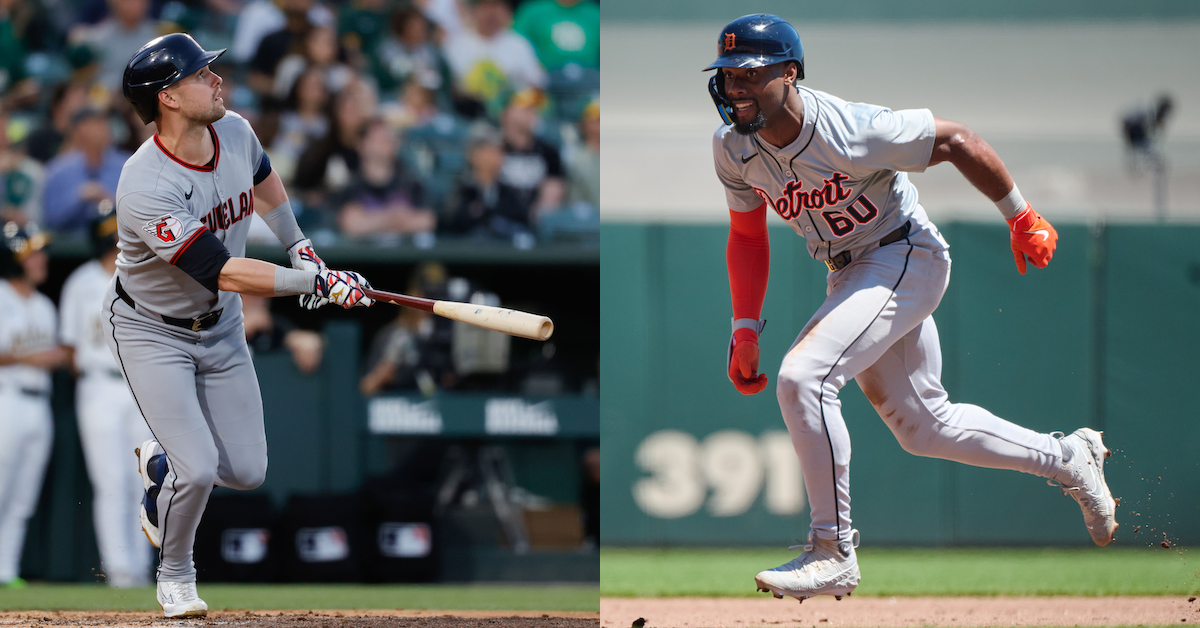
How many outfielders does one team need? It really, really depends on who you ask. On Thursday, the Royals and Brewers decided that they needed to add at least one more each to their very differently sized stores. Kansas City signed Lane Thomas to a one-year deal for $5.2 million, with up to another million in incentives, according to Will Sammon of The Athletic and Mark Feinsand of MLB.com, while Milwaukee agreed to a major league deal with Akil Baddoo, the terms of which are not yet known, according to Ken Rosenthal of The Athletic. It’s safe to assume it’s a split contract, as Baddoo still has one minor league option left.
Thomas is by far the bigger addition, but we’re going to start in Milwaukee in order to highlight two very different approaches to building an outfield.
You know all about Baddoo. His athleticism allowed him to spend years on the top prospect lists for the Twins and Tigers, peaking at 12th in the Minnesota system in 2018. That was a long time ago. Detroit nabbed Baddoo in the 2020 Rule 5 Draft, and he debuted in 2021, getting off to a blazing start and running a 108 wRC+ with 1.7 WAR over 124 games. But despite several extended looks, he never stuck. Over nine seasons in the minors, he owns a wRC+ of 120, compared to 87 in the majors. From 2022 to 2025, he put up just 0.1 WAR with a 73 wRC+.
That’s not inspiring, and the Brewers have plenty of outfielders. They’ve got Jackson Chourio, Christian Yelich, and Sal Frelick. They’ve got Isaac Collins, who was somewhat unexpectedly brilliant this year. They’ve got Garrett Mitchell, owner of a career 114 wRC+, trying to bounce back from an injury-marred campaign. They’ve got speedy fill-ins like Blake Perkins and Brandon Lockridge. Even Jake Bauers spent time in the outfield in 2025. That’s so many outfielders. Add in Baddoo, and you now have a full baseball team worth of outfielders! Not only that, but they’re good. Brewers outfielders produced 10.4 WAR this season, the fifth-best mark in baseball.
Why bother adding Baddoo? First, because he has a few things to offer. He is still just 27, and he stole 28 bases this year (27 in the minors). He’s a left-handed hitter with a career 93 wRC+ against right-handed pitching in the majors. Running and holding your own against righties are useful skills. The second reason is that Badoo may – may – fit Milwaukee’s system better than most places. He’s a speedy player who hits the ball on the ground, and the Brewers are unique in their success with that particular approach. The Twins organization, where Baddoo started out, was one of the league’s most focused on lifting and pulling the ball, and whether or not it’s by design, no team put the ball on the ground less than the Tigers in 2025. In the unlikely event that there’s a league-average hitter lurking somewhere inside Baddoo, the Brewers are better suited to unlock him.
The third reason is the biggest: Injuries and underperformance happen. All eight of the players mentioned earlier received at least 50 plate appearances as an outfielder this season, and that’s not all that high a number; the Astros and Royals had 12 such players. The difference is that all eight of Milwaukee’s outfielders put up positive WAR. That’s the depth that helped them to finish fifth in outfield WAR despite Chourio taking a slight step backward and dealing with a hamstring injury, despite Yelich needing more time as a DH, and despite the injuries to Mitchell.
All of this is to say that the Brewers really value outfield depth. They value players whose speed gives them a higher floor. They don’t want to be below replacement level even when they’re down to their sixth replacement outfielder. If all goes well in Milwaukee, Baddoo won’t make the roster out of camp and probably won’t even sniff any major league playing time. Chourio and Frelick will have big years in right and center, while left field will belong to some combination of Yelich, Collins, and Mitchell. But how often do things go perfectly? Baddoo has a few possible strengths, and the Brewers have the depth to use his best qualities judiciously. This team is not going to be caught without a competent outfielder.
The Royals are at the other end of the spectrum. They finished dead last in outfield WAR in 2025. They combined for -1.1 WAR, and they were the only team below zero. Seven of the 12 players who got at least 50 plate appearances in the outfield put up negative value. Mike Yastrzemski, the only Royal with more than 1.0 WAR in the outfield, now plays for the Braves. Adam Frazier, whose 0.1 WAR as an outfielder ranked third on the club, is a free agent. Jonathan India, whose 0.02 WAR ranked fifth, is not an outfielder (and when you factor in his WAR in the infield, he finished the season at -0.3 WAR).
Despite all that, the Kansas City outfield now seems to be set. They’ve got defensive whiz Kyle Isbel slated to play center. They’ve got 2024 first-rounder Jac Caglianone set to get his first full season in right field. And now they’ve got Thomas in left. If all goes well, they won’t need anybody else. The problem is that hoping all goes well seems to be the extent of their plan. Behind those three, the Royals have a utilityman in Nick Loftin and fourth-outfielder types in Drew Waters, Tyler Tolbert, John Rave, Dairon Blanco, plus recent acquisition Kameron Misner. Steamer projects all five of them to put up below-average performances on both offense and defense in 2026.
To be fair, I should note that Rave played great defense in his debut in 2025, and he could probably offer something north of replacement-level performance should a starter go down. Moreover, ZiPS is a bit more bullish. Dan Szymborski filed his ZiPS projections for the Royals just before Thomas signed, but here’s what he had to say about the outfield: “ZiPS doesn’t really like the outfield this time around either, but it does think that there are enough defense and platoon advantages in the various players slated to man the grass that the Royals could eke out respectable production from the group, certainly quite a lot more than they got last year.” Together, the three outfield spots combined for 5.9 projected WAR, just a hair below average, and Thomas likely bumps them just over that bar.
Should the three starters stay healthy, this outfield could, possibly, be very good. Isbel is a standout flycatcher in center, but his career wRC+ of 78 makes him likely to continue to put up somewhere between 1.0 and 1.5 WAR. However, he puts the ball in play a lot, and there’s always a chance he could BABIP his way into a two- or three-win season. Caglianone is a truly exciting player who put up -1.6 WAR over his 62-game debut thanks to ugly defense, a slow start at the plate, and some catastrophically bad batted ball luck. It’s maybe a little too early to expect him to blossom into the star power hitter we all hope to see, but it’s not impossible. And that brings us to Thomas.
Thomas is 30 years old, and his 2025 season in Cleveland was thwarted at every turn by injuries. He missed time with a bone bruise after taking a pitch off the wrist in April. A week after returning in May, plantar fasciitis sent him back to the IL multiple times, and he had surgery to alleviate the issue in late September. If you’re curious about what that surgery might look like, you can read about it here. At the time of the surgery, the Guardians said that Thomas would be back to full activity within three or four months, so he should be ready for spring training with plenty of time to spare. In all, he got into just 39 games this past season, putting up a 48 wRC+ and -0.5 WAR. His 31% strikeout rate was uncharacteristically high, and his 31% hard-hit rate was uncharacteristically low. In other words, he really didn’t look like himself.
Let’s assume Thomas can get back to something approaching his previous form. From 2021 to 2024, he ran a 103 wRC+ and batted .248. He walked just under 8% of the time and struck out just over a quarter of the time. Depending on which metric you trust, his defense was either right around average or a bit worse. He averaged 1.6 WAR and 17 home runs per 500 plate appearances. That’s not quite a league-average player, but it’s not all that far off. Thomas put up 2.9 WAR as recently as 2023, and it’s worth noting that reports indicate that the plantar fasciitis has been dogging him since as early as 2024, so maybe his true talent level is a bit higher than his recent numbers indicate.
I’ve been describing the best-case scenario here: Caglianone breaks out in a major way, Isbel maintains his defense and runs a great BABIP, Thomas gets healthy and turns right back into the player he was in 2023. Everybody stays healthy. That’s something like a 10-win outfield. It’s also something of a fantasy. We don’t know how fast Caglianone will develop; the projection systems have him between 1.2 WAR and 1.7 in 2026. Isbell is unlikely to turn into a league-average hitter at age 28. And we really don’t know what version of Thomas they’ll get next season. The advanced metrics have mostly thought he was something of an average defender for a while now, and if he’s lost any speed, the big outfield in Kansas City could be a tough assignment. He’s still recovering from surgery, and even if he avoids the IL, he’ll probably need rest throughout the season. He’s by no means a sure thing, and instead of taking a page out of the Brewers’ playbook, the Royals don’t look very likely to build in much depth behind him.
Davy Andrews is a Brooklyn-based musician and a writer at FanGraphs. He can be found on Bluesky @davyandrewsdavy.bsky.social.
The real problem is that even the good version of Thomas is an extreme short side platoon player (>50bps spread in his wrc+), so the Royals need a platoon partner for him and based on the depth chart that guy isn’t on the roster
Kyle Isbel!
(looks at splits pages, sees Thomas owns a better career mark against righties than Isbel does)