
Padres Sign Michael King to Three-Year Deal, Unless You Read the Fine Print
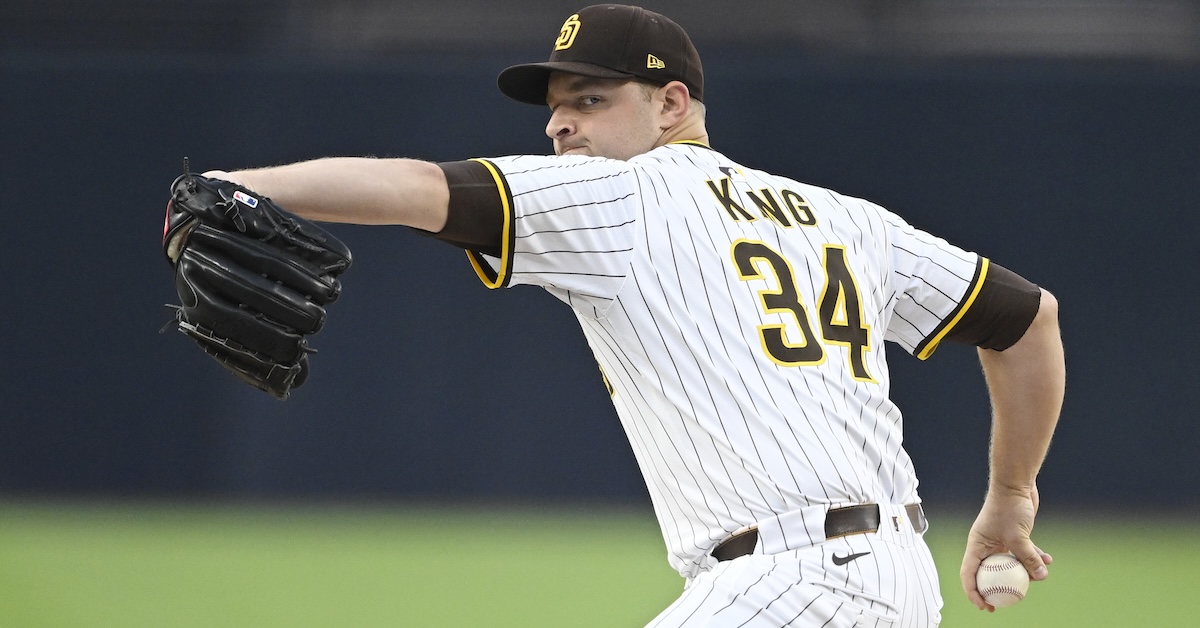
The San Diego Padres have re-signed starting pitcher Michael King to a… let’s just call it a three-year deal worth $75 million for now, though the particulars are somewhat more complicated.
Good for the Padres, getting their Christmas shopping done on time; not all of us are so organized. I also can’t remember if I’ve already used the joke about how a reunion between King and the Friars is the opposite of Becket, the 1964 film starring Richard Burton and Peter O’Toole. These are confusing times.
Especially for the Padres, who have been one of baseball’s more chaotic teams in the 2020s, shipping massive talents in and out with little warning and little regard for the long-term future. King came to San Diego in one of the more famous examples of this behavior: the trade that sent Juan Soto to the Yankees in 2023.
That all-in attitude — even when the Padres were selling in the short term, it was to set up another major push in the medium term — was assumed to have a shelf life. Especially after the death of popular owner Peter Seidler, whose largesse enabled GM A.J. Preller to satisfy his inexhaustible thirst for making deals.
As is so often the case with owners who cared about winning, Seidler’s heirs seem less interested in winning than cashing in on a profitable investment. In November, they put the team on the market. About two weeks later, they let the top right-handed pitcher on the market, Dylan Cease, walk in free agency. Relief ace Robert Suarez followed Cease out the door last week.
With the franchise in a transitional state, it would not have been surprising if King had also been left to seek alternate employment. Keeping him in the fold gives the Padres rotation a much-needed boost. King has been excellent when healthy, and while the current rotation begs to be compared to the what-might-have-been of a unit that also includes Cease, Blake Snell, and Yu Darvish (who’s going to miss the entire 2026 season with an elbow injury), a front three of Nick Pivetta, King, and Joe Musgrove is plenty good. And there’s plenty of high-end starting pitching talent left on the market if the Padres feel like going back for more.
You bring King back, when you have the chance, because of how good he can be when he’s healthy. The apotheosis of Michael King came in Game 1 of the 2024 NL Wild Card Series against Atlanta, when he struck out 12 batters in seven scoreless, walkless innings. According to game score, this was tied for the third-best playoff start in Padres franchise history, behind two Kevin Brown masterpieces during the 1998 postseason.
Look at the video and you’ll see why.
The 2024 Braves were a good lineup, and King made them look completely lost. He’s got four pitches he’ll throw frequently to hitters on either side of the plate: four-seamer, sinker, changeup, sweeper. The four-seamer is whatever; I want to talk about the other three.
The sinker-changeup combo really makes King, for me. In that playoff start, he was getting the kind of two-seamer movement you usually only see in old clips where Greg Maddux got away with scuffing the baseball for a couple innings. King, like Maddux, was dotting it front-door and back-door for called strikes here. The changeup comes in with a nearly identical movement profile, but with a velocity differential of about six miles per hour. That means a hitter can guess right on both movement and location and still be early or late.
And in case anyone gets too comfortable, King also throws a sweeper that looks like a changeup for a while, then gets Vaudeville-caned all the way to the other side of the plate. And then some, in fact. The plate is 17 inches wide; in 2025, the difference in induced horizontal break between King’s sweeper and changeup was a tick over 35 inches. This explains how you get Travis d’Arnaud, who usually knows what he’s doing at the plate, swinging at a pitch four feet out of the strike zone in this game.
Just for fun, King will also sprinkle in a slider, which has abnormally little horizontal movement for a pitch of that type but excellent vertical movement. The hitter thinks he’s getting a sweeper, but instead of breaking in on a lefty, it goes straight for the floor.
Now, that one playoff start was the best night of King’s life. He usually doesn’t throw that hard, with that much movement, or — if we’re being fair — get that many favorable strike calls. But over the course of the entire 2024 regular season, King was a good bat-misser for a starting pitcher (78th-percentile whiff rate, 81st-percentile strikeout rate) while posting some of the best quality-of-contact numbers in the league; his HardHit rate, 30.3%, was the best in the league among qualified starters. If you lower the threshold to 100 innings, only Snell beat him.
It’s hard to do both of those things at the same time. Since 2024, here are the starting pitchers who have thrown 100 innings in a season with a HardHit% of 34% or less and a Whiff% of 25% or more: Snell, Chris Sale, Corbin Burnes, Hunter Brown, Hunter Green, King, Tarik Skubal (twice), Tyler Anderson, and Zack Wheeler. If Burnes is worth $35 million a year at this stage of his career, you can make a pretty easy case that King is worth $25 million.
The structure of the deal, as I insinuated before, clouds that simple assertion. A three-year commitment is relatively short for a 30-year-old of King’s ability, and this contract is even less straightforward than the headline figures would make it look.
King turned down a one-year, $22.05 million qualifying offer to try his luck in free agency. The deal he got from the Padres has the following structure: $17 million in total compensation for 2026, with $5 million coming in salary and the rest in the form of a signing bonus. The two ensuing seasons are due to pay him $28 million and $30 million, respectively, and King has the option to sever the contract after either 2026 or 2027 and collect a $5 million buyout. Between his 2026 compensation and the buyout, King will make, at a minimum, almost exactly the $22 million he just turned down. If he thinks he can beat $29 million in AAV in free agency over the next two seasons, he can go back on the market at the next opportunity, unencumbered by the qualifying offer.
Every married couple, sooner or later, goes through hard times. When a rough patch hits, some people get divorced; others work through their problems and stay together. The latter group of couples can be further subdivided into two types: First, couples who go to therapy, learn to communicate, reignite the spark in the relationship, and recommit fully. You do whatever it takes to make the relationship work, and deal with the problems, rather than the symptoms.
Other couples paper over the cracks. Your job keeps you away from the family 80 hours a week? Well, we’ll still fight about it, but not in front of the kids. The overbearing in-laws turn in their spare key, but still come over four nights a week. One spouse drinks too much? Well, they’re not going to quit, but they’ll think about cutting back.
Cease’s contract in Toronto is a commitment; King’s contract in San Diego is a stopgap.
And it has the potential to work out quite badly for San Diego. Any deal that features an opt-out after every season puts the player in the driver’s seat; if King is better than expected, the Padres will only benefit from their savvy signing for one year. If he’s bad, or worse, if he gets hurt again, they’ll be on the hook for the whole contract. And this contract is so backloaded I wonder if the Seidler heirs signed off on it under the assumption that the $30 million in 2028 will be some other owner’s problem.
King intuitively feels safe; he’s a solid 6-foot-3 athlete with a boring name and a smooth, loose delivery. He does everything you’d want a starter to do at least reasonably well. He has two fastballs, two distinct breaking balls, and one of the best changeups you’ll see. He gets lefties and righties out, he gets soft contact, he gets whiffs, he gets batters to chase, he works fairly deep into games. He gets hit sometimes, like most pitchers, but in two seasons in San Diego, King has only really had one nightmare start.
At the same time, he’s appeared in seven major league seasons, and he’s only been a healthy, consistent starter in one of those campaigns. In 2025, he was limited to 15 starts by a nerve injury in his shoulder, and later by a knee injury suffered during his rehab. The chances that the Padres end up paying out the last two years of this contract, and regret doing so, are higher than they’d probably like.
But that’s a problem for another year. And quite possibly another owner. Eat, drink, be merry, and throw the sinker. Tomorrow is not promised.
Michael is a writer at FanGraphs. Previously, he was a staff writer at The Ringer and D1Baseball, and his work has appeared at Grantland, Baseball Prospectus, The Atlantic, ESPN.com, and various ill-remembered Phillies blogs. Follow him on Twitter, if you must, @MichaelBaumann.
Incredible deal for King, kudos to his agent. 3/75 would have been pretty fair without any opt-outs. Now, if he has a healthy platform year in either of the next two seasons, he gets to re-enter free agency without a QO.
It’s definitely on the unfriendly side for the team, but they’d otherwise be so hard-pressed to get a pitcher of King’s caliber without giving up another core player that it’s worth the downside risk.