
Pitchers Shouldn’t Be Allowed To Wear a Single-Digit Uniform Number Without a Government License
I try not to be a stick in the mud. I really do. But I was poking around in RosterResource recently, and I saw something that gave me a headache. Edwin Díaz, who wore no. 39 with the Mariners and Mets, had to pick a new number with his new team, as the Dodgers had retired no. 39 for Hall of Fame catcher Roy Campanella.
He’s choosing no. 3. Díaz actually made his new number public back in December, but I’d missed the news. Good thing; it would’ve ruined my Christmas. Too many pitchers are wearing single-digit numbers these days, and it has to stop.
Every sport has its own position-based numbering conventions. Football’s are the most rigid; it’s only in the past decade that the NFL relaxed its numbering system after decades of sticking linebackers in the 50s, receivers in the 80s, and so on. Even now, offensive players’ eligibility to catch a pass is restricted by uniform number; a player wearing a number between 50 and 79 still has to check in with the referee if he wants to line up as a tight end or fullback.
In hockey, only goalies can wear no. 1 by rule. By tradition, defensemen wear single-digit numbers other than no. 7 and no. 9, which are reserved for forwards, along with numbers in the teens. (I have season tickets for Princeton’s men’s hockey team; one of their defensemen wears no. 11, and every time he takes the ice I get this weird chemical taste in my throat.)
Rugby union players wear uniform numbers one through 23, assigned by position on a game-by-game basis. A player can start at fullback one game and wear no. 15, then come off the bench the next game, wearing no. 22. That’s a little weird in a world where most team sport athletes adopt a number for a whole season at least, but it’s not unique; soccer only adopted permanent squad numbers in the 1990s.
Baseball has never quite been so rigid, but its numbering conventions serve a similar purpose. The Yankees, who are credited with introducing squad numbers to baseball, gave out no. 1 through no. 8 to their starting position players based on batting order in 1929, reserving double-digit numbers for pitchers.
After World War II, the norm against pitchers wearing single-digit numbers was cast in concrete, and only started to wear down in the early 2000s, when I was in high school. This is how uniform numbers ought to work in baseball.
| Number | Position |
|---|---|
| 0-10 | Position players |
| 11-19 | Position players and Japanese pitchers |
| 20-29 | Everyone |
| Double numbers 33 through 99 | First basemen, pitchers, outfielders |
| 30-32, 34-43, 45-65 | Pitchers |
| 67-76, 78-87, 89-98 | Coaches and spring training NRIs |
This terrific Wall Street Journal article by Stefan Fatsis (one of the all-time great chroniclers of athletic esoterica) presents a window into the norms of that age.
The news hook for Fatsis’ article was the fact that two major league pitchers — David Wells of the Red Sox and Josh Towers of the Blue Jays — were wearing single-digit numbers at the same time. That had only happened three times from 1960 to 2005, the year Fatsis’ article was published. Both pitchers had their reasons. Wells’ longstanding affection for Babe Ruth was by this point well-known; he’d bought one of the Bambino’s game-worn Yankees caps for $35,000, then suffered an additional $2,500 fine after he wore it in a 1997 game. He picked no. 3 with the Red Sox in tribute to his hero.
Towers’ reasons were more quotidian. At 6-foot-1, 185 pounds, he was on the small side for a pitcher. When he arrived for his first game with the Blue Jays in 2003, he told Fatsis, Toronto’s equipment manager had only one jersey on hand in his size: no. 7. Towers took a liking to it and, despite having the opportunity to change it, wore it for parts of five seasons with the team.
That kind of mistake was, for decades, the only way a pitcher could get his hands on a single-digit jersey number. Fatsis led his story with the tale of Rob Bell, who showed up for his first game with the Rangers in 2001 and asked the equipment manager for the lowest number he had available, expecting something in the teens.
The equipment manager in question was Zack Minasian. He handed Bell no. 6, and later told Fatsis, “I just think I went brain dead that day.”
Nowadays, everyone’s braindead, and the kind of person who’ll give a pitcher a single-digit uniform number is allowed to be the general manager of the San Francisco Giants.
I went through every team’s roster and found 575 pitchers with a current major league number assignment, as of Saturday afternoon. (Obviously that’s going to go up as more free agents sign and teams assemble their spring training rosters.) Here’s what they’re wearing, compared to 20 years ago:
| Time Period | Total | 0-9 | 10-19 | 20-29 | 30-39 | 40-49 | 50-59 | 60-99 | 00 |
|---|---|---|---|---|---|---|---|---|---|
| May 2005 | 351 | 2 | 18 | 40 | 102 | 92 | 80 | 17 | 1* |
| January 2026 | 575 | 9 | 17 | 49 | 80 | 102 | 112 | 206 | 0 |
It’s not an apples-to-apples comparison, as there’s a nearly two-thirds increase in the number of pitchers with numbers, with (obviously) no corresponding change in the quantity of available uniform numbers. That’s partially because it’s the offseason, partially because I’m counting a lot of guys who are on 40-man rosters who won’t break camp with the big league teams, and partially because baseball in 2026 requires a lot more pitchers than it did 20 years ago.
But in May 2005, no pitchers were wearing numbers in the 80s and 90s. Now, it’s not just scrubs and training camp filler, it’s Luis Gil, Will Warren, Spencer Strider, Taijuan Walker, Tanner Houck, and Dylan Cease — these are legit big leaguers, including a couple stars, wearing numbers that would’ve been untouchable when they were kids.
Even so, a pitcher with a high number — even a weird one, like 84 or 98 — isn’t quite as viscerally upsetting as one with a single digit. Here are the nine offenders, with their 2025 stats.
| Team | # | Player | Throws | WAR | ERA | IP |
|---|---|---|---|---|---|---|
| COL | 0 | Jaden Hill | R | 0.3 | 3.38 | 29 1/3 |
| SDP | 1 | Yuki Matsui | L | -0.3 | 3.98 | 63 1/3 |
| WSN | 1 | MacKenzie Gore | L | 2.9 | 4.17 | 159 2/3 |
| LAD | 3 | Edwin Díaz | R | 2.0 | 1.63 | 66 1/3 |
| STL | 3 | Dustin May | R | 0.8 | 4.96 | 132 1/3 |
| DET | 4 | Beau Brieske | R | -0.5 | 6.55 | 22 |
| LAD | 7 | Blake Snell | L | 1.9 | 2.35 | 61 1/3 |
| DET | 9 | Jack Flaherty | R | 2.5 | 4.64 | 161 |
| WSN | 9 | Cade Cavalli | R | 0.5 | 4.25 | 48 2/3 |
At lower levels, numbers change frequently and few jerseys are ordinarily available. And even up to the college level, where two-way players are still common, pitchers wear low numbers without anyone batting an eye. Clarke Schmidt wore no. 6 at South Carolina. Cade Horton wore no. 9 at Oklahoma. College pitchers who take numbers in the teens and low 20s often spring for something more traditional once they hit the big leagues. (Gerrit Cole, Aaron Nola, and Carlos Rodón are three examples.)
But it’s bothersome in the majors, for two reasons that came up in Fatsis’ story. He quotes then-Red Sox GM Theo Epstein, who joked that a single-digit number looked odd on Wells, a big guy with plenty of open real estate on his jersey.
That’s a big thing; the pitcher is the only player in baseball — maybe the only athlete in all of team sports — who spends most of the game with his back to the TV camera. And pitchers are big dudes, by and large; even a skinny two-digit number, like 11, feels inadequate for a pitcher’s broad thorax. Think of someone as big as Yu Darvish; that’s a lot of white space to stare at for a long time.
The other quote comes from Bell, who posted a 7.18 ERA in 18 starts in 2001, while wearing no. 6: “It looks weird… You better pitch well with a single digit on your back, and I didn’t.”
A pitcher who chooses a single-digit number is mocking convention. He’s drawing attention to himself. This is not a normative statement, to be clear; pitching in a single-digit number is the same as dyeing one’s hair or wearing bright colors. It merely invites observers to look, and to judge.
The thing about individualism is that the more common an act of stylistic rebellion becomes, the less compelling it gets. Think about examples from the world of music. There’s an artistic thread that runs from genuinely transgressive early punk acts like the New York Dolls, to The Clash, to Green Day, and within a couple generations you can listen to Metro Station in the car with your parents.
We’re not quite there with single-digit pitcher numbers, but there’s a clear trend.
Guys like Bell, Wells, and Towers poked holes in the dam, but there are two pitchers in particular I blame for (or credit with) knocking the whole thing down.
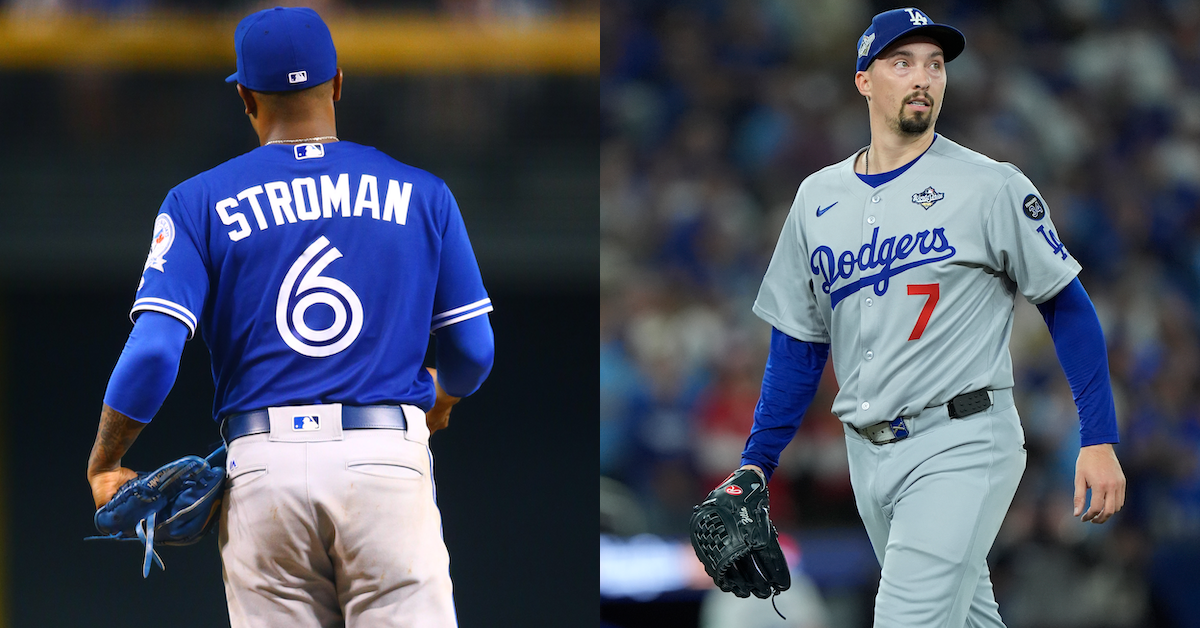
The first is Marcus Stroman, who wore no. 7 at Duke, then no. 54 as a rookie in 2014, then switched to no. 6 for the rest of his tenure with the Blue Jays. Stroman spent the rest of his career in single digits, including for two appearances at the World Baseball Classic.
The other is Blake Snell, who has never worn a double-digit number in the big leagues. He was attached to no. 4, in honor of his December 4 birthday, and asked for it when he debuted with the Rays in 2016. He kept it for his three years in San Diego, switching to no. 7 for the Giants (who’d retired no. 4 for Mel Ott) and the Dodgers (who’d retired no. 4 for Duke Snider).
I’m good with Snell and Stroman wearing single-digit numbers, because both of them are pitchers for whom an unusual, unsettling, attention-grabbing sartorial choice makes sense. They’re both kind of odd pitchers with big, outspoken personalities, with the “What the hell are you looking at?” attitude you need to pull off the equivalent of a single-digit pitcher number in streetwear. And both of them are (or were, in Stroman’s case) good enough to back it up. Take it from Bell; that last part matters.
Thumbing one’s nose at social conventions is like capsaicin. If there’s a savory dish that wouldn’t be improved by the judicious application of red pepper flakes or a couple slices of pickled jalapeño, I’ve yet to encounter it. It wakes up the senses, delivers a jolt of adrenaline, generally makes life feel a little richer and more exciting.
That does not mean it’s a good idea to pick up a Carolina Reaper and stuff it down your gullet. That’s a good way to find out why those social conventions exist in the first place: ignore them and you’ll end up with burning skin, stomach cramps, and diarrhea. Regulations, as they say, are written in blood.
Including, if you’ll indulge the metaphor a little longer, the one I’m about to propose. One or two particularly interesting pitchers wearing single digits? That’s fun. But if everyone does it, we’ll have chaos.
Therefore, I propose that MLB should issue a limited number of licenses to pitchers who want to wear a single-digit uniform number. Like taxi medallions, they can be exchanged or sold, but the government will only allow so many at one time. I say three is a good number to start with for the entire league.
In order to get a single-digit medallion, a pitcher will have to demonstrate that he embodies the kind of devil-may-care, punk rock attitude his number would demonstrate. Pitchers who throw a four-seamer and a slider and say things like, “I’m just trying to throw strikes and trust my defense,” can wear no. 35. That’s a good number for sheep.
And they’ve got to be good enough to do the number proud. Jack Flaherty’s certainly cool enough for a single-digit number, and Dustin May is weird enough, but remember Bell’s Law: You’ve got to pitch well with a single-digit number on your back. If your ERA is over 4.50, you run the risk of ending up with a uniform number over 10.
I think we can all agree that I, personally, would be the best person to be vested with the unilateral discretionary power to issue and revoke these licenses. This task I’m willing to perform for the league, gratis, out of a sense of profound personal duty to look out for the best interest of the sport. Give me a call, Rob. I’m ready to serve.
Michael is a writer at FanGraphs. Previously, he was a staff writer at The Ringer and D1Baseball, and his work has appeared at Grantland, Baseball Prospectus, The Atlantic, ESPN.com, and various ill-remembered Phillies blogs. Follow him on Twitter, if you must, @MichaelBaumann.
This is an excellent idea, and the more I think about it, the more I think it’s frankly critical for MLB to adopt this rule to improve the product. I expect it will be the centerpiece of the next CBA negotiation.
Well said. (In the same tone of voice you used.)