
Reds, Rays, and Angels Link Up In Three-Team Swap
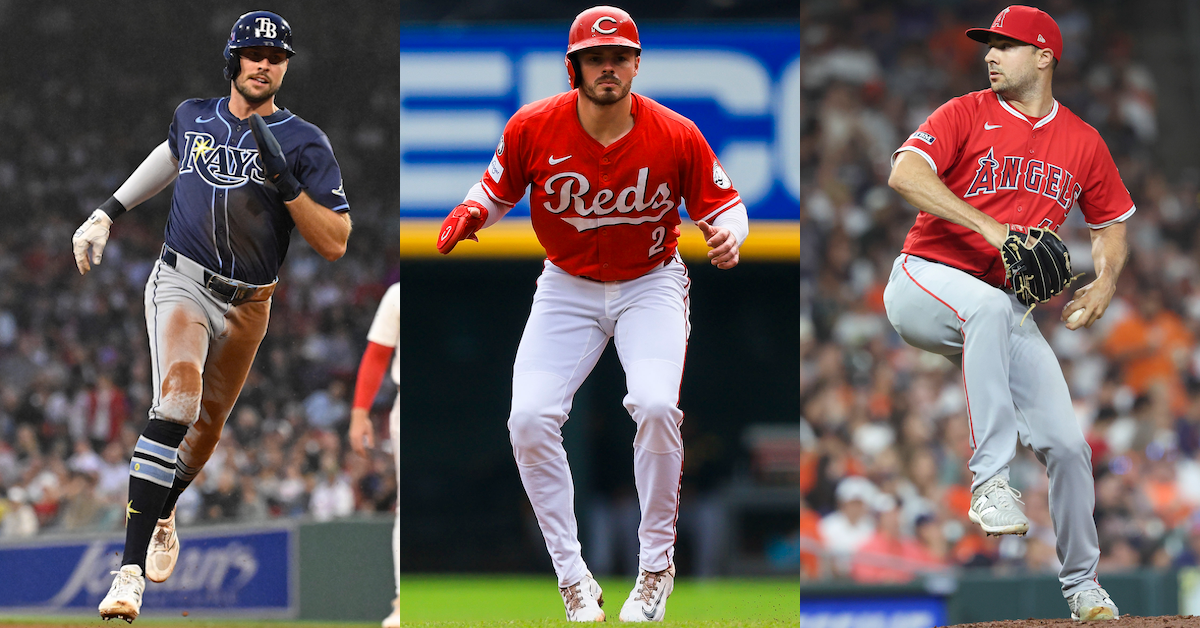
Last week was one of the busiest of the offseason so far, with Kyle Tucker taking his talents to Chavez Ravine and Bo Bichette heading to the Mets. Given those glitzy headlines, it was easy to miss an annual rite of winter: a weird, zero-sum-feeling trade that didn’t need to be a three-teamer but was anyway because the Rays got involved. The particulars: The Rays sent Josh Lowe to the Angels, the Angels sent Brock Burke to the Reds, and Tampa Bay got Gavin Lux from Cincinnati and prospect Chris Clark from the Halos.
The first thing that drew my eye in this trade is that the two hitters are at least superficially similar: lefties with enormous platoon splits and no real defensive home. Lux has a career 99 wRC+; Lowe 101. They get to those marks in extremely different ways, though, and I think that’s as good of an entry point into analyzing this swap as any.
Lowe is an archetypical lefty power bat, and the Angels simply don’t have anyone like that. Last year was easily Lowe’s worst as a pro on a rate basis, and he also spent a month and a half on the IL. But his 11 homers would have been the second-most by an Angels lefty, behind Nolan Schanuel’s 12 in 150-ish more plate appearances (Yoán Moncada also hit 12 lefty homers, but he left in free agency). Overall, the Angels were 29th in baseball in home runs hit by lefties, with 34 for the entire team put together.
Lowe will immediately be the best lefty thumper on the team, and also the only one; Schanuel, an OBP guy, is the only other everyday player who bats left, and they don’t have any switch-hitters on the major league roster either. Having at least a few lefties to keep opponents honest truly matters. I spend a lot of time minimizing the importance of lineup construction, but that’s different from roster construction. It’s a lot easier to get sluggers like Mike Trout and Jorge Soler favorable matchups if you can wedge Lowe in between them. His ludicrous platoon splits (career 115 wRC+ against righties, 42 wRC+ against lefties) mean that only a madman would bring in a righty reliever against him. But what are you gonna do, let Trout face the tiring guy you already have in instead? And if your lefty specialist gets Lowe out (when he gets Lowe out?), Soler and his colossal, lefty-killing power are due up next.
That style of alternating batting order is how lefties like Lowe get many of their good matchups, so I completely understand why the Angels wanted a guy like him the middle of their order. The real question is: This lefty? Lowe was quite bad in 2025. He was actually below replacement level by our calculations, at -0.1 WAR, thanks to his aforementioned awful season at the plate and subpar defense in right field. His biggest issue wasn’t even lefties, though of course he was cartoonishly bad against them, just like always. The problem was that he hit a middling .242/.307/.420 against righties, which works out to a 100 wRC+.
What went wrong? Basically everything. His bat speed declined by a tick, he chased at a career-high rate, and while he made a bit more contact than his career average, that’s just not his game; he was in the 27th percentile for whiff rate (higher is better for hitters) in 2025, which is actually the best mark of his major league career. The oblique strain that sent him to the IL was just the latest in a two-year nightmare; he hurt his oblique twice in 2024, and also dealt with hamstring and hip injuries.
That’s actually the upside case for Lowe. He looked like a future star in a breakout 2023 season, and he’s basically been hurt ever since. That 20 homer, 130 wRC+ season would make him one of the Angels’ best hitters. He has plus power and has generally done a good job pulling the ball in the air, although he was bad at it during his horrid 2025 season. If this was all an injury-related blip, though, the future prognosis could be pretty good. Lowe is set for a reasonable $2.6 million salary in his first year of arbitration, which means he has two years of team control remaining beyond this one. He hasn’t yet turned 28. There are the bones of an interesting player here, and on a team like the Angels, where there isn’t much minor league talent knocking on the door, he might be a meaningful upgrade over what they had.
So why did the Rays get rid of him? They’re realists, basically. They clearly like Lowe – they’re the ones who offered him that arbitration salary, for example, and they’ve repeatedly made trades in the past to clear up playing time for him. But that was mostly before his big downswing, and now his career arc is misaligned with the team’s preferences. They generally don’t like to retain players as they progress through arbitration; team control and thus trade value heads down while salaries heads up, and that’s just not the Tampa Bay way. Combine that with the fact that Lowe has been mediocre for two straight years and that they gave Jake Fraley, another lefty corner outfielder, a $3 million deal this winter already, and Lowe was surplus to them. I thought he might be a non-tender candidate, in fact, and it’s not at all clear that the Rays would keep him even if he bounces back in 2026.
He might not have been surplus if he could replace his fel-Lowe ex-Ray, Brandon Lowe, the team’s longtime second baseman who got shipped out to Pittsburgh in December. That makes Lux extremely intriguing. Lux mostly DH’ed and played left field for the Reds in 2025, but he came up as a second baseman and the Rays have already announced that he’ll be back at the keystone for the upcoming season.
Lux might be a platoon-y lefty like Lowe, but he gets to his value very differently. He doesn’t impact the ball with great ferocity. In fact, he’s only notched double digit home runs once in his big league career. Though he came up as a do-everything prospect, he’s evolved into a patient hitter with a great sense of the zone. He’s walked slightly more than 10% of the time in his career, and took free passes at a career-high 11.1% clip last season. He seemed to lean into contact over power, a strange choice to be sure in homer-happy Cincy, but the result was a .350 OBP that made him a league average bat even with a mere five homers in 500 plate appearances.
The Rays doesn’t need a lefty to make their lineup work in the same way the Angels do, but they do need offense from second base, and preferably lefty offense for platooning reasons. It doesn’t hurt that Lux can play everywhere. Sure, he doesn’t play well anywhere – please, do not show your children videos of Lux in left field – but the Rays are unmatched when it comes to figuring out ways to get their best players on the field in multiple configurations, and Lux will only aid them in that pursuit. He’s probably a 45 defender at second and third, maybe a 40, but Tampa Bay is great at positioning and was already playing Brandon Lowe, hardly a defensive wizard. Lux’s glove will be an upgrade on his.
Lux’s offensive game feels very high-floor to me. An 8% swinging strike rate and a great approach at the plate mean that he’s going to be on base a lot even if hits aren’t falling. That combines well with the power bats at the center of the Tampa Bay order. Sure, he’s a free agent after this year and making $3 million more than Lowe, but given that I half expected the Rays to move on from Lowe anyway, the team control isn’t an enormous issue. And even for the spendthrift Rays, a starting second baseman for $5.525 million is eminently reasonable. If someone offered their front office the ability to swap Lowe for Lux straight up, I think they would have accepted it.
Somehow, though, they got a reasonable prospect in the deal as well. Chris Clark is an interesting player in his own right. I got a detailed scouting report on him from Eric Longenhagen:
Clark is a gangly 6-foot-4 righty with a great looking arm action and enough feel for location to project as a starter despite below-average overall athleticism. A 2023 fifth rounder out of Harvard, Clark has drastically improved his changeup while stretching out to 144.2 innings in 2025. He had a good year on paper — 24.3% K%, 7.5% BB%, 1.31 WHIP — albeit mostly as an old-for-A-ball starter; he’s now 24 and spent most of the year at Low-A Inland Empire.
Clark was a low-slot fastball/slider guy in college, but some tweaks to his delivery have made it easier for him to turn over a changeup, and that pitch is on track to be his best one, as it has bat-missing tailing action. Improvement in this area is why he has backend starter projection. Clark’s command of his fastball (it sits 91-94 mph and touches 96) is better than that of his slider (an average, gyro-style 81-84 mph offering) by a fair bit. He isn’t the kind of pitcher who we think could turn an average slider into a plus one via plus command, so he’s probably more of a backend/swingman type than a lock to make a good rotation. His arc is still a feather in the cap of Angels’ player dev, as a backend starter is a great outcome for a fifth round pick. Clark enters his 40-man platform year having made one Double-A start, and he’ll likely spend 2026 split between High- and Double-A competing for a roster addition after this season.
Eric’s job, of course, is to evaluate prospects in great depth and spend a long time thinking about all the possible avenues of success and failure. Mine is to take that research and distill it down into something I can think about in terms of value in trade, and so I’ve got this: Clark is a back-end starter lottery ticket, with added utility if you’re looking to lose an argument about pre-revolutionary agrarian economies to Will Hunting.
Let’s circle up with the last team on the trade before taking a look at the broader picture. The Reds were an awful fit for Lux. They have more infielders than they have playing time for, which explains his continued appearances in left and at DH. Their park rewards you for putting the ball in the air with power, and he doesn’t do either of those things very often anymore. They’re trying to supplement their young core with free agent additions while also keeping the budget low, so his salary was a burden. Every headwind you can imagine was stacked up against Lux there. He wasn’t even clearly a better offensive option than the guys he was competing with, what with Top 100 prospect Sal Stewart already having debuted at the tail end of the 2025 season and plenty of other bats clogging the bench.
Burke, their return in this deal, checks multiple boxes. He’ll earn less than Lux this year. He won’t block any top hitting prospects, what with him being a reliever and all. And the Cincinnati bullpen was middling in 2025 even with 33 innings of 2.45 ERA lefty excellence from Taylor Rogers in the back half of the year. With their bullpen mostly unchanged (they added Caleb Ferguson and Pierce Johnson, but lost Scott Barlow, Brent Suter, and Rogers), something needed to be done.
Burke is a pretty weird pitcher, but an effective one. You’d expect a slider-happy lefty with a low strikeout rate to obliterate same-handed batters but struggle with righties. But Burke’s best pitch isn’t that slider, it’s a nasty changeup that he throws a third of the time when he’s facing righties. He has meaningful reverse splits in his major league career, though after regressing his observed results towards the mean a bit, I expect that he’ll be about even against both sides going forward.
Another appealing part of his game is that even though he throws a four-seamer instead of a sinker, Burke is a groundball pitcher, a great fit for Great American Ball Park. And while a lot of these particulars make him sound like a soft tosser – the left-handedness, the pitch mix, the grounders-over-strikeouts results – he sits 95-96 mph and tops out around 100. Figuring out how well one particular reliever will pitch in the coming year is always a crapshoot, but guys like Burke do well in the aggregate, and I like Cincinnati’s strategy of assembling a ton of solid bullpen arms and letting the 2026 season sort out who the best of them are. It doesn’t hurt that Burke will earn $3 million less than Lux, saving them a few bucks for another speculative relief addition.
As I look over this trade, I keep thinking that a straight swap of Lux for Burke is the most logical way this could have gone. The Angels wanted a lefty bat, the Reds wanted a middle reliever, and each had what the other wanted. But somehow – and I really do think that Lux’s lack of power is a likely reason – that construction of the trade didn’t work for the Angels. So the Rays got in on it and prospered.
“Three years of Josh Lowe” sounds pretty great, especially when you’re comparing it to one year of Gavin Lux. Realistically, though, guys with major league statistics similar to Lowe’s mostly don’t make it to free agency without getting non-tendered. From Tampa Bay’s probabilistic perspective, it was probably more like “One-and-a-half years of Josh Lowe” or so in expectation, depending on how he played this season. At that point, they’re almost the same player, and Lux fits the particulars of the Rays’ roster much better. And Clark isn’t nothing; he’s the type of player whom Tampa Bay often gets the most out of, and like Cincy’s offseason reliever approach, the Rays like finding lesser-regarded pitching prospects in high volume to feed into their pitching development machine. That’s quite an upgrade overall, even if it sounds like they’re surrendering the most years of proven major league talent in the deal.
Cincy’s side of the trade is also easy to understand. Their roster looks better today than it did before this deal, and they saved a little cash to boot. Lux was a nice bounce-back candidate last year, but he didn’t rebound as much as they hoped and didn’t fit the roster all that well anyway. Might as well move on and improve at an area of need, even if a lefty reliever isn’t as exciting as a former Top 10 prospect.
That just leaves the Angels, and while I get the temptation to get many years of team control when acquiring a prime-age hitter, I don’t love the details of the deal in this case. They’re making a bet on variance; most hitters with trajectories similar to Lowe’s don’t bounce back, but most isn’t the same as all. A high-end outcome here – Lowe shaking off the injuries and posting a 3-WAR season with 25 bombs, say – would make the Angels the clear winners of this deal. Lux and Burke can’t deliver that kind of long-term value even if they have a great year. Clark potentially could, but the odds are obviously lower; Lowe has already been a difference-maker in the big leagues, while Clark has pitched four innings above A-ball.
That’s a fine defense of the Angels’ side of this deal in a vacuum, but I just don’t buy it. Lowe probably isn’t going to work out; that’s just the cold hard truth about players whose careers get derailed by injuries for multiple years. Even if he does, solid lefty corner bats kind of grow on trees these days. With teams going younger and more athletic in general, slugger types without much defensive value aren’t in high demand. Maybe you can dream on Lowe somehow regaining his offense and also fulfilling the defensive promise he showed as a prospect, but the odds of that are surely miniscule.
How different is Lowe from JJ Bleday, a former top prospect and lefty masher who the Reds got for $1.4 million in free agency after the A’s non-tendered him? How different is he from Fraley, claimed off waivers this fall and then re-signed after a non-tender? This kind of player, in general, just doesn’t move the needle. I’m not saying that the Angels could have gotten Lowe for nothing, but if they were truly desperately in need of left-handed power, it’s weird to wait until mid-January and then trade an intriguing pitcher to the Rays (and a solid reliever to the Reds) to get a reclamation project. That just sounds like a bad process to me.
The truth is that this deal probably won’t matter all that much. It’s not earth-shaking, and I doubt that any of these players will be the difference between their clubs sneaking into the postseason or missing out. But just because something probably won’t matter doesn’t mean it can’t. The Rays don’t win every trade, but they make a ton of them, win more than they lose, and try to build their team out of accumulating small advantages and pressing their successes. This is the exact kind of deal that they’d like to do a bunch of, because you never know which probabilistic advantage will come through. I like Cincinnati’s side of this deal, and I love Tampa Bay’s, but I think the Angels’ side overvalues Lowe’s brand name instead of looking at the landscape of baseball as it exists today.
Ben is a writer at FanGraphs. He can be found on Bluesky @benclemens.
When I saw Lux was in the trade I figured he’d end up with the Angels. It is weird that they might play Lowe in CF but they are the Angels.