
The 300: A Tribute to the Ultra-Durable Mickey Lolich and Wilbur Wood
All WAR figures refer to the Baseball Reference version unless otherwise indicated.
Denny McLain was the ace of the 1968 Tigers, going 31-6 with a 1.96 ERA en route to both the American League Cy Young and Most Valuable Player awards, but during that year’s World Series against the defending champion Cardinals, he was outshined by teammate Mickey Lolich. While McLain started and lost Games 1 and 4 before recovering to throw a complete-game victory in Game 6, Lolich went the distance in winning Games 2, 5, and 7, the last of which secured the Tigers’ first championship in 23 years. By outdueling Bob Gibson — the previous year’s World Series MVP and the author of a 1968 season to rival McLain’s — in Game 7, Lolich secured spots both in Fall Classic lore and the pantheon of Detroit sports heroes.
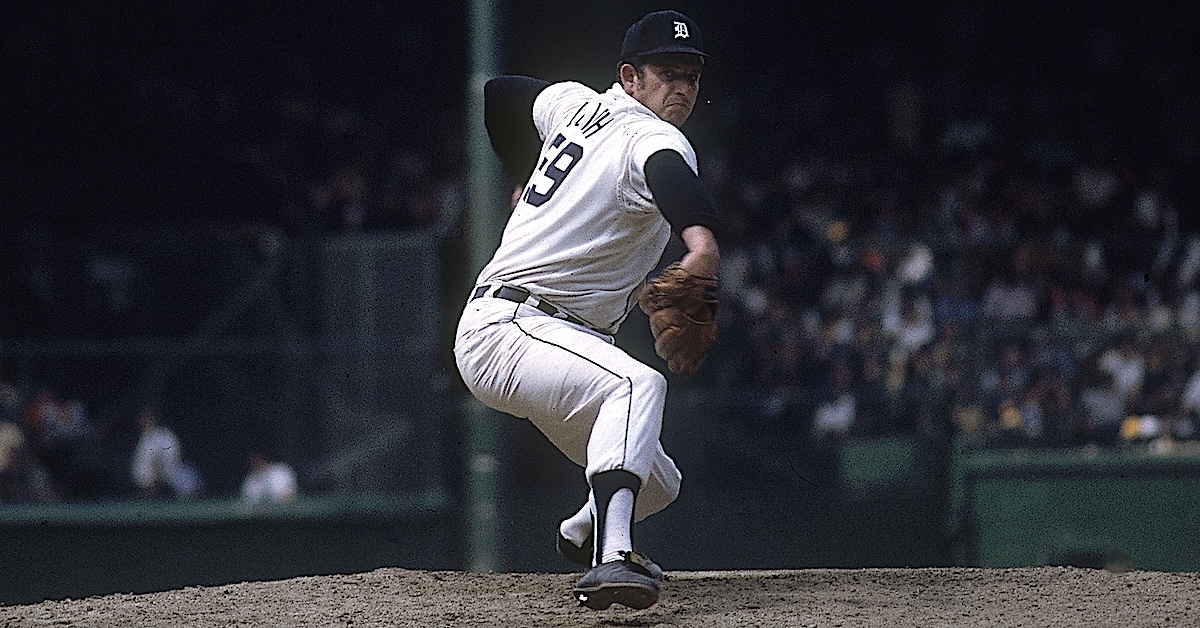
Lolich died last Wednesday at an assisted living facility in Sterling Heights, Michigan at the age of 85. Beyond his World Series heroics, he was a three-time All-Star with a pair of 20-win seasons and top-three Cy Young finishes. A power pitcher whose fastball was clocked as high as 96 mph, he struck out more than 200 hitters in a season seven times, with a high of 308 in 1971. Even today, he’s fifth in strikeouts by a lefty with 2,832, behind only Randy Johnson, Steve Carlton, CC Sabathia, and Clayton Kershaw, and 23rd among all pitchers.
But for as much as anything, Lolich is remembered for piling up innings. In that 1971 season, he went 25-14 while making 45 starts, completing 29 of them and totaling 376 innings — leading the AL in all of those categories except losses — with a 2.92 ERA (124 ERA+). He also topped 300 innings in each of the next three seasons, including 327 1/3 in 1972, when he went 22-14 with a 2.50 ERA.
“No pitcher in 125 years of Tigers big-league life was so tied to durability, or so paired his seeming indestructibility with such excellence during his time in Detroit,” wrote the Detroit News’ Lynn Henning in his tribute to Lolich. “No pitcher in Tigers history quite matched his knack for taking on inhuman workloads that could forge even greater gallantry at big-game moments.”
“Lolich was a gallon of ice cream when you only wanted a cone, simply a great pitcher, and for seven or eight years the toughest lefty in the league,” said slugger Reggie Jackson in 2015. Added Jackson, who hit just .203/.261/.375 against Lolich in 69 plate appearances, “When he stepped on the mound at 1 p.m., you knew he would be there until the end and he never missed a start. Today, they talk about 200 innings being special. Hell, Mickey had 200 innings by August 1.”
That 1971 campaign was the only time Lolich led his league in innings, because the following season, White Sox knuckleballer Wilbur Wood — who had thrown 334 innings the year before — threw 376 2/3 innings over the course of 49 starts, 20 of which he completed. Wood followed up with an AL-high 359 1/3 innings in 1973, then 320 1/3 innings in ’74, which merely ranked fourth behind future Hall of Famers Nolan Ryan (332 2/3), Fergie Jenkins (328 1/3), and Gaylord Perry (322 1/3).
Wood, a lefty himself, won at least 20 games in his four 300-inning seasons, made three All-Star teams, and finished third in the 1971 Cy Young race behind Vida Blue and Lolich, then second in ’72, behind Perry and ahead of Lolich. He died on January 17 in Burlington, Massachusetts at the age of 84.
While at opposite ends of the spectrum stylistically, Lolich and Wood had a couple things in common besides being rubber-armed lefties competing in close proximity. Both benefited from the tutelage of maverick pitching coach Johnny Sain, a three-time All-Star whose second act nurturing hurlers while bucking the establishment — famously, he eschewed running, encouraged throwing on an almost-daily basis, and exhorted his pitchers to fight for higher salaries — brought him even greater acclaim. And neither Lolich nor Wood was built like a top-flight athlete. Both leaned into that reality, and contemporary media dwelled upon it. Though listed at 6-foot-1 and 170 pounds on his Baseball Reference page, by his own account Lolich was well over 200 pounds in his heyday and around 220 later in his career. In his 1968 World Series coverage, the The New Yorker’s Roger Angell described Lolich as “a swaybacked, thick-waisted left-hander.” For a 1972 Time article called “Fat Man on the Mound,” the hurler himself claimed that big bellies ran in his family, and continued:
“I guess you could say I’m the redemption of the fat man,” he cheerfully observes. “A guy will be watching me on TV and see that I don’t look in any better shape than he is. ‘Hey, Maude,’ he’ll holler. ‘Get a load of this guy. And he’s a 20-game winner.’
“His left arm was but an extension of a uniquely structured athlete. Lolich was 6-foot-1 and had uncanny rotation of hips that were even broader than the belly that became something of a trademark through his later big-league years,” wrote Henning, who elsewhere noted that Lolich never even reported a sore arm, let alone spent time on the disabled list for an arm injury. “His mid-structure shifted with such ease that his arm was spared stress that came with throwing a big-league pitch — a degree of strain that has long bedeviled and betrayed pitchers not able to absorb the repetitions on which Lolich seemed to thrive.”
In the wake of his Game 7 victory, Lolich explained that working through fatigue helped his sinkerball. “When I got a little tired the ball sank eight inches instead of four,” he told reporters.
Of Wood, listed at 6 feet and 180 pounds on Baseball Reference, Peter Gammons wrote in a 1973 Boston Globe feature, “Wilbur Wood is a plumber in the offseason, and for that he could pass. Or a taster in a beer factory.” The article’s subheadline described him as “balding [and] fleshy,” and within, Wood conceded, “I’ve been fat all my life. I was a fat baby.”
“On the mound, he displays a comfortable expanse of tum and the stiffish-looking knees of a confirmed outdoorsman, and thus resembles a left-handed accountant or pastry chef on a Sunday outing,” wrote Angell in 1977.
With their everyman physiques, the two southpaws reminded the baseball world that pitching prowess comes in all shapes and sizes. They were part of a generation of ultra-durable pitchers who debuted in the early 1960s and thrived in the ’70s, a time of four-man rotations and scoring levels so low that in 1973 the AL introduced the designated hitter to increase offense. Several of their cohorts pitched well into the 1980s, with six (Carlton, Perry, Ryan, Phil Niekro, Tom Seaver, and Don Sutton) reaching 300 wins and two others falling just short but reaching 3,000 strikeouts (Jenkins and Bert Blyleven). All eight are in the Hall of Fame, while Wood, who retired after the 1978 season, and Lolich, who retired (for the second time) after ’79, are not. Wood, who went 164-156 with a 3.44 ERA (114 ERA+) in 2,684 innings, compiled 50.0 career WAR with a 42.8 S-JAWS, which ranks 106th in the latter category, just above former White Sox teammate and Hall of Famer Jim Kaat. Lolich, who went 217-191 with a 3.44 ERA (104 ERA+) in 3,638 1/3 innings, accumulated 48.0 WAR and 39.7 S-JAWS, tied with Blue for 148th and still ahead of six Hall of Famers, including Jack Morris and another contemporary, Catfish Hunter. Their repeated ability to shoulder such massive workloads puts both in the company of their Cooperstown-bound contemporaries:
| Player | Count | From | To |
|---|---|---|---|
| Gaylord Perry+ | 6 | 1969 | 1975 |
| Robin Roberts+ | 6 | 1950 | 1955 |
| Fergie Jenkins+ | 5 | 1968 | 1974 |
| Phil Niekro+ | 4 | 1974 | 1979 |
| Mickey Lolich | 4 | 1971 | 1974 |
| Wilbur Wood | 4 | 1971 | 1974 |
| Jim Palmer+ | 4 | 1970 | 1977 |
| Don Drysdale+ | 4 | 1962 | 1965 |
| Sandy Koufax+ | 3 | 1963 | 1966 |
| Juan Marichal+ | 3 | 1963 | 1968 |
The pair threw more innings in a single season than any pitcher since the start of the Live Ball era in 1920. While they benefitted from 162-game schedules as opposed to the 154-gamers of their predecessors, the 1972 season was shortened by a players’ strike. Only one pitcher from the previous half-century even approached their totals:
| Player | Team | Season | W-L | IP | ERA | WAR |
|---|---|---|---|---|---|---|
| Wilbur Wood | CHW | 1972 | 24-17 | 376 2/3 | 2.51 | 10.7 |
| Mickey Lolich | DET | 1971 | 25-14 | 376 | 2.92 | 8.5 |
| Bob Feller | CLE | 1946 | 26-15 | 371 1/3 | 2.18 | 10.0 |
| Grover Alexander | CHC | 1920 | 27-14 | 363 1/3 | 1.91 | 12.0 |
| Wilbur Wood | CHW | 1973 | 24-20 | 359 1/3 | 3.46 | 7.6 |
| George Uhle | CLE | 1923 | 26-16 | 357 2/3 | 3.77 | 6.0 |
| Dizzy Trout | DET | 1944 | 27-14 | 352 1/3 | 2.12 | 9.3 |
| Red Faber | CHW | 1922 | 21-17 | 352 | 2.81 | 9.6 |
| Urban Shocker | SLB | 1922 | 24-17 | 348 | 2.97 | 7.1 |
| Robin Roberts | PHI | 1953 | 23-16 | 346 2/3 | 2.75 | 9.8 |
| Steve Carlton | PHI | 1972 | 27-10 | 346 1/3 | 1.97 | 12.1 |
| Gaylord Perry | CLE | 1973 | 19-19 | 344 | 3.38 | 7.8 |
| Bob Feller | CLE | 1941 | 25-13 | 343 | 3.15 | 8.2 |
| Gaylord Perry | CLE | 1972 | 24-16 | 342 2/3 | 1.92 | 10.8 |
| Phil Niekro | ATL | 1979 | 21-20 | 342 | 3.39 | 7.4 |
From 1968–77, at least four pitchers annually recorded 300 innings except for ’76, when only Cy Young winners Palmer and Randy Jones did. After four reached the threshold in 1977, however, only Niekro (1978 and ’79) and Carlton (1980) did so.
…
Michael Stephen Lolich was born on September 12, 1940, the only child of parents Steve (a director of city parks) and Margarite Lolich in Portland, Oregon. He was naturally right-handed, but as a two-year old fractured his left collarbone by crashing his tricycle into a parked motorcycle, which fell on top of him. He spent four months in a cast, and after it was removed, doctors advised Margarite to make him use his left hand to strengthen that shoulder. “I’ve been throwing left-handed ever since I started picking up blocks southpaw style,” he said in 1964.
Lolich soon graduated to “throwing figs at city buses 150 feet from the top of my grandparents’ garage,” he said in 2015. When he was 11, his father volunteered him as a right fielder for a short-handed team of 14- and 15-year-olds. “We were getting beat pretty bad and I thought, ‘I can throw as good as those guys,’ so I volunteered to pitch,” Lolich wrote in his 2018 autobiography, Joy in Tigertown. “To the surprise of everyone, I blew all the batters away because they couldn’t hit my fast ‘fig.’”
The teenage Lolich starred while setting state records for strikeouts; his teams made it to the 1955 and ’56 Babe Ruth League World Series and the ’57 American Legion World Series. He struck out 18 for Lincoln High School in the state championship game in 1956, and after going 19-5 as a senior in ’58, signed with the Tigers for a $30,000 bonus. He battled severe control problems during his first three years in the minors (1958–61), walking 98 hitters in 104 innings at two stops in 1959, and over seven batters per nine in each of the next two seasons, remaining viable only because he notched even more strikeouts.
Getting struck in the face by a line drive while at Triple-A Denver in 1962 didn’t help. Lolich had already peeved the Tigers by delaying his arrival to spring training so he could take a civil-service exam, his backup plan to baseball. When Tigers general manager Jim Campbell demoted Lolich to A-level Knoxville, where he’d spent parts of 1959–61 clashing with manager Frank Carswell, the 21-year-old pitcher refused to report, and instead went home to Portland. In striking out 16 batters in a relief stint for a local semipro team, he caught the attention of someone from the Portland Beavers, the Triple-A affiliate of the Kansas City A’s. They arranged to lease Lolich, and under the instruction of pitching coach Gerry Staley, a former major leaguer, Lolich added a sinker to a repertoire that already included a four-seamer, curve, and changeup, and traded velocity for command, cutting his walk rate to a manageable 3.9 per nine while going 10-9 with a 3.95 ERA.
After barely missing the cut for the Tigers in the spring of 1963, Lolich briefly pitched at Triple-A Syracuse before being called up to debut on May 12, 1963. He spun two shutout innings in relief against Cleveland, striking out the first two batters he faced, Max Alvis and Sam McDowell. He made his first start on May 21 against the Orioles, and got his first win on May 28 against the Angels, tossing an eight-hit complete game while allowing just one unearned run. In 18 starts and 15 relief appearances totaling 144 1/3 innings, he went 5-9 with a 3.55 ERA (105 ERA+).
Lolich broke out in 1964, going 18-9 with a 3.26 ERA in 232 innings, completing 12 of 33 starts and making 11 relief appearances, as well, often within a day or two of an early hook from a start. Manager Chuck Dressen, who had taken over in mid-1963, advised Lolich that he had been tipping his pitches by raising his arms higher on fastballs than on breaking balls, so the hurler altered his windup. He threw six shutouts, good for fourth in the league, including three in a row from September 1–9, part of a 30 2/3-inning scoreless streak.
Lolich turned in uneven performances over the next four seasons, going a combined 60-45 with a 3.59 ERA (92 ERA+) and a net of just 4.9 WAR. He closed the 1965 season with five straight complete games, across which he allowed just seven runs (four earned), but even so, his 3.44 ERA that year amounted to a modest 102 ERA+; his 226 strikeouts ranked second in the league, his first of four times as runner-up in that category. He was dreadful in 1966 (4.77 ERA, 73 ERA+, -1.5 WAR), and while he meshed with Sain when the coach arrived in ’67, he scuffled for the first half of that season, too. In late July, in the midst of a personal 10-game losing streak, Lolich was called up to spend 12 days of active duty in the Michigan Air National Guard, a regular occurrence for him from 1963–69. Amid ongoing rioting in Detroit, he initially commanded a 12-man unit in charge of protecting a police radio tower; soon he was shifted to a motor pool because higher-ups didn’t want a renowned athlete either to shoot at anybody (Lolich’s ability as a marksman had qualified him for that assignment) or to be shot at. An anonymous death threat from the Black Panthers led to FBI snipers being positioned on the roof of Tiger Stadium during his first two post-riot starts.
“Finally, as I threw my last warm-up pitch before the first inning, Norm Cash came over to me on the mound, and he said ‘Mick, I wish you a lot of luck in this game, and I’ll never talk to you again, because two targets are [harder] to hit than one,’” Lolich told The Athletic’s Katie Strang in a 2018 interview. “And he went back to first base.”
Despite that extra pressure, Lolich went 9-1 with a 1.31 ERA over 12 starts upon returning, closing the season with a 28 2/3-inning scoreless streak in the midst of a four-way pennant race. His three-hit shutout of the Angels in the opener of a September 30 doubleheader moved the Tigers into a tie with the Red Sox and Twins for first place with three games to play. Alas, Detroit lost the nightcap and split another doubleheader the next day, finishing one game back.
Lolich’s 1968 season had its ups and downs, as well; a rough July led to his exile into the bullpen for the first half of August, and while he rebounded with three shutouts in a four-start span and finished 17-9, his 3.19 ERA translated to just a 95 ERA+. Matched up against the Cardinals in the World Series, he followed McLain’s Game 1 loss with a six-hit, one-run complete game in which he hit a solo home run off Nelson Briles, the only one he would hit in his 20-year professional career. “Two strikes on me, and I decided to swing at the next white thing that flew by,” Lolich told Kenny Eggers of the Portland Tribune in 2018. “(Briles) hit the middle of my bat and the ball went out of the park. I got tired running the bases. I decided I’d never hit another (homer) — too far to run.”
The Cardinals chased McLain in the third inning of what became a 10-1 rout in Game 4 to go up three games to one, but Lolich staved off elimination by scattering nine hits and three runs in a 5-3 victory in Game 5. Tigers manager Mayo Smith decided his best bet to win the series was to bring his top two starters back on two days of rest, bypassing Game 3 starter Earl Wilson, who’d also been knocked out early. McLain regrouped to throw a complete game in a 13-1 romp, pushing the series to Game 7.
For six innings at Busch Stadium, Lolich and Gibson traded zeroes, with the former picking off both Lou Brock and Curt Flood at first base in the sixth. “I was asked to pitch five innings,” Lolich told Strang. “I pitched five innings, walked off the mound and said, ‘Well, I did my job.’ My manager was asking for me and said, ‘Could you pitch one more?’ And I felt pretty good, so I pitched one more and walked off, and he says ‘Can you pitch one more?’”
The Tigers broke through for three runs against Gibson in the seventh. “I walked up and tapped [Smith] on the shoulder, and I said ’Well, now I’ll finish this thing for you,’ and he said, ‘That was just what I wanted to hear.’ And I finished it for him.”
Lolich became the ninth pitcher to start and win three games in the same World Series, and just the fourth of the Live Ball era. Nobody has done it since:
in a Single World Series
| Player | Season | Team | Opponent |
|---|---|---|---|
| Bill Dinneen | 1903* | BOS | PIT |
| Deacon Phillippe | 1903* | PIT | BOS |
| Christy Mathewson | 1905 | NYG | PHA |
| Babe Adams | 1909 | PIT | DET |
| Jack Coombs | 1910 | PHA | CHC |
| Stan Coveleski | 1920* | CLE | BRO |
| Lew Burdette | 1957 | MLN | NYY |
| Bob Gibson | 1967 | STL | BOS |
| Mickey Lolich | 1968 | DET | STL |
Lolich was named the World Series MVP. Perks included a Dodge Charger, a phony-baloney role in a “10-day camping trip” Dodge shot for an advertising brochure, and an invitation from vice president Hubert Humphrey to watch the liftoff of Apollo 8, as Lolich was a space buff.
After that triumph, Lolich came into his own; over the next seven seasons, he would average 18 wins, 302 innings (!), 231 strikeouts, and 5.3 WAR while pitching to a 3.41 ERA (109 ERA+). He made his first All-Star team in 1969, going 19-11 with a 3.14 ERA (119 ERA+) and 271 strikeouts (second again) in 280 2/3 innings. During a spring training bullpen session in 1971, while coming off a 14-19, 3.80 ERA season, Lolich figured out how to throw the cut fastball that Sain (who left the Tigers in late 1969 after butting heads with Smith) had tried to teach him. “I couldn’t make my fastball to hit the outside corner. I was getting very frustrated,” Lolich recalled to Eggers. “I gave the ball a little flip to get some spin on it, and damn, there was the cut fastball.”
That discovery set up Lolich’s run of 300-inning seasons, which included All-Star selections in 1971 and ’72 as he won 20 games twice and finished third in the league in WAR both times (8.5 WAR in 1971, 7.4 in ’72). He helped the Tigers win the AL East in 1972 with an 86-70 record in the strike-shortened season — striking out 15 Red Sox in his final start — but the team lost to the A’s in the ALCS. Lolich held Oakland to one run over the first 10 innings in Game 1, but departed after allowing back-to-back singles to start the 11th; those became the tying and winning runs, aided by Al Kaline’s throwing error. Lolich allowed one run over nine innings in Game 4, but the A’s won that one in 10, as well.
As the Tigers slipped from 85 wins in 1973 to 72 in ’74 to 57 in ’75, Lolich’s performance also dipped; he went 16-21 with a 4.15 ERA (91 ERA+ in ’74) and 12-18 with a 3.78 ERA in ’75. He won the 200th game of his career by beating the White Sox in a rain-shortened seven-inning start at Comiskey Park on May 25, but late in the season, went on a 1-13 skid while the Tigers scored just 14 runs in his 14 starts, getting shut out seven times. The streak finally ended with his 5-1 complete-game victory over Boston in what proved to be his finale as a Tiger. In December 1975, he was traded to the Mets in a four-player deal that sent Rusty Staub to Detroit. Threatened with a pay cut by Campbell, he waived his 10-and-5 rights to allow the deal.
Lolich did not take to New York, where he battled with pitching coach Rube Walker over his regimen, which included neither running between starts nor icing afterwards. (He preferred scalding hot showers, a tip Tigers trainer Jack Hommel gleaned from Satchel Paige.) After going 8-13 with a 3.22 ERA, Lolich retired at age 35, freeing himself from a two-year contract worth about $125,000 a year. He was fifth in major league history with 2,799 strikeouts at the time; the retirement likely cost him membership in the 3,000-strikeout club.
In February 1978, Lolich signed with the Padres, agreeing to work primarily as a reliever. Torn cartilage in his right knee limited him to 34 2/3 innings, but he posted a 1.56 ERA when available, and mixed in a new knuckleball that Hoyt Wilhelm taught him. In the spring of 1979 he predicted he could extend his career another 10 years thanks to the knuckler, but he pitched sparingly and poorly, and retired to open a doughnut shop in Detroit’s northern suburbs, where he learned to bake the doughnuts himself. “I frittered away the years after I played baseball. You could even say I apple frittered them away,” he quipped.
“I just wish he had gone into the doughnut business 10 years earlier,” recalled Jackson.
In retirement, Lolich also enjoyed riding his motorcycles — a passion dating back to his playing days, much to the Tigers’ chagrin — as well as shooting, archery, banjo playing, ham radios, and even pilot lessons.
…
Wilbur Forrester Wood Jr. was born on October 22, 1941 in Cambridge, Massachusetts, the older of two children of Wilbur Sr. and Svea Swenson Wood. Wilbur Sr. starred as the captain of both the baseball and basketball teams at Boston University; he later pitched and played shortstop on a semipro team and worked in the wholesale food business.
Both Wilbur Jr. and his brother Jimmy were athletic, playing football, hockey, and baseball as the calendar dictated. When Wilbur Jr. was in junior high, his father taught him a pitch he called the palmball, thrown off the fingertips and imparting no rotation. While it helped him stifle older hitters on Belmont sandlots, not until years later did the pitch evolve into Wood’s signature knuckleball.
“I figured it must be a good pitch because Dad was making more money as a semipro than he was as a food broker,” said Wood. “But I couldn’t throw the palmball because my hand was too small. I just kept trying to throw a ball that wouldn’t spin. It turned out to be the knuckler. I never knew a damn thing about it — what kept it from rotating or how to control it — so I never used it… I couldn’t afford to fool around with it.”
At Belmont High School, Wood led the football team to the Middlesex League championship as a junior, and starred as a defenseman on the hockey team, but baseball had his heart. Relying on an excellent curveball and a less imposing fastball, he went 24-2 and threw four no-hitters in his high school career, leading Belmont to a state championship as a junior in 1959.
Bill Stone, Wood’s high school coach, estimated that around 50 colleges recruited him for one sport or another. Scouts from the Cardinals, Braves, and hometown Red Sox were also interested — but only to a degree. Roland Hemond, the Braves’ farm director at the time and later the general manager of the White Sox, told Gammons in 1973, “He was a fuzzy-faced, chubby little guy who didn’t throw very hard. I watched him throw batting practice and I couldn’t get very excited.”
Hoping to capitalize on local interest, the Red Sox signed Wood for a $25,000 bonus in 1960. After four appearances for D-level Waterloo, he was promoted to B-level Raleigh, where he went 3-5 with a 3.84 ERA and 6.9 strikeouts per nine in 77 1/3 innings as an 18-year-old. Over the winter, the Red Sox added him to their 40-man roster and invited him to spring training, where he struck out the side against the Giants in his Cactus League debut. After going 8-5 with a 3.15 ERA and 8.3 strikeouts per nine for B-level Winston Salem, he was called up to the Red Sox, whose attendance had taken a hit with the retirement of Ted Williams. Just over a year after graduating high school, the 19-year-old Wood debuted on June 30, 1961 with four innings of mopup relief in a 10-2 loss to Cleveland; he allowed two runs and struck out three, the first of whom was Tito Francona, father of current Reds manager Terry Francona. He spent most of July with the Red Sox, posting a 5.54 ERA in 13 innings before being sent down to A-level Johnstown.
Wood endured numerous call-ups and demotions over the next half-decade as he struggled to establish himself in the majors. “The little sonofagun just couldn’t throw hard enough,” former Red Sox manager Johnny Pesky told Gammons, “but he wanted to pitch and tried his darnedest.” Wood’s lone big league appearance in 1962 was a 7 2/3-inning start on September 22 against the Senators. He made six starts for Pesky’s Sox in June and July of 1963, getting hit for a 5.43 ERA, then spent a couple months in the bullpen; of his 25 appearances, 24 were in losses. After four early-season appearances for Boston in 1964, he spent most of the season at Triple-A Seattle (where he’d also spent part of 1963). In September he was sold to the Pirates, for whom he made one long relief appearance and two starts. He spent all of 1965 with Pittsburgh, making 33 relief appearances and one start; he put up a 3.16 ERA in 51 1/3 innings of mostly low-leverage work, but the Pirates went 4-30 in those games and he clashed with manager Harry Walker. On August 29, in his 67th major league game, he tossed a scoreless sixth inning against the Astros; the game was tied at the time, but the Pirates scored two runs in the bottom of the inning, and when they held on, he was credited with his first major league win.
Wood’s basic problem was his over-reliance upon his curve because his fastball “was a couple yards too short,” as he often said. In the spring of 1966, the Pirates outrighted him to Triple-A Columbus, where he spent all season starting, going 14-8 with a 2.41 ERA and eight shutouts in 224 innings. Somebody noticed; in October, the Pirates traded him to the White Sox for a player to be named later (pitcher Juan Pizarro). The following spring, manager Eddie Stanky told Wood he had no room for him as either a starter or a short reliever. Taking the advice of Wilhelm, still going strong for the White Sox at age 44, the 25-year-old Wood committed to the knuckleball. While he’d already mastered the grip, he accepted the future Hall of Famer’s help in refining his mechanics, adjusting from a three-quarters delivery to a more overhand one, and releasing the ball with a stiffer wrist.
The experiment was a success. Wood made 51 appearances, including eight starts when the staff was stretched thin, posting a 2.45 ERA in 95 1/3 innings for a team that finished fourth with 89 wins. The next spring, with the help of pitching coach Marv Grissom, Wood ditched his windup, which made his occasional fastball, curve, and pickoff move more effective. Though the White Sox lost 295 games from 1968–70, Wood proved himself resilient and focused, leading the AL in appearances in each of those three seasons, with a high of 88 in ’68; he threw 159 innings that year, including 14 in his two starts, and finished with a 1.87 ERA, a 13-12 record, 16 saves, and 5.4 WAR. The Sporting News named him its AL Fireman of the Year. He totaled 153 appearances and 241 1/3 innings in 1969–70, with a 2.91 ERA and 36 saves.
Manager Chuck Tanner, who took over with 16 games remaining in 1970 — and brought in Sain as his pitching coach — announced during the offseason that the 29-year-old Wood would get a chance to start, putting him in the company of Phil Niekro and his younger brother Joe as the majors’ only knuckleballing starters. The results were astounding. Wood completed 22 of 44 starts with seven shutouts while going 22-13 with a 1.91 ERA, second in the league behind Blue; his 189 ERA+ and 11.7 WAR both led the circuit. Because the knuckleball wasn’t nearly as physically taxing as other pitches, he took 20 starts on two days of rest and another 15 on three days of rest. Not only did Wood make his first All-Star team and place third in the Cy Young voting, but he also finished ninth in the MVP voting as the White Sox improved to 79-83.
That winter, the White Sox traded for Dick Allen, and the next year, with Wood completing 20 of 49 starts and going 24-17 in his 376 2/3 innings, they improved 86-76. Wood’s 10.7 WAR was a hair behind Perry’s 10.8; he was the third pitcher out of four with back-to-back 10-WAR seasons in the Live Ball era, joining the Lefty Grove (1930–31) and Gibson (1968–69), with Randy Johnson (2001–02) the only one to do it since. In the AL Cy Young voting, Perry got nine first place votes to Wood’s seven, narrowly winning.
In 1973, Wood became the first pitcher since Walter Johnson in 1916 to win and lose at least 20 games in the same season; he went 24-20 with a 3.46 ERA and 7.6 WAR while finishing fifth in the AL Cy Young voting, then 20-19 with a 3.60 ERA and 5.5 WAR in ’74, when he made his third and final All-Star team. He pulled double duty a couple of times, with mixed results. On May 28 against Cleveland, he pitched the last five innings of a 21-inning suspended game from two days earlier, allowing an unearned run in the top of the 21st but earning the win on Allen’s three-run walk-off shot. He followed with a four-hit shutout in the evening’s regularly scheduled game. On July 20, 1973, he failed to retire any of the six batters he faced in the opener of a doubleheader against the Yankees, allowing six runs. Tanner sent him back out to start the nightcap, and while he pitched into the fifth inning in a game called after six due to rain, he took the loss in that one, too.
“He has the greatest psychological makeup I’ve ever seen,” Sain told Gammons. “Nothing ever bothers him; he’s the same, win or lose. And throwing that pitch requires the nature of a master surgeon.”
Wood slipped to 16-20 with a 4.11 ERA in 291 1/3 innings with the White Sox in 1975. While he started seven of the team’s first 18 games in 1976, in the last of those he was drilled on the left kneecap by a line drive off the bat of Ron LeFlore. The injury ended his season, and he was never the same, both gun-shy and less physically capable. Bypassed in the 1976 expansion draft because of his injury and $135,000 salary, he went 7-8 with a 4.99 ERA in 24 starts and six relief appearances for Chicago in 1977, and 10-10 with a 2.20 ERA in 27 starts and one relief appearance in ’78. At 37, he failed to drum up interest as a free agent, and retired to Belmont, where he bought a fish market and later became an account manager for a pharmaceutical company.
In an era of pitch counts, five- and six-man rotations, and offseason trips to Driveline and other facilities, the nature of starting pitching has changed so much that just five pitchers totaled at least 370 innings over the past two seasons combined. We simply won’t see anyone come close to what Lolich and Wood did in the early 1970s.
Brooklyn-based Jay Jaffe is a senior writer for FanGraphs, the author of The Cooperstown Casebook (Thomas Dunne Books, 2017) and the creator of the JAWS (Jaffe WAR Score) metric for Hall of Fame analysis. He founded the Futility Infielder website (2001), was a columnist for Baseball Prospectus (2005-2012) and a contributing writer for Sports Illustrated (2012-2018). He has been a recurring guest on MLB Network and a member of the BBWAA since 2011, and a Hall of Fame voter since 2021. Follow him on BlueSky @jayjaffe.bsky.social.
Terrific work, Jay. Thanks.