
The Context of the Texas Ranger Statue at Globe Life Field
Content warning: This piece contains historical photographs of a racist effigy being hung from a school building. They may be upsetting to readers.
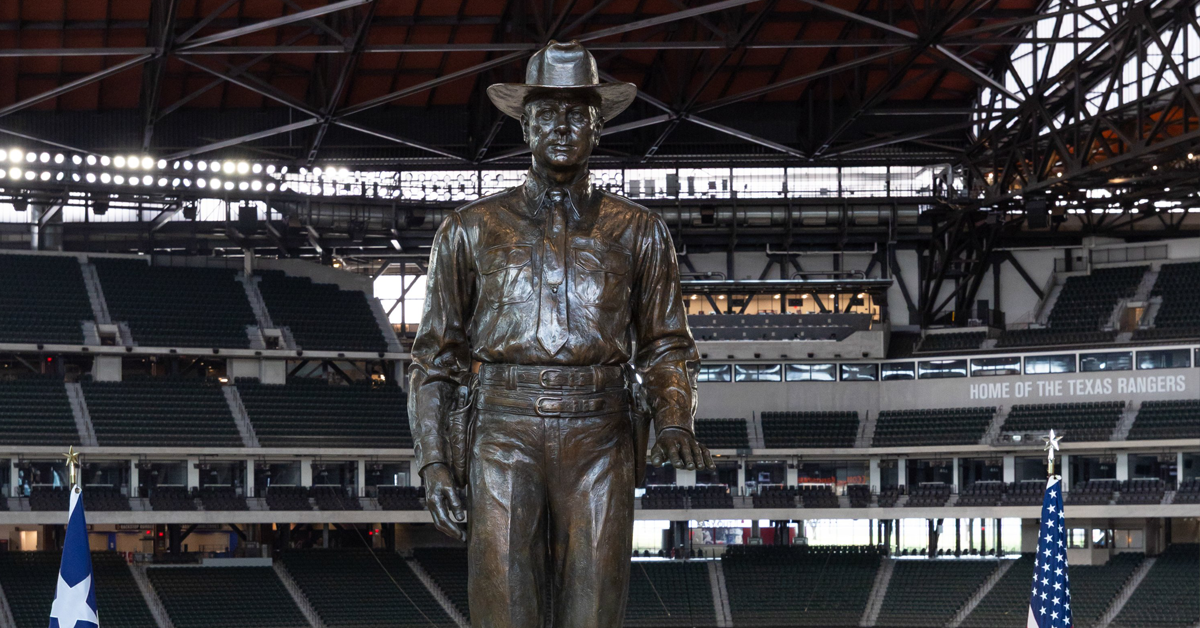
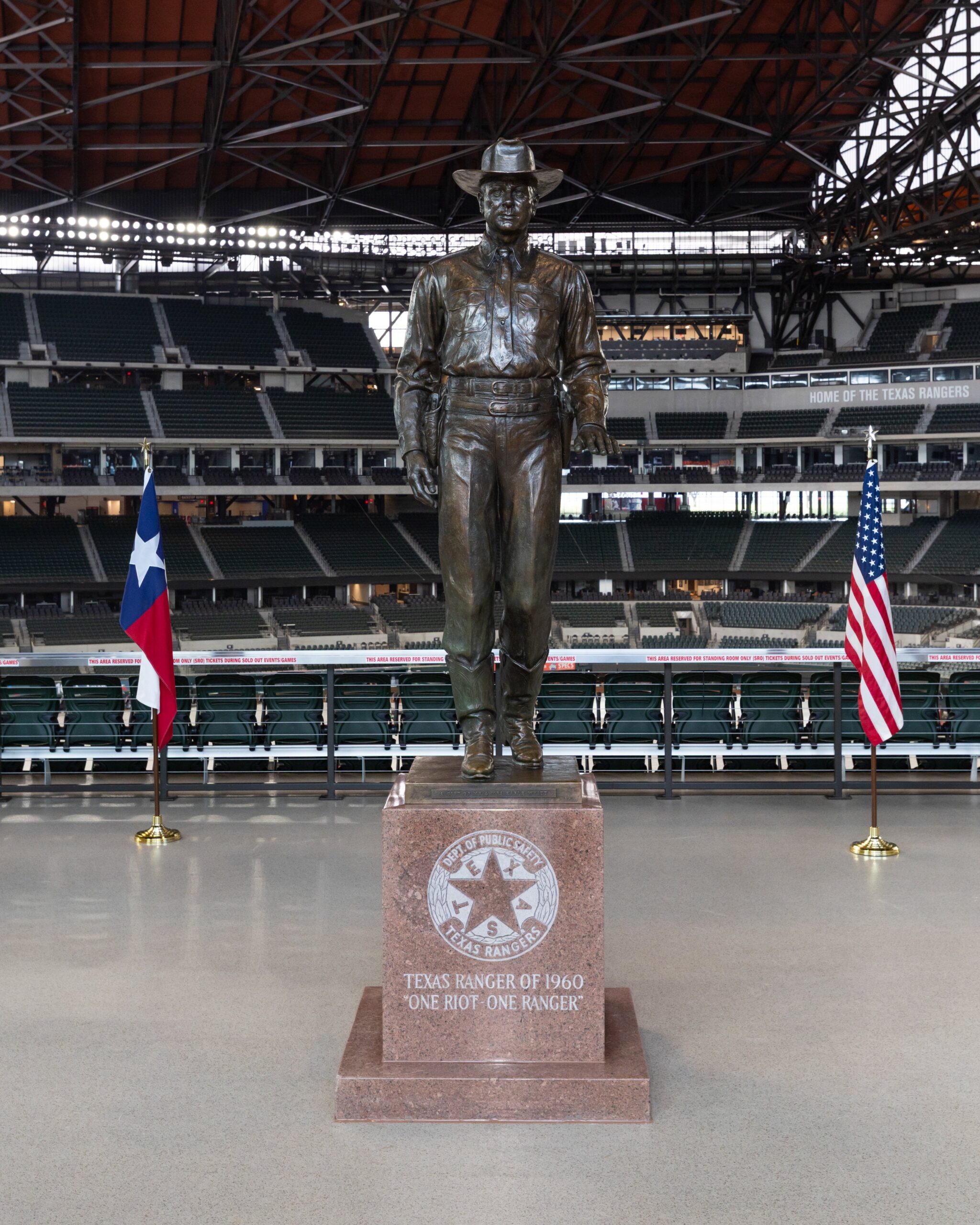
The Rangers host the Royals for a two-game series starting on March 23. It’s their final tuneup before Opening Day, and the first time Rangers fans will enter Globe Life Field this year. Those who filter into the ballpark through the TXE Energy North entrance will encounter a 12-foot-tall bronze statue of a Texas Ranger – not a ballplayer, but a lawman – in the left field concourse, his extended left hand instructing them to calm down, his right hand hovering next to his pistol. The Ranger stands atop a red stone base engraved with the agency’s logo and the words:
TEXAS RANGER OF 1960
“ONE RIOT – ONE RANGER”
The team has been unusually quiet about the statue, offering little context about its provenance or significance. An unveiling ceremony was held the morning of Monday, March 2, but reporters weren’t informed about it until the night before, and they weren’t invited to ask questions. Majority owner Ray Davis’ remarks were brief and vague. Posts on the team’s social media accounts showed only a picture of the statue beneath the text, “New addition to the concourse.” A press release revealed some details about the statue, the name of the sculptor and where it once stood, but it said nothing about how the statue ended up at the ballpark.
This is the story of how the statue arrived at Globe Life Field, but it’s not the story of why the team decided that it belongs there. Only the team can tell that story, and it is not interested in doing so. Last week, in response to an emailed list of questions, a club spokesman referred FanGraphs to the team’s initial press release.
“One Work That Will Really Live Down Through the Ages”
Though often referred to as “One Riot, One Ranger,” the name of the statue is “Texas Ranger of Today,” and it was created by prominent San Antonio sculptor Waldine Amanda Tauch. It was commissioned in 1959 by the Dallas Historical Monuments Commission and paid for with a $25,000 donation (made anonymously at the time) from restaurateur Earle Wyatt. Tauch’s design beat out those of three other artists. “He will be a two-gun man — with one hand on his gun — who is entering the scene of a fight,” she told reporters. “He will be a man that everyone respects and trustfully looks upon as law and order.” Tauch had ambitions for the statue, saying, “I would like to leave some one work that will really live down through the ages.” Oddly, the Ranger is posed nearly identically to Tauch’s 1969 sculpture of General Douglas MacArthur. On April 30, 1961, the statue was dedicated at Dallas Love Field Airport. Apart from temporary stints at Union Station and the Frontiers of Flight Museum, it stayed at Love Field until 2020, when professor Doug Swanson published a book called Cult of Glory: The Bold and Brutal History of the Texas Rangers.
The book was an attempt to tell the story of the Rangers, separating truth from myth without shying away from the darkest chapters of the organization’s history, such as the atrocities committed during the Mexican revolution. According to the Bullock Texas State History Museum’s account of the Porvenir Massacre, “Texas Rangers were sent to patrol the border, but rather than enforcing the law impartially, they participated in and often instigated the killing of hundreds of ethnic Mexicans between 1914 and 1919.”
The phrase “One Riot, One Ranger,” has become an unofficial motto for the Texas Rangers Division. There are differing accounts of its origin. The most famous references an incident from 1896, when Captain Bill McDonald was charged with breaking up an illegal prizefight. Local officials were dismayed that only one Ranger arrived to deal with the unrest. Replied the Ranger, “You only have one riot, don’t you?” In a phone interview, Swanson tried to explain how the Rangers acquired their larger-than-life reputation. “In part, it’s because they helped make Texas what Texas is,” he said. “They helped settle Texas, for lack of a better word. They were the people who fought the Native Americans; they were people who fought outlaws. They fought in the Mexican-American War, all of that. They had this long history. At the same time, they’ve been really good at promoting themselves as these superhuman lawmen who do nothing except engage in justice and honorable behavior and fight on the side of right – which they have in many cases, but which they haven’t in many cases.”
A Pulitzer Prize finalist, Swanson spent 34 years at the Dallas Morning News. He was also “a huge Rangers fan” who got engaged at Arlington Stadium during a Rangers-Yankees game. In 2016, after stints at the University of Texas at Austin and the University of North Texas, he began teaching journalism at the University of Pittsburgh. “You know, the Pirates may have a team this year,” he said. “That should be your story.”
Cult of Glory wasn’t the first book to document the Rangers’ past atrocities, but it arrived at a moment of national reckoning over police brutality, particularly as it affected communities of color. It was published on June 9, 2020, 15 days after Minneapolis police officer Derek Chauvin murdered George Floyd, an unarmed Black man; the killing was captured on video and prompted protests of police violence across the country. On June 4, D Magazine ran an excerpt from the book that began with a section on the statue. It identified the model for the statue as former Texas Ranger Captain E.J. Banks, known as Jay, and it ran under the headline, “The Horrible Truth of Love Field’s Ranger Statue.” The statue was removed later that day. “Protests at an airport present too much risk,” said then-aviation director Mark Duebner. The statue went into storage at Hensley Field, a former Naval Air Station, and news outlets ran pictures of the Ranger lying horizontally on a dolly – his calming left hand now pointed straight up toward the ceiling – as workers in hard hats wheeled him out of the airport.
“He Could Hit Harder Than Any Man I Ever Saw”
Born in 1912, Banks spent nine years as a highway patrolman and served in the Coast Guard during World War II. He joined the Rangers in 1947 and became a legend for his toughness during a time of gang wars. Said one of his subordinates, “I don’t want to make a folk hero of the man, but he was formidable. He was big and powerful. He could hit harder than any other man I ever saw.” Banks’ most celebrated accomplishment was a 1957 car chase and shootout in which he killed notorious murderer Gene Paul Norris and accomplice Carl Humphrey, reportedly shooting Norris 23 times.
Banks gained national fame in 1956, when the country was mired in a battle over segregation. Two years after Brown v. Board of Education of Topeka, state police and federal troops forcibly integrated schools across the South. In Texas, Governor Allan Shivers twice sent in the Rangers to make sure the schools stayed segregated. He’d campaigned on segregation, and even after more than 100 school districts had integrated, he continued to fight it. Striking a tone that’s all too familiar today, he blamed the turmoil on “paid agitators.”
On Friday, August 31, after a federal court refused to stay the decision to integrate the Mansfield Independent School District, a mob of 400 people descended upon Mansfield High School to prevent Black students from registering. They blocked the doors. They hung effigies. They brought hunting dogs. They smashed the cameras of out-of-town reporters. A lawyer representing three Black students tried to register them by telegram, but superintendent R.L. Huffman refused to accept the proxy registration. “Now you guys know I’m with you,” he assured the mob, before making sure they hadn’t overlooked two doors around the back.
Shivers sent his own telegram to the Mansfield trustees, instructing them to transfer to another district any students “who might be the cause of difficulties.” To enforce this directive, he dispatched Banks and fellow Ranger Lewis Rigler. The telegram also served as a photo opportunity. On the front page of the Fort Worth Star-Telegram, a highway patrolman hands the telegram to the president of the Mansfield school board. Between them stands Banks.
On September 4, Reverend D.W. Clark of St. Timothy’s Church in Fort Worth admonished the demonstrators, telling them to love their neighbors. The incensed crowd surrounded him, screaming. A widely circulated AP report described Banks’ extrication of Clark in heroic terms: “Banks came through the crowd very quietly, took the priest gently by the arm, and said, ‘I think we’d better go.’ He led the priest off the school grounds.” The article was often accompanied by a photo of a smiling Banks leaning against a tree, surrounded by adoring high school girls. A photo taken from another angle, which didn’t make it into newspapers, shows that the cheerful gathering took place on the front lawn of the school, in the shadow of an effigy hanging from the entrance to the school. Another picture showed Banks and the girls laughing as he playfully handcuffed two of them together.
The next week, Banks and three other Rangers were sent to Texarkana College, a community college. On September 10, a mob estimated at 300 people assembled to physically block Black students from entering. People started arriving at 7:00 AM. They brought signs: “No NAACP Goons” and “Go North, N*****.” Two Black students arrived, 17-year-old Steve Poster and 18-year-old Jessalyn Gray. The crowd screamed epithets as the teenagers tried to find a way in. They separated Poster and Gray, kicking him and throwing gravel at her. The two left, but a few minutes later, they returned and asked the Rangers to escort them into the college. Banks refused, and relayed to reporters what he said to the teenagers: “Our orders are to maintain order and keep down violence. We are to take no part in the integration dispute and we are not going to escort anyone in or out of the college.” Wrote Swanson, “The local White Citizens Council was so happy with the Rangers’ actions they treated Banks to a chicken dinner.”
Photographs played an important role in how the narrative unfolded across the country. They also raised Banks’ profile. That September, Life magazine ran a series of articles on the skirmishes across the South. The September 17 and September 24 issues contained photos from Mansfield and Texarkana. One showed an effigy that had been hanging over Main Street in Mansfield. It was covered in blood-red paint and accompanied by two signs. The first read, “THIS NEGRO TRIED TO ENTER WHITE SCHOOL.” The second read, “THIS WOULD BE A HORRIBLE WAY TO DIE.”
The defining picture of the incidents also came from Mansfield. In the foreground, in the left of the frame, Banks leans calmly against a tree, his thumb tucked into the waistband of his holster. Banks is in perfect profile, facing to the right and drawing the viewer’s attention to the center of the picture. The dramatic brick façade of the school commands the background. In the center, the high, gabled main entrance juts out from the surrounding wall. The door to the school, set in a sweeping arch, is patrolled by nine high school boys, their hands on their hips. Some 30 feet above them, at the peak of the gable, an effigy with a noose around its neck hangs from a light standard.
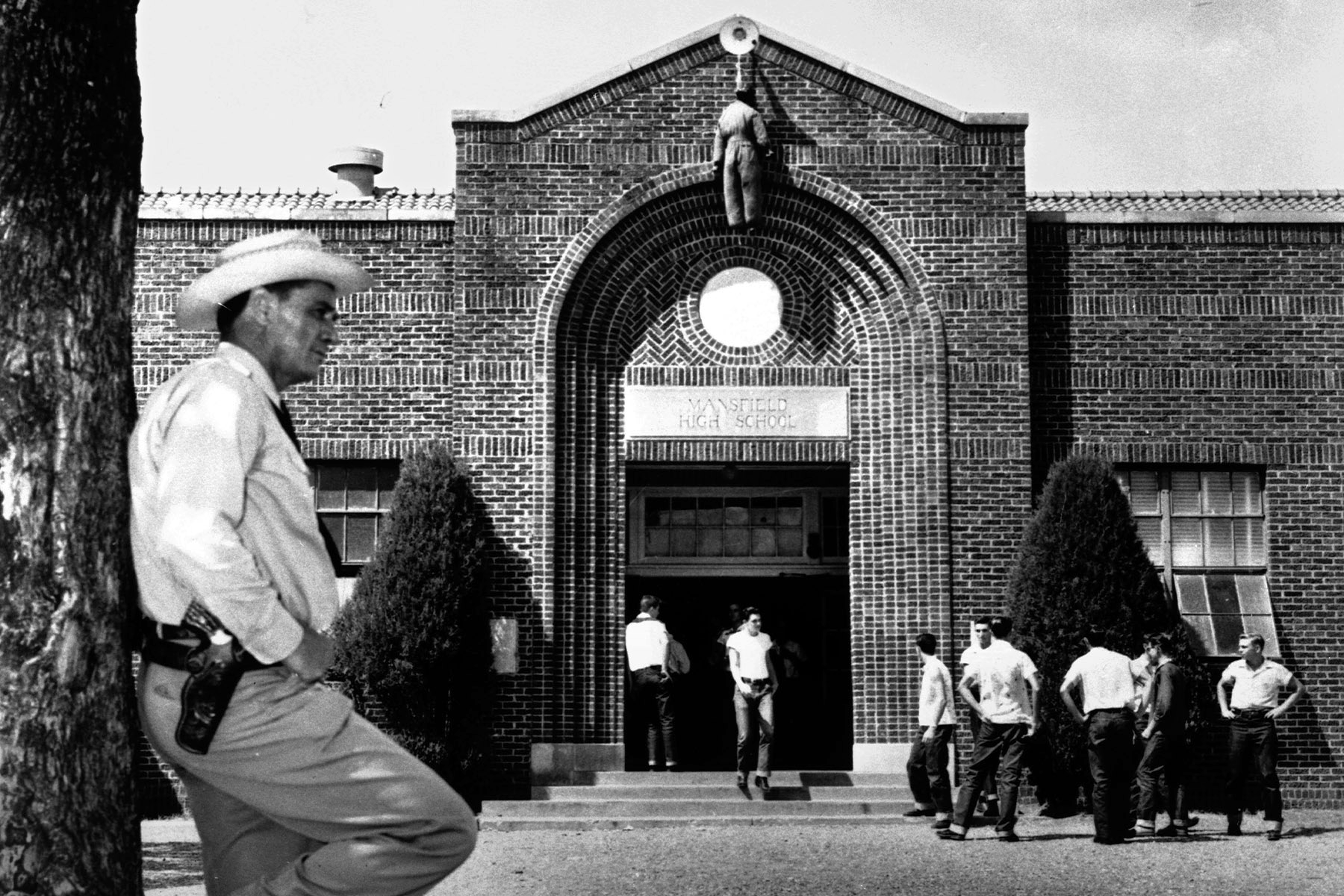
The picture appeared in Time magazine. “Banks became for a while the face of uniformed, armed, and officially sanctioned white resistance to court-ordered civil rights,” wrote Swanson. Less than two weeks later, Banks was promoted from sergeant to captain. His rising celebrity earned him appearances on the “Today” show, “Name That Tune,” and “What’s My Line?” Wrote the Dallas Morning News, “Whenever they needed a big, handsome guy to trot before the public, whether on network TV or at a beauty pageant, they called on Banks.” In some respects, Banks makes a fitting avatar for the Rangers. He killed men and committed acts both heroic and despicable. He earned a reputation for toughness, and he excelled at parlaying it into widespread fame.
“I Always Thought Models Were Kind of Sissy”
Ray Davis wasn’t the only speaker at the unveiling last week. Russell S. Molina, a businessman and board member of the Texas Ranger Association Foundation (TRAF), said, “This statue represents all Texas Rangers, not any single individual.” Asked in a phone interview whether his remarks were intended to imply that the statue was not modeled on Banks, Molina was more direct. “It is not,” he said. When informed that the Texas Ranger Hall of Fame & Museum lists Banks as the model for the statue, he conceded that Banks was “one model of many models… But that is not a model of him. That is not about a singular individual.” This contention feels disingenuous. The statue’s history is inextricably tied to its model, and the relationship between the two is well documented.
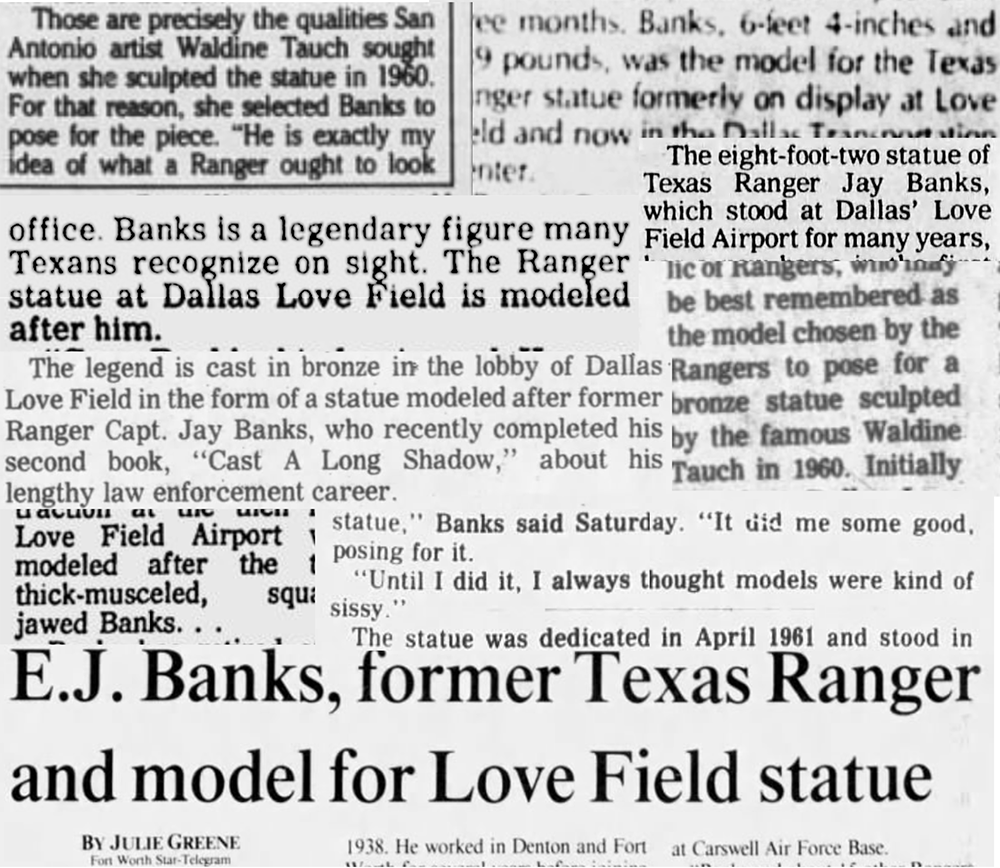
“The artist used one ranger who posed for her,” read a 1960 profile of Tauch in the San Antonio Light. Because the statue was intended to be a composite of all Rangers, “She promised authorities that she would not reveal his name.” An article in the Brady Herald, supplied to FanGraphs by Molina, told the same story of a single model: “Dr. Tauch used a model in doing the work but he will remain anonymous so the statue will be a tribute to all ‘Texas Rangers of Today.’” It was Banks who revealed that he was the model for the statue. “I don’t mind admitting I enjoy remembering the statue,” he told the Longview Daily News in 1976. “It did me some good posing for it. Until I did, I always thought models were kind of sissy.”
The article was adapted for syndication by the Associated Press and ran in at least 10 different newspapers. Tauch acknowledged her instructions to avoid making the likeness any one Ranger, but said she only made “a few minor changes,” and that the statue looked so like Banks that many called it simply “the Jay Banks statue.” In another interview, she said Banks was “exactly my idea of what a Ranger ought to look like.” According to the 2010 book Time of the Rangers, Banks lent Tauch his hat, boots, pistols, and holsters, which explains why the statue’s holsters bear a similar design to the ornately tooled leaf pattern of Banks’ actual holsters. They were sold at auction in 2012, accompanied by a notarized letter of provenance that read, “these are the holsters that he was wearing when he posed for the statue.”
Just as relevant, Banks has existed in the public consciousness as the model for the statue for 50 years now. Long before Swanson’s book, he was identified as such by the Public Art Archive, many dozens of articles in newspapers and magazines, TV broadcasts, and books about Ranger history. A 1982 biography, authorized by Banks, was titled Legend in Bronze. He posed for pictures in front of the statue. It wasn’t just the first line of his obituary; it was the headline. And, of course, in 2020, the statue was taken down specifically because of its connection to him. At this point, it isn’t possible to tell the full story of the statue without including Banks and his role in defending segregation.
For Failure To Perform His Duty
When asked whether, hypothetically, his opinion of the statue would change if he knew definitively that it was modeled on Banks, Molina responded with a question: “Do you think one picture should define a man’s legacy?” He cited Banks’ relationship with Earl Ray Peterson, who went on to become the first Black chief of the Rangers, as proof of his character. Said Molina, “He was there at Mansfield doing a job that the governor told him very specifically what to do, and he was very successful at that.” It’s a familiar argument. “As modern Rangers still must, mid-20th-century Rangers followed orders,” wrote Mike Cox for True West Magazine. “They didn’t unilaterally set state policy. Wrong as what happened in Mansfield was, Banks and other Rangers would have been out of a job had they not done what Gov. Allan Shivers sent them to do.”
Banks soon found out how true this was. In March 1960, before the statue was even finished, he was fired from the Rangers. When Banks claimed he’d resigned rather than been fired, Colonel Homer Garrison Jr. held a news conference to explain that for “practically a year,” he had repeatedly ordered Banks to raid illegal gambling establishments in Tarrant County. “For failure to carry out department orders,” Garrison said, “Captain Banks has been relieved of his command and dismissed.”
Following his dismissal, Banks was hired as chief of police in Big Spring, Texas. In June 1971, the city fired him after complaints that included refusal to cooperate with other law enforcement agencies that sought to investigate theft within his department, refusal to fire incompetent officers, and discrimination in enforcing ordinances on the sale of beer and pornography. Twice, Banks’ refusal to follow orders cost him his job. In Mansfield and Texarkana, he did what he was told. He later wrote that the mobs “were just ‘salt of the earth’ citizens. They were concerned because they were convinced that someone was trying to interfere with their way of life.”
Another photograph from Mansfield – one that didn’t make it into the newspapers – tells the story in an entirely different way. The lighting is no longer crisp. The composition is purposefully amateurish. Where the photograph that has threatened to define Banks was ambiguous and poignant, this one is so on the nose that it borders on caricature. In it, Banks is no longer leaning against the tree out on the front lawn. He’s right on the steps of the high school, posing next to Rigler. The photograph is taken from below, and it cuts the men off at the waist. That’s done intentionally, so the top of the frame will capture the effigy directly above their heads. The two Rangers wear big smiles for the camera.
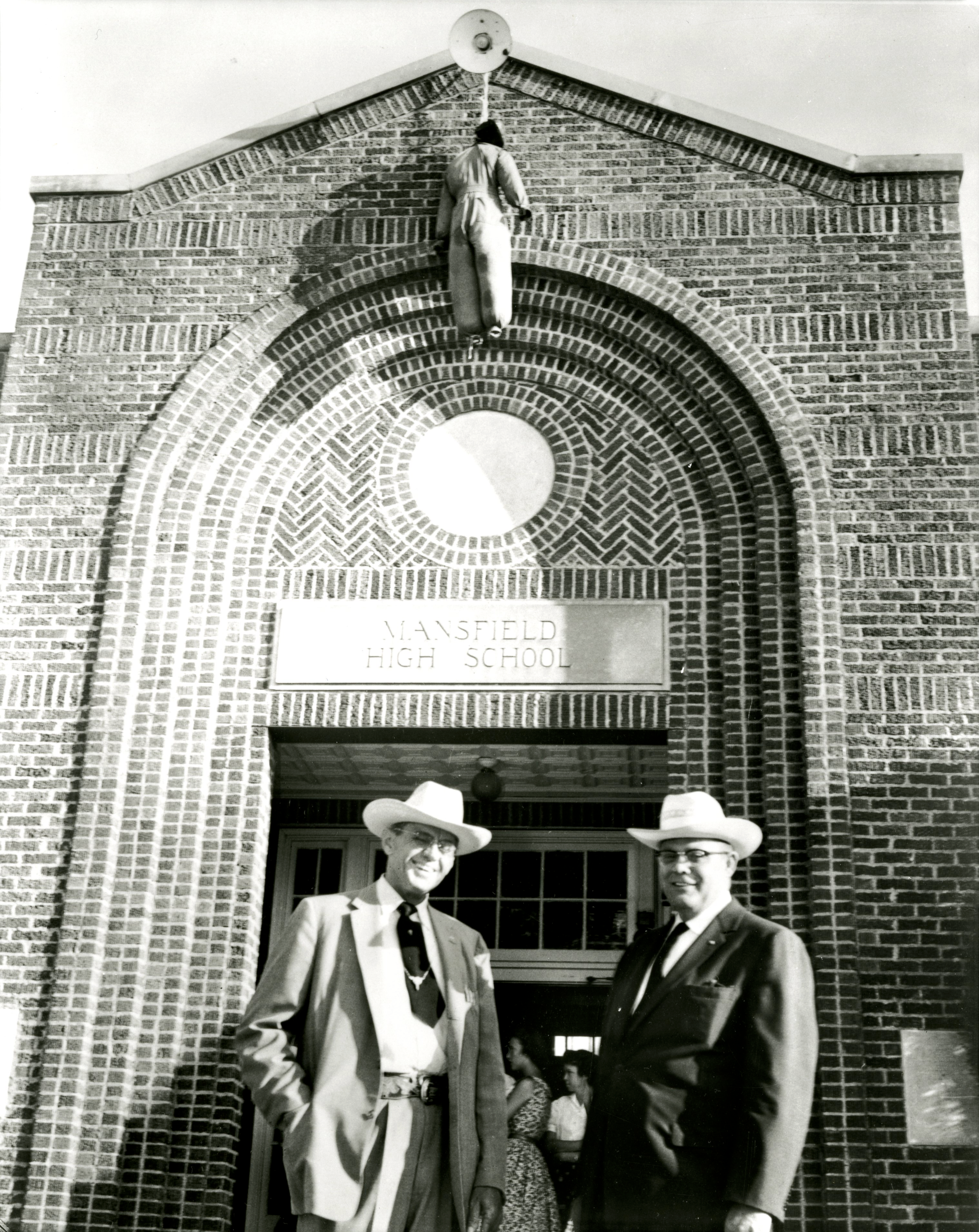
This is the context behind the statue. This is the reason why, at a time of heightened scrutiny of law enforcement, it was removed from Love Field the moment that context was brought back into public consciousness. Swanson had no idea his work would result in the removal of the statue. He wasn’t necessarily in favor of the decision. “I thought at the time,” he said, “and I still think it would have been better if they could add some context to it, to explain what the statue represented, both good and bad, and explore some of the history related to it. And maybe a few people would stop and read it and maybe understand a little bit more about it. That’s the point I was trying to make.”
At the time, Dr. Sonia Hernández, the George T. & Gladys H. Abell Professor of Liberal Arts II at Texas A&M’s history department, was more hopeful about the removal of the statue. In a phone interview earlier this month (during which she clarified that she was speaking only for herself, and not on behalf of Texas A&M), she explained, “Removing a statue doesn’t necessarily lead to justice or a more equitable society. However, it is a recognition, especially on the part of authorities or the state… We are paying attention and we need to be mindful of the kinds of stories that we value.”
Hernández hesitated to put all the focus on Banks. “It’s a Ranger and it’s the larger context. You get at the Rangers through one individual, through an agent. And I go back to the larger culture of impunity.” To some, recognition of the statue’s significance felt like a culmination of years of research and scholarship to acknowledge the full truth about the Rangers, starting with the Canales Hearings in 1919 and Américo Paredes’s 1958 book, With His Pistol in His Hand.
“I Mean, Who Wants Bad Publicity?”
Molina explained that he himself spearheaded the effort to return the statue to public display. “I wanted to make sure that the truth got told and that the statue was put back up,” he said. He started negotiating with the city in 2021 or 2022. In February 2023, he arranged for the Office of Cultural Affairs to loan the statue to TRAF, which would be responsible for finding it a new home. Administrative Action 235385, which made the loan official, says the contract expires on December 30, 2027.
The original agreement was to place the statue at a brand new museum and Hall of Fame devoted to the law enforcement agency, said Molina, but that project has been delayed. “I’ve always thought Texas Ranger baseball was the ideal place, and it just so happened that I had a conversation with a friend of mine who knew somebody there.” He estimated that it took six to nine months to go from that initial conversation to the unveiling earlier this month.
The only public mention of the new destination came at a Public Art Committee meeting on February 3. The move had already been decided. “He – ‘One Riot, One Ranger’ – will be moved to the museum-like setting at the Texas Ranger ballpark,” said the Committee’s Lynn Rushton-Reed. “He will be part of that museum that tells the story of the Rangers and how the Rangers baseball team got their name, so back in a museum-like setting.”
Last week, the Arlington branch of the NAACP issued a statement expressing “deep disappointment” in the team’s decision to host the statue just 14 miles from Mansfield. After the Public Art Committee meeting, the NAACP had “reached out to representatives of the Texas Rangers organization to express our concerns about honoring a historical figure connected to events that undermined civil rights and educational progress in our region. Despite those concerns being raised, the organization ultimately chose to move forward with the statue’s installation.”
United States Congressman Marc Veasey, whose district includes parts of Arlington less than two miles from Globe Life Field, has also come out against the statue. In a letter to Rob Manfred, Ray Davis, and team co-chairman Bob Simpson, Veasey wrote, “It sends a chilling message about which parts of history are being elevated and which sacrifices are being forgotten. Ballparks should be places where families gather, where children fall in love with the game, and where fans of every race, faith, and background feel welcome. Honoring a figure tied to resisting school integration — and doing so with imagery that evokes racist violence — sends exactly the wrong message about who belongs in that space.”
As a historian, Hernández is well-equipped to put the reemergence of the statue in context. “I was disappointed,” she said, “and perhaps not entirely shocked, given the developments in the last couple of years – widespread assaults on anything that is accurate, critical history, American history – and what’s been happening across institutions of higher education.” Still, she couldn’t help but express some surprise at the team’s decision, saying, “I mean, who wants bad publicity? Nobody wants bad publicity.” Swanson echoed her thoughts: “It’s a curious choice, this statue, I guess is what I would say in the end. I don’t know why they would want to associate themselves with a statue that has such a problematic history.”
“I Don’t Know How They Would Handle That”
In conversation, Molina stressed the need to look at the big picture. “The full context is really what is critical,” he said. “Because you’ve got to know what was happening the day before, the week before, the month before, a year before. And then, more importantly, what happened the day after, the week after, the month after, and years after.” When asked whether the Rangers planned on providing any additional context to the statue at the ballpark, Molina replied, “Well, that’s a good question. Not to my knowledge. I don’t think Texas Ranger baseball has any plans on that. But I may be speaking out of turn. I don’t know. Honestly, I don’t know.”
Swanson and Hernández both echoed the need for context. “I wish there was more information,” said Swanson. “I wish there was more context. I wish we could embrace the history of it, both good and bad.” Hernández gave the historian’s perspective on the danger of presenting the past through a “noncritical” lens: “Up through the late 20th century and into the 21st century, there’s been evidence-based scholarship on the dark chapters associated with this elite law enforcement unit…. There’s certainly great things about Texas. I am a Texan. But I think it’s also important to tell it like it is. And when you obscure or gloss over the not-so-great things about any historical figure, any historical site, any historical development, you’re doing a disservice to the greater American public.” The NAACP’s statement ended by “calling on the Texas Rangers organization and ballpark leadership to engage in constructive dialogue with community stakeholders regarding how history is represented.”
Despite the agreement that the statue should be part of a larger conversation, few seem to think it’s possible to provide the appropriate context for the statue at Globe Life Field. “I don’t know where you would do it,” said Molina. Said Hernández, “It is really difficult to complicate that history at that place. People are coming and going, especially children, young people, visitors. It’s going to be difficult to do that in a place like that… Can you separate history from heritage and have those deep, impactful conversations where people dialogue? Can you do that at a stadium or at an airport? I don’t think so.” Swanson put it more bluntly: “I mean, are they going to put up a plaque over by the beer stand that tells the rest of the story? I don’t know how they would handle that.”
“It’s not about being politically correct,” said Hernández. “It’s not about supporting one group over another. It’s the kind of nation that we can have, built on trust and honesty and respect for one another. And that’s a really basic way to put it, but I think it’s really important. You ask yourself, ‘By doing this one thing or by supporting this one thing, am I living up to that standard? Is this the kind of world that we want to promote?’ Really thinking about the next generation, especially at a ballpark where you take your kids.”
For now, at least, the point is moot. The ballclub has given no indication it will provide any additional context about the statue to the more than two million fans who attend home games each year. At D Magazine, sports editor Mike Piellucci described the unusually collapsed timeline of the unveiling. The team announced the 10:00 AM ceremony in an email sent at 6:01 PM the night before, saying only that it concerned “a new permanent non-baseball addition to the left field concourse,” and that reporters would be expected to leave by 10:30. No one would have time to do research or prepare questions. No one would get to ask questions anyway. Wrote Piellucci, “The organization concealed what it was unveiling because it knew what the reaction would be.”
Fans will necessarily view this most recent development within the larger context of the club’s other actions. The Rangers are the only major league team without a Pride night. The Rangers are one of just two teams that don’t provide paid maternity leave to employees. They have now installed this statue while taking great pains to avoid any discussion of its significance. Reasonable observers might deduce that the through line connecting these decisions is a disregard for marginalized groups.
“We recognize that the history of the Texas Rangers, like that of our state and nation, includes moments that must be confronted honestly,” said Molina at the unveiling. But no one can force the ballclub to explain why a statue so objectionable that it spent six years in storage is now an appropriate addition to Globe Life Field. Through its actions, the team has made it clear that it would prefer to sidestep the conversation entirely, and that it believes it can do so. When fans arrive on March 23, they will be armed only with what they already know and believe about the statue and the organization it represents. No doubt, many will see the statue the way the artist intended, as “a man that everyone respects and trustfully looks upon as law and order.”
Editor’s note: An earlier version of this piece erroneously identified Robert Wilonsky as Dallas’ aviation director at the time of the statue’s removal from Love Field. It has been updated to reflect that Mark Duebner held that role.
Davy Andrews is a Brooklyn-based musician and a writer at FanGraphs. He can be found on Bluesky @davyandrewsdavy.bsky.social.
As a longtime Texas Rangers fan, let me say that I absolutely hate this statue and I won’t be buying any tickets while it’s there. And everyone who knows the Rangers knows that Ray Davis is a bigot and the reason for all of the bad policies of the team.