
The Giants Start To Address Their Pitching Needs
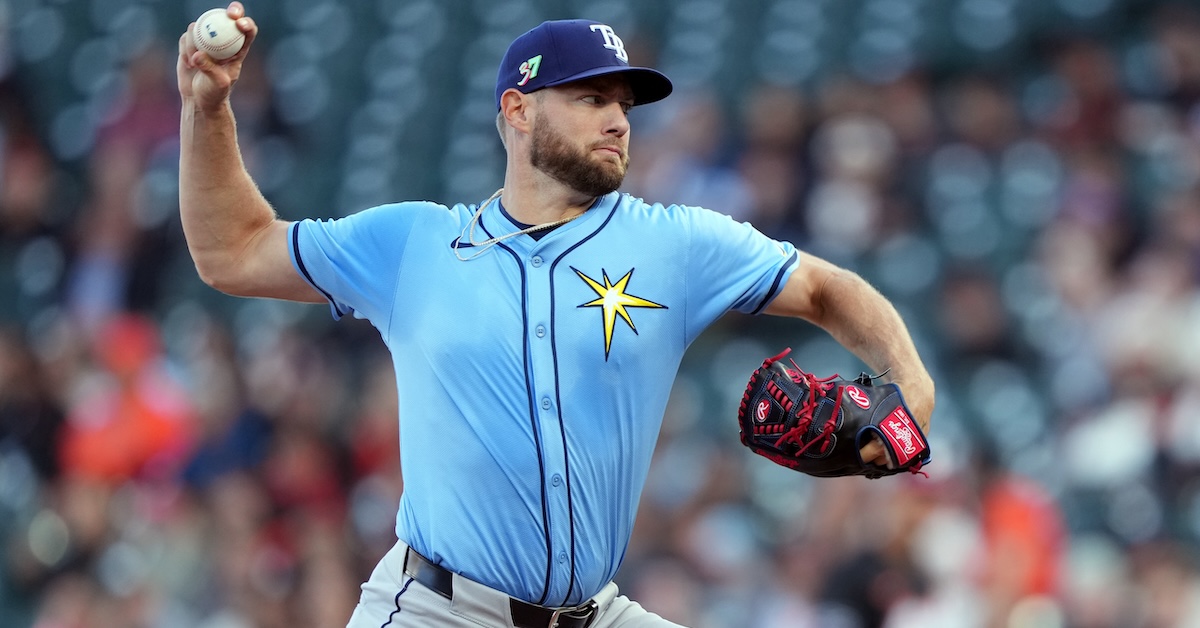
The Giants have one thing so many other teams covet: a genuine ace to lead their starting rotation. Only one other starting pitcher has accumulated more WAR than Logan Webb over the last five years, and he’s eighth in baseball in park- and league-adjusted FIP over that same period. After posting the best season of his career in 2025, Webb will continue to lead the rotation in ‘26. The rest of the pitching staff, though, is rife with question marks. San Francisco took its first steps toward addressing some of those issues this week, signing Adrian Houser, Jason Foley, and Gregory Santos to bolster the depth across the staff.
On Tuesday, Houser agreed to a two-year, $22 million contract with a club option for a third year. He made a name for himself as a reliable backend starter and swingman for the Brewers across his first seven seasons in the big leagues, before bouncing around six different organizations over the last two years. Traded to the Mets during the 2023-24 offseason, Houser struggled to a 5.84 ERA and 4.93 FIP across seven starts and 16 relief appearances. He made a handful of minor league appearances in the Orioles and Cubs organizations during the remainder of 2024, then signed a minor league deal with Rangers last offseason. Texas never called him up, and so he opted out of that deal and signed a major league contract with the White Sox in May.
I don’t think anyone was expecting a big breakout once Houser joined Chicago’s starting rotation. For most of his career, both of his fastballs averaged around 93-94 mph, but his velocity had dipped a few ticks by the time he was 32 and pitching for the Mets. It was a surprise, then, to see him firing 95-mph four-seamers as a member of the White Sox.
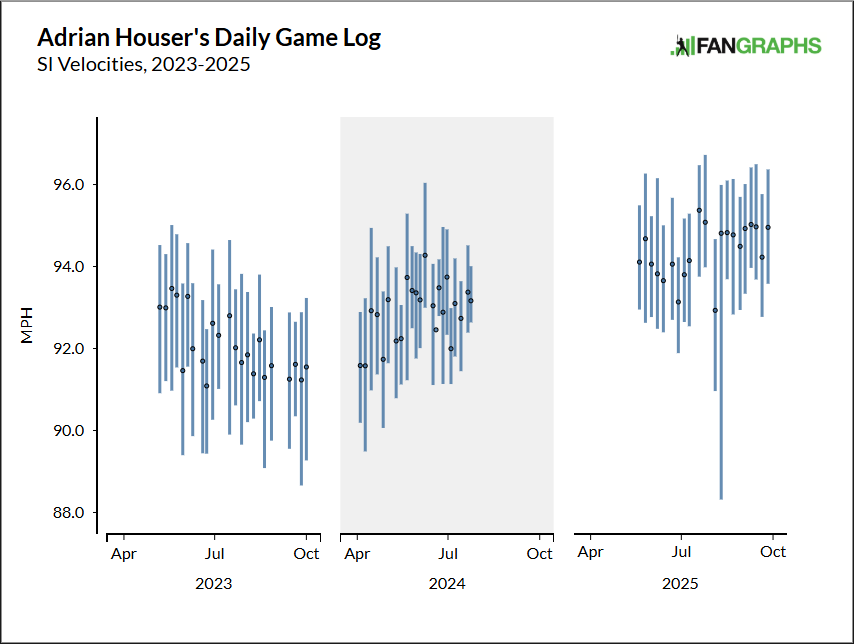
Houser added nearly two mph or more to all five pitches in his repertoire last year. Back in May, in an interview with James Fegan over at Sox Machine, Houser detailed the offseason mechanical adjustments he’d made to get that velocity spike.
The overriding theme of the fix sounds simple enough from description, removed from the strength building and reps needed to make it second nature. Houser has found more power from dipping deeper and riding longer on his back leg in his delivery, but lacked the balance to pull it off until he started setting up his hands farther away from his body. With his arms more extended, Houser is able to push on the gas pedal a little harder for a little longer.
“I was able to really get into my backside and use my lower half, versus being tall and falling down the mound or getting to my knee and not having much push-off,” Houser said. “I noticed that it actually helped with my arm path on all my other pitches. I was able to get to my changeup and my curveball and my slider a little bit better. This isn’t just a velo thing or a balance thing, it’s an actual arm path and overall mechanics thing.”
That extra oomph helped him post a 2.10 ERA and a 3.34 FIP across 11 starts with the Sox; however, his underlying peripherals didn’t paint as pretty a picture. His strikeout-to-walk rate barely budged from his previous career norms, though it was an improvement from where it was in 2024. The big reason why he enjoyed so much success in Chicago was some improved contact management. A 4.23 xFIP and a 3.98 xERA during those 11 starts fill in most of the rest of the picture. Houser allowed just three home runs during this stretch, and his xwOBACON outpaced his actual wOBACON.
Houser was traded from the White Sox to the Rays right before the trade deadline, and he almost immediately felt the negative effects of regression toward his peripherals. He maintained his velocity gains with his new organization, and his strikeout-to-walk ratio did improve slightly, but his ERA jumped up to 4.79 and his FIP rose by more than a run to 4.38. Just as he didn’t really “deserve” the 2.10 ERA with Chicago, he probably didn’t really deserve the 4.79 ERA with Tampa Bay either. His underlying batted ball metrics took a bit of a hit with the Rays — he allowed more hard hits and barrels — but a three-point increase in his groundball rate mitigated the damage from some of that hard contact.
| Year | K% | BB% | wOBACON | xwOBACON | Hard Hit% | Barrel% |
|---|---|---|---|---|---|---|
| 2023 | 20.0% | 7.1% | .367 | .364 | 46.3% | 7.1% |
| 2024 | 14.6% | 10.4% | .365 | .364 | 40.4% | 8.8% |
| 2025 (w/ CHW) | 17.1% | 8.0% | .314 | .336 | 45.6% | 4.9% |
| 2025 (w/ TBR) | 18.5% | 6.6% | .374 | .343 | 50.3% | 7.4% |
Even though the amount of hard contact he allowed this year was higher than league average, his expected wOBACON fell substantially from where it was in 2023 and ‘24. Whether that improved contact management was a result of his improved velocity is unclear, but turning up the heat certainly didn’t hurt.
The Giants are certainly hoping that Houser’s mechanical changes carry over to next year, and it’s possible that the run-suppressing environment in San Francisco will help him limit damage on contact. There are some concerns about his durability — the 125 innings he pitched in 2025 were the second most of his career and the most he’s thrown in a single season since throwing 142 1/3 in 2021. Even if Houser isn’t available for a full season, he joins a starting rotation that desperately needs some known quantities. Behind Webb, the Giants will line up Robbie Ray and Landen Roupp, both of whom are perfectly capable mid-rotation starters. After adding Houser, San Francisco has a plethora of internal options to choose from to fill the fifth-starter spot, but none of them is an established big leaguer yet.
| Player | IP | ERA | FIP | WAR |
|---|---|---|---|---|
| Logan Webb | 202 | 3.32 | 3.15 | 4.1 |
| Robbie Ray | 180 | 4.20 | 4.18 | 1.6 |
| Adrian Houser | 150 | 4.34 | 4.29 | 1.1 |
| Landen Roupp | 131 | 4.14 | 4.10 | 1.1 |
| Trevor McDonald | 74 | 4.15 | 4.19 | 0.6 |
| Hayden Birdsong | 60 | 4.44 | 4.54 | 0.4 |
| Kai-Wei Teng | 61 | 4.36 | 4.38 | 0.4 |
| Carson Whisenhunt | 36 | 4.28 | 4.40 | 0.3 |
| Blade Tidwell | 27 | 4.33 | 4.41 | 0.2 |
| Carson Seymour | 9 | 3.93 | 3.97 | 0.1 |
Of the group of pitchers listed below Houser in that table — including Trevor McDonald, Hayden Birdsong, Kai-Wei Teng, Carson Whisenhunt, Blade Tidwell, and Carson Seymour — only Birdsong has thrown more than 100 innings in the big leagues. The Giants now have the luxury of sorting through that group while only needing to cover one rotation spot. And the injury concerns that Houser comes with — and that are still present for Ray and Roupp to a lesser degree — are somewhat mitigated by the huge pile of depth arms the team can call up in case of emergency.
The two bullpen arms the Giants added won’t be so quick to make an impact like Houser will in the rotation. They signed Foley to a one-year, $2 million contract after he missed nearly all of this season with a shoulder injury. It doesn’t appear as though he’ll be healthy for Opening Day, but if his rehab goes well, it’s not hard to imagine him as a key high-leverage arm during the second half of the season. During Detroit’s miracle run to the postseason in 2024, Foley was a critical piece of its pitching chaos strategy that served the team so well down the stretch. Despite converting 28 saves for the Tigers that year, Foley isn’t a traditional high-powered leverage arm. His career strikeout rate is just 18.1%, and he leans heavily on a bowling-ball sinker and a gyro slider. He doesn’t walk many and generates a ton of groundballs, though his margin for error is pretty slim without punchouts.
Injuries have derailed Santos’ career to an even more extreme degree, and as a result, he was only able to secure a minor league deal this offseason. He actually made his major league debut with the Giants back in 2021, but it wasn’t until 2023 that he broke out with the White Sox. Traded to the Mariners before the 2024 campaign, he wound up pitching just 14 1/3 innings across two seasons in Seattle; recurring knee issues, a lat strain, and a biceps injury shelved him for extended periods of time. Like Foley, Santos features a hard sinker and a decent slider, doesn’t strike out as many as you’d expect based on his high velocity, and runs an excellent groundball rate. Still just 26, Santos certainly has the tools to be a high-leverage option for the Giants if he can put his injury woes behind him.
With Camilo Doval and Tyler Rogers traded away at the deadline, and Randy Rodríguez lost to Tommy John surgery in 2026, the Giants could certainly use as many live arms for their bullpen as they can get. Ryan Walker is still on the roster and should be the presumptive closer for now, but the rest of the relief corps is filled with questions. Neither Foley nor Santos will provide immediate answers, but if healthy, each possesses the skills to bolster the pen at some point in 2026.
As the headline indicates, the Giants are reportedly still in the market for starting pitching, though they may be squeezed for resources at this point. Their projected payroll for 2026 is already $3 million past where they ended this year, and they still have holes to fill in the outfield corners and the bullpen. If they’re going to add to their starting rotation, it really should be a frontline starter; signing Houser gives them the known backend option they needed to shift away from being so reliant on their unproven youngsters. Of course, if San Francisco acquires a top starter, those less experienced guys could always slide to the bullpen to support the current group of relievers. And because Foley can’t be counted on right away, and the Giants don’t really know what to expect from Santos, another established bullpen arm wouldn’t be a bad idea either.
Jake Mailhot is a contributor to FanGraphs. A long-suffering Mariners fan, he also writes about them for Lookout Landing. Follow him on BlueSky @jakemailhot.
It’s probably a kind of illness to have strong feelings about the Houser deal but I hate it. The Giants have repeatedly hinted that they were not going to spend a lot of money this off-season, so why are they proportioning a decent chunk of that to a guy who projects to be worse than McDonald, Whisenhunt, etc. Even though I don’t 100% those projections I don’t think he’s a clear upgrade. The good teams find these kind of guys as minor league FAs or waiver claims. Giving him a second year just seems bizarre.
Unless the Giants really feel they can unlock something (fewer sinkers?), I don’t understand this one.
Houser has had a strange career, but aside from his disastrous 2024 the main thing in his record to be concerned about is injuries. He has been hurt a lot, but when he pitches he has rarely been bad and sometimes been good. Like last year.
Guys like him don’t usually get more than one year deals because the upside is limited. Sinker-heavy right handed starters are kind of a throwback, and maybe at some point you get Jake Arrieta or Tigers-era Doug Fister but usually when it works it’s more like Tanner Roark.
I think he’s a decent bet to give his team basic, functional innings when he’s healthy. Not someone you want starting a playoff game but unlikely to embarrass you either. A good price for a #4.
Right, someone needs to pitch those innings. I like taking a chance on a guy who’s got a fairly visible, quantifiable change to his stuff/mechanics, and was able to be a useful 4/5 type before that. Price is a bit steep, but, you know, pitching.