
Tyler Soderstrom Hits It Big With Seven-Year Extension
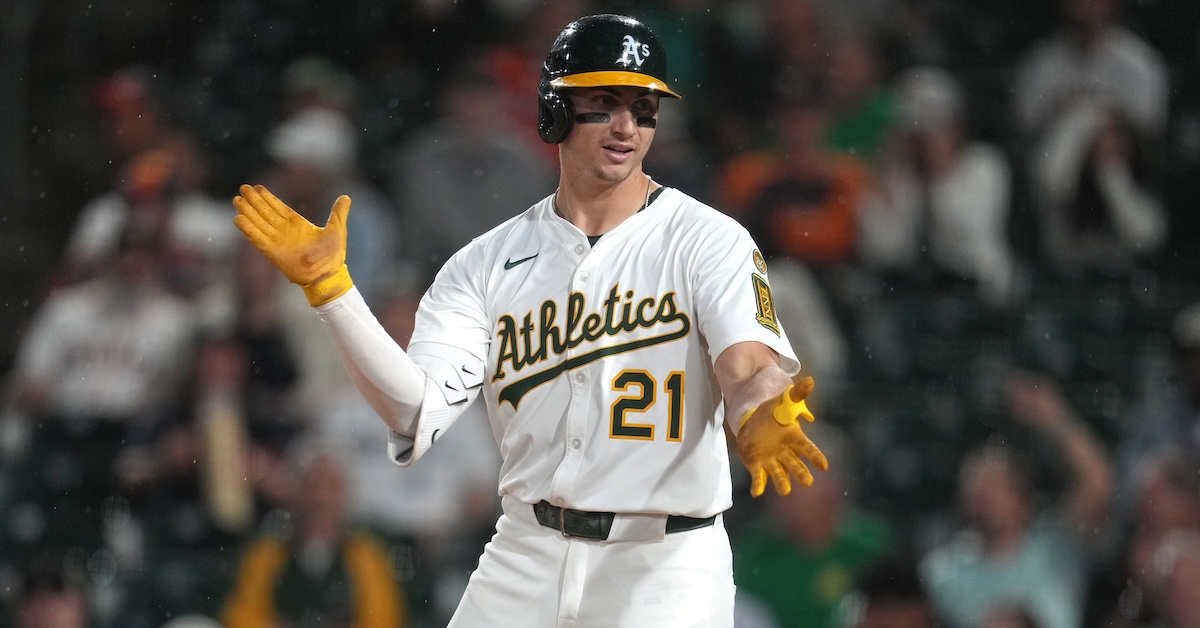
It’s not just the park. The A’s put on a power show in 2025, clobbering 219 homers, getting results up and down the lineup. Nick Kurtz led the way with a superlative rookie season, but he wasn’t alone; Brent Rooker socked 30 bombs, Lawrence Butler added 21 of his own, and Tyler Soderstrom split the difference with 25. Rooker and Butler signed extensions before the season. Kurtz is going to be around forever. Add Soderstrom to that group, too: Over the holidays, he and the A’s agreed to a seven-year, $86 million contract extension, as Jeff Passan first reported.
Soderstrom’s route to stardom is emblematic of this A’s team. He’s always hit well, but figuring out how to plug him into the lineup hasn’t been straightforward. Three years ago, he was a top 25 global prospect as a catcher. Huge, easy power combined with an ability to play the toughest position on the diamond were the selling points. But as he worked through the upper minors and debuted in Oakland, a clear weakness emerged: Soderstrom couldn’t actually catch all that well, and Shea Langeliers, another catching prospect, was an obstacle to everyday playing time behind the dish. After catching 123.2 big league innings that were both statistically and aesthetically ugly enough for the team to pull the plug, Soderstrom was left in search of a position.
In 2024, an early-season minor league stint to work on his defense combined with a mid-season injury meant Soderstrom barely played first base, the new position the A’s selected for him. But between drafting Kurtz and making Rooker a full-time DH, that position didn’t promise much long-term stability. Soderstrom went into 2025 trying to learn left field while also attempting to improve on a lackluster career batting line. A former catcher playing the outfield and maybe not even hitting well? His career was surely on thin ice.
But Soderstrom’s talent shone through almost immediately. He bashed his way through March and April with a 147 wRC+, launching home runs to every corner of the stadium with bruising power. Despite a crush of outfielders, the A’s made Soderstrom an everyday option in left so that they could call Kurtz up at first base. He ran with the job; at year’s end, his 125 wRC+ made him one of the better hitters on one of the better offensive teams in baseball.
That brings us to the present day and the contract extension. Soderstrom’s career trajectory has changed massively in the last 12 months. A full season of good offensive production at age 23 has ZiPS dreaming… well, maybe not big, but perhaps it’s dreaming medium:
| Year | BA | OBP | SLG | AB | R | H | 2B | 3B | HR | RBI | BB | SO | SB | OPS+ | WAR |
|---|---|---|---|---|---|---|---|---|---|---|---|---|---|---|---|
| 2026 | .252 | .320 | .440 | 511 | 62 | 129 | 25 | 1 | 23 | 86 | 46 | 130 | 4 | 109 | 1.0 |
| 2027 | .257 | .326 | .451 | 514 | 64 | 132 | 26 | 1 | 24 | 89 | 48 | 127 | 4 | 113 | 1.3 |
| 2028 | .260 | .330 | .460 | 515 | 66 | 134 | 26 | 1 | 25 | 91 | 49 | 123 | 4 | 117 | 1.6 |
| 2029 | .260 | .333 | .462 | 511 | 66 | 133 | 26 | 1 | 25 | 90 | 51 | 120 | 4 | 118 | 1.7 |
| 2030 | .259 | .333 | .457 | 505 | 64 | 131 | 26 | 1 | 24 | 89 | 51 | 117 | 3 | 117 | 1.5 |
| 2031 | .261 | .335 | .457 | 494 | 63 | 129 | 26 | 1 | 23 | 85 | 50 | 114 | 3 | 118 | 1.5 |
| 2032 | .261 | .334 | .456 | 476 | 60 | 124 | 25 | 1 | 22 | 82 | 49 | 111 | 3 | 117 | 1.4 |
| 2033 | .259 | .333 | .449 | 448 | 55 | 116 | 23 | 1 | 20 | 76 | 46 | 105 | 3 | 115 | 1.2 |
Those offensive numbers are quite good for a guy who came into 2025 with a career wRC+ of 83, and who ran up a 102 wRC+ in his last thousand minor league plate appearances to boot. But projection systems love the rapid improvement and plus plate discipline that Soderstrom displayed in his breakout year. At just 24 years old, ZiPS also sees some age-related improvement in the coming years. Overall, the system would offer him $64 million for seven years, or $77 million counting the eighth option year.
Why are the headline WAR projections lackluster despite solid offensive numbers? Because ZiPS doesn’t think Soderstrom’s defense is good enough for prime time. Take 2026, for example. Notching 550 or so plate appearances with above-average offense is a strong baseline. To turn that into 1.0 WAR, you need to be an awful defender — we’re talking somewhere around -15 runs of Def — but the model just isn’t buying his good 2025 numbers in left field.
If you think he’s a decent defender, maybe a scratch left fielder, that’s somewhere between half a win to a win of improvement in each year. I’m in that camp, though I completely understand why the model isn’t. It works based on historical parallels, and catchers who initially move to first base generally aren’t elite defenders in the outfield. They generally aren’t outfield defenders at all – the error bands are, assuredly, quite wide there.
Leaving aside the specifics of difficult defensive projections, you can see what the Athletics were thinking in making this deal. Soderstrom is going to be a valuable offensive contributor for years to come, and he’s going to be a valuable offensive contributor in a way that tends to get compensated well by the arbitration process – dingers pay, basically. The A’s have now extended the number of years where they’ll get that valuable offense while simultaneously locking in a market-ish rate – assuming ZiPS is close but a bit naive about his defense.
That might sound boring, but it’s the kind of thing that good teams do. Sign a ton of your young players to contract extensions, and you’ve massively increased the odds of ending up with a star player who will stick around for a while. Those projections are just midpoints. Some proportion of the time, future Soderstrom will keep developing into a middle-of-the-order bopper and leave those numbers in the dust. Some other, unknowable proportion of the time, he’ll regress into mediocrity, with 2025 as his career-best production.
Even if that’s symmetrically distributed around his midpoint projections, the A’s accrue a lot of benefit from that noise. The kind of player that Soderstrom might develop into, his top-end outcome? You can’t find those guys easily, and particularly not without surrendering either a ton of prospect capital or cold hard cash.
Importantly for the team, Soderstrom’s mid-level outcomes are also useful to them. One of their biggest problems in recent years has been depth; some very bad players have racked up playing time for the A’s as they bounced from Oakland to Sacramento and suffered through the depths of a rebuild. Even in 2025, the best iteration of the team since 2021, they gave plenty of plate appearances, 2,249 to be exact, to hitters who didn’t even achieve a 95 wRC+ (a number I set to exclude Butler from a list of ignominy).
The more guys like Soderstrom the team can retain, the less likely that problem is to persist in the coming years. With Soderstrom, Rooker, Butler, and Kurtz now all lineup mainstays for the foreseeable future, the floor is higher than it used to be. Add in Langeliers, who will be around for three more years, and that’s five positions where the A’s have good offensive options. I’m a bit less optimistic about Jacob Wilson than consensus, but he’s no slouch either. Jeff McNeil will add to that floor in 2026 (he’s likely gone afterwards). Denzel Clarke can’t hit, but his elite defense provides a baseline of its own.
Now, would Soderstrom be around in 2026 even without this deal? Of course. But this general idea – raising the floor by extending young contributors – is a solid one, and it’s even more important for the itinerant Athletics. No matter what they say publicly, their attention is surely focused squarely on 2028, the first year they’re scheduled to play in Las Vegas. Heck, GM David Forst said as much at the press conference for this signing, which the team even held in Vegas to hammer home the point.
Other than McNeil, every Athletic I’ve mentioned in this article will still be under contract in 2028. That’s a broad base of offensive competence, one that the team can supplement with external additions or minor league promotions as they see how the rest of the squad develops. It also frees up resources to add pitching, a notable team weakness in recent years. From that perspective, the combination of years of control and cost certainty in this deal are huge wins for the A’s; it’s meaningfully easier for them to chart their first few years in Sin City than it was a year ago, and every extension they reach pushes the needle even further on the dial.
Now, will the A’s be disappointed if Soderstrom ends up hitting his ZiPS projections in their entirety, rather than just the offensive side of things? Probably. But even that situation wouldn’t be awful; it’s more “slight overpay” than “roster clogger.” There’s value in making this bet over and over again, as the A’s have with Rooker and Butler. Take enough bites at the apple, and the bad outcomes won’t feel so bad because there will be good outcomes as an offset.
In other words, you might not be wild about any of the team’s signings individually, but it’s hard to argue with the thinking behind them in the aggregate. Finding the right players is only half the battle. Getting them on your big league team at the same time, at rates that you can afford, is the real key. The Athletics hit on a bevy of position players in the past few years, and now they’re turning that into team stability by handing out deals. You love to see it.
Ben is a writer at FanGraphs. He can be found on Bluesky @benclemens.
“If you think he’s a decent defender, maybe a scratch left fielder, that’s somewhere between half a win to a win of improvement in each year.”
Soderstrom finished the year with 5 OAA and 10 DRS in LF despite learning the position on the fly. I think there’s a decent chance that he’s not just a scratch left fielder, but a downright good one, which would make this extension a slam dunk.