
What if Baserunning and Defense Were as Valuable as Hitting?
In just about any sport you can name, offense is king. If you’re the one who scores the goals, the points, the runs, the whatever they call it in polo – the biscuits, maybe? – you’re going to get the plaudits. Who’s the greatest defenseman in the history of hockey? It’s Bobby Orr, of course, because he was the first great offensive defenseman. This pattern very much holds when it comes to baseball.
Among other things, the sabermetric revolution helped us codify the value of hitting relative to the other facets of the game. To wit, according to weighted runs above average – and we’re using that particular stat because, like standard baserunning and defensive metrics, it’s a counting stat that compares a player to the performance of an average player – the most valuable hitter during the 2025 season was one Aaron Judge. Judge created 82.5 more runs than the average hitter. That’s 21 runs more than any other player, and an astonishing 36 more than any other player not named Shohei Ohtani. Judge was the best offensive performer in the game by a mile, which makes him the frontrunner for the American League MVP award, even though he put up negative value as a baserunner and, depending on which metric you trust, his defense graded out somewhere between pretty good (DRS, FRV) and really bad (DRP). The best defender was Patrick Bailey, who put up 30 fielding runs, and the best baserunner was Corbin Carroll, who finished with a measly 10.3 baserunning runs. Offense is just more valuable than defense and baserunning. Here’s the distribution of values for the three portions of the game:
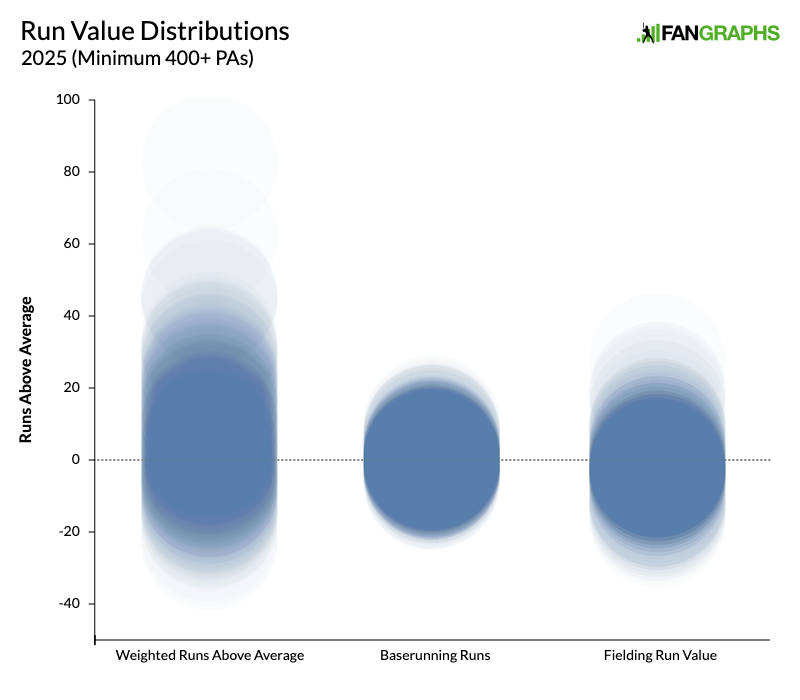
Hitting is so much more valuable than the other two components, and the range of outcomes is much wider. There’s no such thing as a baserunner who’s so slow that they can’t advance from first to second on a single or so fast that they can consistently go all the way from first to home. A fielder can only steal an out at a time (or a strike, if they’re a catcher), and you get a lot more chances to hit a home run than to rob one. Ohtani and Judge are unquestionably the best players in the game right now because of their hitting prowess (not to mention that whole Ohtani pitching deal), but what if we were to even things out?
In this article, we’re going to act as if defense and baserunning are just as valuable as hitting in order to find the most productive all-around position player in the game. In order to do that, we’ll need to put all three elements on the same scale. Essentially, we’re handicapping batting value in order to weight all three facets equally. Luckily, these values are already normalized against the league average, so we don’t have to worry about that part. For the sake of simplicity, we’ll normalize everything to 100 runs. Judge’s 82.54 wRAA constitutes 100 of our runs, so every player’s wRAA is multiplied by 1.21. Likewise, Carroll’s 10.3 baserunning runs mean that all baserunning totals are multiplied by 9.74 and Bailey’s 30 fielding runs mean that all fielding totals are multiplied by 3.33. Is there a smarter, more complicated way to do this? Probably, but this should work just fine. Now fielding and baserunning are every bit as valuable as hitting.
So who’s the MVP in this league? If you want to peruse the entire leaderboard, this link will take you to a spreadsheet. I’ll show you the top 10 and the bottom 10 here. In the spirit of kindness, I’ll share some thoughts about the leaders, and I’ll spare you the gory details about how poor Edgar Quero ended up with a score of -85.
| Rank | Name | Hitting | Baserunning | Fielding | Total |
|---|---|---|---|---|---|
| 1 | Bobby Witt Jr. | 32 | 72 | 67 | 171 |
| 2 | Corbin Carroll | 37 | 100 | 17 | 154 |
| 3 | Pete Crow-Armstrong | 7 | 65 | 70 | 142 |
| 4 | Trea Turner | 24 | 77 | 37 | 138 |
| 5 | José Ramírez | 31 | 71 | 20 | 121 |
| 6 | Byron Buxton | 29 | 83 | 7 | 118 |
| 7 | Fernando Tatis Jr. | 27 | 57 | 30 | 114 |
| 8 | Shohei Ohtani | 75 | 36 | 0 | 111 |
| 9 | Ceddanne Rafaela | -4 | 38 | 73 | 108 |
| 10 | Elly De La Cruz | 13 | 91 | 0 | 105 |
| 1461 | Michael Conforto | -12 | -15 | -27 | -53 |
| 1462 | Agustín Ramírez | -7 | -9 | -40 | -55 |
| 1463 | Heliot Ramos | 4 | -25 | -37 | -58 |
| 1464 | Nathaniel Lowe | -7 | -41 | -13 | -61 |
| 1465 | Jonah Heim | -20 | -31 | -10 | -61 |
| 1466 | Nick Castellanos | -7 | -18 | -40 | -65 |
| 1467 | Josh Bell | 6 | -59 | -13 | -67 |
| 1468 | Keibert Ruiz | -13 | -26 | -37 | -76 |
| 1469 | Logan O’Hoppe | -18 | -25 | -37 | -79 |
| 1470 | Edgar Quero | -3 | -36 | -47 | -85 |
Bobby Witt Jr. is our king, which feels fitting as he’s already royalty. Witt makes a whole lot of sense at the top. He’s a true five-tool player, which means a lot in this particular version of reality. Keep in mind that we’re not messing with positional adjustments, so he’s not getting a bump because he plays shortstop. He’s just that great at everything. That’s rarer than you may realize. Only three players put up enough value this year to be above a 20 in all three categories: Witt, Trea Turner, and Fernando Tatis Jr. It’s a really impressive feat. Meanwhile, thanks to a -40 in baserunning, Judge fell all the way to 19th despite his 100 mark in hitting.
The big takeaway is that we’ve got a whole lot of athletes on this leaderboard. Speed is really helpful when it comes to both baserunning and defense, so it’s no surprise to see players like Carroll and Pete Crow-Armstrong. As we’ve all been saying for years, Byron Buxton really is one of the best, most complete players in the game when he’s healthy. We shouldn’t be surprised to see José Ramírez either. No matter how tortured our math, no list of the game’s best all-around players would be complete without him.
Of course, you can’t keep Shohei Ohtani off the top 10 either, no matter that he doesn’t get any defensive credit as a designated hitter. He’s that good a hitter, and he’s that good a baserunner even when he’s not going out and stealing 59 bases. By all rights, we should replace his defensive zero with a total that reflects the value he brings as a pitcher. If we were to do so – giving him credit for 17.6 runs above replacement, which would turn into 29.8 when we grade on our curve – he would sneak past Turner for fourth place at 141. He’s pretty good, and frankly, he threatens to make a mockery of this whole exercise. How could anyone be more well-rounded than Ohtani?
One fun thing to note is that even though Ohtani was the second-most productive hitter in baseball this year, his score in the hitting column is only 75. That’s because Judge is absolutely destroying the curve for everybody. But as good as Judge is on offense, Bailey is crushing the curve even harder on defense. The second-highest defensive mark is a 73, because 30 FRV is the second-highest mark recorded in the 11 years the stat has been available. First place belongs to Bailey’s general manager Buster Posey, who earned 32 FRV in 2016. Baserunning is much more egalitarian, with De La Cruz coming in second at 91.
That number prompts the shocking realization that as much as we celebrate De La Cruz’s exploits, we may still be underestimating his baserunning prowess. Although he didn’t repeat his massively aggressive 67-stolen base 2024 season, he still notched 37 swipes and continued to be one of the games best baserunners beyond just stealing. He vaulted to second in the league because he stayed just as aggressive in terms of taking the extra base, and he didn’t get thrown out even once when trying to do so.
Where’s Cal Raleigh, you might ask? Well, Raleigh is all the way down at 35th in part because of his -27 baserunning, but also because the two areas in which he excels are the two parts of the game that have the steepest curves. He was fifth in our offensive score, at 55, but that was still 45 points below Judge. He was a strong defender, but not on Bailey’s level; his defense graded out at 23, which ranked 32nd.
Ceddanne Rafaela may be the most interesting player on this list. He’s the only member of the top 15 with a negative number in any column. For a while this season, it looked like Rafaela might add hitting to his excellent defense and baserunning, but he regressed and finished with a 91 wRC+. What makes his defense even more impressive is that injuries to teammates once again forced him into the infield, where he’s not a special defender. He spent 24 games at second base and his defense graded out perfectly average there. He earned a Gold Glove as an outfielder and finished top three in all three major defensive metrics despite basically ceding one-seventh of the season. Rafaela’s baserunning is also a pleasant surprise. He was worth 0.6 baserunning runs in 2024, but he added 15 percentage points to his stolen base success rate and got more aggressive when it came to taking extra bases. He really can be a valuable piece even if he never figures it out at the plate, and in this warped version of reality, he’s already one of the very best.
It would be fun to live in this world, where baseball’s most athletic players dominate the game just as thoroughly as any big slugger, and the wiry Bobby Witt Jr. reigns as king. Instead, we’ll have to stay in our boring reality where, well, I guess we still have Shohei Ohtani. It’s not all bad.
Davy Andrews is a Brooklyn-based musician and a writer at FanGraphs. He can be found on Bluesky @davyandrewsdavy.bsky.social.
That was fun.
I think the current bias affects the player pool that MLB left you to work with. Hitting is so much more important than anything else that if there is an Aaron Judge of fielding or base running out there, he still has to hit at least a little or else he isn’t going to get playing time and won’t be able to accrue counting stats, if he is in the league at all. On the other hand, guys who can only hit and are a disaster with the glove and on the basepaths have always been given opportunities, even before they could be stashed at DH.
Can accrue baserunning value if you don’t get on base. Can’t rack up optimal defensive value if you’re constantly being replaced at the dish.
I assume you mean can’t accrue BR value, but yeah. That’s my point. There is no fielder or runner so good that you can live with say, a wRC+ of 40. According to the leaderboards, Jose Molina had the highest single season dRAR in 2008 with 46.7. He had 297 PA in 100 games. Part of that was because he was a catcher, but also because his wRC+ was 51.
On the other hand, there is almost no such thing as being so bad on defense that you aren’t allowed to hit. Ryan Doumit had -57.6 dRAR in 2008, but got 497 PA because of his 123 wRC+. Adam Dunn shows up twice in the bottom 10. He accrued -88.2 dRAR in 2008-9, but got 1319 PA because he hit 78 HR and had a wRC+ of 136.
Rarely, a baserunner will be given a longer leash. 1986 Vince Coleman and 2008 WIlly Teveras had great BsR seasons w/ wRC+ of 66 and 54, but those baserunning numbers meant their oRAR was -10.9 and -17.2, which isn’t unplayable. both were full time players.
I would bet that even if defense is less important, the very best defenders at SS/C/CF in the world are playing in MLB (or another high level pro league). Baserunning I’m less confident the best guy is in MLB, but Davy is definitely right that even if there is a better base runner than Carroll out there, it’s by a fairly small margin.
I don’t know about that. Christian Pache is nowhere to be found in MLB. Billy Hamilton hardly played. Austin Hedges doesn’t play much. Nick Allen isn’t considered a starter. Bobby Wilson. These guys barely had careers and were superb defenders by defensive runs on FG
Billy Hamilton played a lot early in his career. In the 5 MLB seasons from 2014-2018, 1877 players had at least 1 plate appearance in the 5 MLB seasons from 2014-2018. During that time he had 53.0 BsR (17.7 better than the next player) and 71.3 Def (9th overall, or 2nd not counting catchers). On the strength of his exceptional base running and superb defense, he played in 677 games and had 2714 plate appearances over that 5-year span. The guy was 58th in games played and 67th in plate appearances from 2014-2018 despite having a 69 wRC+. He was 1 of only 10 players to be a qualified hitter with a wRC+ below 70 over those 5 years. Of those players, Nick Ahmed had the second most plate appearances and games with 1584 PA and 455, respectively.
So it seems that otherworldly base running and defense will sometimes grant you lots of opportunity to play in hopes that the hitting eventually comes around. It did that for Billy Hamilton, whose base running and defense gave him 222 more games and 1130 more chances at the plate from 2014-2018 than the next best defensively gifted player who couldn’t hit.
Speed and defense are also generally only carrying skills when players are younger. Billy Hamilton was mostly average, with a couple of above-average seasons until he hit age 28. At which point he wasn’t playable anymore because the defense and speed were no longer elite enough to offset the lack of hitting.
I agree with this. Hitting is so important and so difficult that I bet the athletes best suited for baseball defense (agnostic of hitting ability) are actually playing other sports better suited to their abilities. The best infield defenders are probably soccer goalies, tennis players, or beach volleyball players. The best outfield defenders are probably wide receivers. Unless they can hit enough to excel at baseball from a young age, a gifted athlete is going to be in another sport. See Michael Jordan, contrast with college basketball player Tony Gwynn.
Great point.