
What Will Sonny Gray Look Like With the Red Sox?
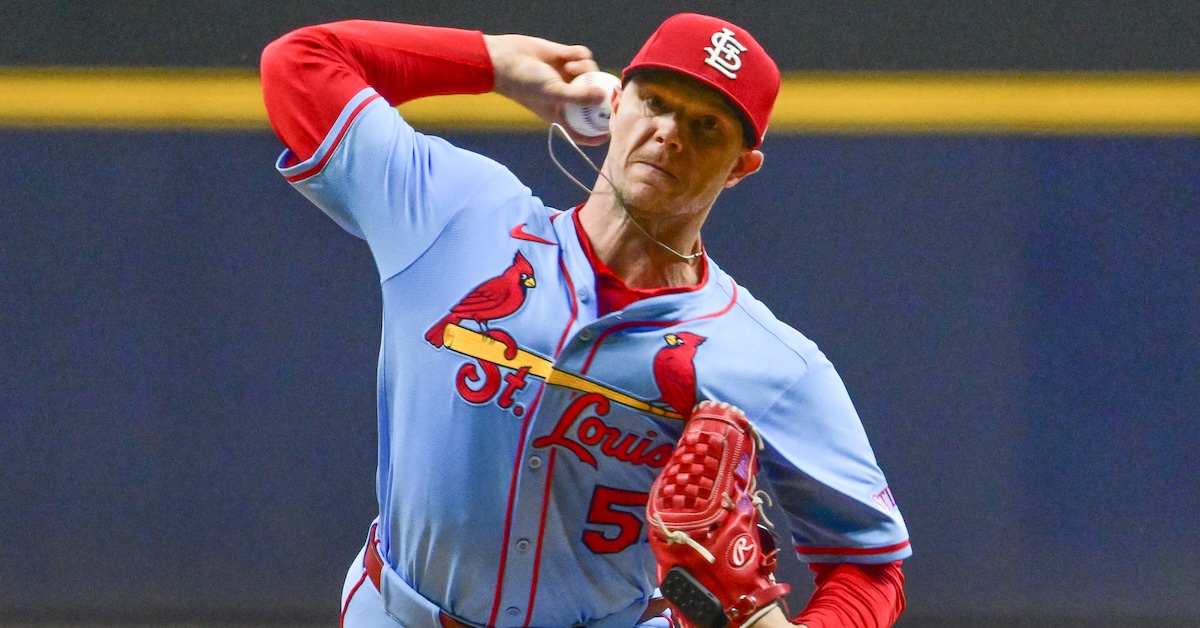
When the Red Sox traded for Sonny Gray, they knew they were getting an old-school starter with seven pitches. He’s got a sinker and a four-seamer. He’s got a cutter, a traditional slider, and a sweeper. He’s got a curveball and a changeup. The traditional slider is the only one of the seven that Gray doesn’t throw regularly; the others all saw at least 15% usage against righties or lefties in 2025. Gray is 36 years old. He’s a three-time All-Star with 330 starts and 125 wins under his belt, and a career ERA of 3.58. At this point, you might assume that he’s about as finished a product as you could find, but you’d be wrong, and that seems to be part of the reason he’ll be pitching in Boston next year.
In 2024, the Red Sox made waves for throwing fastballs just 36.6% of the time, the lowest mark ever recorded and almost certainly the lowest mark of all time. That number went up in 2025, in large part because they added Garrett Crochet, who owned a brand-new sinker to go with a four-seamer that was one of the very best pitches in baseball 2024. But it wasn’t just Crochet. Brayan Bello brought back the four-seamer he’d ditched in 2024. A finally-healthy Lucas Giolito threw four-seamers at his highest rate since 2020. With Aroldis Chapman replacing Kenley Jansen, the closer role saw fastballs replace cutters. In all, the Red Sox finished the season with a fastball rate of 48.3%, the 11th-highest in the league. That’s quite a bounce-back. The Red Sox were very explicitly trying to get away from fastballs, but as the 2025 season showed us, the broader goal was to have their pitchers throw their best pitches more often.
That brings us to Gray, who throws the kitchen sink but still throws fastballs 40% of the time. In 2025, he led with his four-seamer against lefties and his sinker against righties, throwing both pitches 29% of the time in those situations. Shortly after the trade went through, Boston’s chief baseball officer Craig Breslow discussed it with reporters. MLB.com’s Ian Brown published a quote: “It will be a great match for Bails [pitching coach Andrew Bailey] and the rest of the pitching group and the philosophies they have in terms of leaning into strength and potentially away from slug and pitching away from fastballs when you have secondaries as your best pitch.”
That alone made me curious to see whether and how Gray might look different when he suits up for the Sox next year. Gray fanned those flames further during his introductory Zoom call with the Boston press. Our resident interview ninja David Laurila asked whether Gray is open to changing his pitch mix this coming season. The answer was so thorough and thoughtful that David published the whole thing earlier today. You should read it! But the short answer is yes. Gray is not just open to adjusting his pitch mix. He’s excited about it. He’s excited about talking pitch design and pitch shapes. He’s already talked to Bailey – excuse me, Bails – multiple times and will be talking to him again today. He’s confident in his ability to spin the ball, and he knows “that’s a cult in Boston.” Knowing all this, let’s have some fun looking at Gray’s repertoire and thinking about what might change. Let’s start with his pitch mix, courtesy of this handy new Baseball Savant breakdown:
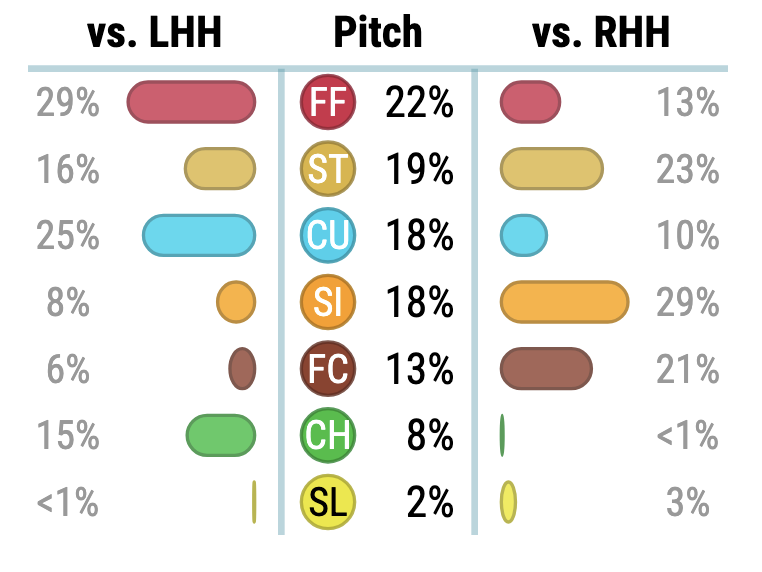
Deemphasizing the four-seamer seems like the obvious priority. The pitch averaged just 91.7 mph in 2025, putting it more than three full ticks below the league average. It’s not a terrible pitch, but it’s no longer a standout, even against left-handed batters. In 2025, they put up a .411 wOBA against it, and it graded out as below average in terms of run value.
The good news is that the sweeper seems like it could easily absorb some of that four-seamer usage. It’s been Gray’s best pitch in each of the past three years, both according to the stuff metrics and Statcast’s run values. To be clear, Gray already throws his sweeper a lot, especially to lefties. Among the 77 righties with a sweeper who threw at least 500 pitches to lefties, his 16% rate was the 15th highest – but if any team is going to give a pitcher license to lead with a bendy pitch, it’s the Red Sox. Bello was just behind Gray at 14.5%, and Boston traded for two of the pitchers ahead of him on that list, Dustin May (37.7%) and Jordan Hicks (20.7%), at the deadline. Moreover, if you take a look at Baseball Prospectus’ arsenal metrics, you’ll see that nearly all of Gray’s pitches tunnel best with the sweeper anyway.
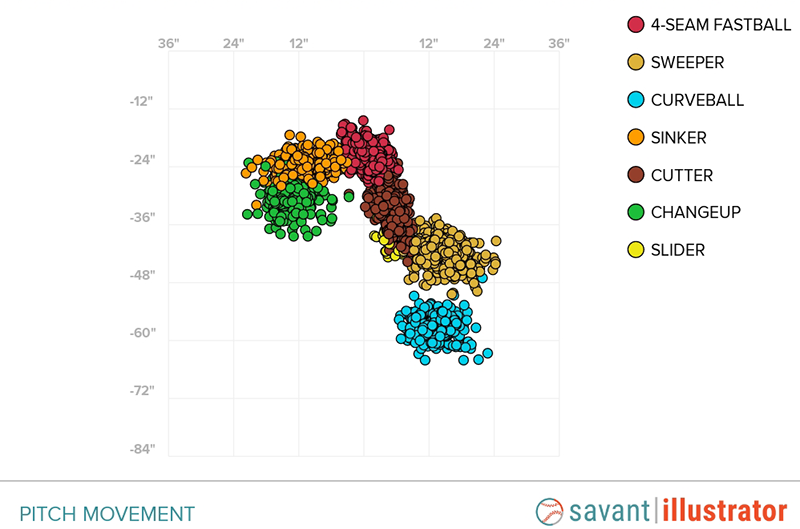
Leading with the sweeper against lefties would likely have several knock-on effects, which is to say that it would require a bit of an overhaul, usage-wise. It might mean backing off the curveball a bit so that lefties couldn’t just sit on something slow and bendy. It might mean mixing in some backdoor sweepers that just catch the outside corner looking for called strikes; right now Gray mainly throws backfoot sweepers looking for swings and misses. It would also make sense to throw a few more sinkers because of the way Gray’s pitches move. He has an extremely high release point, and his four-seamer has a tiny bit of cut rather than arm-side run. It’s basically a cutter (and as Michael Rosen pointed out to me last night, Gray’s cutter is basically a gyro slider). That vertical orientation allows the four-seamer’s movement to mirror the curveball better, while the sweeper and sinker, with their horizontal movement, make a more natural pair:
I’m definitely not saying that Gray should just become a sinker-slider guy against lefties. The curveball is still great, and the sinker is never going to be a pitch he wants to throw too much to lefties. This is just what seems like the logical way to reorganize an arsenal if the goals are to throw your best pitches more and deemphasize your fastball. The table below shows Gray’s numbers against lefties over the past three seasons, and it’s very clear that the sweeper has fared better than the curveball. Breslow specifically mentioned a focus on slugging percentage, and the sweeper’s is more than 255 points lower than the curve’s and the four-seamer’s! Although the sinker has gotten fewer whiffs than the four-seamer, it’s also performed better by just about any other metric:
| Pitch | Whiff% | wOBA | RV/100 | HH% | SLG |
|---|---|---|---|---|---|
| Sweeper | 41 | .138 | 2.64 | 35.7 | .158 |
| Curveball | 30.1 | .291 | 1.10 | 41.1 | .413 |
| Sinker | 9.9 | .270 | 1.39 | 33.3 | .311 |
| Four-Seamer | 16.7 | .385 | -0.02 | 35.6 | .486 |
Things aren’t as clear-cut against right-handed batters. Gray’s approach against righties is very simple, and it’s been the same for nearly his entire career: pound the corner low and outside.
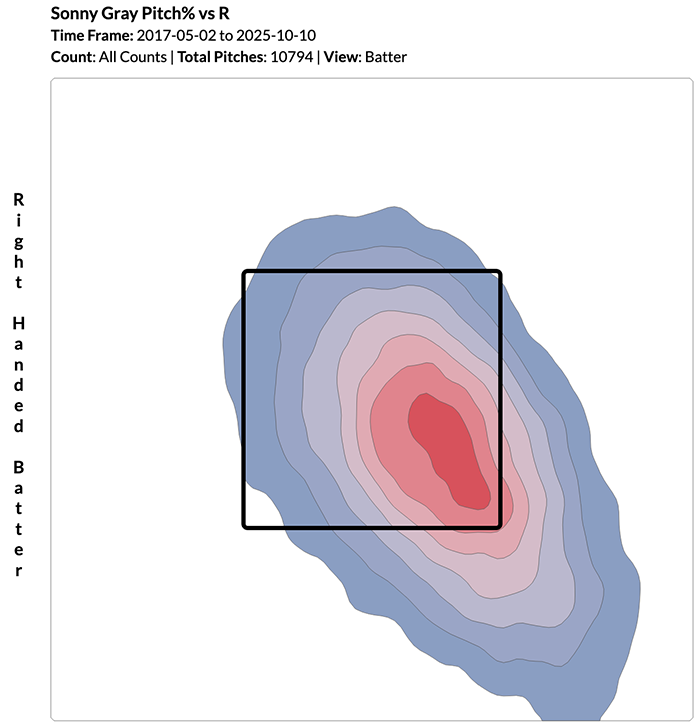
That plan allows Gray to rack up called strikes and keep hitters from barreling up the ball. I doubt it’s going to change all of a sudden in his age-36 season. Against righties, Gray already leads with the sinker and sweeper. He could ramp back up to where he was at the beginning of the decade, throwing those two pitches roughly 70% of the time, but those weren’t necessarily his best years, and both pitches took a step back in terms of effectiveness in 2025, while the cutter performed much better. If the Red Sox like what they see in the cutter, they might try to emphasize it a bit more, but I’m not sure that’ll happen. It’s possible that Gray will turn the dial to 11 and see if he can succeed as a 40% sweeper guy. I would personally love to see this, but I’m not sure either the Red Sox or the guy who finished in second in the Cy Young voting as recently as 2023 are ready to get quite that extreme.
With his steep arm angle, cutterish four-seamer, and abundance of seam-shifted wake, Gray is a fascinating pitcher. This article is just conjecture because it’s fun to think about what he could tweak. It’s what I might be talking about if I’d just signed him, but I have no way of knowing know what the Red Sox are thinking. I haven’t even talked about Gray’s changeup, because it’s not that much of a factor right now, but it might make sense to have him try some sort of variation on the traditional circle change grip he uses now. I’ll be watching closely when he finally pitches in front of Statcast cameras next spring.
Davy Andrews is a Brooklyn-based musician and a writer at FanGraphs. He can be found on Bluesky @davyandrewsdavy.bsky.social.
The bum that he is.