
White Sox Take Two Steps Toward Stinking Less
Not every team shows up for spring training with a reasonable hope of winning the World Series, but there is a grand, overarching narrative to follow in every camp. For the Chicago White Sox, it’s whether they can achieve an all-Sean-and-Shane starting rotation — they’re currently 60% of the way there.
That might sound like a modest goal, but it’s a lot more ambitious than what they set out to achieve just last year: Avoid losing 120 games. Again. The White Sox will sink or swim (or at least sink more slowly) based on how their young homegrown players perform, but Chicago’s supporting cast is looking relatively OK.
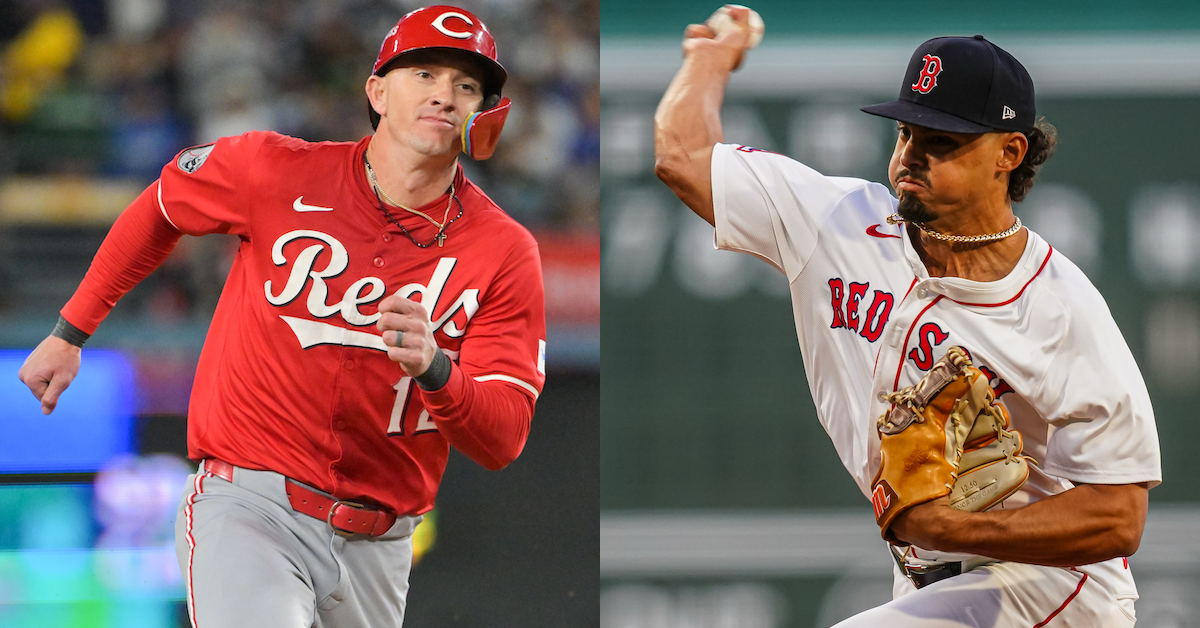
All the more so after this weekend, when the White Sox made two moves: signing free agent outfielder Austin Hays to a one-year contract, and trading for Red Sox pitchers Jordan Hicks and David Sandlin.
Hays is the dictionary definition of a second-division starter in the corner outfield. A third-round pick out of Jacksonville University in 2016, Hays established himself as Baltimore’s starting left fielder in late 2020, and parked there for more than three seasons. He was pretty good for Baltimore, batting .261/.313/.439 from 2021 to 2023. He even rode a red-hot first half to the All-Star Game in his last full season as an Oriole.
What does Hays do well? I guess it’s never a good sign when you lead off a list like that with “he’s got a good throwing arm,” but nevertheless… Hays isn’t an exit velocity monster. He’s never posted a double-digit stolen base season, a full-season walk rate over 7.0%, a full-season ISO over .205, or a full-season wRC+ over 111. He has been a very good corner outfield defender in the past, but that skill seems to be sliding back toward average as he ages. (Hays turned 30 this past July.)
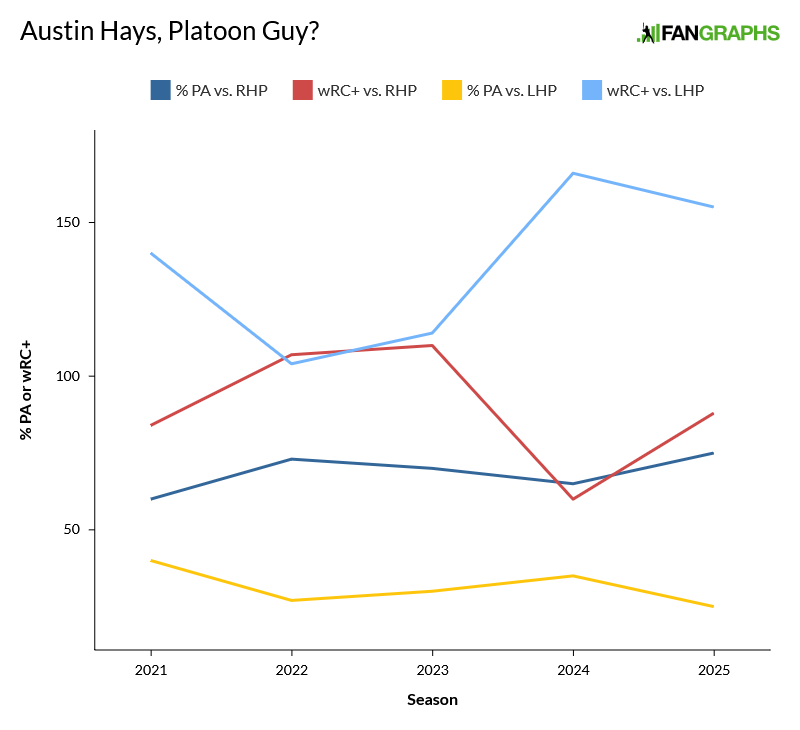
It looks like Hays, who posted pretty average platoon numbers early in his career, might be turning into a lefty-killing platoon bat as he gets older:
The thing about Hays is that he’s not awful at anything. Here’s the range of offensive numbers he’s posted over the past five seasons:
| Season | G | PA | HR | R | RBI | SB | BB% | K% | AVG | OBP | SLG | wOBA | wRC+ | WAR |
|---|---|---|---|---|---|---|---|---|---|---|---|---|---|---|
| Max | 145 | 582 | 22 | 76 | 71 | 7 | 7.0% | 25.7% | .275 | .325 | .461 | .330 | 111 | 2.7 |
| Mean | 122 | 470 | 15 | 60 | 56 | 4 | 5.7% | 22.7% | .260 | .311 | .433 | .320 | 105 | 1.5 |
| Median | 131 | 529 | 16 | 66 | 64 | 4 | 5.8% | 23.1% | .256 | .308 | .444 | .327 | 106 | 1.8 |
| Min | 85 | 255 | 5 | 26 | 20 | 2 | 3.5% | 19.6% | .250 | .303 | .396 | .303 | 97 | 0.2 |
Hays was plenty fine for the Orioles, until they got good and Colton Cowser was ready to be promoted. Then he got traded to the Phillies, who intended to use him as a platoon buddy for Brandon Marsh until he strained a hamstring and went down with a kidney infection. Then he was OK playing regularly for an OK Reds team.
Hays might not be amazing at anything, but he’s also not terrible at anything, and he pulls the ball enough to finagle 15 homers a year out of unremarkable batted ball quality. Is that underwhelming for the 2024 Orioles or 2024 Phillies? For sure.
But for the better part of a decade, the White Sox have been filling every position player vacancy with Leury García. A couple years ago, they had García change his facial hair and start going by the nom de guerre Lenyn Sosa, but they’re not fooling me. I’d expect Hays to be an improvement on that situation in 2026, and if he’s anything more, he can be flipped at the deadline.
The Hicks trade is a bit more of a creative move. The hard-throwing right-hander is entering his third year of living with the consequences of a bad career decision. After establishing himself as a pretty good reliever for the Cardinals and Blue Jays, Hicks signed with the Giants in January 2024, with the intention of becoming a starter.
That kind of reliever-to-rotation transition has been in vogue as reliable starting pitchers are being hunted to extinction. Sometimes (Clay Holmes, Reynaldo López) it works pretty well. But the Cardinals had already tried Hicks as a starter for eight games in his age-25 season, and it went quite poorly. The second time around, it went even worse.
By the time the Giants sent Hicks to Boston in the Rafael Devers trade last year, he had a 6.47 ERA. In 21 appearances for the Red Sox, all out of the bullpen, Hicks was even worse: an 8.20 ERA, 6.19 FIP, and three homers and 12 walks against just 15 strikeouts.
Hicks had been due to make $12.5 million in each of the final three seasons of his backloaded four-year contract. His inclusion in the deal was less about Boston believing in him as a pitcher than it was about adding ballast to a trade that sent almost $300 million worth of Devers the other way. If Hicks could return to form as a good setup guy, so much the better, but if not, well, we can always trade him to Chicago.
I suspect White Sox GM Chris Getz is no more sanguine about Hicks’ future than Red Sox chief baseball officer Craig Breslow was. But Boston is kicking in $8 million to grease the skids, lowering Chicago’s effective financial commitment to $17 million total over two years. That’s not a trivial expenditure for a team whose projected payroll is only $86 million as of this writing, but it’s workable.
Hicks is still only 29, and he was a good high-usage, contact-suppressing leverage reliever as recently as 2023. Maybe the White Sox can just resent the clock to where he was before the Giants started futzing with his repertoire to try to make him a starter. At the same time, Hicks was throwing 100 mph three years ago; his average fastball velo in 2025 was in the 97 mph range, even though he was mostly working out of the bullpen.
Hicks pitched through and/or around a shoulder injury in 2025, which probably explains some of the lost velocity. But if he doesn’t get it back, he could be in trouble; pitching at 97 is a different proposition from pitching at 100. Especially for a pitcher whose fastball shape had trouble missing bats even when he was the hardest-throwing righty in baseball. Anything Chicago gets from Hicks from here on out should be considered a bonus.
This trade is mostly about Chicago getting Sandlin for nothing but money. Sandlin has bounced around a ton in a short career. He went to junior college out of high school, and then was the one of two power arms who popped for Oklahoma during the Sooners’ run to Omaha in 2022. (The other being Cade Horton.) Sandlin wasn’t quite as impressive, but the Royals gave him an over-slot bonus in the 11th round, then traded him to the Red Sox for John Schreiber in the spring of 2024. I’ll let Eric Longenhagen take over from here:
Sandlin throws hard and, after dealing with oblique and forearm issues in 2023 and 2024, he was finally able to work 106 innings in a completely healthy 2025. He was still sitting 96 and touching 100 in September, partially solidifying the notion that he can be a big league starter. There are still other potential barriers to that, however. Sandlin’s fastball lacks explosive movement, he still doesn’t have a great offspeed pitch with which to attack lefties, and he’s a control-over-command type who throws strikes (his fastball, slider and cutter strike percentages are all around 66%), but mostly in the heart of the zone.
His breaking balls — a slider in the 82-87 mph range, and a cutter that averages about 90 and will bump 94 — are both nasty and fairly distinct from one another. Against lefties, Sandlin peppers the top of the zone with cutters and sliders before elevating his fastball with two strikes. Against righties, he throws a ton of sliders, almost as often as his fastball and cutter combined. He was able to strike out a batter per inning in this fashion in 2025 but had pronounced splits (.807 OPS vs. LHH, .637 vs. RHH), and he barely ever throws his changeup or curveball.
The White Sox have had recent success coaxing better changeups out of pitchers with naturally-good breaking balls, and perhaps they’ll be able to do that with Sandlin. He has the size, and now seemingly has demonstrated the durability, to justify development as a starter during his first couple of years on the 40-man roster. His ultimate upside is something like a good fourth starter, but his more likely long-term outcome is as a really nasty reliever.
Sandlin threw 106 innings across two minor league levels in 2025, pitching out of the rotation and the bullpen, and ending the season in Triple-A. If he’s not major-league ready at the start of the season, a team like the White Sox ought to have space to give him a big league audition at some point in 2026.
Headed the other way is 22-year-old Gage Ziehl, a short starter out of the University of Miami who has good command and secondaries — best among them a mid-80s slider — but a lack of bat-missing ability that limits his ceiling to that of a depth starter. He was 34th on the recent White Sox top prospects list, with a 35+ Future Value. Chicago is also sending a player to be named later to Boston in the trade.
These are the kinds of moves a team like the White Sox should be making. There was a time when conventional wisdom called on non-contending teams to tear everything down to clear payroll and open playing time for prospects, even long-shot prospects. Unfortunately, living that experience 162 games a year, often for several years in a row, sucks butt. Losing games for want of a below-average, or even replacement-level, player is not worth the chance of getting a marginally better draft pick.
At the same time, the White Sox picked up a good prospect (Sandlin isn’t the second coming of Paul Skenes or anything, but he’s interesting and near-major league-ready) for basically nothing but money. And as underwater as Hicks’ contract is, and as bearish as I am on the odds of him returning to previous form, the odds of that happening are definitely not zero.
The White Sox aren’t anywhere near being good again. At best, they’re within sight of a village where they can get directions to a place where they can find a map that’ll take them to the path toward being good again. But you have to start somewhere.
Michael is a writer at FanGraphs. Previously, he was a staff writer at The Ringer and D1Baseball, and his work has appeared at Grantland, Baseball Prospectus, The Atlantic, ESPN.com, and various ill-remembered Phillies blogs. Follow him on Twitter, if you must, @MichaelBaumann.
The Red Sox just pulled off one of the shrewdest trades of the winter by shipping Jordan Hicks, and at least most of his ridiculous contract, to the White Sox. This is one of the better examples of addition by subtraction I have seen and the Red Sox also save around $17 million. Sandlin is an interesting prospect and may tilt the deal in the White Sox direction but he is way down the list of potential Red Sox starters and is well worth the price for getting Hicks out of Boston.
I’m sure that’s how the Bosox saw it, because it dipped them under the second tax line. But the Chisox also get two players-to-be-named-later out of this deal as well, so it works out from their end, too. If Hicks can return to being a mid-leverage reliever so much the better. Boston couldn’t afford giving him enough rope to find out, but Chicago can.
The alternative was to DFA Hicks, keep Sandlin and pay the $17M. I don’t like that the Red Sox chose to save money and make the team worse.
Its not my money, so who am I to criticize billionaires for how they spend their billions of dollars.
I really don’t like that they’re selling a prospect.
The only way it’s good for them is if they are really low on Sandlin and he was in danger of losing his 40-man spot in the near future. Which actually might be what is happening here from their end, in which case it’s fine.
But there is simply no reason why the Red Sox need to be worried about money. Even if Sandlin is only a functional reliever, it’s not good for them.
At least I’m not alone. Ben was firmly in my corner when I asked his opinion of this deal during today’s chat. To ignore that financial considerations should not be considered is foolish and the only other choice was to DFA Hicks because he could never have made another appearance in a Red Sox uniform.
If they were going to DFA him otherwise–just DFA him. Why give another team money *and* a 45 prospect and get basically nothing back?
DFAing costs them the whole contract, $25M. Evidently they preferred paying $8M and Sandlin, assuming the PTBNLs aren’t impactful.
Yeah, which seems penny-wise and pound-foolish.
I am sorry that you don’t understand that a player is still under contract even after they are designated for assignment. They would have been on the hook for the entire $25 million then. This way they save $17 million. The question of whether David Sandlin is worth that to the Red Sox at this point is valid but he is very far down the depth chart and it is well understood that the Red Sox are able to trade from this surplus. At least it wasn’t Tolle or Early which would obviously change the equation dramatically.
Combining jumping to a conclusion with high-horse sniping–nice.
The Red Sox are one or two infielders away from having a championship-caliber team and something like the third or fourth best revenue in the game. If they didn’t want Hicks around they could definitely DFA him and it would be fine. Why they are spending any attention on moving Hicks when their infield looks like that is beyond me.
But if Sandlin was going to lose his roster spot anyway, you might as well do it.
Yeah the 40-man spot is what I’ve been wondering about. Otherwise this is a trade that didn’t need to be made.
(We should absolutely criticize how billionaires spend their dollars)
The Red Sox would have been on the hook for the entire $25M and by never having to use Hicks they have made the team better. His two months with the Red Sox were some of the worst pitching I have seen in my 77 years of rooting for the team. You are not the only person on the site who doesn’t understand that designating a player for assignment does not abrogate the teams financial commitment to the player for the length of the contract. This why Rendon had to negotiate his retirement. The Angels wish they could have just DFA’d him.
I won’t speak for anyone else here, but I fully understand that a DFA means the Red Sox pay hicks in full for the amount remaining on his contract.
The Red Sox saved $17M by giving a prospect to the White Sox. Why on earth are you happy that John Henry is giving away prospects to save money? The team is worse now than it was yesterday!
I dunno about that. Look, when your team pulls off a salary dump you just don’t say “nice salary dump” because who benefits? Owner wallets? I only care if they do something with it. E.g. I was pissed at Jerry Reinsdorf last week for dumping salary for very little. But then he actually spent that money so I now can, with cautious optimism, say, “nice salary reallocation”.
(and let me clarify I’m pissed at Jerry Reinsdorf on general for being a cheapskate generally, but I feel slightly better about LRJ)
There are apparently also two PsTBNL going back to the White Sox. I don’t remember ever seeing three of those in one deal.
The Hicks deal is easily the best move Getz has ever made. He traded a 35+ with 4 innings above A+ and a PTBNL for a near MLB ready 45, two PTBNL’s (per MLB.com), and $17M in debt. You take that deal every day, even if they DFA Hicks tomorrow.
If Hicks reverts to adequacy and throwing 100 MPH then he can offload some of the debt and get back another lottery ticket prospect. If he doesn’t he can soak up some innings on a bad team while younger pitchers try to get better in more favorable circumstances. The only thing he really gave up was some short term payroll flexibility that he wasn’t going to use on good players anyway.
Except Luis Robert.
This deal is obviously good for the White Sox, but I really don’t like that they clearly have orders to keep the payroll under $100M and it cost them a chance to hold Robert and try to recoup some value for him.
I don’t know if they have orders on payroll or if they just lost a game of chicken with Robert, waiting for him to be healthy and good again, then selling low on him when it didn’t happen. I don’t think they were ever going to extend him and they have been trying to move him for over a year. I think the moves are only tangentially related and maybe signing Murakami was more related to moving Robert than this. Certainly Reinsdorf has shown a reluctance to spend on a team that has no chance to make the playoffs
You can also argue whether or not Robert was a “good” player after the last two years. The rest of the league didn’t seem to think so, even though I still liked watching him.
In any event, this is the sort of move Hahn talked about making with payroll space during the last rebuild, but never actually did.
I am interested in what the PTBNL are, but there’s a good chance that they are not much. James Fegan said in the SoxMachine comments that he hears the White Sox are sending an “org soldier” whom they otherwise would’ve released. I’m assuming that what the Red Sox are sending back is not much more significant than that. But I wonder what the delay is? Some speculation that has to do with opening up spots on the 40 man roster by using the 60 day DL at the start of spring training. So which players at the end of the Red Sox’ 40-man could be insignificant additions to this trade?
Hmmm, the most interesting is probably Tyler Uberstine. He was a non-prospect at the start of 2025, but he is MLB-ready, and his top-line numbers were pretty good last year (10 K/9, 3 BB/9, 3.5 ERA). He’s probably like #9 or #10 on Boston’s SP depth chart, but it would be good for him and the white sox if he was the PTBNL because I don’t see him getting a chance in Boston.
For a long time PTBNL were drawn from a pool of prospects who either weren’t eligible to be traded, guys who didn’t have R5 protection and so they wanted to wait until after the R5, or players who were rehabbing.
I guess it could be that they just need to scout the players a little more but I would guess that at least one of the players in the pool is someone who is rehabbing, like Conrad Cason or Yordanny Monegro, and they’re waiting to see how the recovery goes for that guy before deciding on him or a backup.
If you really want to dream big you can dream on Casas, but it seems unlikely the Red Sox would just give him away like that.
And yet since Getz is behind this move, I’m convinced it’s a horrible move that Sandlin probably stinks and the White Sox are the only ones who haven’t figured that out yet.
Austin Hays apparently wanted a chance to play every day, and the White Sox didn’t have anyone to play right field. Looks like a good situation for everyone. If Hays can put together a full season he might get looks as a starting outfielder next offseason.
For me, the jury is still out on whether or not this was a good deal for the Red Sox. If trading Hicks enables Mr. Henry to thumbs-up Breslow adding a high-impact infielder, then it’s a great deal for the Red Sox. But if they don’t use increased payroll flexibility to improve the club, then trading Hicks morphs into something evoking broader contemplation about how awful the Devers trade was. Trading Devers freed up payroll, long-term. Trading Hicks helped maximize that a bit more for the next 2 years specifically, but cost a borderline MLB-ready pitching prospect who also has added value being under team control for multiple seasons.
If Breslow isn’t immediately figuring out how to acquire Horrner (and extend him), or add some other meaningful player in a larger blockbuster by shipping out outfield and pitching depth, then I’m not sure what the plan is with this. It seems to be leading to something, but what? Red Sox offseason still feels incomplete
I would be very surprised to hear that there is an impact infielder that is still available out there now that Eugenio Suarez and Brendan Donovan are out of bounds. But I suppose anything is possible.
It looks to me that Breslow just traded some pitching depth, one far less touted than Tolle and Early, for financial relief and spared Cora from ever having to call the awful Hicks in from the bullpen. I raised this question with Ben in today’s chat and he is firmly in agreement that this is a plus for the Red Sox.
What expensive high impact infielders are still available?
I just mean “expensive” through the lens of the Red Sox brass, and I’m referring to Ketel Marte. The trade cost would reportedly be enormous, but the added salary might be ok to whoever at FSG worries about such things now that Hicks is gone. I realize the D-backs have taken a public stance Marte’s not on the block, but a desperate Breslow might cough up enough prospect capital for it to happen
I think they always intended to roll with Mayer at 3B and Gonzalez/Campbell at 2B. Not a terrible plan, but there’s quite a bit of risk involved with it. There’s a disturbingly high chance of “entire infield apart from 1B cratering/not even being available to play”. Pretty ironic considering last year’s infield situation.
If the Hicks deal wasn’t about the 40-man, it’s about John Henry being a cheapskate.
If that has been their post-Bregman plan, it’s a stupidly risky one that was an unnecessary path to take given what was available at the start of winter. I don’t believe Mayer at 3B and Hammy-Romy combo at 2B was their original plan, but may have been a predetermined Plan B or even Plan C.
At the start of the offseason, Breslow spoke openly about the need to add power, and that adding someone to the lineup that the opposition has to plan around is important. He completely failed to meet that objective, however. Contreras is not that type of player, and also Bregman’s bat is gone. The roster is a weirdly inflexible mess. An abundance of superb outfielders but not enough quality infielders, and too left-handed a lineup. The insanely deep rotation could still carry the squad far, if the defense holds, infield stays healthy, and the lineup approaches something average in terms of run production. Probably not all of that goes swimmingly, but in theory it could
I agree with all of this. Maybe they thought they were going to keep Bregman. I do think they don’t want to block Campbell, but Campbell is so useless defensively. This roster is the opposite of well-rounded. And what happens when Story misses half the season and/or is terrible?
The Leury Garcia morphing into Lenyn Sosa line was one of the funniest I have read in these pages in a while. Put into words what I was thinking these last two years on the WSox utility situation. .
My kid is named Hayes and was “Purple Hayes” his first Halloween, so I very much appreciate the loss we have here.
I love it when my team makes a trade that is so obviously terrible for them.
The rough shape of Sandlin’s profile reminds me a lot of what Shane Smith’s profile read like this time last year: big, mid-20s righty who
If Smith is indeed the model for Sandlin, they’ll look to add:
It’s not that big of a deal really, but Lenyn Sosa and Leury Garcia are really not that similar besides being White Sox players who are MLB-quality but not a lot better than that. Leury was the goofiest type of prospect: top tools were speed and arm. Lenyn was at one point looking kind of like a Yolmer Sanchez type, but found some power and is basically a bat-first infielder who fields just well enough to stay out of DH. Leury had minimal power but was a rather useful defensive player all over the diamond.
But yes, it is certainly true that the last time the Sox tried to be good, they had a nasty habit of trying to fill holes with players whose upside was to be merely adequate and whose downside was to be out of the league.