
Yankees Finally Kick Off Their Offseason by Trading for Ryan Weathers
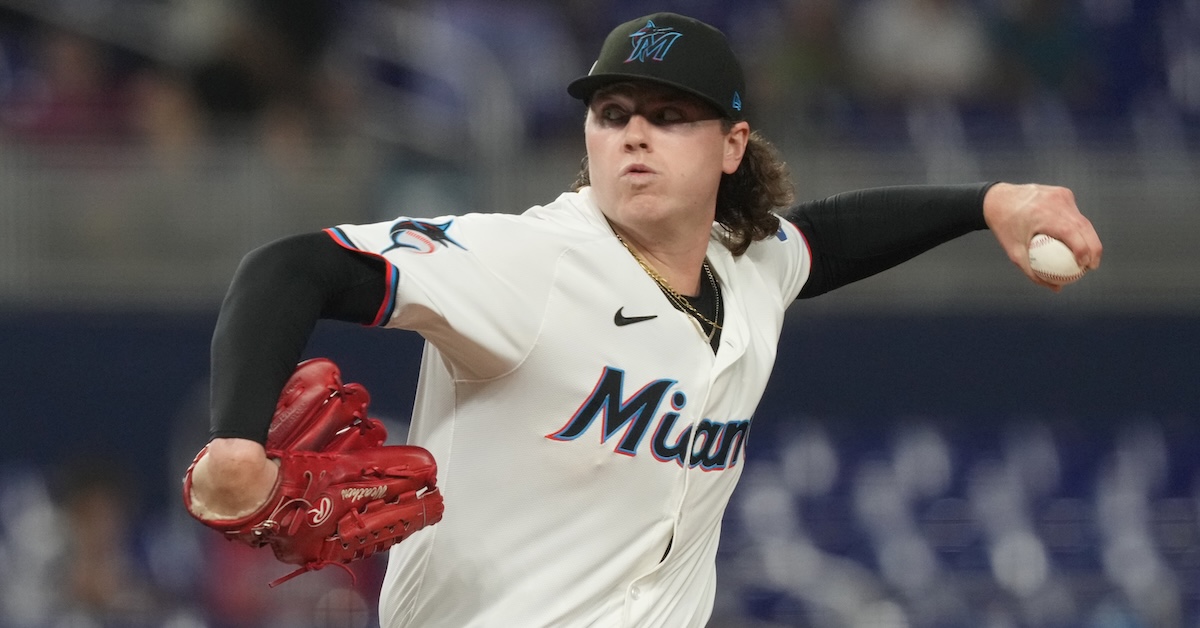
Though they may have failed in their reported pursuit of former Miami starter Edward Cabrera, who was ultimately dealt to the Cubs last week, the Yankees still managed to complete a trade with the Marlins for a starting pitcher. As Jack Curry of YES Network reported on Tuesday night, Ryan Weathers is on the move from Miami to New York. In return, the Marlins will receive a group of four minor leaguers from the Yankees: outfielders Dillon Lewis and Brendan Jones, along with infielders Dylan Jasso and Juan Matheus.
Frankly, it’s impressive that Yankees general manager Brian Cashman can get anything done while locked in a staring contest with agent Scott Boras over the terms necessary to re-sign outfielder Cody Bellinger. As for Miami’s side, I deeply respect the Marlins pro scouting department for looking at all the work they did scouring New York’s farm system for potential targets during the Cabrera talks and refusing to let all that effort go to waste.
Weathers, like Cabrera, still has three seasons of team control remaining before he hits free agency. This is not a rebuilding team trading contracts set to expire before its next window of contention opens. Rather, the Marlins, who are in the early stages of transitioning from rebuilding to contending, have such a surplus of starting pitching that they feel comfortable trading not one, but two established starters in favor of stockpiling additional position player talent in the minors. When Michael Baumann wrote up the Cabrera trade, he speculated that we might see debuts this coming season from Thomas White and Robby Snelling, two of Miami’s top pitching prospects who both graduated to Triple-A last year. By trading Weathers in addition to Cabrera, the Marlins are all but committing to giving one or both of them meaningful innings in the majors in 2026.
As it stands, Miami’s starting rotation will be Sandy Alcantara, Eury Pérez, Max Meyer, Braxton Garrett, and Janson Junk, with Meyer and Garrett both returning from injury. Meyer is working back from a hip impingement that may require re-working his mechanics to prevent a recurrence of the issue. Garrett will be roughly 15 months removed from UCL surgery at the start of spring training. Both should be fully healthy, but they carry the uncertainty associated with a return to form following a major injury. Meanwhile, Junk has been on the Triple-A shuttle with five big league clubs ever since his debut in 2021. Last season was his best to date, totaling 110 innings pitched with an ERA- of 98. Ryan Gusto is also in line to cover some innings, though he’s unlikely to block White or Snelling if the Marlins front office feels they’re ready to contribute.
Unlike the Cabrera trade, which netted the Fish a major league-ready outfielder in Owen Caissie along with a couple of much fringier hitters still in the low minors, the Weathers swap is for a package of four players, none of whom are true headliners, though it wouldn’t be fair to compare them to a bag of balls either. Lewis is clearly the centerpiece of the deal. Jon Heyman reported Miami’s affinity for the 22-year-old right-handed-hitting outfielder back during the Cabrera negotiations. Brendan Gawlowski, one of our in-house prospect-knowers, told me he believes Lewis will be able to handle center field, but his role is most likely on the short side of a platoon. A decent approach combined with plus power provides some upside if Lewis can still access it once he starts seeing higher quality pitching. And perhaps the Marlins feel their player development staff can clean up his swing mechanics and unlock more consistent contact.
Of the other three position players in the deal, Gawlowski would have Jones next on his pref list followed by Matheus, then Jasso. Paraphrasing his notes on the trio: Jones offers better defense in center than Lewis, but less power. The 23-year-old hits from the left side and currently lacks the bat speed necessary to support a swing that’s on the long side. Matheus is the youngest of the group at 21, having signed with the Yankees out of Venezuela at 18. He’s been playing third base since getting to High-A and seems to have good defensive instincts there, but a light arm might force a move to second. He’s a switch-hitter with good barrel control from both sides who hits for more contact than power. Jasso signed out of Mexico at age 20. Now 23, he projects to play a passable third. He bats from the right side and has decent bat speed, but he has a steep swing with plenty of miss in it, and he struggled to catch up to high velocity toward the end of last season.
The quartet of players heading to the Marlins does backfill their minor league system as they continue graduating players to the majors. And having just completed a deal with one prospect as the primary return, they opted to diversify their strategy and make a volume play, hedging their bets across four lower-tier prospects. Whether any of these players has enough upside for the hedge to pay off remains to be seen, but ideally the Marlins selected these guys because they already have specific thoughts on how to help them level up. After all, they have been scouting the Yankees system all winter.
As for the remainder of Miami’s offseason, they could choose to upgrade the roster in any number of ways, but it seems more likely that they will spend 2026 evaluating which of the young hitters on their roster will make up the core of the next contending Marlins squad. Of the group RosterResource currently projects to break camp with the team, the oldest are Kyle Stowers and Griffin Conine, both checking in at a grizzled 28 years old.
On the other side of the trade, the Yankees are facing a much different time horizon. As a general rule, the Yankees always prioritize winning in the here and now over planning very many seasons into the future, but having Prime Aaron Judge on the roster has to ratchet up the intensity on that instinct even further. Because Prime Aaron Judge is not an infinite resource. It’s impossible to know exactly how many grains of sand can pass through the hour glass before it’s gone for good, but Judge turns 34 this year.
Anyway, the Yankees will not be patiently seeking marginal improvements from a young roster. They’ll be hoping that 35-year-old Gerrit Cole can rebound from Tommy John surgery, and that needing surgery to remove bone spurs won’t stop 33-year-old Carlos Rodón from returning to his 2025 form. But since both pitchers are slated to start the season on the IL alongside fellow hurler Clarke Schmidt (who underwent the internal brace version of Tommy John last July and won’t return until the end of 2026, if at all), New York needed reinforcements. Enter Weathers.
Even though Weathers was the fall back option after the Yankees were outbid on Cabrera, that doesn’t mean there isn’t plenty to be excited about. Weathers has had a rough go of it with injuries the past couple of seasons, but not necessarily the type to suggest a troubling pattern; it’s not as though he’s been dogged by recurring elbow soreness or forearm tightness. He missed three months in 2024 with a strained left index finger, then was out six weeks in 2025 with a flexor muscle strain; he was only healthy for a few weeks before a lat strain knocked him out for three months. The good news is he’ll head into the 2026 season following a fully healthy offseason.
Betwixt and between last season’s IL stints, it looked like Weathers had leveled up his arsenal. Though his top line stats were slightly worse in 2025 compared to 2024, his pitch characteristics tell a different story. Overall, Weathers uses an east/west approach, with his four-seamer, sinker, and changeup breaking arm side, and his sweeper breaking glove side. The sweeper and changeup are his swing-and-miss pitches, with the sweeper generally deployed against lefties and the changeup against righties.
Because of the way changeups typically move, it’s pretty common for southpaws to avoid throwing them to their fellow lefties and go to a different secondary pitch instead. But Weathers is different. Though he does favor his sweeper against left-handed hitters, when it comes to his changeup, “He’s one of the few lefties out there who is very comfortable throwing it left-on-left,” as Marlins bullpen coach Brandon Mann explained to David Laurila last September. “When you have the ability to go to the same hand, inside, with your changeup, it opens up a lot for your other pitches. Changeups do that in general.” So instead of being one of those four-pitch pitchers who is really more of a two-pitch pitcher in practice because he splits his arsenal by batter handedness, Weathers uses his full repertoire against lefties and righties alike, giving them more distinct looks to contend with and keeping them off balance.
In 2025, Weathers built on that approach further by making a few tweaks. He added a tick of velo to most of his offerings, but most notably his four-seam fastball, which went from 96 mph to 97 mph (the average left-handed fastball sits just over 93 mph). One tick may not seem like a huge jump, but when you’re already three ticks above average, any extra juice is a big deal. Further, he increased the vertical separation between his four-seamer and his changeup, with the former adding a bit more rising action and the latter dropping more. His final tweak was adding a gyro slider as a contrast to his other offerings, which all feature dramatic horizontal break, but the bullet spin on the slider prevents it from moving more than an inch or so in either direction. Now he has five pitches that spin in the same (or mirrored) direction so they look the same at first, but then dart off in different directions.
Injuries prevented us from really getting to see what Weathers’ upgraded arsenal could do. Looking ahead to 2026, some blend of his performance in 2024 and 2025 feels like a reasonable baseline expectation (and the Steamer projections agree), but if Weathers continues to workshop those changes, he could easily exceed expectations. Further reason for optimism lies in his batted ball data. He generates a ton of groundballs (76th percentile in 2024), and even though the Yankees infield defense wasn’t stellar in 2025, they’ll benefit from getting full-season contributions from last year’s trade deadline acquisitions, Ryan McMahon and José Caballero. And regardless of the quality of the infield defense, when Yankee Stadium is your home ballpark, keeping the ball on the ground is always preferable. Even when hitters do hit it in the air against Weathers, they don’t tend to pull the ball, and fly balls hit the opposite way or up the middle are less likely to inflict damage. These batted ball tendencies hold especially true for left-handed hitters (or they did in 2024, the last time Weathers accrued enough innings to have somewhat meaningful platoon splits), which had to be particularly attractive to the Yankees given their home park’s notorious short porch in right field.
The Yankees did well in acquiring Weathers regardless of where he landed on their pref list of potential targets, especially given that they didn’t have to deal from their top-end prospects to get a deal done. Now the “worst” thing that could happen is that Cole and Rodón both return to the rotation healthy and effective, pushing some combination of Weathers, Will Warren, and Luis Gil to the bullpen (which could use some reinforcements of its own in the meantime). Nevertheless, any number of other catastrophes could befall the Yankees pitching staff, so Cashman should continue to multitask shopping for starters while he gets this whole Bellinger situation sorted out. He could also look into acquiring a shortstop who can actually hit, though admittedly there aren’t many of those lying around.
Kiri lives in the PNW while contributing part-time to FanGraphs and working full-time as a data scientist. She spent 5 years working as an analyst for multiple MLB organizations. You can find her on Bluesky @kirio.bsky.social.
Marlins had the makings of an excellent rotation in a wealthy market interested in baseball. I’m not seeing why they act like they’re in Milwaukee or Cleveland
Because the population takes a dive every summer. Only the As and the Rays sell fewer tickets.
Tbf Ticket sales are hardly the only revenue stream, and frankly maybe the least lucrative. The biometric data alone these orgs collect from ages like 9-10 prob earlier on are worth billions upon billions, and thats before every org in this depraved, degenerate baby killing society opened a sportsbook etc etc etc
This is maybe most to say this whole small market nonsense needs to gooooo, its mostly made up and thrown onto the mountain of lies propping up this house of cards esp as the league continues to follow the NFL model and secure public funding, land, and offloading player development to the NCAA and/or pay to play labs that cover operations
The comments below are fair, but however you slice and dice it, Miami is not profitable despite having a small payroll. Relocation is in their future.
I think their stadium lease expires in 2070 or something wild like that. I don’t think the city, after basically paying for the whole thing, will let them leave so easily.
Bankruptcy Can void contracts.
MLB is never giving up on Florida. In fact this could just be the beginning; I heard Barry Larkin on the radio recently stumping for an expansion team in Orlando. Even if new stadiums were ratified in Montreal and Oakland — two wonderful fanbases that were robbed of their teams — I bet they’d lose out to Manfred’s insistence on trying to make baseball work in a place where no one seems to want it.
That franchise has burned so many bridges with the fans that they make a whole lot less money than those two franchises.
It’s not a huge market or an unusually wealthy one but they should pull in more than Cleveland or Milwaukee. For sure! But they haven’t given the fans any reason to care about them since the Stanton / Yelich / Ozuna trades. Two of which actually worked out for them, but everyone is so jaded by their huge cost cutting measures that people have given up on them.
I respectfully disagree. Few people have given up on them, but most of their potential fans leave town before baseball season starts. The revenue and profit estimates from Forbes routinely put Miami at or near the bottom of MLB.
Are you referring to snowbirds? Arizona does just fine and they should have the same problem
IDK, they were drawing 1.5M to 1.8M fans a year between 2013 and 2017. It cratered in 2018 and has only partially bounced back. In 2023 they made the playoffs and only drew 1.15M. This year they drew about the same amount too. Unless the demographics of the area has changed or people are leaving town more often I think there’s a fairly clear line between them trading every recognizable name for cost savings / them losing a lot and a bunch of people giving up on going to baseball games.
Not that 1.7M a year is great, the Reds, Guardians, and Brewers all handily topped that this year. But losing a third of your attendance is a pretty big drop!
It’s a struggle of being a warm, snowbird area without a core fan base. The majority of baseball fans that live in Miami are from somewhere else and grew up rooting for another team. Plus Miami and Tampa were founded in the 90’s, so most people that grew up in the area at that time are still young and haven’t been around enough to establish a fan base. Plus, their parents are probably from New York or something, so their fantitude has been passed down from their parents, who probably grew up worshipping Bobby Murcer or something. Atlanta is the same way. The Braves are the same way – we’re lucky in that we had the TBS and “team of the south” pull for so many decades, which has allowed us to establish a stable fan base. But, the Falcons and Hawks have some of the worst attendance numbers and most fair weather fans in the league. Seriously, if a team with a halfway decent fan base comes to Atlanta (Giants, Steelers, Patriots, etc) we are outnumbered in attendance. The south is a transplant area and it’s very hard to establish a loyal fan base due to the nature of it.
There are a lot of transplants and native southerners are obsessed with college football, pretty much everything else is an afterthought.
They do have lots of kids in the system ready to be part of the rotation like Snelling and soon White. I agree with the rest of your post.