
You Can’t Spell Braves Without Some of the Letters in Yastrzemski
The Winter Meetings historically mark the beginning of the signing period for marquee free agents, and this week has seen several stars agreeing to big contracts. But there were also plenty of little deals among the titans, and one of them in particular fascinates me. That deal: The Braves signed Mike Yastrzemski to a two-year, $23 million contract, with a club option for a third year, as Jon Heyman first reported.
There’s a lot to unpack with this one, but we might as well start with Yastrzemski. The 35-year-old outfielder is nothing if not consistent. In a 2025 split between the Giants and the Royals after a deadline deal, he logged his seventh straight season with a WAR total between 1.5 and 2.5. It was his fifth straight year with a wRC+ between 99 and 111, and the third of those five years where it was exactly 106. He played his usual solid outfield defense, and the Royals even felt confident enough in him to occasionally use him in center field. If he’s your best outfielder, your outfield probably isn’t all that good. If he’s your third-best guy, it’s probably great.
But while Yastrzemski’s season looked like the others in terms of his overall line, it was a tale of two halves. In San Francisco, he started slowly and never really got going. He posted the worst contact quality marks of his career while struggling to a below-average line. Then he went to Kansas City and went on a huge heater, for lack of a better way to describe it. Everything got better all at once. Yastrzemski’s barrel rate increased from 7.1% to 10.9% at the same time that his swinging strike rate declined from 8.0% to 5.4%. That’s a neat trick if you can pull it off, and as a result, he hit more homers in KC than in SF in half the plate appearances, all while cutting his strikeout rate to an otherworldly 11.8% and also walking 13.4% of the time.
Do you know how hard it is to slug .500 while playing your home games at Kauffman Stadium? To paraphrase Ron Washington, it’s incredibly hard. Bobby Witt Jr. slugged .501 last year, for example. Yastrzemski got to his power thanks to a massive fly ball rate, and he paid the price in BABIP as a result, but it was still an incredible two months. At times, he felt like the second-best hitter on the team, and the Royals made a run at playoff contention for a while, though they ultimately fell short.
That version of Yastrzemski would command a pretty penny in free agency, even at age 35. But that’s not really how baseball works. Players get that hot all the time. It’s a game of streaks. He has reached those lofty highs at least briefly in every season he has played in. The reason that his Royals production looks so good is that he got traded to them roughly where the red X is on this chart:
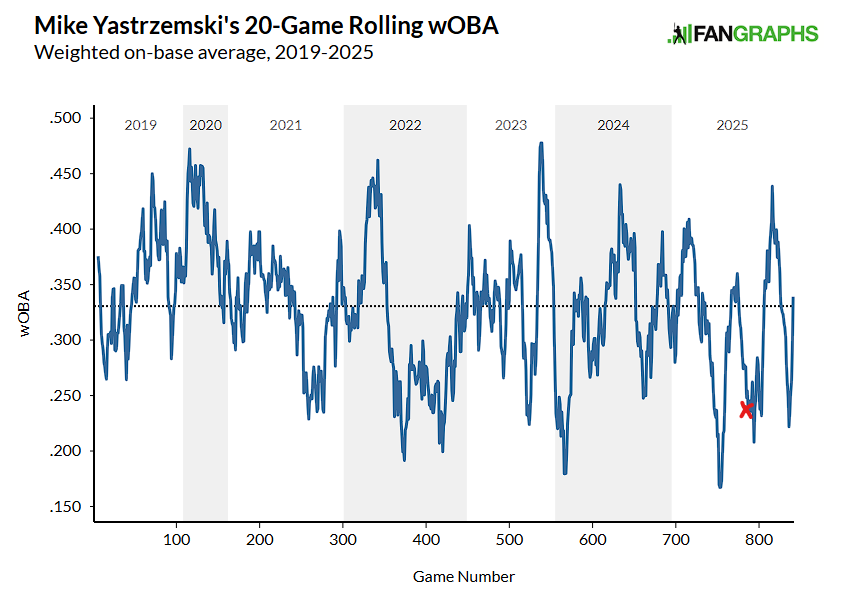
That’s not to say that I’m not encouraged. I’m a lot more excited about Yastrzemski’s trajectory now than I was in late July, that’s for sure. But I’m a little skeptical that he’ll be able to keep this form going indefinitely; he posted the lowest strikeout rate of his career and highest full-season walk rate (his 2020 walk rate was slightly higher), and still only hit at basically his career level. I don’t think you can bet on him repeating that in 2026. Steamer agrees, pegging Yastrzemski for a 102 wRC+, which sounds about right to me.
That brings us to the Braves’ side of the equation. Honestly, a 102 wRC+ left fielder would suit the Braves just fine. They played a lot of Eli White (84 wRC+) and Alex Verdugo (66 wRC+) out there last year. Jurickson Profar manned the position after returning from suspension, but he’s more of a DH at this point in his career, a spot that opened up with the departure of Marcell Ozuna. Unquestionably, Yastrzemski is a big step up over what Atlanta had going on there.
This upgrade is of particular importance to the Braves as they attempt to rebound from a dismal 2025 season. Atlanta gave a lot of plate appearances to bad hitters last year. They did so because they were short on depth; some of their veterans played poorly, but a bigger issue might have been counting on 1,110 plate appearances from White, Verdugo, Nick Allen, and Nacho Alvarez Jr. in the first place. Some of that was out of their control – they didn’t know Profar would get suspended for half the year – but they can’t afford another wasted season like that, not with a roster built to win now. Yastrzemski is good enough to be a starter on a playoff team, and the Braves don’t have enough starters for their playoff-hopeful club. This is a meaningful improvement.
Here’s the thing though: This particular type of meaningful improvement has not been particularly expensive in free agency of late. I didn’t put Yastrzemski on my Top 50 Free Agents list because I followed recent trends in team behavior in making those predictions. Solid veteran hitters have gotten squeezed in recent years. Yastrzemski is probably a 1-2 WAR player next year; Steamer combined with FanGraphs playing time allocations has him at 1.1 WAR, but I think they’re too harsh on his defense, so I’d bump him up a hair. That resume, at age 35, has not been a good way to get a big paycheck of late.
Last winter, 14 hitters who were projected for between 1.0 and 2.0 WAR in 2025 signed contracts. Ten of those 14 were 31 or older. That group got an average AAV of around $9.5 million, and even that might be a bit high for a Yastrzemski comp; that group includes Joc Pederson, who was coming off a 3-WAR season and has an offense-first profile that teams historically prioritize in free agency, as well as Michael Conforto, whose one year, $17 million deal had the main effect of proving to people that the Dodgers can’t fix everyone. Pederson was one of only two players in this cohort to get a multi-year deal with an eight-figure AAV. The other? Profar.
In other words, guys with Yastrzemski’s general profile usually get smaller deals than this one. Cedric Mullins, an at least generally similar outfield option, just got $7.5 million for one year, though to be fair his season trajectory was the inverse of Yastrzemski’s, with a crash at the end. A lot of the players in Yastrzemski’s tier are going to get shorter deals with lower AAV’s than this.
Why sign Yaz early and for a lot, then? To make sure you get him. It’s not like the recent decline of the middle class in free agency is a state secret. All you have to do is look at the contracts. Yastrzemski knows this as much as I do. When you’re dreading a one-year prove-it deal after seven straight years of proving it, getting $23 million is a can’t-miss opportunity. If you think of free agency as an eBay auction, this is the “Buy It Now” price; I suspect that pretty much any team could have offered Yastrzemski this much and gotten the deal done.
If all the Braves cared about was getting some veteran outfielder, any veteran outfielder, I think they could get it done for less. Miguel Andujar, Adolis García, and even 29-year-old Willi Castro are roughly similar guys. Andujar and García even seem very Braves-y to me; they’re interesting reclamation projects. Max Kepler is around and wouldn’t cost much. Clearly, then the Braves wanted this veteran outfielder and thought they couldn’t risk waiting to see if he would sign with them for less.
There’s an obvious reason for that, at least in my mind. Other than his brief Royals stint, Yastrzemski has spent his entire big league career in San Francisco. He’s extremely comfortable playing the tricky outfield there. Buster Posey, the team’s POBO, was Yastrzemski’s teammate on a 107-win team a mere four years ago. The Royals reportedly had interest in a reunion, but it seems pretty clear who would likely win a tiebreaker for his services if everyone offered him a similar deal.
I’m thinking of this contract as an “overpay” dictated by circumstances. I don’t think that overshooting the market for role players to make sure you get a specific one is a good long-term plan. The whole reason that this group has seen their compensation decline is that there are many such players competing for relatively few jobs. Anyone who claims to be certain – or even 75% certain – that Yastrzemski will outperform the average of his peers in this class is guilty of overconfidence. The future is uncertain and unknowable. Maybe the Braves will be right, and maybe they won’t, but paying double what everyone else pays for something isn’t good strategy.
That’s all well and good in the long run, but the Braves just burned down an entire season thanks to a lack of veteran depth. There’s no help coming from the farm, either. We don’t list a single hitting prospect in the entire organization with a 2026 ETA. This is the team they have, and if they’re a player short, they might have a tough time patching that hole. That’s a perfect storm to motivate an aggressive offer early in December, particularly if it’s not a contract with franchise-altering downside if it goes terribly wrong.
The Braves even got a bit of a sweetener in the deal. When you hear “two years plus a club option,” the club option is frequently no more than a toss-in. It’s for a lot of money, or at an extremely advanced age, or has conditionality, or some other reason that it’s more window dressing than actual difference maker. This one, though? It’s listed at $7 million, but there’s a $4 million buyout included in the headline contract; Yastrzemski will receive $19 million over the first two years, then a further $4 million if the Braves let him walk or $7 million if he stays. Now, 38-year-old Mike Yastrzemski doesn’t project to be all that valuable. There’s a decent chance that even for just $3 million more than the buyout, the Braves will prefer to clear a roster spot and save some money by letting Yaz walk by then. It’s certainly not worthless, though. It’s basically at-the-money, in my eyes. In other words, there’s a 50% chance of the Braves exercising it at the moment. It’s not a huge toss-in, but it’s a nice one.
In other words, Yastrzemski might have been in a bad spot in the big picture, what with the way free agency has gone of late, but it didn’t matter. He was in a great spot locally, the option a contending team with no backup plans decided they had to have. I was expecting to see Yaz back in San Francisco next year, to be honest, but what was he going to do, say no to this? The Braves’ predicament was his gain – and hey, now that he’s a Brave, they look more likely to make the playoffs and less likely to have a gaping hole in their roster in 2026. It’s a lesson in how exigent circumstances can lead to contracts that look out of place relative to their peer group.
Ben is a writer at FanGraphs. He can be found on Bluesky @benclemens.
The fact that the Braves’ bench after this signing is still Vidal Brujan, Brett Wisely and Eli White…. woof
once they get a real SS then Dubon will be the bench.
Eli White is now the 5th outfielder, which seems perfectly acceptable to me.The Braves are still hoping to sign Kim (or acquire another SS), which puts Dubon on the bench. Also, I read that the Braves are interested in Willi Castro. And last, but most important, Spring Training is still 2 months away, and the Braves have shown they are very aggressive to improve the team this winter. I expect more signings or trades soon
yep