
A Look at Jordan Luplow, a Bright Spot in the Indians’ Lineup
Indians outfielder Jordan Luplow might not be a household name. But he has turned some heads in Cleveland with majestic home runs like this one:
.@MLB:
Herein lies our official application for Jordan Luplow's participation in the Home Run Derby.
We know that you, the social media account, make these decisions, so that's why we're reaching out.
Thanks,
AtIndians pic.twitter.com/owoB1wWVzl
— Cleveland Guardians (@CleGuardians) June 6, 2019
That is quite the blast, but it’s clear the Indians’ Twitter account is being facetious. Luplow isn’t a legitimate Home Run Derby candidate, even with the All-Star Game being played in his home park in Cleveland. (Since 2013, at least one player from the hosting team participated in the Home Run Derby.) Francisco Lindor and Carlos Santana are much better options to serve as the hometown player.
Luplow has experienced something of a breakout this season. He is 25 years old and had just 190 plate appearances to his name prior to 2019. But, this season, he’s playing for an offense that has produced an 82 wRC+ team-wide, allowing him to serve as a bright spot in the order. In 120 plate appearances, Luplow has hit .248/.308/.523 with eight home runs and a 113 wRC+. His .275 ISO leads all Indians hitters, while also ranking in the top 10% of players with at least 100 trips to the plate.
The Indians acquired Luplow in a rather insignificant trade with the Pirates last November as part of what was a quiet offseason for the presumptive AL Central champions. Even in retrospect, the trade looks like a move for depth, not one for a top contributor. Luplow had hit just .194/.274/.371 in parts of two seasons with Pittsburgh. He didn’t make enough contact to generate any power, and he certainly didn’t walk enough to keep his OBP afloat. He was a replacement player in every sense of the word, and, by WAR, he actually was worse than that (-0.3).
Luplow hasn’t taken the league by storm since, but for a team that is so starved for offense, his bat has actually shined. He ranks fourth on the team in wRC+, and he hits lefties better than anyone else. Luplow’s 187 wRC+ against left-handed pitching is fifth in baseball among the 179 hitters with at least 50 plate appearances versus southpaws. It makes sense, then, that 17 of Luplow’s 28 starts this season have come against a left-handed starter. Luplow’s success, while quiet, is new. It is still too early to tell whether he will revert back to being a Quad-A bat in the future, but for now, he looks like a useful platoon piece in what is otherwise a very bad outfield. Let’s investigate what’s different.
One could argue that Luplow was utilized incorrectly while in Pittsburgh, but that point doesn’t really hold up. Yes, it is odd that Luplow made almost exactly as many starts versus lefties (21) as he did against righties (20) in his two years there. But it’s not as if he set the world on fire against southpaws while in Pittsburgh, either. He was just bad against pitchers of both handedness.
Something appears to have changed. In this case, it’s not a launch angle increase. His average launch angle has actually dropped by 4.3 degrees from 2018 to 2019, which has led to a slight increase in his groundball rate (42.5% in 2018 to 46.7% in 2019).
What we are seeing is a significant increase in medium- and hard-hit balls. Among hitters with at least 100 plate appearances, Luplow has the third-lowest soft-hit rate (7.9%), a 13.7 point year-over-year drop. With that, his hard-hit rate has jumped by 12.5 points, from 23.0% to 35.5%. When he makes contact, Luplow has a .434 xwOBA, putting him in the 78th percentile among hitters with at least 50 results. Luplow can crush the ball, which is something he couldn’t do pre-2019:
| Year | wOBA | %ile Rank | xwOBA | %ile Rank | xwOBA on Contact | %ile Rank |
|---|---|---|---|---|---|---|
| 2019 | .344 | 67th | .332 | 55th | .434 | 78th |
| 2018 | .277 | 20th | .296 | 36th | .309 | 21st |
It’s important to point out that Luplow did not come out of the gate with immediate success. He was actually optioned to Triple-A Columbus on April 13 after sporting a .235 wOBA in his first 17 plate appearances, eight of which ended in a strikeout. Upon his return to the majors, he worked with Indians hitting coach Ty Van Burkleo and assistant Victor Rodriguez to fix some mechanical issues in his swing.
“I was doing things that I didn’t know I was doing,” Luplow told Joe Noga of Cleveland.com. “Getting on my back side a little too much and not being able to let my hands release and get through some balls.”
From video, it’s hard for me to tell if there’s a discrepancy in Luplow’s weight distribution. Here are three Luplow swings.
The first is from 2018, while with Pittsburgh:
The second is from before his demotion:
And the last comes after his return to the majors:
His new swing looks more explosive than his two old swings, but there’s only so much that we can gather from three individual swings. Still, whatever the change, it has yielded successful results:
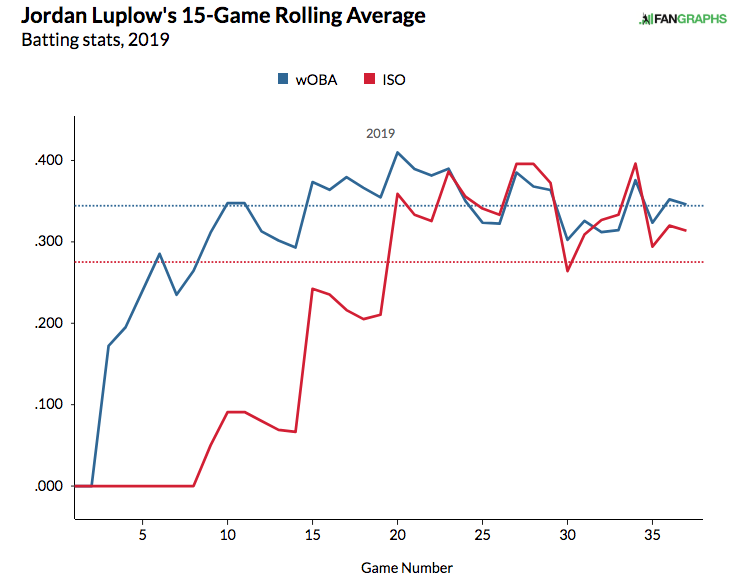
Luplow has seen a huge rise in both his ISO and his wOBA. Since his return from the minors (which only removes 17 PA from the equation), Luplow has slashed .255/.311/.574 with a 125 wRC+. His plate discipline numbers still aren’t great, but, for what the Indians need, Luplow has been everything they could have asked for.
In a year that has been disappointing for Cleveland, we should acknowledge the successes. Not everything has gone awry. Jordan Luplow probably isn’t going to be in the Home Run Derby, but he still remains one of the bright spots in this lineup, albeit a still relatively dim one. If you’re an Indians fan, that is worth celebrating.
Devan Fink is a Contributor at FanGraphs. You can follow him on Twitter @DevanFink.


His wRC+ against righties, on the other hand, is 22. The result of his terrible performance against righties (and subsequently, his relatively low number of plate appearances) is that this “success” for Cleveland has added 0.6 fWAR, and we’re about 40% of the way through the season.
For a number of reasons, I think it’s perfectly fine to ignore successes when they come on the short side of a platoon through mid-June.
Also worth noting that he’s hit 50% of his home runs this year against Manny Banuelos (in only 6.7% of his PAs). He homered against him twice on May 9th, once on May 14th, and once more on May 30th. Not sure he’s going to get many more chances to abuse Manny so he’s going to have to diversify.
I just looked at Manny B’s game log and learned that he has started the last 7 games he has appeared in, and has a FIP well in excess of 7 as a starter (it looks like 3 of the last 4 have been against Cleveland). There are guys who are DFA’d every other week who would be an improvement over that.
Extremely small sample size, but his wRC+ since Memorial Day vs righties is 127. Only 13 PAs though, so like I said – small sample size. But he doesn’t get the opportunity to play very often again righties because Martin is usually in CF with Naquin in RF and Mercado in LF. His success against lefties and recent adequacy against righties makes me wonder what would happen if they just let him play, though. As it is, while you’re right, 0.6 WAR through 40% of the season isn’t that much, if you can get a guy with 1.5 WAR in only 300 PAs, that isn’t bad at all for the small half of a platoon.
Jordan Luplow playing every day sounds like a really good development strategy for a team that isn’t likely to contend. If that 10 game deficit grows substantially then maybe they will.
I cannot believe I wrote that sentence.
Which part? The part about Luplow playing every day or the part about the Indians being unlikely to contend? 🙂
Yeah, I really never understood how Luplow got pigeon-holed as a platoon bat. His minor league numbers don’t show much of a platoon difference. And in 2016, when he was at A+, he actually hit righties substantially better than lefties. To be sure he hit poorly againat righties in his first two shots at the majors. But he also hit poorly against lefties during those two shots.
I have had the same question. People who say “he should never hit against RHP” obviously didnt look at his minor league numbers. His AAA numbers at Indianapolis show he was very competent against them. My concern is that his K% at the majors has been quite a bit higher than any of his minor league seasons, but I would like to see what he could do with a stretch of playing everyday.
Any chance he’s related to Al Luplow, who played in the 60’s, starting with Cleveland?
I believe that is his great uncle.
A former Pirate who is significantly better after leaving Pittsburgh? No way!
yeah like Ivan Nova
“Significantly” is overstating this a fair amount.
I guess I don’t understand the tone of this article. It seems like it is supposed to be complimentary but is rather backhanded, referring to him as a Quad A player, basically saying the only reason he should be celebrated is because he is in a lineup that is so bad, and calling him a bright spot that is relatively dim.
The guy is only 25 with good minor league numbers, and he was used sparingly at the ML level over 2 seasons with the Pirates. It isn’t crazy to believe that he’s a better player than the .194/.274/.371 he put up with Pittsburgh. He didn’t play well in those 190 PAs when he was 23 and 24 years old – that makes him a Quad A player? You mentioned he’s 5th in baseball in wRC+ vs left handed pitching…that is the 97th percentile. That isn’t good compared to the rest of a bad offense, that is good compared to all of baseball. His 113 wRC+ is tied for 119 out of 320 players with 100+ PAs, and the 125 wRC+ since he returned from AAA would be in the 70s out of 320. He’s done well, regardless of the people around him.
Look at it this way: his wRC+ of 125 since he’s come back to the majors is better than guys like Mookie Betts, Shin Soo Choo, Trevor Story, Javy Baez, Matt Chapman, Ronald Acuna Jr in the same timeframe – but those guys aren’t bright lights that are relatively dim.
Luplow is a corner OF with an OPS of .831 with no arm and limited range. He has value but it isn’t a ton. He’s a sub .800 OPS guy in PNC due to park dimensions and stuggles with the big OF in LF.
The prospect that the Pirates got back (Thomas) is one the FG guys really like. Could be a win for both sides.
What???
No arm with 8 OF assists in 632 innings of MLB play in the OF? That’s GG level assist numbers over a full season. He’s so bad of an OF, he can play CF at league average metrics. He has a sprint speed approaching 29 ft/s. The scouting report on Luplow is fictitious at best.
A 25 year old MLB ready OF who can play all 3 spots, has a rocket arm, above average speed, and hits for power compared to a 20 year old still in Rookie/Short A ball is not a comparable trade at this point. If it is the Indians are a clear winner since the Pirates and Indians also swapped replacement level Utility infield bats with about same OPS/wRC+ expectation in the same trade with the Pirates already having an MLB ready SS.
I get the sense that you might be a Pittsburgh fan that is trying to convince yourself that losing Luplow isn’t a big deal? MLB corner outfielders in 2019 have an OPS of .785, so being 50 points above average is valuable.
Per Baseball Savant his sprint speed is in the 88th percentile in baseball and he gets a better jump than 2/3s of other outfielders. He’s fast, gets a decent jump, and is a good route runner – he has range. Plus he’s been positive in OAA (Outs Above Average) there for 2018 and 2019, and Fangraphs has him with a positive DRS and UZR in limited duty both seasons.
And somebody else already mentioned the 8 outfield assists – maybe the word is that his arm isn’t that good and that’s why he’s had the opportunity for so many assists, but he’s shown that the arm is in the very least serviceable enough to get some assists when he gets the chance to throw someone out.
He’s just another guy regurgitating scouting report info about Luplow that sites like FG, BA, and others put out without doing any real evaluation on their own. It’s painfully clear Luplow’s arm is plus value defensively and probably should have been graded as 60 or 70 instead of 40 or 45.
Any Pirates fan who isn’t critical of this trade and is critical of the Archer trade doesn’t realize that trading Luplow after Polanco’s injury and after already trading Meadows put them in the roster crunch they have while also spending more money than they needed to. I as a Pirates fan could have handled the Archer trade on it’s own, but couldn’t figure out why in the world they traded Luplow after Polanco’s injury and the timetable following his surgery and then go out and sign the guys Luplow is essentially replacing in Lonnie Chisenhall for 2M and Melky Cabrera to a minor league deal. They could have signed Melky to a minor league deal who then gets the veteran minimum if he makes the roster and kept Luplow for less than they paid for Chisenhall.
One of the most noticeable things about his newest swing is that he appears to have reduced his leg kick greatly and his hand move a bit less before the swing initiates.