
After Some Tweaks, Rays Prospect Brayden Taylor Is Working to Put His Disappointing Season Behind Him
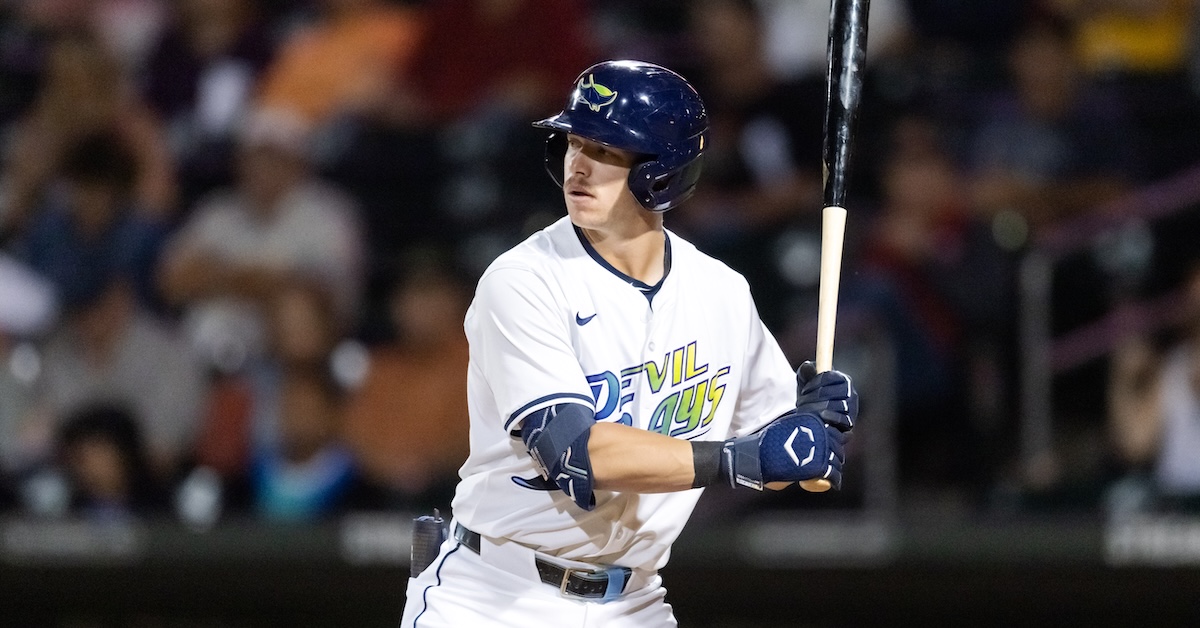
Brayden Taylor had a disappointing season. Ranked seventh when our Tampa Bay Rays Top 56 Prospects list was published last February, the 23-year-old infielder went on to slash .173/.289/.286 with eight home runs and a 77 wRC+ over 437 plate appearances with Double-A Montgomery. It was a precipitous fall from the previous summer, when Taylor homered 20 times with a 143 wRC+ between High-A Bowling Green and the Double-A Biscuits.
I asked Taylor, a 2023 first-round pick out of Texas Christian University, about his lackluster performance in the early weeks of the Arizona Fall League season, where he was suiting up with the Mesa Solar Sox.
“Sometimes in baseball you just get a little bit out of sync,” said Taylor, who rallied to the tune of a .264/.400/.472 line in the hitter-friendly AFL. “Your sequence doesn’t feel good. Your body doesn’t feel good. Your mentality isn’t the greatest. I just didn’t have my best year at the plate.”
His balls-in-play luck going in the wrong direction played a part in that. The West Jordan, Utah native saw his BABIP plummet from a healthy .322 in 2024 to a wholly frustrating .229 in 2025. No qualified hitter at or above his level of the minors had a lower mark. While quality of contact was undeniably a factor — not squaring up the baseball has its consequences — such a precipitous slide is nonetheless both uncommon and cruel.
It is also worth noting that Taylor didn’t become increasingly whiff-prone or lose his grasp of the strike zone. His 14.0% walk rate and 27.7% strikeout rate were nearly identical to what they were a year prior.
Taylor didn’t bemoan his poor fortune when I mentioned the BABIP-decline that accompanied his basically unchanged walk and strikeout rates. Instead, he elaborated on having been out of sync.
“At the beginning of the year, I actually felt pretty good,” Taylor told me. “I was making outs, but I was in the right ballpark. Then I kind of started searching for things that I didn’t need to search for. That’s when I started getting out of whack, out of sequence. I was trying to search for results when what I should have been doing was trusting the process. But I did start to make some physical adjustments in the box toward the end. We saw some progress. I started playing some better baseball.”
The tweaks, which were prompted by his coaches and coordinators, centered on how he rotated out of his load.
“The biggest thing we focused on was my hip line,” explained the lefty-hitting Taylor. “My hips were staying too far uphill with my leg lift. Instead of bringing my leg straight up and down, we worked on bringing it to my midsection to keep the hips online so that I can be in a better position at launch.
“Doing that changed my bat path,” he added. “Instead of my body being so uphill, and the bat just coming up and out of the zone, the adjustment allowed me to stay in the zone a lot longer. The bat being in the zone a lot longer is what I want. I want to be able to hit through seven baseballs, not come up and hit only one of them. Right? I want to have that adjustability to be able to stay through it and hit as many balls as I can.”
And again, squaring them up for hard contact on a more consistent basis is a must. Taylor clearly has the tools to do that — he was a first-round pick for a reason — so it’s a matter of his mechanical adjustments bearing fruit. Ditto his ability to clear the mental hurdles that every player faces in this game of failure. To Taylor’s credit, he recognizes that development isn’t linear, and that sometimes you need to go backward in order to go forward.
“It is very apparent that I didn’t have the year I wanted to,” said Taylor. “But I’m also grateful to have had it, because I would rather go through some changes and learn how to deal with the failure. That’s a big part of this game, continuing to make adjustments and being able to deal with adversity. I’m excited to continue working — that’s why I’m out here [in the AFL] — and take the work into next season.”
Count Erik Neander among those who remain bullish the youngster’s potential.
“He was a player that the entirety of our major league staff loved him when he came over,” Tampa Bay’s president of baseball operations told me. “Well-rounded, the low heartbeat, the offensive potential. It just didn’t happen for him this past year. He got off track and couldn’t really recover, but he hung in there. It’s part of the development process, part of growing up as a player. Brayden needed to make some adjustments, and we’ll see where those take him. [The 2026 season] will be big for him.”
David Laurila grew up in Michigan's Upper Peninsula and now writes about baseball from his home in Cambridge, Mass. He authored the Prospectus Q&A series at Baseball Prospectus from December 2006-May 2011 before being claimed off waivers by FanGraphs. He can be followed on Twitter @DavidLaurilaQA.
Not the only Rays prospect to struggle at large last season. It’ll be a pretty substantial make or break campaign for half of our higher end prospects (Isaac, Taylor, Carson, and the majority of our worthwhile arms).