
The Relationship Between Framing and Blocking
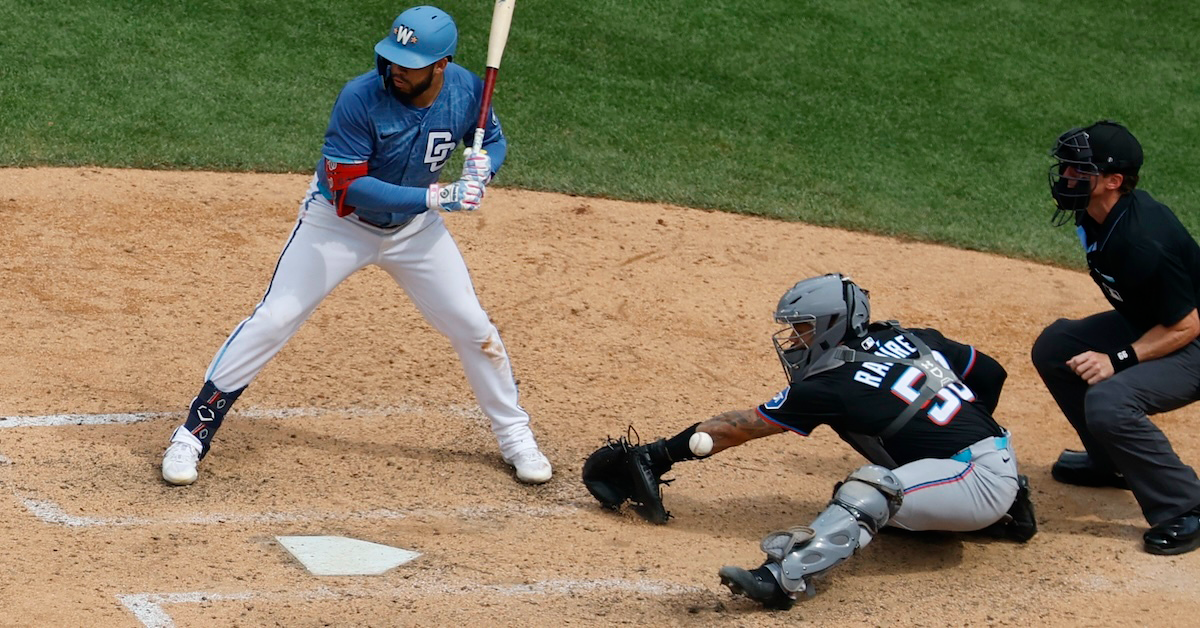
On Monday, Michael Rosen wrote a fun article about catcher blocking. He didn’t just write about it; he created his own blocking metric from scratch in order to grade every catcher in the game and to understand how much value a single block or passed ball can carry. The whole article is excellent, but one piece in particular caught my eye. Michael put together a supercut of Agustín Ramírez’s passed balls, all of which shared a theme. They weren’t the pitches in the dirt that you’d expect to end up as passed balls. They were normal pitches on the edges of the zone, ones that Ramírez tried so hard to frame them that he ended up missing them entirely. Michael drew the obvious inference: His framing focus, I believe, may have led to some of these inexcusable passed balls. At the risk of piling on, here are the pitches in question:
I’m so sorry, Agustín. This is brutal, and it makes Michael’s point very bluntly. It also makes me wonder about the relationship between the framing skill and the blocking skill. Does selling out to be a better framer hurt your blocking? Clearly, it can and at least sometimes does for Ramírez, but it still doesn’t strike me as a particularly likely hypothesis overall. Moreover, even if framing does hurt your blocking, the trade-off would certainly be worth it.
Statcast’s numbers indicate that one block above average is worth roughly a quarter of a run, a much bigger swing than the average called strike. That makes sense because a block or a wild pitch lets a runner move up a base. Blocking opportunities also come around more often than framing opportunities. In 2025, Statcast indicated that we saw 60 takes in the shadow zone (the edge of the strike zone) per game. That’s 30 chances per game for each team’s catcher. Statcast also classified pitches as blocking opportunities, and it identified 39.7 per team game. That’s a lot more chances, nearly 10 more a game for each catcher.
However, although catchers have more blocking opportunities (or as the kids call them, blockportunities), wild pitches and passed balls just don’t happen all that often. We saw only 0.34 per game. The average blockportunity has a higher than 99% chance of getting blocked. Alejandro Kirk was the best blocker in baseball in 2025, and he racked up just 0.19 more blocks per game than the average player. On the other hand, Austin Hedges ran the best shadow zone strike rate in the game at 48.6%. The league average was 42.2%, and if we do a little arithmetic based on his 1,595 shadow zone takes over 479 2/3 innings, we see that he earned 1.9 extra strikes per game. That’s 10 times the number of blocks per game that Kirk saved.
So while you have a lot more opportunities to block the ball, the actual variance between a good framer and a bad framer is a lot higher on a per-pitch basis than the difference between a good and bad blocker. In terms of overall value, Patrick Bailey’s league-best 25 framing runs trounced Kirk’s league-best five blocking runs. If you had to pick one skill to be good at, you’d choose framing every time. Moreover, if there were a correlation, the number of extra passed balls that would come with being a good framer might be so small that we might not notice them unless we ran the numbers.
Luckily, you don’t have to choose one. I ran the numbers, pulling career blocking and framing numbers for every catcher with at least 5,000 pitches caught from 2018 to 2025. That left a sample of 125 catchers, and I broke their numbers down on a per-opportunity basis for blocking and per-pitch basis for framing. The correlation coefficient between framing runs per pitch and blocking runs per opportunity is .44. That’s a positive correlation, which means that good framers aren’t bad blockers. In fact, it’s just the opposite.
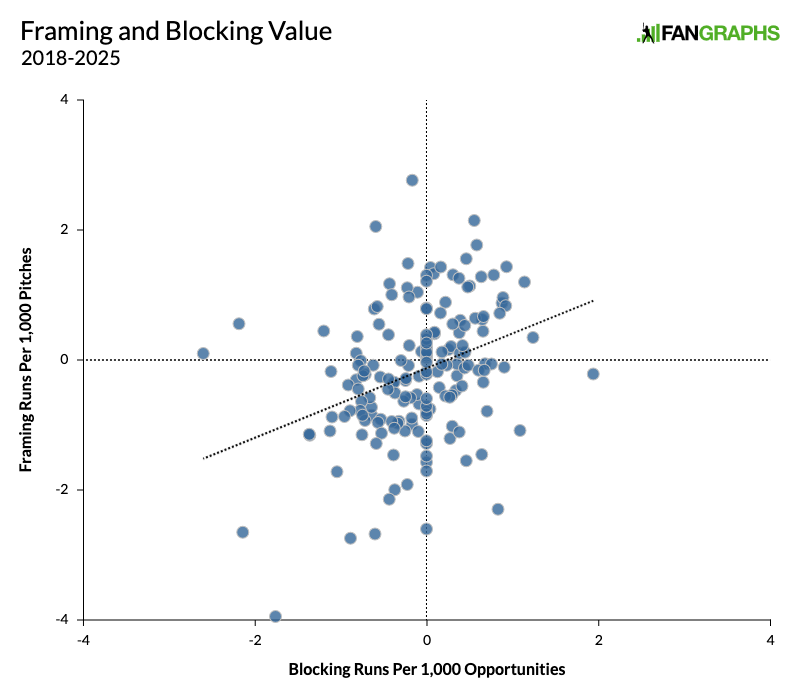
In the scatter plot above, 72% of the dots are in either the upper right or lower left quadrant (or on a borderline). That is to say that most catchers are either good at both framing and blocking or bad at both. It’s not all that common to be great at one and bad at the other. Pitch framing is absolutely a hyper-specialized skill, but not so much so that it’s completely divorced from the rest of a catcher’s job. If you’re good at catching the ball in such a way that you can rack up framing value, you’re probably just good at catching the ball period — or, at the very least, at keeping the ball in front of you.
That said, when breaking down the numbers for different parts of the zone, we can see some differences. While you don’t have to choose between being a good framer and being a good blocker, where you choose to focus your framing abilities matters at least a little. Unsurprisingly, the blocking skill is most strongly correlated with being a good framer at the bottom of the zone and least strongly correlated at the top. There could certainly be some selection bias here. Catchers who receive more balls at the bottom of the zone (maybe because their pitchers tend to throw more breaking or offspeed stuff) will naturally be better prepared for all those low pitches. They’ll be better at both blocking and framing them. It’s intuitive enough, and it’s really hard to be a good receiver in all quadrants of the zone.
| Overal | Top | Bottom | Left | Right | Heart | Chase/Waste |
|---|---|---|---|---|---|---|
| .44 | .19 | .26 | .21 | .22 | .27 | .20 |
Still, the strongest correlation to blocking in the table above actually comes on pitches over the heart of the plate. Once again, players who receive the ball well tend to block well too.
Even so, I did find one spot where the numbers did show a slight negative correlation between framing value and blocking value, and it’s exactly where you’d expect it. If we limit our sample to the players who have caught at least 20,000 pitches, we end up with just 51 players. For these players with the most robust individual samples, the correlation coefficient between blocking and framing at the top of the zone is -.07. It’s extremely weak, but it is a negative correlation, meaning that players who are better at framing at the top of the zone do tend to be worse at blocking.
I’d also note that we see more framing opportunities at the bottom of the zone than the top, and that’s been true in every year since Statcast started compiling framing numbers. Combine that with whatever small blocking bonus comes with being a good framer specifically at the bottom of the zone, and you can understand why one-knee-down catching has completely taken over the sport. Focusing on the low pitches just seems smart. More importantly, the automated ball-strike system is coming in 2026. While it looks unlikely to obliterate the value of framing, we don’t really know how it will affect the game at the big league level. Should framing value take a hit, the value of blocking and preventing stolen bases could start to catch up.
Davy Andrews is a Brooklyn-based musician and a writer at FanGraphs. He can be found on Bluesky @davyandrewsdavy.bsky.social.
This is phenomenal stuff. There’s intuitive sense in the relationship between framing at the bottom of the zone and blocking. I think it makes sense that there’s more room for framing a pitch at the bottom of the zone (where the ball is further from the eye-level of the umpire) versus the top (where it is generally coming right at them).
Something that I think will be worth keeping an eye on as move into the ABS challenge era is which pitchers and which catchers are having the most challenges (and the success rate thereof) called against them. Is it the top class of framers or is it guys who were shaky to begin with? Because the hitter can also potentially get fooled by an astute framing job — I imagine most hitters have some sense, even if not exact, of where the catcher is set up and how much they’re moving around. If you’re “quiet” back there, that might just be the difference between a hitter thinking that the catcher yanked it back or maybe it just was a really good pitch.
I am very curious to see how it plays out from a skill set point of view (who is correct most frequently), a game theoretical point of view (I was still thinking about running some numbers on this), and how it affects strike zone outliers (think Aaron Judge or Jose Altuve).
This is great stuff!
I wonder if we can try to measure if catchers emphasize blocking vs. framing depending on game status?
It’s not clear which way that would go. If I were a catcher and I’m looking out at loaded bases, would I lean more toward trying to steal an extra strike (decent probability, small improvement in status), or would I try to make as sure as possible that I don’t let a pitch go wild (low probability, but complete disaster)? Or maybe it depends on the current score?
It’s also possible that we don’t have enough data to tease out any effect, which would be small if it exists.
I’d love to see some questions around that make it into David Laurila’s interviews with players. I bet catchers have thoughts about this!
“In the scatter plot above, 72% of the dots are in either the upper right or upper left quadrant (or on a borderline). That is to say that most catchers are either good at both framing and blocking or bad at both.”
I think you mean lower left, not upper left
Jeez louise. Thank you for catching this. I’ve fixed it.
For all the talk about framing and blocking I am constantly amazed at their ability to reach, very high and very wide, and pluck a 98 mph heater, with movement, out of the air. Catching is incredibly hard and it is a pleasure watching great defensive catchers . There are many other reasons why I value catching as important as SS and CF on the defensive spectrum and team results is foremost amongst them. When a team is a consistent contender it very often coincides with there being a long term catcher on the roster. Berra, Campanella. Freehan, Bench, Posada, Varitek, Mauer, Posey, Molina, Smith were all with their teams for many years. I think each of these stars, except Smith, played at least 10 years with the same organization and provided that special something that kept their teams at or near the top.
A nice day for an outdoor gathering in your neighborhood is a blockpartytunity
The framing statistic needs some further understanding. Essentially, a catcher is given credit for a pitch outside the zone that is called a strike.
“Should framing value take a hit, the value of blocking and preventing stolen bases could start to catch up.” The purpose of the ABS system is for framing value to take a hit, to minimize and to rectify incorrect calls. The only reason framing data may not take a significant hit is that the ABS system will correct all incorrect calls (assuming they are challenged), while the framing data apparently analyzes only incorrectly called strikes. (See #2 above.) Even so, framing value is going to take a hit, the only question is the size of the hit. And it’s not just the challenged calls that are going to affect the framing data. As seen this past season, when the margin for error for umpires was decreased, the umpires are going to get less calls wrong.
What happened this past season was the umpires traded some fraction of incorrect strike calls for a lot more incorrect ball calls.
For the entire Statcast era, the percent of called strikes in the Statcast shadow zone hovered between 45.9% and 48.5%, with 2023 and 2024 sitting both a little above 46%.
Last season, it was 42.2%. Even given the established variance over a decade, that’s a huge difference.
For taken pitches that Statcast classifies as shadow zone and in the zone (you need to use both the Gameday and Attack Zones together to pinpoint this), the rate of called strikes dropped from 81.1%, where it had been for a few years, to 77.3%, which was the rate around the beginning of the Statcast era.
The called strike rate on shadow zone balls had been steadily decreasing across the decade from 25% down to around 18% by 2024. Last year, it was 13.8%.
Umpires did not improve their correctness. The league decided to shift the “margin for error” to significantly favor calling balls over calling strikes. We can argue about why or whether they should, but the numbers are what they are.
Sure, we only have a decade or so of well-measured data to test against, but season-to-season spikes just didn’t happen over this time. Except for last year, when we know the league publicly admitted to the adjustment to the buffer zone, which shifted from a box entirely outside the zone, to a smaller box straddling the zone boundary.
This article got me wondering: which baseball skills *do* trade off? The article points out that you might *think* blocking and framing would trade-off, but at a broad-brush level they don’t, apparently because “catching pitches” is a real skill that some catchers are better at than others, and that skill is useful in *both* blocking and framing. Whatever trade-off exists between blocking and framing, it’s quite weak and only shows up between blocking and one very specific sub-type of framing.
So, does that principle generalize? Like, is “general athleticism” (or maybe “general baseball playing ability”) a skill that’s useful to everything ballplayers do? If you did a giant principal component analysis of all baseball performance metrics, maybe you’d find a first principal component that basically says “more athletic players are just better at everything”? So that, if you wanted to find trade-offs between different skills, you’d have to control for general althleticism?
Thinking about it a bit, I guess there *are* a few super-strong trade-offs between baseball skills. I mean, so strong that they’ll show up in the data even if you don’t control for general athleticism. The most obvious trade-off is between pitching and hitting. There are just two kinds of professional ballplayers: position players (good at hitting, bad at pitching), and pitchers (good at pitching, bad at hitting). Which is what makes Ohtani so amazing–he’s an exception to the single biggest, most obvious trade-off in baseball.
I guess there’s also a trade-off between defensive ability and hitting ability, which I suppose might come down to size and build? Shortstops and centerfielders as a group are the smallest players, the best defenders, and the worst hitters, whereas first basemen and DHs as a group are the biggest players, the worst defenders, and the best hitters. But that seems like a much weaker trade-off than the trade-off between pitching and hitting.
But I’m having trouble thinking of any others. For instance, everybody talks about how some pitchers are natural pronators while others are natural supinators, but I dunno–do the data say there’s actually a trade-off there? Or is it another case like catcher framing vs. blocking, where any trade-off is actually pretty weak and only shows up if you control for a bunch of other variables?
For an overwhelming majority of hitters contact vs power trades off at some non zero rate
Yes, absolutely–within individual hitters. Which is my point. If you look across hitters, the trade-off becomes much weaker, though I haven’t checked if it goes away entirely. Presumably, the trade-off looks much weaker if you look across hitters, because some hitters are just better than others at everything that goes into hitting.
Pitcher stuff vs. control/command: the more your pitches move, the harder it is to land them exactly where you want.
Contact vs. power: there’s some pretty strong evidence that without either top-of-the-scale strength or unbelievable bat control, you’re generally getting one or the other, not both.
I’d say defensive positioning isn’t quite so binary, and it’s definitely more of a strategy tradeoff versus a skill/ability one, but in the peak shifting era, it was clearly a game theoretical choice between continuing to pull for power and cutting down your swing to try to guide the ball to the opposite field.
Thinking about it further, I’d guess all trade-offs are weaker (or even non-existent) at lower levels of baseball than they are in the majors. For instance, two-way players aren’t all that rare in college, and in high school the best player on the team often is the best pitcher, the best hitter, and the best shortstop.
Makes sense to me that the tradeoffs would become more acute when the talent band narrows. When the task in question is more difficult, it’s logical that specialization (which is a tradeoff in its own sense) would help.
What pitchers throw and how well they command their pitches also matters. I once saw a curve thrown in the middle of the strike zone called a ball. It was supposed to be a chase pitch, but missed badly. Salvy had to change his stance to catch it cleanly. What umpires see is the flight of the pitch, but they sense catcher shifts.
The trade-off is that catching is such a difficult skill that those who can do the job defensively do not need to hit to be of value to a team. Can anyone imagine a player like Martin Maldonado being an everyday player on a World Series winning team at any other position or Jeff Mathis playing for over 15 seasons with a lifetime batting average below .200. Teams are forced to use these one-dimensional players because there are so few who can catch and hit. Shortstops who can field, however, are available, in large numbers, from Seattle to San Pedro de Macoris and the hit tool plays a much larger role in their value. Catching is unfairly treated because the demands of the position are too difficult for most to achieve. Two players come to mind instantly when I think of catchers whose careers have been misinterpreted, Lance Parrish and Jorge Posada. Lance Parrish, with 3 Gold Gloves, 6 Silver Sluggers, 8 All-Star games, a WS championship and 324 HR’s, 5th all-time among catchers, got exactly 1.7% of the vote in his only appearance on the ballot. Posada was guilty of being on a team with so many stars that he was overlooked but he was a tremendous player in his own right. 5 Silver Sluggers, 5 All-Stars, 2 top 10 finishes in the MVP voting along with 4 WS Championships and an .846 career OPS+ is also worth more than a one and done. I hope Salvador Perez is seen as the great player, and team leader, that he has been for 14 years and is not snubbed in a similar manner.
Exceptional article. The exact kind of gold standard statistical analysis I come to this website for: take a common baseballism and expose the degrees of correctness
Fantastic article! I would guess that part of the reason for the correlation is that you can’t really frame a pitch if you didn’t catch it at all, and by missing it you might have made it look more like a ball. I’d bet that passed balls are a lot less likely to get called strikes than similar pitches with similar movement and location that did get caught.
Quick search on Statcast pulls up 22 pitches last year that registered in the strike zone, were passed balls, and were called balls. Thankfully, none of them registered as middle-middle.
That’d be a good place to start searching for comparisons — the search I used used the “Flags” option to mark Passed Ball, used the Gameday zones, and looked for pitch result: ball or ball in dirt (just in case?). You could easily pull that over the whole Statcast set.
Could there be a selection effect here? Like, blocking and framing are both part of defense. And, in order to get into MLB, you either have to be good at defense, or good at offense, or some combination of both. And so there tend to be bad defensive players who are bad at all aspects of defense (but are good enough hitters to make up for it), and good defensive players who are good at all aspects of defense (to make up for their lousy offense).
Like, I remember reading a really cool explanation many years ago about how, e.g., power hitting and contact hitting aren’t really as opposed to each other as they seem. the things that make you good at one also tend to make you good at the other, if you look across the entire population of everyone who plays baseball. It’s just that, in MLB, we cut out all the people who are bad at both from the sample.
That’s Berkson’s Paradox, where two positive traits that aren’t correlated in the wider population look negatively correlated at at the far right edge of the distribution. Classic example is thinking your options in the dating pool are either hot/boring or homely/charming— only seems that way because you ignore all the homely/boring people.
It shows up a lot in sports once you know where to look for it, because you have to clear a really high threshold to make it to a pro league. The weak negative correlation between framing and blocking at the top of the zone seems to be another example.
Ruiz of the Nats is a bad framer and blocker. But above average at base stealers. Overall his defense is terrible. So I suspected they were not opposites.
I’m not sure this really disproves the argument that there is a tradeoff to be made here. Showing that on average better blockers are better framers and vice versa is one thing, but that doesn’t inherently mean there isn’t a tradeoff. A great linebacker is good at defending the run and the pass but he still has to make tradeoffs every play as far as how aggressive he is. Math and Reading SAT scores are generally positively correlated becuase both are driven by common traits, intelligence, work ethic etc. but there’s clearly a tradeoff in how you focus your study time and attention. Framing and blocking could be like this. Augustin Ramirez generally seems to be a below average defender, he’s also seemingly chosen to try to minimize framing weakness and take the L on passed balls. Under a different set of choices he might be below average at both instead of okay at framing and terrible and blocking.
I’m not sure how you’d really measure this tradeoff question.
I’d be curious to see similar blooper rollups of other catchers. A lot of the clips in that supercut are pretty harsh crossups, even though the pitch ends up being close to the zone. Is it that much of a demerit just because the pitch ended up in the shadow zone when it was down and in, even though the catcher was calling for high and away?