
Anthony Rizzo, Bruised Into History
This season, Anthony Rizzo has obliterated 30 baseballs into the seats for home runs. As of last night, in perfect symmetry, 30 baseballs have exacted revenge for their wounded brothers by hitting Anthony Rizzo. This is a rare accomplishment. Is this an accomplishment? This is a rare accomplishment.
Until now, only one player had ever before reached that particular 30/30 threshold — Don Baylor, in 1986. That year, he knocked 31 dingers, and was hit 35 times. Over his career, he hit hundreds of homers. And he was hit by hundreds of pitches. He’s fitting company. If you want to make Rizzo more special, he’s also exceeded 30 doubles, which Baylor didn’t, so now by those terms Rizzo is the first-ever 30/30/30 player. Anyhow, going back to the original 30/30 terms, if you loosen the restrictions, there have only ever been six 25/25 player seasons. In 2004, Craig Wilson slugged 29 homers, and was slugged by 30 pitches. He came painfully close to belonging in the Baylor/Rizzo tier. Maybe that year he was robbed of a home run. I don’t know, so I’ll pretend, to aid the narrative. Craig Wilson: almost historic. Too bad.
Rizzo, of course, has picked up on the hit-by-pitch frequency. It’s hard not to notice an uptick in getting hit by baseballs. His stated preference would be to stop getting hit by baseballs so much, but he hasn’t been convinced to change anything about his behavior, so this is just a thing that’s going to happen. He’s gotten pretty good about taking these things in stride, and yesterday, after he was hit for the 30th time, he smiled at his own dugout, which isn’t how people ordinarily respond to abuse.

Oh, sure, he’s been mad about getting hit sometimes, but he’s not that much of a jawer. He understands that these bruises come with the territory, and he knows pitchers are usually just trying to establish the inner bit of the plate. Without intent, it’s just a mistake, but what a series of mistakes. To put Rizzo’s season in additional perspective, I pulled some FanGraphs data stretching back to 2002. For each individual season, I took all the qualified hitters, and I calculated z-scores for their rates of home runs per pitch, and their rates of hit-by-pitches per pitch. Below, Rizzo’s 2015 is obviously highlighted.

It’s the right-most point in the plot. The home runs are present, but by no means exceptional. The hit-by-pitches are exceptional. A simpler way to think about this, if you’re not a fan of mentally processing z-scores: Rizzo leads baseball by having been hit 30 times. The guy in second place is at 21. Third place is a two-way tie at 17. Rizzo is blowing the competition away. There’s no ongoing race for the hit-by-pitch title — it’s Rizzo’s, and it’s been Rizzo’s for an awful long time.
Rizzo’s power is nothing new. That’s been his selling point, even going back to his performance in the minor leagues. If you were thinking about him before the year as a 30/30 threat, the homers would almost be a given. The hit-by-pitches are the real surprise, superficially. Rizzo’s been an everyday player three years in a row. Between 2013 and 2014, he more than doubled his hit-by-pitch rate. Between 2014 and 2015, he’s doubled it again. Usually, players don’t double statistical rates without a good explanation. This one’s easy to explain. Rizzo batting in 2013:
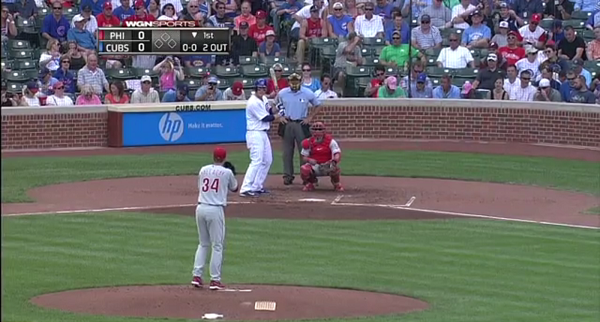
Rizzo batting in 2014:

And Rizzo batting in 2015:
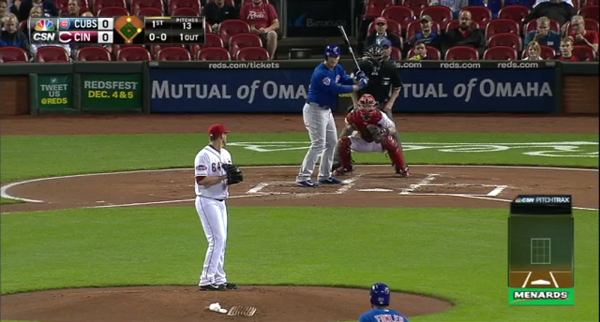
He’s moved much closer to the plate, where now his back foot is touching the inner chalk line of the box. It would be hard to crowd the plate any more while staying within the boundaries of the official rules. Moving closer has been a conscious decision on Rizzo’s part, and that’s one of the reasons he can’t get too mad about the beanballs — in a way, he’s brought this on himself. If he wanted them to stop that bad, he could back away. He’s not backing away, so, that’s effectively a green light.
The biggest change happened between 2013 and 2014. I don’t know how much of a difference there is between the last two years, in terms of Rizzo’s stance, but some of the increase could just be randomness. And there’s also the matter of Rizzo now being firmly established, so he’s the most likely Cub to be targeted for hit-by-pitch retaliation. Rizzo counts as a big-time vet now. So that’s another little boost to his numbers. He’s allowed to protest the intentional beanballs. The others, he should and does just take.
Over the three years, pitchers have only slightly moved away from Rizzo. In 2013, they threw 15% of their pitches inside, off the plate. This year, they’re a hair over 13%. They don’t want to lose that side of the plate, so, again, hit-by-pitches are going to happen as a consequence. Where has Rizzo been hit? Baseball Savant can help with this. Here’s a screenshot of Rizzo’s stance:

Now let’s fold in the balls that’ve hit him with some really terrible attempted photoshop:

There’s activity almost everywhere, but, thankfully, nothing doing above the shoulders. You get a bit of knee and shin action, but it’s more concentrated about Rizzo’s elbow, which also means his back assuming he turns away. Headshots aside, the greatest risk of a hit-by-pitch is getting struck in the hand, but to this point Rizzo’s been more or less able to avoid that. So he gets his bruises — it’s impossible not to get bruised — but he can protect himself from fractures. Getting hit a lot guarantees pain, but it doesn’t guarantee stints on the DL.
Since this post began by talking about hit-by-pitches and home runs, let’s also mix in the dingers:

The colors are obnoxiously similar but just by thinking for half of one second you should be able to figure out which of those dots were one base and which were four. By standing close to the plate, Rizzo allows himself to extend his hitting zone away, but that doesn’t mean he’s vulnerable in. He’s currently posting a career-high slugging percentage against pitches inside from the middle of the plate. He can cover almost everywhere, which is most of what makes him so dangerous.
Without showing photographic evidence, I can just tell you Rizzo stands closer than his other left-handed Cubs teammates. Kyle Schwarber looks similar, but he’s still a few inches back, and that can make all the difference. To close out, here are this season’s left-handed hit-by-pitches, with Rizzo in black and the others in light gray:

It’s not like Rizzo is way closer than everybody else. It really is just a matter of inches. But you can see most of the black dots a little closer to the plate than the rest of the dots. You get an image of where Rizzo stands, and you get an image of where the average lefty stands. It all makes sense. In this way, hit-by-pitch totals are highly predictable. All you need to know is a guy’s stance, and how willing he is to chase soft stuff away. Or, anything that tells you how a hitter is likely to be pitched. Mostly, it’s the stance.
I mentioned earlier that Rizzo leads baseball in hit-by-pitches, 30 to 21. The player with 21 is Brandon Guyer, and Guyer has seen half as many pitches as Rizzo has. Guyer, then, is even more extraordinary in his getting-hit-a-lot-ness, but Guyer’s also hit just eight home runs. One day, maybe he’ll get his own post. But today belongs to Rizzo — not because he excels in one category, but because he excels in an unlikely pair.
Jeff made Lookout Landing a thing, but he does not still write there about the Mariners. He does write here, sometimes about the Mariners, but usually not.
Oh yay, another one!
Just went you thought 3 articles in 2 days was nice, we get blessed with a fourth! Yay!
A team either has to be really good or particularly horrible to earn such a streak on Fangraphs. For the first time in a long time for the Cubs, it’s the former and not the latter. Let us have our sweet moment now, in case some messed up, against all odds, asinine thing happens and ruins it.
Tomorrow on fangraphs:
Kyle Schwarber, More toppings than Piazza
Arrieta; even Jesus Couldn’t Do this
Jorge Soler; Sun affects Jorge’s power
For the record, I don’t like when fangraphs ambushes us with 3-4 pieces in a day or two about any team. I like diversity, and besides some of the Cub articles just being poorly done (see the Addison Russel one), I just get tired of reading about the same group of guys repeatedly.
Ambush? As in “A surprise attack by people lying in wait in a concealed position”? Rather than “generously provide us with free and largely useful analysis”?
I don’t get why people expect to have an even distribution of articles amongst the 30 teams. Right now, as in with less than a week left in the entire grueling season, the Cubs are one of 5 or so teams even worth writing about.
Of course, if this free content isn’t up to snuff, I supposed you could, you know, just NOT READ the damn articles…
To be fair, the Cubs have a lot of interesting players, but didn’t draw much attention during the first half, so it makes sense that they’re getting attention now that they are in the spot light. However, 4 in 2 days does seem a bit much. Regardless, I have to congratulate you on your fake titles. Except Soler’s, that joke has been beaten dry. Instead Soler: Power potential equal to nuclear fusion, Soler: Flaring through the majors, Soler: A G-type player, or Soler: A panel discussion would have been better.
and gay ozzie guillen crying like a schoolgirl
I read the articles; as I do most things on this site. What I always found interesting was how personal people take it when a commenter expresses some degree of displeasure with a piece.
What I also find interesting is that 5 teams are worth writing about, yet 10 make the playoffs. Very bizarre.
Coming up with content daily is the most difficult part of this job; I understand that fully. I do think it would be in fangraphs best interest if writers talked about what they plan on writing about on a given day; that is not unheard of in this industry.
I enjoy reading fangraphs. I enjoy commenting. I enjoy interacting with the readers of fangraphs as well as the authors. I don’t take this personally or seriously; I’m here for the information and the entertainment and I’m always going to voice my opinion in regards to what I believe makes fangraphs a more enjoyable place for everyone who visits.
What people dislike about your comment is that your displeasure stems not from the actual article, but from the subject of the article. If you want to say this article sucks and is poorly written, that’s one thing (and you would be wrong, because no Jeff Sullivan articles suck), but you seem to only be upset because of what it’s about. It’s not even about the Cubs. It’s about Anthony Rizzo, who happens to play for the Cubs. It has nothing to do with his Cub-ness. It’s kind of like being a racist, except with baseball teams.
WHERE ARE THE PADRES ARTICLES?! I NEED TO KNOW MORE ABOUT JEDD GYORKO.
Trying to analyze how close he stands to the plate with HBP placement is like trying to analyze how hard a guy hits the ball by looking at his average home run distance. You’re really just cutting of a piece of the distribution based on the arbitrary criterion that they got hit or that they hit past, respectively. What matters is the frequency.
It’s also instructive to look at Rizzo’s strike zone. As he’s crowded the plate, he’s getting more pitches on the inside corner (or just off it) called balls.
Is he also getting more pitches on the outside corner (or just off it) called strikes…?
Doesn’t the very outside corner get called on most lefties anyway? Still an interesting question, but if he’s managed to make the strike zone a little bit fairer by reducing inside pitches that are called strikes and keeping the outside boundary (which is, as I understand it, already a ways off the plate) the same, this becomes very interesting.
A lot of people think that guys who stand close to the plate are susceptible to inside pitches, but it’s usually the opposite. They’re standing closer because they can handle the inside pitch easier than the outside pitch. So the strategy is usually to pitch them off the plate inside and on the plate outside – which leads to HBPs.
It depends on the hitter. Some crowd the plate to reach that outside pitch, but some are just trying to take away the inside corner. I once played a team (When I was in middle school) who in the middle of the game started to stand almost right on the plate. They were trying to get any pith on the inside corner called a ball.
Or they might stand close to the inside corner because they can’t hit the inside pitch and focus on barreling up the outer half. Anything inside corner can be taken for a strike, called a ball because it’s “close to the batter”, or if it’s a little inside taken for a HBP and the free base.
I would say it varies on the hitter and their ability to get their hands “inside”.
We know from research, that a fastball inside requires a quicker batter reaction because the barrel has to travel farther.
——————————
This year during the LLWS (bear with me), Mexico’s batters were standing right on top of the plate and literally striding in front of the plate (out of the batters box) because anything inside would hit them and they could cover all of the outer half with the barrel. How the opposing coach didn’t jump all over this is out of my understanding.
————————————-
Also, by standing so close to the plate, it’s possible that Rizzo takes away breaking ball opportunities from LHP’s as well … or forces them to get more plate.
Futher explanation …
A batter, when standing close to the plate, can actually “turn away” (show his back) to the pitcher on an inside pitch and actually have parts of his body closer to the plate than when he started.
So, while it appears they are “turning away”, they are actually “turning into” an inside pitch by making their front hip and/or shoulder finish closer to the plate.
I cannot speak for the professional levels, but at the college level this was done and not done on accident. As a former pitcher, it used to piss me off greatly.
I don’t, at all, expect batters to have to jump out of the way of a pitch because then batters would be taken advantage off with lots of pitches that start inside and break toward the plate … but by the same token, we need to make sure that they are not just taking away the inside corner … but the pitcher’s ability to “pitch inside effectively”, which also includes throwing pitches off the inside corner but not in the vicinity of where the batter could reasonably be expected to stand. “From inside corner to belt buckle” is likely too much give to the pitcher in regards to “pitching inside effectively”, but the pitcher needs to be able to throw balls out of the zone, off the inside corner, (especially when ahead in the count) without undue risk of the batter turning “into” the pitch.
But there’s a rule against getting yourself deliberately hit by a pitch, and if I was an opposing coach, I’m thinking there’s at least a few times I’d be calling for that rule to be enforced against Rizzo.
In the office, we have decided that we need a new metric to accurately track Rizzo’s performance this year: HBS (Hit By Strike).
HBP are fascinating to me. Some players just seem to enjoy a higher pain threshold and/or greater disregard for their body than others.
Some also wear +2 plate mail whilst batting.
The Cubs had shirts made for this.
http://www.cbssports.com/mlb/eye-on-baseball/24643711/photo-cubs-playfully-troll-anthony-rizzo-with-t-shirts
First time I have read your excellent reports (invite from my brother), but I’d like to know how valuable are guys that foul off a lot of pitches. I’m sure Rizzo does, as I think Werth does of the Nationals. The more they foul off, your team gets to the other bullpen a lot quicker. Sort of an unsung hero who never gets the credit.
I don’t know how much of an effect it would have, but Rizzo last year was not anything special in this area, fouling off 52% of pitches he made contact with. Werth was actually below average, only fouling off 47% of pitches he made contact with.
those 17 steals are what really amazes me, and Goldy’s 21 for that matter.
Carlton Fisk stole 17 bases in a season…TWICE! Anybody can steal 10+ bases in 162 games (if they try).
There is no reason for any MLB regular to not have 10 SB and if they have any speed at all they should easily have 20 SB.
Carlos Santana also has 11, or what it’s worth.
Much of it also depends on how often they’re given the green light to steal (or attempt to). Not many players get all green light all the time.
Well, the important thing’s not the total number but the percentage. I think the break-even point in terms of runs gained/cost on the basepaths is around 72% success rate, right? I know there have been articles on it before. Sure, every Major Leaguer could probably get 10 steals if they tried. But if it takes them 30 or 20 or even 15 attempts to do so, you’re throwing runs away.
He, as do many of his contemporaries, wears body armor. (So much for a “high pain threshold”.) He, as do many of his contemparies, dives into the pitch. As a pitcher, this pisses me off greatly, especially when a) the hitter shrugs off the hit to the armor, or b) the umpire ignores the fact that the pitch was a strike (rule 6.08) or c ) the hitter goes out of his mind when the pitch gets him in the ribs, back or buzzes him high. No apologies, tough guy. I WILL get in your armored kitchen. I’d rather put you on first, Anthony, than give in and watch you put one in the seats. Comes with the territory.
ADAA Continuation Rule 113-D, sir. Sudden death.
I like your style, Mark.
Except he doesn’t wear body armor. Just look up at the photos in this very article. The only thing he’s wearing is an undershirt. No shinguards, no elbow guards, nothing. So when he gets hit, he feels it.
“To be fair, the Cubs have a lot of interesting players, but didn’t draw much attention during the first half,”
EXACTLY! The way the Cubs and especially Bryant were ignored until just recently is a criminal conspiracy — or Cardinals conspiracy, which amounts to the same thing. New dynasty, ignored! Best farm system in MLB in last decade, ignored! Best team rookie class in history, ignored! Rookie third baseman already better than peak Mike Schmidt, ignored! I’ll be glad when we sweep the playoffs and WS so we can really sneer at these people.
Kris Bryant wasn’t ignored. Go search the site on his name. There’s plenty of articles.
Best farm system? Hardly. You just saw the Cardinals win 100 games and they sustained multiple injuries to top players. Did they complain? Nope. They brought up the next guy in line. They do it year after year. Not one 90 win season.
Best thirdbase? The guy in STL is no slouch but Bryant’s got a ways to go before passing Mike Schmidt.
I’m not getting into a bs Cubs/Cards debate. Cubs definitely have some young, talented pieces. It’ll be fun to see what the post season holds. But your comments are unfounded and premature.
In case it’s not clear, this is a meta troll account: he’s beating poster florida ron to the punch of saying homeristic things about CHN, and doing so in an ostenisbly humorously exaggerated manner. (While changing his name to “wrong,” ho ho ho.) Imo this is as obnoxious as the homeristic posting in the first instance, but ymmv.
Thank you. I missed that.
The Cubs play in Chicago … not Kansas City.
The Cubs finished in 3rd place. IMO, they get way more attention than a 3rd place team should receive.
The guys who lead the league in HBP year after year are doing it on purpose. Biggio did it. Quentin did it. Fielder drops the shoulder into the pitch like a master. It is definitely a skill.
Though I would advise Mr. Rizzo not to take so many pitches in the legs. One direct hit to the knee and he could be in for a bad time.
100% agreed. Fernando Vina made a living from hbp for years. It takes a toll on the body if you wanna play that game. Knees, hips, lower back will come back to bother you as you get older.
I like how when you look at the plot of all LHB HBP, you can basically see a human being, in a batting stance. Sweet!