
Athletics Prospect Jamie Arnold Has Two Changeups and a Major League Mindset
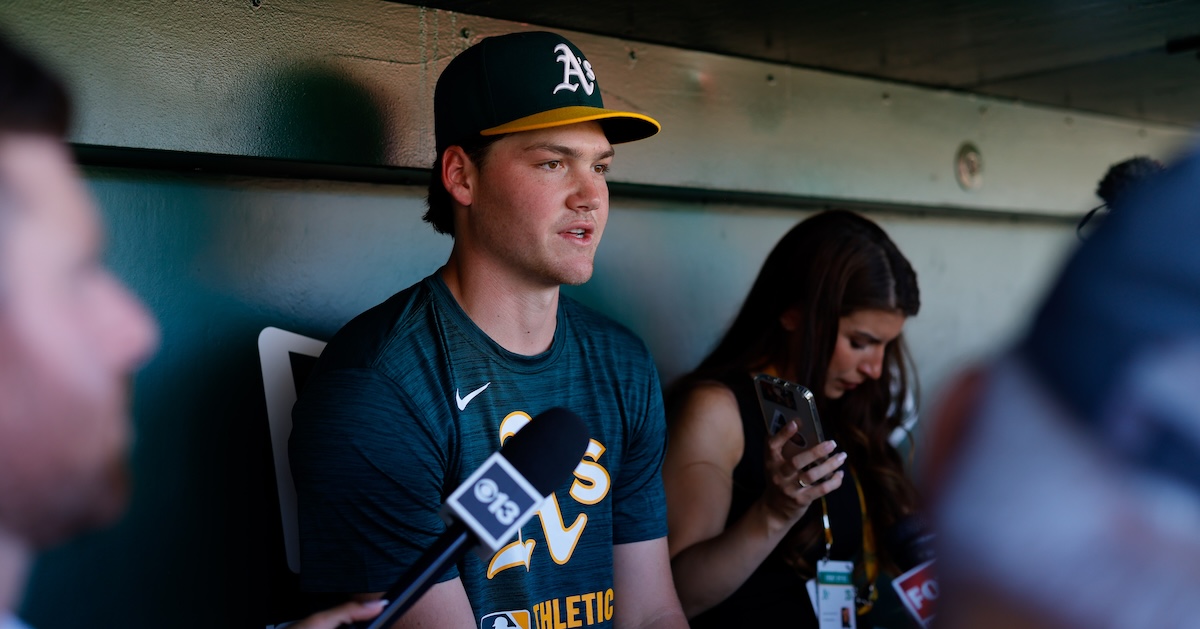
Jamie Arnold has a six-pitch mix that plays up thanks to outlier traits. He also has a lofty ceiling. Drafted 11th overall last year by the Athletics out of Florida State University, the 21-year-old southpaw will debut professionally this season having just missed out on our 2026 Top 100 Prospects list. And while he didn’t quite make that cut, Arnold did merit inclusion on the prospect team’s Picks to Click list, which highlights players expected to make next year’s Top 100. (Eric Longenhagen was present for Arnold’s spring training debut last Friday, video of which can be seen here.)
His delivery plays a role in his effectiveness. As Michael Baumann wrote prior to last summer’s draft, “Arnold’s long arm swing and extreme low release point make it hard to find an easy comp for him.” My colleague also referred to him as “a pitchability lefty,” which is notable given that the 6-foot-1 Tampa native possesses plus raw stuff. He certainly dominated at the amateur level. Over his last two collegiate seasons, Arnold went 19-5 with a 2.96 ERA while allowing just 153 hits over 190 1/3 frames. Moreover, he punched out 278 batters and issued just 53 free passes.
Arnold discussed his arsenal — which currently includes two changeups — as well as the mindset he takes with him to the mound, at the A’s spring training facility in Mesa, Arizona.
———
David Laurila: I’ve read the reports, but how would you describe yourself as a pitcher? How do you get guys out?
Jamie Arnold: “I’m in the zone a lot; I’m a strike-thrower and like to limit walks. You could say that I’m a groundball pitcher, but I also put up strikeout numbers. So I like to play both roles: a pitcher who gets quick outs, and a pitcher who punches guys out.”
Laurila: Strikeouts are good…
Arnold: “One hundred percent. I’m focused on getting ahead early, and if that results in a ground out — an early out — I’ll take that all day. But once I get to two strikes, I definitely want the punch out.”
Laurila: What is your full repertoire?
Arnold: “When I signed, it was [four-seam] fastball, slider, two-seam, and one changeup. I had the makings of a cutter, but it wasn’t very solidified. Now it’s four-seam, two-seam, slider, cutter, and two different variations of a changeup.”
Laurila: Why two changeups?
Arnold: “I’ve been throwing a kick change, and while the movement on it is good, it has been tough to command at times. Going into the offseason, I wanted to add something that I can throw early, get ahead in counts with. It’s a little split change. I mean, it still has good movement, but I can command it better. I can use it early, then throw the kick change later in counts.”
Laurila: You had the kick change in college?
Arnold: “Yes. I started throwing a kick in the fall of my junior year. My sophomore year, I really just threw a fastball and a slider. I also had a changeup, kind of a bad variation of a circle change, but it was just there to show. It’s hard to pronate from my slot, so finding the kick change was huge for me.”
Laurila: And the newer one is a split. How different are the movement profiles of your changeups?
Arnold: “You can barely call it a split — I kind of just split the seam — but in the offseason, it would be around 15-18 horizontal and on the zero line for vert. The kick change will be more like eight horizontal and -10 vert. So the kick has more depth, whereas the split has more arm-side movement. Velo-wise, they’re pretty similar, around 85-86 [mph].
“Since I’ve been out here in Arizona, the split has actually been moving a little differently; it’s been probably 12 horizontal and -3 vert. I don’t know if it’s the air out here, or just that stuff changes sometimes. The kick change is moving about the same, though.”
Laurila: Do you expect to continue throwing both, or eventually settle on one or the other?
Arnold: “We’ll see how the hitters do against them. That will be biggest tell for me. I’ve thrown live [BPs], and they both serve a purpose. They’ve both been good pitches. It’s really dependent on how well I can command the kick change. If I can command it in the zone, or out of the zone when I want to, it’s the better offering.”
Laurila: What do you consider to be your strikeout pitch?
Arnold: “Honestly, I would like to say that my slider, my four-seam, and my kick change are all strikeout pitches. The other day, I actually got a punch out on a cutter, so it really depends. Sequencing is going to be a big factor in that, as well.”
Laurila: What about a best pitch overall? Do you have one?
Arnold: “Not really. I think it just depends on what’s working that day. I mean, metrics are a great thing — the Stuff+ models will tell you this pitch is better than this pitch — but at the end of the day, it depends on how well you’re commanding it and what the hitter is seeing.
“If you look at the numbers, my four-seam… I’ve got a flat approach angle, and people like that a lot. My slider is a sweeper, and is 85-plus, so it grades out well. Metrically, the kick change is maybe my best pitch, because it’s an outlier. It’s almost a righty curveball from a left-handed slot, which is something I don’t think you see very often. But again, there is more to it than just stuff. I’m a big mindset guy. You can have the best stuff in the world and not get out of High-A if you lack a good mindset. And that’s not tangible. You can’t quantify a mindset.”
Laurila: Any final thoughts?
Arnold: “The biggest piece now, at this level… again, it’s more about how well you command. That’s really what I’m seeing from watching everyone, from watching big league games. It’s about how you use your stuff, where you’re throwing it, keeping the hitters off balance. I’m working on developing that way as a pitcher.”
David Laurila grew up in Michigan's Upper Peninsula and now writes about baseball from his home in Cambridge, Mass. He authored the Prospectus Q&A series at Baseball Prospectus from December 2006-May 2011 before being claimed off waivers by FanGraphs. He can be followed on Twitter @DavidLaurilaQA.
Every pitch I throw is a change up!
Well except for my eephus pitch. That’s the one that badly misses the catcher.