
Athletics Top 36 Prospects
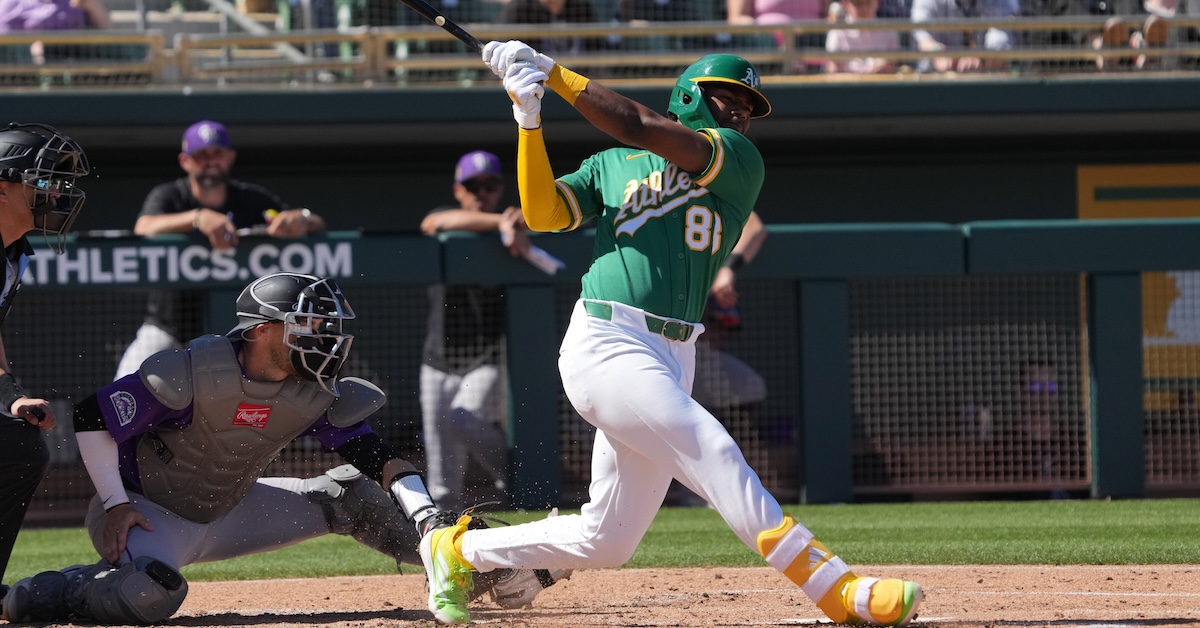
Below is an analysis of the prospects in the farm system of the Athletics. Scouting reports were compiled with information provided by industry sources as well as my own observations. This is the sixth year we’re delineating between two anticipated relief roles, the abbreviations for which you’ll see in the “position” column below: MIRP for multi-inning relief pitchers, and SIRP for single-inning relief pitchers. The ETAs listed generally correspond to the year a player has to be added to the 40-man roster to avoid being made eligible for the Rule 5 draft. Manual adjustments are made where they seem appropriate, but we use that as a rule of thumb.
A quick overview of what FV (Future Value) means can be found here. A much deeper overview can be found here.
All of the ranked prospects below also appear on The Board, a resource the site offers featuring sortable scouting information for every organization. It has more details (and updated TrackMan data from various sources) than this article and integrates every team’s list so readers can compare prospects across farm systems. It can be found here.
| Rk | Name | Age | Highest Level | Position | ETA | FV |
|---|---|---|---|---|---|---|
| 1 | Leo De Vries | 19.5 | AA | SS | 2026 | 60 |
| 2 | Gage Jump | 23.0 | AAA | SP | 2026 | 50 |
| 3 | Kade Morris | 23.8 | AAA | SP | 2026 | 45 |
| 4 | Jamie Arnold | 22.1 | AA | SP | 2027 | 45 |
| 5 | Wei-En Lin | 20.4 | AA | SP | 2028 | 45 |
| 6 | Johenssy Colome | 17.5 | R | 3B | 2032 | 45 |
| 7 | Braden Nett | 23.8 | AA | MIRP | 2026 | 45 |
| 8 | Junior Perez | 24.8 | AAA | CF | 2026 | 45 |
| 9 | Devin Taylor | 22.3 | A+ | LF | 2028 | 40+ |
| 10 | Henry Bolte | 22.7 | AAA | CF | 2027 | 40+ |
| 11 | Breyson Guedez | 18.5 | A | LF | 2031 | 40+ |
| 12 | Steven Echavarria | 20.7 | A+ | SP | 2028 | 40+ |
| 13 | Dylan Fien | 20.5 | A+ | C | 2030 | 40+ |
| 14 | Joshua Kuroda-Grauer | 23.2 | AAA | 2B | 2027 | 40 |
| 15 | Cole Miller | 20.9 | A | SP | 2028 | 40 |
| 16 | Mason Barnett | 25.4 | MLB | MIRP | 2026 | 40 |
| 17 | Tommy White | 23.1 | AA | 3B | 2026 | 40 |
| 18 | Shotaro Morii | 19.3 | R | TWP | 2031 | 40 |
| 19 | Edgar Montero | 19.4 | R | 3B | 2030 | 40 |
| 20 | Eduarniel Núñez | 26.8 | MLB | SIRP | 2026 | 40 |
| 21 | Corey Avant | 24.4 | AAA | SIRP | 2028 | 40 |
| 22 | Kenya Huggins | 23.3 | AA | SP | 2027 | 40 |
| 23 | Yunior Tur | 26.7 | AAA | SIRP | 2026 | 40 |
| 24 | Will Johnston | 25.3 | AAA | SIRP | 2027 | 40 |
| 25 | Chen Zhong-Ao Zhuang | 25.6 | AAA | SP | 2026 | 35+ |
| 26 | Henry Baez | 23.5 | AA | SP | 2026 | 35+ |
| 27 | Gunnar Hoglund | 26.3 | MLB | SP | 2026 | 35+ |
| 28 | A.J. Causey | 23.4 | AA | SIRP | 2027 | 35+ |
| 29 | Zane Taylor | 23.9 | AAA | SIRP | 2028 | 35+ |
| 30 | Jose Parra | 20.3 | R | SP | 2029 | 35+ |
| 31 | Stevie Emanuels | 27.2 | AAA | SIRP | 2026 | 35+ |
| 32 | Jared Johnson | 25.1 | A+ | SIRP | 2026 | 35+ |
| 33 | Gavin Turley | 22.4 | A | LF | 2029 | 35+ |
| 34 | Ricky Duran | 17.5 | R | 3B | 2032 | 35+ |
| 35 | Ayden Johnson | 18.2 | R | 3B | 2031 | 35+ |
| 36 | Darwing Ozuna | 18.0 | R | RF | 2031 | 35+ |
- All
- C
- 2B
- SS
- 3B
- LF
- CF
- RF
- SP
- SIRP
- MIRP
60 FV Prospects
1. Leo De Vries, SS
| Age | 19.5 | Height | 6′ 2″ | Weight | 210 | Bat / Thr | S / R | FV | 60 |
|---|
| Hit | Raw Power | Game Power | Run | Fielding | Throw |
|---|---|---|---|---|---|
| 40/50 | 45/60 | 50/60 | 50/50 | 40/50 | 60 |
De Vries was unanimously viewed as the best prospect in the 2024 international class, a potential do-everything, switch-hitting infielder with power from both sides of the plate. He signed for just over $4 million, which is about what you’d expect from a top-of-the-market player. Same as they have with other of their recent high-profile prospects, the Padres wasted no time in pushing De Vries’ promotion pace; most players his age are in the DSL and domestic complex leagues during their first two seasons, while De Vries broke camp in 2025 at High-A Fort Wayne. He was dealt to the Athletics at last year’s deadline as part of the Mason Miller trade and instantly became the A’s top prospect.
After more than holding his own as an 18-year-old in High-A, De Vries was incredible down the stretch at Double-A Midland, where he hit .281/.359/.551 with five homers in 103 plate appearances. He followed that with a .426/.460/.723 2026 Cactus League line in 50 plate appearances, and broke camp back in Midland. The pace at which De Vries has conquered the minor leagues gives him a very real shot to debut before he turns 20 in October of this year, and add another young, franchise-changing player to the A’s everyday lineup as they transition from Sacramento to Las Vegas.
De Vries is a switch-hitting shortstop with weaponized power from both sides of the plate. He is a plus athlete, twitchy with good body control. He has a quick bat and a lofted stroke from both sides of the plate, with perhaps a little more verve and bat control from the left side. His exit velocities are more fringy or average than above at this point, which isn’t unexpected because — it is worth periodically reiterating — he was 18 years old last season and has plenty of physical development ahead. At peak, De Vries is going to be dangerous on every swing he takes. His hands are quick enough to make contact in all parts of the zone, and he has home run power from line to line. Though his lift-heavy style of hitting will likely cap his contact rate to some extent, it won’t be to a degree that hinders his power output.
There are still pretty big error bars when projecting De Vries’ defensive future. Though he’s a tall, bigger-framed athlete, the skinny-ankled De Vries has so far stayed lithe and agile enough to play a viable shortstop. He will contort himself to make some cool, acrobatic plays that take advantage of his plus raw arm strength, but his hands and range are merely sufficient for a shortstop, and he has had bouts of inaccuracy on deeper throws. We’re cautiously optimistic about him staying at shortstop in a vacuum, with the primary threat to that being a slippage in range caused by him trending bulky in his mid-20s. De Vries’ hands should improve with reps, and his solution to throwing inaccuracy has been to play hot potato with the baseball and quickly flick two-hoppers to first base. It isn’t ideal, but it works. He looks much more comfortable airing it out as he moves from right to left across the bag. This comfort perhaps makes third base Plan B, as most plays there are made moving in that direction. Jacob Wilson is a better shortstop defender than De Vries, and that alone might be what precipitates a change, rather than De Vries’ ability. Regardless, we think De Vries will contribute on both sides of the ball as a 30-homer, heart-of-the order hitter who is either a tenable shortstop or a plus third baseman.
50 FV Prospects
| Age | 23.0 | Height | 6′ 0″ | Weight | 197 | Bat / Thr | L / L | FV | 50 |
|---|
| Fastball | Slider | Curveball | Splitter | Command | Sits/Tops |
|---|---|---|---|---|---|
| 60/60 | 60/60 | 50/50 | 40/50 | 35/45 | 93-96 / 98 |
Jump was a notable high school prospect in California because of his invisiball heater, which had above-average velocity to go with plus riding life and a flat angle. Concerns that he couldn’t throw strikes pushed him to UCLA, where he struggled with walks as a freshman and missed his sophomore year recovering from TJ. After he transferred to LSU for his draft year, Jump’s command improved, and for the last two seasons, he’s thrown a starter’s rate of strikes while increasing his workload to 112.2 innings. Jump paved over High-A hitters throughout the first six weeks of the 2025 season and was promoted to Double-A Midland in mid-May. After that, the A’s started to dial down his per-outing workload, and he failed to work into the sixth inning in any start from June on. He struggled at the very end of the year and surrendered more than half the runs (27) he gave up all season (50) during its final month, but he still finished 2025 with a 3.28 ERA. He was nails during 2026 spring training, broke camp with Triple-A Las Vegas, and has tee’d himself up to make his big league debut at some point this year, especially if he avoids the late-season swoon of his prior campaign.
Jump’s fastball sits 93-96 mph and gets on top of hitters quickly because they don’t seem to pick up the baseball out of his hand. He’ll reach back for 97-98 when he wants it, even late in outings, but the key to its success is its uphill angle. Though he lacks expert feel for location, Jump’s super short arm action keeps his release consistent enough for him to throw a starter’s rate of strikes. He mixes in a couple of different breaking balls — gyro sliders in the 84-88 mph range and two-planed slurves in the 78-83 mph range — and a splitter that has had about 300 rpm less spin on average than the 2025 version and is the pitch Jump struggles most to control. Each of these pitches will flash plus throughout a typical start, but the slider is the one that is most consistently good and located where Jump wants. Though he might always produce elevated walk rates due to his style of attack, Jump has a plus fastball/slider combination that will miss big league bats for five innings at a time. His ceiling could look like that of Robbie Ray, with whom Jump shares some mechanical effort and violence.
45 FV Prospects
3. Kade Morris, SP
| Age | 23.8 | Height | 6′ 3″ | Weight | 190 | Bat / Thr | R / R | FV | 45 |
|---|
| Fastball | Slider | Curveball | Changeup | Cutter | Command | Sits/Tops |
|---|---|---|---|---|---|---|
| 50/50 | 50/50 | 40/45 | 40/50 | 50/55 | 50/60 | 92-94 / 96 |
A NorCal high schooler who matriculated to Nevada, Morris posted a 5.42 ERA pitching on the surface of the moon during his draft year in Reno, but was a young-for-college spinmeister with starter-caliber repertoire depth and athleticism, and became a shrewd third-round pick by the Mets. He’d pitched his way to High-A when he was acquired by the A’s in the 2024 trade deadline deal that sent Paul Blackburn to New York, then the A’s accelerated his promotion pace in 2025 and he spent the majority of the year at Triple-A Las Vegas. Morris pitched 150 innings across 28 starts, and enters 2026 as one of the A’s more polished pitching prospects.
Morris executes a lateral sinker/slider attack with lots of tailing uphill heaters in on the hands of righties. He can locate fastballs to his glove side to set up harder sliders and true sweepers away from righties, which he routinely dots just off the corner. He’s competitive, confident, loose-armed, and athletic, and he repeats his delivery well, giving him the look of a big league starter in every way but his frame, which is slight and skinny but not without career-long starter precedent (Chris Bassitt is a fair body comp).
Morris can manipulate his breaking stuff to include a slower curveball, which he uses to get looking strikes. He’s crafty and will mix speeds and shapes across a range of about 14 mph. This, plus his fastball’s natural sink, helps him generate a lot of groundballs. He needs to develop a changeup to guard against platoon vulnerability, as none of his breaking balls are truly geared for getting lefties out. He has some feel for creating downward sink on his current changeup, which still needs refinement. If he develops a good cambio over time, then we’re talking about a starter who you would feel comfortable giving the ball to in a playoff series. For now, Morris looks more like the sort who plays a valuable, innings-eating no. 4/5 starter role during the regular season and then shifts into relief come playoff time. He’s a good bet to debut at some point in 2026 and play a role in the A’s rotation for the next several years.
4. Jamie Arnold, SP
| Age | 22.1 | Height | 6′ 1″ | Weight | 188 | Bat / Thr | L / L | FV | 45 |
|---|
| Fastball | Slider | Changeup | Cutter | Command | Sits/Tops |
|---|---|---|---|---|---|
| 50/55 | 60/60 | 40/50 | 30/50 | 30/45 | 92-95 / 98 |
Arnold entered his draft spring as a potential top-three pick, but his 2025 wasn’t as dominant as his sophomore year. His strike-throwing (especially with the fastball) backed up. College hitters were still flummoxed by his delivery and stuff, and chased at a rate that helped him keep his walk rate down at a solid 7.7%. But visually, Arnold wasn’t locating his fastball, and that was supported by the data under the hood: He posted a 45% zone rate, and a 59% strike rate with his fastball, both way below the big league average. Arnold ranked 17th on the FanGraphs Draft Board and was picked 11th overall.
Before the start of the 2026 regular season, Arnold was again having control issues on the backfields, but he was still given a very aggressive assignment and sent to Double-A Midland. He ends up behind in counts and has to lean on his slider to claw his way back in. That was okay against college hitters (Arnold had a 2.98 ERA as both a sophomore and junior) but might not fly against upper-level minor leaguers. Arnold’s delivery would win a Madison Bumgarner look-alike contest, as he has a swooping, lower-slot delivery that creates awkward uphill angle and tail on his 94-ish mph fastball (his velo slipped more into the 91-92 range late during spring training). He began incorporating more cutters as Opening Day approached, perhaps just because he was working deeper into minor league spring outings and getting to use it as he faced hitters multiple times, or perhaps because the A’s are searching for something he can throw for a strike. Arnold’s slider has more two-planed finish, while his cutter, which was often about 87 mph in my look, stays uphill, and his changeup often moves like a glorified two-seamer.
There are mid-rotation ingredients here. Arnold’s mechanical fluidity is appealing, his delivery’s unique elements should help his fastball play up if he ever learns to command it, his slider is really nasty, and he has the makings of a four-pitch mix. But we’re now entering a second consecutive year in which his fastball control looks a bit sketchy. Though it was reasonable to hope that Arnold would return to peak form and be set up to race through the minors this year, that’s not how he looked during 2026 camp. A pre-season Pick to Click, he is pretty clearly behind several of Pre-Vegas’ other well-regarded arms on the big league depth chart right now and is treading water with his pre-draft FV grade. That said, this is still a really good pitching prospect who may just need more time than the prospect zeitgeist seems to think he will in order to reach his ceiling.
5. Wei-En Lin, SP
| Age | 20.4 | Height | 6′ 2″ | Weight | 179 | Bat / Thr | L / L | FV | 45 |
|---|
| Fastball | Slider | Curveball | Changeup | Command | Sits/Tops |
|---|---|---|---|---|---|
| 55/60 | 50/55 | 50/50 | 40/50 | 30/50 | 90-94 / 97 |
Lin signed in mid-2024 but wasn’t widely seen until he pitched for Taiwan in a February 2025 WBC qualifier, where he worked out of the bullpen. He then had a dominant first half at Low-A Stockton as a starter thanks to the riding angle of his low-90s fastball and the quality of his parachuting mid-70s changeup, which garnered plus-plus miss. He was promoted to High-A Lansing, where he worked as a long reliever — about three innings per outing for 11 outings — before a two-start shot of espresso at Double-A to end the year. Altogether, Lin worked 87 innings and had one of the best strikeout-to-walk ratios in the minors, with 33.4% strikeout rate and 6.3% walk rate.
After three 2026 Cactus League outings with the big league team, Lin left camp to pitch for Taiwan in the World Baseball Classic. There we saw what his arm strength looks like when the adrenaline is really flowing, as he worked in the 93-95 mph range against Korea. His fastball was back in its usual 90-94 band during Lin’s final backfield start of the spring before he broke camp at Double-A Midland.
Lin’s body and mechanics look like a Jose Quintana starter kit. He’s spindly and thin, and moves with great mechanical efficiency, though without quite the same grace and precision as Quintana. His walk rates slipped as he was promoted last year, and his full-season walk rate was likely better than his true command talent, but he has four distinct pitches and controls them enough to project as a big league starter. Lin’s fastball punches above its weight thanks to its ride and angle. It generated an elite miss rate last year, above 30%, and unlike Lin’s walk rate, that mark did not dip as he was promoted last season. Off of that pitch, he’ll bend a mid-80s slider into the zone, and this pitch tunnels well with his elevated fastballs. Lin still needs to improve his ability to locate it off the plate, but it has the movement of a big league finishing pitch if he can get there.
Lin’s changeup dominated A-ball hitters last year but fell by the wayside once he started facing more advanced guys. It often flutters in south of 80 mph, which might be too slow to trick big leaguers. Still, his arm action is lovely, and he should have a traditionally effective changeup in time. For a pitcher the age of a college sophomore, this is a great foundation. Lin probably doesn’t have the command profile of a Quintana or a Joe Ryan such that he’ll truly be able to weaponize his fastball’s movement to an elite degree, but that’s going to be an impact pitch for him even if he’s only ever sitting 93, and he might yet add more velocity. He’s tracking to debut ahead of his chalk 40-man timeline and should be up by late 2028.
6. Johenssy Colome, 3B
| Age | 17.5 | Height | 6′ 1″ | Weight | 190 | Bat / Thr | R / R | FV | 45 |
|---|
| Hit | Raw Power | Game Power | Run | Fielding | Throw |
|---|---|---|---|---|---|
| 20/45 | 55/60 | 20/60 | 55/50 | 30/45 | 60 |
Colome, who signed for $4 million in January, might have the best pure bat speed in the entire 2026 international signing class. The hip/hand separation he’s able to create at his swing’s apex is incredibly explosive, though it sometimes requires a very deep load and big effort to generate. Colome’s swing can look out of control at times, or ineffectual in the same way that Miguel Andujar’s sometimes can, but the talent to hit for that kind of power is absolutely here. Colome has worked out at both shortstop and third base on the A’s complex and has the arm to play either spot, but his hands and actions at short are more on the fringe of what’s typical at the position, and some scouts have him projected to third. Volcanic bat speed gives him a big power-hitting ceiling, while his swing mechanics and potential corner fit make Colome volatile.
7. Braden Nett, MIRP
| Age | 23.8 | Height | 6′ 3″ | Weight | 185 | Bat / Thr | R / R | FV | 45 |
|---|
| Fastball | Slider | Curveball | Changeup | Cutter | Command | Sits/Tops |
|---|---|---|---|---|---|---|
| 60/60 | 50/50 | 60/60 | 40/50 | 50/50 | 30/40 | 94-98 / 100 |
Nett is one of the best undrafted free agent signings of the post-COVID era. He entered pro ball as a wild, arm strength developmental project with an ideal pitcher’s frame and a great looking arm action, and during the last two seasons, his strike-throwing improved. He walked 20.1% of opponents in his first full season, then 14% in 2024, and hovered around 10% at Double-A on either side of the 2025 Mason Miller trade. He was added to the 40-man roster after the 2025 season, but made just one appearance in the 2026 Cactus League and began the regular season on the IL with his second rotator cuff injury of the last few years.
When Nett has been healthy, he has worked in the 94-98 mph range and bumped 100, and he sat 96-97 in our lone 2026 data point before the injury. Buttressing his heater are three different breaking balls, all with plus or better raw spin but roughly average on-field performance. Nett’s cutter was his most-used secondary with San Diego, but it was de-emphasized and usurped by his slider after the A’s acquired him. The nastiest pitches he throws are his best curveballs, but his feel for locating his slider is much more consistent than that of his curve. His terrific arm speed allows us to project that his changeup will continue to improve with reps. Even if his walk rate regresses toward his career norm (based on how Nett’s feel and release consistency have looked in person, we think it will), it’s worth developing him as a starter for at least another couple of years to give that changeup reps. There’s a right tail outcome here where Nett’s command clicks and he becomes a mid-rotation starter, which might not happen until his late 20s. Until then, we expect him to be an inefficient five-and-dive type at the back of the A’s rotation. If injuries continue to limit his innings, the A’s might pull the reliever parachute at some point, but probably not until late in 2027.
8. Junior Perez, CF
| Age | 24.8 | Height | 6′ 0″ | Weight | 190 | Bat / Thr | R / R | FV | 45 |
|---|
| Hit | Raw Power | Game Power | Run | Fielding | Throw |
|---|---|---|---|---|---|
| 30/35 | 55/55 | 50/55 | 60/60 | 45/45 | 60 |
Perez broke out as a complex-level Padre back in 2019, then was traded to the A’s as the PTBNL for Jorge Mateo after the 2020 season. He crawled through A-ball during the next couple of years, striking out 30% of the time or more from 2021 through 2024, though he managed to hit a bunch of homers and steal a bunch of bases in each of those seasons. He cut his strikeout rate (28.6%) in a repeat season at Double-A Midland in 2025, and kept it there (26.9%) during the final two months of the season after he had been promoted to Las Vegas. It was enough of an improvement (ditto for Perez as a center field defender) for the A’s to add him to their 40-man roster, putting him in position to debut in 2026 and compete for a sustained role starting in 2027.
Perez has plus bat speed and good enough timing to damage pitches in the zip code of the zone’s center, which he sprays to all fields. He lacks great bat control, and swings underneath a ton of in-zone fastballs and breaking balls that find the top and bottom edges of the box, respectively. Perez’s 74% in-zone contact rate would be one of the three lowest among qualified big leaguers since 2024, and he posted that mark mostly at Double-A. This makes his hit tool feel flimsy and gives him strikeout-driven bust risk. The good news is that his selectivity at the dish means he tends to target pitches he can handle, and he does a good amount of damage when he makes contact.
The piece of Perez’s profile that will actually give him room to strike out at an elevated clip is his defense, which has improved across the last few seasons to the point where he can now play a passable center field. Perez is a plus runner and takes fairly efficient routes to balls hit into the gaps and over his head, and he also has a good arm. He is not nearly as good out there as Denzel Clarke, but he’s a more consistent power threat on offense. What the A’s want out of their center fielder of the near future might depend on how the rest of the offense is performing. Perez could be a plus corner defender and occasionally spell Tyler Soderstrom or Lawrence Butler against lefties, who he posted a .375 xwOBA against in 2025. He’s a pretty good roster fit for them and should play a meaningful role soon, perhaps by the second half of 2026 if he continues to strikeout less than 30% of the time in Vegas.
40+ FV Prospects
9. Devin Taylor, LF
| Age | 22.3 | Height | 6′ 0″ | Weight | 215 | Bat / Thr | L / R | FV | 40+ |
|---|
| Hit | Raw Power | Game Power | Run | Fielding | Throw |
|---|---|---|---|---|---|
| 35/50 | 55/60 | 30/55 | 50/50 | 20/30 | 30 |
One of the most consistently productive college hitters in the 2025 draft class, Taylor finished his Indiana career with a .350/.459/.672 line and raked with wood in two years of summer ball. He has gorgeous feel for all-fields contact, and he can drive pitches on the outer third to the opposite field with power and turn on pitches on the inner half. He makes it look easy with the way he reads and reacts to pitch location and speed, as he can adjust his hands and upper body posture to put the barrel on the ball. Taylor is a lower launch guy who might not quite hit for his raw power in games, and he’s a terrible outfield defender who might just be a DH. The defensive piece is a body blow to his overall value and gives him basically zero margin for error as a hitter, but this projection is enthusiastic enough about Taylor to consider him a corner outfield platoon bat.
10. Henry Bolte, CF
| Age | 22.7 | Height | 6′ 3″ | Weight | 195 | Bat / Thr | R / R | FV | 40+ |
|---|
| Hit | Raw Power | Game Power | Run | Fielding | Throw |
|---|---|---|---|---|---|
| 20/30 | 55/60 | 30/45 | 80/80 | 30/45 | 45 |
I have been skeptical of Bolte’s baseball card stats over the last couple of years. He is a .268/.370/.434 career hitter in the minors and has enticing physical prowess and twitch, but the length of his swing undermines his impressive tools in a couple of key ways, which is why he continues to project as a souped-up fifth outfielder. Bolte is long levered and ends up underneath a ton of elevated fastballs, and the contact he does make (he posted a 67% rate last year, toward the bottom of the big league scale) tends to be on the ground and/or to the opposite field.
Make no mistake, Bolte will sizzle hard liners and grounders at the first and second basemen, because once his wrists get going, he strikes the baseball with impressive force. But hitters with this contact profile — both in how little contact there is and the nature of the spray when it’s made — tend to underperform from a game power standpoint. If we’re looking for recent examples of players like this who still find a way to be productive, we can look to Garrett Mitchell, who has been successful in a fairly small sample amid injury.
Bolte presents a similar dichotomy on defense, where his speed and athleticism give him impact range, but a lack of ball skills and feel cause his defense to play down. He struggles with errant reads and discomfort at the catch point, and will be a right field-only fit in the big leagues if things continue this way. Bolte’s speed gives him utility as a pinch-runner, his power makes him a threat to crush a mistake in the middle of the zone, and his speed and athleticism make it feasible that he can improve as an outfield defender over a long period of time. This is the type of athlete who teams give chance after chance to improve, and it’s plausible that Bolte will have a meaningfully good peak offensive season or two in his late 20s. That’s essentially baked into his grade here.
11. Breyson Guedez, LF
| Age | 18.5 | Height | 5′ 10″ | Weight | 160 | Bat / Thr | L / L | FV | 40+ |
|---|
| Hit | Raw Power | Game Power | Run | Fielding | Throw |
|---|---|---|---|---|---|
| 20/30 | 45/55 | 25/50 | 50/50 | 30/55 | 50 |
If the A’s had a breakout prospect during 2026 camp, it was Guedez, a medium-framed outfielder with an exciting contact/power blend who is sneaky toolsy. Guedez signed for $1.5 million in 2025, then slashed .359/.395/.490 during his DSL debut, with a 6.7% walk rate and 9.5% strikeout rate. He raked in a half-dozen big league spring training games in 2026, homered in the A’s Breakout game, and looked more physical and toolsy than his amateur scouting reports suggested, though still a good bit more compact than the Leo De Vries and Edgar Montero types (Wilyer Abreu is a fair body comp).
Guedez has plus bat speed and impressive strength for his age. He’s muscular throughout his lower body and upper extremities, including in his hands and wrists. His swing has some natural uppercut to it, though that didn’t manifest in a ton of airborne contact during his pro debut, as he was more of a doubles machine, with 15 of them in 53 games. Even though Guedez is very likely to end up as a left field-only fit on defense and lacks big body projection, he is a rather exciting young hitting prospect with one ruby red flag in his data: his chase. Guedez chased at a 39% overall last year (the big league average is 30%) and a whopping 60% with two strikes (the big league average is 38%). Those are scary numbers for someone likely to wind up on the low end of the defensive spectrum. Guedez was given a fairly aggressive assignment to Low-A Stockton at age 18, and the way his plate discipline trends throughout the season will be the most influential variable for his overall grade during the next year. Here he’s graded like a high school prospect who’d go in the early second round.
12. Steven Echavarria, SP
| Age | 20.7 | Height | 6′ 1″ | Weight | 195 | Bat / Thr | R / R | FV | 40+ |
|---|
| Fastball | Slider | Curveball | Changeup | Command | Sits/Tops |
|---|---|---|---|---|---|
| 45/50 | 50/55 | 45/50 | 40/50 | 30/45 | 93-97 / 99 |
Even though aspects of his fastball’s plane and shape were suboptimal, Echavarria’s breaking ball quality and projectability made him one of the more exciting high school pitchers in the 2023 draft, and he signed for $3 million rather than go to Florida. He’s now pitched in two full seasons, with the second (2025) being a bit rocky, as Echavarria struggled when he was stretched out to work five or more innings at a time and had his per-outing innings cut mid-year. He still managed to throw 104 frames, nearly twice as many as he had the year before, but his ERA and various FIPs were all above four, and Echavarria K’d just seven per nine despite plus fastball velocity.
Though Echavarria’s lack of fastball movement and spotty command make that pitch more hittable than most heaters this hard, all three of his secondary pitches flash plus, albeit rarely. He has added a second, harder breaking ball since turning pro (his slider) that now serves as his primary weapon against righties, while his curveball and changeup (which he has been leaned on a bit more often early in outings so far in 2026) have the kind of movement that will be effective against lefties. Location consistency is going to be the biggest variable impacting Echavarria’s outcomes, and it’s possible a stronger lower body will help him get there. Though his stuff looks good, he has consistently under-performed as a bat-misser since signing because he so often lives in the heart of the zone when he’s throwing strikes. He’ll turn 21 this year, and it would be unreasonable to expect Echavarria to be a fully-formed pitcher at this point, but his 40-man timeline is creeping up, and during the next two years it’s going to be important for him to polish his command to avoid relief projection. This is still a high-upside FV grade for Echavarria, but one south of what is typical for someone who got a bonus as big as he did.
13. Dylan Fien, C
| Age | 20.5 | Height | 6′ 3″ | Weight | 210 | Bat / Thr | S / R | FV | 40+ |
|---|
| Hit | Raw Power | Game Power | Run | Fielding | Throw |
|---|---|---|---|---|---|
| 30/50 | 40/50 | 30/50 | 40/40 | 30/40 | 40 |
Fien was successfully signed away from a UCLA commitment for $550,000 and slashed .241/.326/.322 in his first pro season, which isn’t a great Cal League line. Still, he’s a projectable switch-hitter who posted a 75% contact rate while learning how to catch during a fairly aggressive full season assignment. Fien has above-average left-handed bat speed and can move the barrel around the zone enough to do extra-base damage to all fields. His righty swing is not as explosive, but he’s still often on time and has pull-side doubles pop. There is an above-average hit/power combination lurking here if Fien’s 6-foot-3 frame fills out. He needs a ton of work on defense and might ultimately end up at first base, where he’s playing more often than he is catching at the start of 2026. Fien’s promotion pace has been surprisingly aggressive so far (he broke camp with Lansing), but he is going to be a slow burn as a prospect if he continues to catch even part of the time. He’s got a puncher’s chance to be an everyday player and obviously has a much better shot to do so if he can improve behind the dish.
40 FV Prospects
14. Joshua Kuroda-Grauer, 2B
| Age | 23.2 | Height | 6′ 0″ | Weight | 190 | Bat / Thr | R / R | FV | 40 |
|---|
| Hit | Raw Power | Game Power | Run | Fielding | Throw |
|---|---|---|---|---|---|
| 45/55 | 35/40 | 30/30 | 50/50 | 50/60 | 50 |
Kuroda-Grauer grew up in Somerset, New Jersey and stayed in state for college, going to Rutgers, where one of his mothers got her MSW and was later an advisory council member at their Graduate School of Education. JKG raked in college and had more walks than strikeouts as both a sophomore and junior en route to a third-round selection and a $1 million bonus. He slashed .296/.359/.372 in his first full pro season and reached Double-A Midland in the second half (where he hit his first two professional home runs, a mark he’s matched already in 2026) and then hit .345 in the Arizona Fall League.
The bedrock of Kuroda-Grauer’s profile is his exceptional hand-eye coordination and contact ability. He has been damn near impossible to strike out since high school and has posted a K% at or below 10% at basically every level since his freshman season in Piscataway. A majority of his contact is sprayed to the opposite field, with his extra-base damage typically limited to fastballs sliced straight down the right field line and the occasional hanging breaking ball yanked to left. This batted ball profile and below-average bat speed combine to ensure that JKG will slug well under .400 across a large big league sample. His chase rate splits (which explode with two strikes) indicate he may not have especially good strike zone discipline, and this is why his hit tool is projected below his pure bat control; for as much contact as he’s making, a lot of it is of suboptimal quality.
After the Athletics acquired Leo De Vries, Kuroda-Grauer was forced to move off of shortstop (where he took over 80% of his reps in 2025) and play more second and third base (then some outfield in the Fall League) late in the year. He had prior experience at second base and in the outfield (he got reps during college summer ball), but not at third base, and it has been a pleasant surprise how quickly he’s taken to the hot corner. He already has great chemistry with De Vries when the two are operating around second base, and while JKG is merely passable at shortstop, he projects to be a plus defender both in quality and versatility at the other positions he can play. Even though he came to 2026 camp noticeably stronger (he’s added about 25 pounds since his draft year) and it’s plausible he’ll impact the baseball a bit more now, Kuroda-Grauer is likely to be a nice role player rather than a first- or second-division regular at any one position.
15. Cole Miller, SP
| Age | 20.9 | Height | 6′ 6″ | Weight | 226 | Bat / Thr | R / R | FV | 40 |
|---|
| Fastball | Slider | Changeup | Command | Sits/Tops |
|---|---|---|---|---|
| 35/40 | 45/50 | 50/60 | 30/55 | 89-91 / 93 |
Miller signed an over-slot $1 million deal as the A’s 2023 fourth-rounder rather than go to UCLA. He blew out and had Tommy John sometime during 2024 spring training, then returned in 2025, pitching on the complex until late June, when he was promoted to Stockton. Miller posted a 1.90 ERA across 52 combined innings and broke 2026 camp back with Stockton.
Miller still has starter projection because of his size and build (he’s a broad-shouldered 6-foot-6), and also the way he moves, which is loose and fluid if not always under control. He has a lower arm slot that generates a tailing low-90s fastball, but his best pitch is his changeup, which has as much tail and a good bit of sinking action. He can run both his fastball and changeup off the hips of lefty batters and back over the plate, and he can manipulate the shape of an 81-85 mph breaking ball from a curveball to a slider, depending on where he is trying to locate it. Though he lacks great arm strength right now, Miller’s age, size and flexibility make it possible that he might yet throw harder, although he was usually in the low 90s before he blew out and has basically thrown this hard for his entire time as a prospect. Even though his lower-slot delivery is atypical for a starter, there are otherwise lots of starter ingredients here. Miller will track as a backend option for as long as his fastball velocity remains in this pedestrian area.
16. Mason Barnett, MIRP
| Age | 25.4 | Height | 6′ 0″ | Weight | 218 | Bat / Thr | R / R | FV | 40 |
|---|
| Fastball | Slider | Curveball | Changeup | Command | Sits/Tops |
|---|---|---|---|---|---|
| 50/50 | 55/60 | 50/50 | 40/45 | 40/40 | 93-96 / 98 |
Barnett moved into Auburn’s rotation in the middle of his junior season, and his stuff peaked late in the year as the draft approached. The violence and inconsistency of his delivery caused him to project as a reliever on our draft rankings, but he’s been developed as a starter (by two orgs — he was part of the Lucas Erceg trade) and made his big league debut across five starts to end the 2025 season. Barnett struggled with command in those outings, as well as in his first Cactus League start of 2026, and he was quickly optioned to Las Vegas during the first half of spring training.
The barrel chested right-hander has a due north arm slot that imparts vertical ride on his fastball and depth on his breaking stuff. A long, plunging arm action and the trunk tilt required of Barnett to get to this arm slot are tough for him to repeat, and this impacts his command. He has four distinct pitches that he throws for strikes at a roughly 60% clip. It’s the bones of a starter’s mix and pitchability, but only just so. Barnett’s fastball has average velo and uphill angle when it’s located at the top of the zone, but it has a hittable line when it’s middle-down. He attacks righties with his fastball and a 83-87 mph slider (his best pitch), and goes at lefties with his fastball and a tailing changeup. He’ll try to dump in a 12-to-6 curveball early in counts to steal a strike, but he doesn’t land it consistently. Barnett should be deployed as a spot starter and swingman while he has options left, but as his roster flexibility drips away, it’s more likely that he settles into the bullpen side of the equation due to his below-average command.
17. Tommy White, 3B
| Age | 23.1 | Height | 6′ 1″ | Weight | 228 | Bat / Thr | R / R | FV | 40 |
|---|
| Hit | Raw Power | Game Power | Run | Fielding | Throw |
|---|---|---|---|---|---|
| 40/50 | 50/50 | 30/40 | 40/40 | 40/50 | 55 |
A barrel-chested college baseball cult hero, White was among the highest-profile transfers of the college athlete empowerment era, heading from NC State to LSU after an incredible freshman season. He slashed .355/.419/.704 throughout his college career, with 75 homers in three seasons, and signed for $3 million as the A’s second-rounder in 2024. In his first full pro season, he slashed .275/.334/.439 split between High-A Lansing and Double-A Midland, then thrived in the Fall League.
This projection assumes a performance dip is coming for White, who has a pretty extreme inside-out contact profile (he can’t pull fastballs in the air) and a penchant for chase. His operation in the box can get noisy, and he ends up tardy to the contact point. His hands aren’t especially quick, but his ability to rotate explosively through his hips provides glimpses of viable big league corner defender pop. It’s tough for hitters who are routinely late against fastballs to reliably hit for power, and White falls into this category even though his best shots are impressive. A tendency to expand the zone in any count adds further offensive volatility to a profile that was driven by his contact percentage (80% overall) in 2025.
A surprisingly mobile, low-to-the-ground defender for his size, White’s ability to control his body well on the run puts him in a good fielding position, which allows him to cover up for below-average hands. He’ll have to stay as lithe and quick as possible, which can be challenging for athletes built like he is (Maikel Franco is a fair all-around comp for White), but he has a better shot to stay at the hot corner than you’d guess when he gets off the bus. White will likely play a mix of third and first base (where he looks like a future plus defender) in the big leagues as part of a lefty matchup role.
18. Shotaro Morii, TWP
| Age | 19.3 | Height | 6′ 1″ | Weight | 181 | Bat / Thr | L / R | FV | 40 |
|---|
| Hit | Raw Power | Game Power | Run | Fielding | Throw |
|---|---|---|---|---|---|
| 20/40 | 45/55 | 25/50 | 50/50 | 30/45 | 60 |
| Fastball | Curveball | Changeup | Command | Sits/Tops |
|---|---|---|---|---|
| 40/45 | 40/50 | 45/55 | 30/55 | 90-94 / 96 |
Morii comes out of Toho High School in Tokyo and elected to skip the NPB Draft to come stateside as an amateur prospect. This is similar (but meaningfully different) than Rintaro Sasaki skipping the NPB Draft to go to Stanford and eventually be subject to the MLB Draft. Morii came directly to the U.S. for his debut season and slashed .258/.399/.384 in the Arizona Complex League. He creates fairly exciting hip/hand separation and can punish the baseball pretty well for a hitter his age, but Morii is already rather physical and probably doesn’t have much more raw power in the tank. It will likely take improvement in his contact ability (he posted a 71% overall rate in 2025) for him to have the offensive profile of an everyday second baseman, the position at which he fits best and which he played most during my spring 2026 looks.
Morii did not play in a regular season game as a pitcher last year, and instead got reps during instructional league (and again this spring), where he sat in the low 90s with a blunt slider and a splitter in its nascent stages of development. Morii is balanced and controlled over his landing leg and has a short, repeatable arm action. Again, his lack of physical projection makes it tough to forecast improved velocity as he ages. He’s a fun developmental prospect without an obvious plus tool for his profile to truly hang its hat on. His best chance at being an everyday player (or the pitching equivalent) is probably to outperform this power projection and slug his way to an everyday second base role. He’s back in Arizona, where he’ll attempt to hit and pitch during extended spring training, potentially finishing the summer in Stockton if double duty goes well.
19. Edgar Montero, 3B
| Age | 19.4 | Height | 6′ 2″ | Weight | 220 | Bat / Thr | L / R | FV | 40 |
|---|
| Hit | Raw Power | Game Power | Run | Fielding | Throw |
|---|---|---|---|---|---|
| 20/40 | 50/60 | 20/55 | 40/30 | 30/50 | 55 |
Montero put up video game numbers in his second DSL season. He is listed at 185 pounds and as a shortstop, but he’s at least 30 pounds heavier than that already and is very likely to move to a corner. While he wields very impressive power for a hitter his age, the cement on his frame is drier than most at this stage, and there might only be another half grade or so in the tank. His swing takes a while to get on plane, and Montero slices a lot of contact the other way, which are warning signs about his future contract ability against good velo. There are outcomes for Montero that look like Nolan Gorman if he indeed ends up with 70 power. His surface stats led us to consider him for the Top 100, but we moved off him pretty quickly because of these yellow flags.
20. Eduarniel Núñez, SIRP
| Age | 26.8 | Height | 6′ 2″ | Weight | 170 | Bat / Thr | R / R | FV | 40 |
|---|
| Fastball | Slider | Command | Sits/Tops |
|---|---|---|---|
| 70/70 | 70/70 | 20/30 | 94-100 / 101 |
Núñez has been a frustrating pitcher to monitor during the last half decade because he has long had superlative stuff, but very poor control. Sort your TrackMan spreadsheet and Núñez is at or near the top in a number of categories. Nobody in the world who throws as hard as he does can spin the baseball like he does (he averaged 2,700 rpm on his four-seamer last year). But often to see Núñez actually pitch is to watch him traffic cop a rally with walks and bean balls, and he’s had long stretches in the minors where he’s either walked a batter per inning or experienced wild fluctuations in velocity.
Núñez was a minor league free agent in 2024, signed with the Padres, and put things together enough in 2025 that he became part of the Mason Miller trade and made his big league debut with the A’s. And so here we are nine years after Núñez signed, with him touching 101 in Triple-A games and bending in some ungodly 90 mph sliders. On some nights, it looks like he should be closing big league games, while on others he is dangerously wild, a threat to the hands and faces of every righty batter. Núñez still has two option years left, and his service clock has only just started. He’s going to be in our universe for a while. He also has a track athlete’s build and incredible arm speed, and he hasn’t yet been in an org that we know to be great at maxing out pitchers. If his control problems persist to this degree (2026 Núñez doesn’t looked like he’s suddenly found 40-grade control), he’ll remain on the Triple-A/big league fringe forever, but this is the category of player out of which pops a Félix Bautista or a Jeff Hoffman or an Evan Phillips, the guy with freaky stuff who takes forever to put it together, and then has the athletic longevity to sustain a meaningful peak after he does. That’s in play for Núñez, and so I’m valuing him more here than is typical for an older prospect whose control grade would tend to always put him in the 35+ FV bucket.
21. Corey Avant, SIRP
| Age | 24.4 | Height | 6′ 4″ | Weight | 215 | Bat / Thr | R / R | FV | 40 |
|---|
| Fastball | Slider | Splitter | Command | Sits/Tops |
|---|---|---|---|---|
| 50/60 | 50/55 | 40/45 | 40/45 | 93-97 / 99 |
“Cool Breeze” Corey was a reliever at Division-II Wingate who the A’s began to stretch out as a long reliever and spot starter in 2024, before more solidly committing to developing him as a starter in 2025, when he worked 123 innings (including his Fall League frames). Avant still has some reliever risk because of his below-average control — he only walked 10.5% of opponents in 2025, but his underlying strike-throwing was worse than that, and he’s tended to be in the 13% or above area dating back to college — but he is built like a starter at a broad-shouldered 6-foot-4, and he deserves a longer developmental runway since we’re talking about a small school guy who barely pitched in college because he was deployed as a reliever.
Avant throws hard; he was parked in the 93-97 mph range last year, though his fastball’s downhill plane sucks some of the effectiveness out of that pitch. Conversely, the higher slot helps add depth to Avant’s slider, which has great velocity for a standard gyro-style offering. Whether Avant can continue to start will depend on the development of his splitter/sinker, an 87-91 mph offering that he actually has decent feel for locating, but that lacks big movement. Automatic pitch tagging thinks a lot of his splits are two-seamers, so it’s tough to tell exactly how many of them he threw last year, but the number is something like twice what he did in 2024, though still only 200 of them across the entire season. He looks like he takes great care of himself, and he’s an engaged teammate who was often watching his fellow A’s arms with intense focus as everyone got underway this spring. It’s probably more likely that Avant is a reliever in the end, but even if that’s the case, he’ll be a draft-and-develop feather in the cap of the A’s. They should continue with the starter track for another two seasons at least, and decide more about his path when his 40-man roster deadline arrives after the 2027 season.
22. Kenya Huggins, SP
| Age | 23.3 | Height | 6′ 3″ | Weight | 230 | Bat / Thr | R / R | FV | 40 |
|---|
| Fastball | Slider | Changeup | Command | Sits/Tops |
|---|---|---|---|---|
| 50/50 | 50/50 | 40/45 | 45/55 | 92-96 / 98 |
Huggins has a giant frame and showed upper-90s heat at the 2022 Draft Combine, where he sat 96-98 mph and absolutely dwarfed many of the pitchers from the Power Five schools. The Reds used a little more than $400,000 to sign him away from a commitment to Louisiana Tech. He blew out in late June of 2023 (his first full season), had TJ, came back late in 2024, and in 2025 broke camp back at Low-A Daytona, where he made 15 healthy starts prior to the Miguel Andujar trade. Across all of 2025, Huggins worked 78 innings of 3.81 ERA ball with a 22.7% strikeout rate and 10.1% walk rate. He was assigned to Double-A Midland at the start of 2026.
Huggins pitches heavily off a downhill, mid-90s fastball that averaged 94-95 mph even as he set a personal single-season best for innings. We’re talking 75% fastball usage after he joined the A’s org, though he was working more with his secondary stuff — an upper-80s cutter/slider and changeup — during 2026 spring training. Huggins’ high arm slot creates downhill angle on all of his pitches, which is why what is more like a cutter in terms of movement often plays like a slider thanks to the extra depth created by its angle. Huggins’ changeup performed well from a bat-missing standpoint in 2025, but it lacks exciting movement to the eye and was used too little to take its per-pitch performance at face value. Huggins’ strike-throwing track record is pretty short, but his physical conditioning has improved since he turned pro, and he fills the zone with his fastball and slider. There isn’t a true plus pitch here and so Huggins is pretty likely to end up toward the back of a rotation or in the bullpen, but with a good 2026 season, he should contribute in this fashion starting in 2027.
23. Yunior Tur, SIRP
| Age | 26.7 | Height | 6′ 6″ | Weight | 215 | Bat / Thr | R / R | FV | 40 |
|---|
| Fastball | Slider | Splitter | Command | Sits/Tops |
|---|---|---|---|---|
| 60/70 | 40/40 | 45/50 | 40/40 | 94-97 / 100 |
Tur, who entered affiliated ball at age 23, has an NBA wing player’s frame at a broad-shouldered 6-foot-6 and has mostly been developed as a starter. In 2025, he worked 125.2 innings across 30 appearances (26 starts) mostly at High- and Double-A. This spring, he has thrown in relief on the backfields and to start the Triple-A regular season.
Though it’s possible the need for depth will force him back into the Vegas rotation at some point, Tur’s best fit on a big league staff would indeed be as a fastball-heavy reliever. He sat 94-97 as a starter last year, often with 17-20 inches of induced vertical break. Though it’s reasonable to hope Tur will rip upper-90s gas out of the bullpen, that hasn’t happened yet, and he has been in his usual range during single-inning bursts this spring. His secondary stuff — a mid-80s short action slider and a mid-80s splitter — is only fair, and it looks like he may have scrapped his cutter this year. He should still be able to pitch off his fastball in an up/down role while the big league coaching staff tries to find a plus pitch somewhere else, which would facilitate a more consistent role.
24. Will Johnston, SIRP
| Age | 25.3 | Height | 6′ 3″ | Weight | 215 | Bat / Thr | L / L | FV | 40 |
|---|
| Fastball | Slider | Splitter | Command | Sits/Tops |
|---|---|---|---|---|
| 50/50 | 45/50 | 40/50 | 40/50 | 88-92 / 95 |
Johnston moved from Texas A&M’s bullpen into their rotation in the middle of his junior season, and the A’s stretched him out as a starter in pro ball until May of last year, when he returned to relief. For a minute, it looked like his strike-throwing had improved, but it regressed in 2025, as he walked five per nine across 70 innings spent at mostly Double-A Midland, where he’s back to start 2026 (and on the IL with a disc issue in his back).
Lefties with a breaking ball as good as Johnston’s death ball slider tend to play at least a lefty specialist role. It spins around 1,900 rpm on average, several hundred rpm slower than the average big league slider, but there’s something about his high release and his ability to hide the ball that helps this pitch play like a plus-plus offering against both left- and right-handed hitters. Johnston also has a splitter, giving him a second effective way to attack righties. Because he’s light on velo, he often tries to elevate his fastball way above the zone where it can stay out of trouble, which is part of why he doesn’t work efficiently enough to start. Johnston has had back stuff in the past, so this early-season injury is somewhat concerning, but when healthy, he looks like a pretty solid middle reliever thanks to his platoon neutralizing capabilities.
35+ FV Prospects
25. Chen Zhong-Ao Zhuang, SP
| Age | 25.6 | Height | 6′ 1″ | Weight | 215 | Bat / Thr | R / R | FV | 35+ |
|---|
| Fastball | Slider | Curveball | Changeup | Command | Sits/Tops |
|---|---|---|---|---|---|
| 40/40 | 40/40 | 45/45 | 55/55 | 55/60 | 90-93 / 97 |
“Z-man” signed in November of 2021 after he was scouted during the WBSC U-23 World Cup, debuted at Stockton as a 21-year-old the following year, then missed 2023 recovering from shoulder surgery. Over the last two years, his innings count has grown (145.2 innings last season) and he’s pitched well (1.16 career WHIP, 5% career walk rate) with only a little bit of slippage as he’s climbed to Double-A, even though Zhuang has pedestrian stuff. He touched 97 last year, but tends to sit 90-93, and sometimes his velo will slip below that. His changeup has heavy sink and is easily his best pitch, but it isn’t a dominant offering. He’ll be able to change speeds and throw strikes enough to act as a spot starter, and he’ll likely help the A’s this year, but it’s tough to project Zhuang in a long-term rotation role with stuff this light.
26. Henry Baez, SP
| Age | 23.5 | Height | 6′ 3″ | Weight | 175 | Bat / Thr | R / R | FV | 35+ |
|---|
| Fastball | Slider | Curveball | Changeup | Command | Sits/Tops |
|---|---|---|---|---|---|
| 40/40 | 55/55 | 50/50 | 40/45 | 50/55 | 92-95 / 98 |
Baez is a skinny, 6-foot-3 righty who the Padres added to their 40-man roster after the 2024 season and then traded to the A’s in the Mason Miller deal the following deadline. He has spent the bulk of the past 18 months at Double-A, where he’s posted a 1.08 WHIP and 2.60 ERA despite a generic 7.4 per nine across both orgs. He entered 2026, his second option year, as a likely part of the A’s spot starter contingent, but he was put on the IL with what my sources indicate is a shoulder issue when camp broke. Baez was sitting 93-95 during his pre-injury outings this spring and looked like his usual self. He has a mono-rotational delivery in which his entire torso seems to rotate at once as he completes his motion, and as unorthodox as this looks, Baez has been able to throw strikes at a high clip for his entire career. His breaking ball command helps his pedestrian stuff play up a bit, as both his slider and curveball missed bats at an above-average rate in 2025. His changeup isn’t nearly as effective. Without a plus pitch, Baez’s role will likely remain in the fifth through seventh starter area.
27. Gunnar Hoglund, SP
| Age | 26.3 | Height | 6′ 4″ | Weight | 220 | Bat / Thr | L / R | FV | 35+ |
|---|
| Fastball | Slider | Changeup | Cutter | Command | Sits/Tops |
|---|---|---|---|---|---|
| 40/40 | 45/45 | 55/55 | 40/40 | 60/60 | 91-95 / 96 |
Hoglund was a famous high schooler who ended up at Ole Miss and was drafted in the first round by the Blue Jays before coming to Oakland in the 2022 Matt Chapman trade. Injuries have prevented him from throwing more than 100 innings in all but one pro season, and he opened 2026 on the IL with knee and lumbar spine issues. Hoglund got shelled during his six-start big league debut in 2025, and his stuff (which has been better at some points than others) was average or below across the board. His sinking mid-80s changeup is now his best offering. He works with five pitches — a four-seamer, sinker, cutter, changeup and slider — that all generated below-average miss in 2025. Hoglund’s delivery appears less athletic than when he was at his prospect peak, and he hasn’t really been able to demonstrate starter’s durability as a pro. He now looks like a spot starter.
28. A.J. Causey, SIRP
| Age | 23.4 | Height | 6′ 3″ | Weight | 210 | Bat / Thr | R / R | FV | 35+ |
|---|
| Fastball | Slider | Changeup | Command | Sits/Tops |
|---|---|---|---|---|
| 30/30 | 50/50 | 60/60 | 55/60 | 88-90 / 92 |
Causey began his college career at Jacksonville State before transferring to Tennessee for his junior season, and he went in the fifth round as a quick-moving, low-slot righty reliever. He split 2025 as a multi-inning weapon at High- and Double-A in the Royals system (48 appearances, 73.1 innings, 1.72 ERA), then was traded to the A’s at the start of 2026 spring training in exchange for former Rule 5 pick Mitch Spence.
Both Causey’s changeup and slider played like plus pitches last year, though only his changeup, which has huge tailing action and sink in the low-80s, is truly nasty. His slider lives off of deception and command rather than pure stuff, though its uphill angle is difficult for hitters to parse. There are two viable secondary pitches here, including one that can neutralize lefties, which is rare for a sidearmer. Causey’s feel for location helps keep his fastball out of trouble, and his slider command gives him a second way to get ahead of hitters. He projects as a stable middle-inning “look” reliever who is on pace to debut late in 2027.
29. Zane Taylor, SIRP
| Age | 23.9 | Height | 6′ 0″ | Weight | 200 | Bat / Thr | R / R | FV | 35+ |
|---|
| Fastball | Slider | Changeup | Command | Sits/Tops |
|---|---|---|---|---|
| 45/45 | 50/55 | 40/50 | 30/55 | 92-95 / 97 |
Taylor was a priority senior sign as a four-year starter at UNC Wilmington who sat 92-93 during the course of 2025 before his velo climbed not long before the draft, sometimes 95-97, albeit with hittable movement. His build and delivery are more evocative of a reliever, but he has never done anything but throw strikes. Taylor’s slider/cutter has inconsistent velo and shape, but it’s consistently located and generated huge miss and chase in 2025. His changeup is the opposite. It has sink/tail action, but it’s rarely used and is scattered in zone and out. There are lots of starter ingredients here, enough to merit development in that role even if Taylor doesn’t look the part from a size and mechanics perspective.
30. Jose Parra, SP
| Age | 20.3 | Height | 5′ 11″ | Weight | 185 | Bat / Thr | L / L | FV | 35+ |
|---|
| Fastball | Slider | Command | Sits/Tops |
|---|---|---|---|
| 50/60 | 50/60 | 30/45 | 91-95 / 96 |
Parra had a much improved second pro season in the DSL, as he K’d 10 per nine and posted a 2.64 ERA across 44.1 innings. The stout lefty was bringing big velo during the DSL A’s postseason run (frequently touching 96), and flashed a plus two-planed breaking ball in the upper 70s. Parra has a realistic lefty relief outcome but is still roughly a half decade away from the big leagues.
31. Stevie Emanuels, SIRP
| Age | 27.2 | Height | 6′ 5″ | Weight | 215 | Bat / Thr | R / R | FV | 35+ |
|---|
| Fastball | Slider | Curveball | Cutter | Command | Sits/Tops |
|---|---|---|---|---|---|
| 55/55 | 60/60 | 45/45 | 55/55 | 30/30 | 92-95 / 96 |
Emanuels experienced a three-tick velo bump in 2023 and has mostly sustained it since then, averaging anywhere from 93-96 mph on his fastball for much of the last three seasons. He also incorporated a cutter into his repertoire, which now gives him three different breaking ball shapes to show hitters. He deploys cutters, sliders, and curveballs across a 76-90 mph range, so even though hitters can reliably look for movement to one half of the plate, they can’t anticipate speed and shape. Emanuels commands those pitches much better than he does his fastball, which had a sub-60% strike rate last year. His cutter has late, quick action that allows it to stay off barrels, but it’s his slider that misses bats at a comfortably plus rate. He walked six batters per nine at Midland in 2025 but still managed a 2.70 ERA because, collectively, his breaking pitches missed bats at a 45% clip. A lack of fastball command will likely cap Emanuels’ role to up/down relief.
32. Jared Johnson, SIRP
| Age | 25.1 | Height | 6′ 2″ | Weight | 210 | Bat / Thr | R / R | FV | 35+ |
|---|
| Fastball | Slider | Command | Sits/Tops |
|---|---|---|---|
| 55/55 | 60/60 | 30/40 | 93-97 / 99 |
Johnson is a very physical, high-effort relief prospect who utilizes a slider-heavy approach to pitching. He was acquired from the Braves in exchange for Nick Allen after the 2024 season, but he didn’t pitch at all in 2025 due to forearm issues. He is healthy and was assigned to Double-A Midland at the start of 2026.
Johnson’s slider will bend in as hard as 94 mph. He hides the ball well and throws with such violence that it often takes hitters a second to adjust to his delivery. His fastball will touch 99 but was more in the 93-96 mph range during the spring of 2026, and his very high release point creates a downhill angle that hurts the pitch’s ability to miss bats. Johnson’s stuff is pretty nasty, and while his bull-in-a-china-shop control will probably limit him to up/down duty when he debuts, he could pitch his way into a more regular middle relief role if he gains better control of his body in his mid-20s.
33. Gavin Turley, LF
| Age | 22.4 | Height | 6′ 1″ | Weight | 196 | Bat / Thr | R / R | FV | 35+ |
|---|
| Hit | Raw Power | Game Power | Run | Fielding | Throw |
|---|---|---|---|---|---|
| 20/30 | 55/60 | 30/55 | 50/50 | 30/50 | 45 |
If you’re a Colby Thomas fan, this is your guy. Turley packs a huge punch for a hitter his size, hitting 20 bombs with a 61% hard-hit rate at Oregon State in 2025. He slashed .243/.336/.430 at Stockton after the draft. Turley swings incredibly hard, but he pulls off a ton of secondary pitches. He posted a sub-60% contact rate against both sliders and changeups in college, and is a left field fit on defense. That’s a tough bar to clear with big strikeout totals looming. Taylor is a power-hitting dev project who began 2026 on the IL with a fractured thumb.
34. Ricky Duran, 3B
| Age | 17.5 | Height | 6′ 0″ | Weight | 165 | Bat / Thr | R / R | FV | 35+ |
|---|
| Hit | Raw Power | Game Power | Run | Fielding | Throw |
|---|---|---|---|---|---|
| 20/40 | 45/50 | 20/50 | 45/45 | 30/50 | 50 |
Duran is a fairly typical $1 million international signee with exciting physicality and bat speed, but he likely isn’t a shortstop. His swing length creates some hit tool risk. He’ll debut in the DSL this year.
35. Ayden Johnson, 3B
| Age | 18.2 | Height | 6′ 2″ | Weight | 180 | Bat / Thr | R / R | FV | 35+ |
|---|
| Hit | Raw Power | Game Power | Run | Fielding | Throw |
|---|---|---|---|---|---|
| 20/40 | 45/55 | 25/55 | 50/50 | 30/50 | 50 |
Johnson was the best Bahamian prospect in the 2025 international class, a powerfully built youngster with the look of a D-I running back prospect who signed for $1.5 million. He worked out for teams at shortstop, but at his size he was a pretty good bet to move to third base, and indeed Johnson spent most of his DSL debut at the hot corner. He slashed .257/.414/.321 last year and K’d at a 27.1% clip, too much for the A’s to bring him to the States in 2026. Johnson’s bat speed and power projection are still exciting, but he needs to cut his strikeouts this season to retain prospect status for next cycle.
36. Darwing Ozuna, RF
| Age | 18.0 | Height | 6′ 3″ | Weight | 195 | Bat / Thr | R / R | FV | 35+ |
|---|
| Hit | Raw Power | Game Power | Run | Fielding | Throw |
|---|---|---|---|---|---|
| 20/30 | 40/60 | 20/55 | 60/60 | 30/50 | 70 |
Ozuna signed for $850,000 in 2025 as one of the more projectable righty-hitting power bats in the international class. He struggled in his DSL debut, slashing .211/.301/.311 and posting a sub-70% contact rate. But Ozuna’s size — he’s 6-foot-3 and has room for big strength on his frame — and explosive swing are too exciting to move off of him entirely after a bad debut. He will repeat the DSL in 2026 and needs to improve as a contact bat to remain on the list.
Other Prospects of Note
Grouped by type and listed in order of preference within each category.
Outfield Tweeners
Nate Nankil, OF
Ryan Lasko, CF
Cameron Leary, OF
Clark Elliott, OF
Carlos Pacheco, OF
Nankil was the A’s seventh rounder out of Cal State Fullerton in 2023. He made plus contact (but struggled to hit for power) at Lansing last year. He is back there to start 2026 after he floundered during a late-season promotion to Midland. Lasko has run sub-70% contact rates each of the past two years as he’s entered the upper levels of the minors. He can play an okay center field (and he can really, really throw), but not so good that it will carry him to a big league role with a 30-hit/45-power combo on offense. Leary and Elliott are two medium-framed, lefty-hitting outfielders who each have one average tool (for Leary, it’s his hit tool; for Elliott, it’s his pull power), while their other components are below average. Pacheco is a speedy outfielder who has struggled to translate anything close to his complex-level performance to full-season ball.
Up-The-Middle Guys
Casey Yamauchi, INF
Jesus Fernandez, SS
Cole Conn, C
Max Durrington, 2B/LF
Drew Swift, SS
Yamauchi, 25, is an undersized infielder who is still in A-ball, though he posted an 88% contact rate last year. Fernandez, 20, is a well-built shortstop who has been tough to make swing and miss in the lower levels of the minors, but the quality of his contact is so lacking that he hit .178 in Arizona last year. He’s still a name scouts bring up as a deep sleeper in this system because he’s a shortstop with bat-to-ball skills, but he desperately needs to hit the ball harder. Conn, 24, is a switch-hitting catcher from Illinois-Chicago with a 50-hit/40-power/30-defense toolset. He’s at Double-A. Durrington, 19, is a versatile Aussie who played a bit in big league spring games this year. He’s yet to find his footing in games, but he’s athletic and swings hard. Swift is an important Arizona baseball figure after starring at Hamilton High School and ASU before pro ball. He’s a great defender who doesn’t hit enough to play a sustained big league role, but he should wear a major league uniform at some point.
Hard-Throwing Relievers
Jackson Finley, RHP
Grant Richardson, LHP
Donny Troconis, RHP
Abel Mercedes, RHP
Ryan Brown, RHP
Ricardo Osorio, RHP
Finley missed time in college and then all of 2025 due to injury, but when he’s been healthy, he’s thrown hard. He was in the 96-99 mph range during instructs and again this spring, albeit with below-average movement and well below-average command. Richardson is a physical 6-foot-3 lefty who the A’s drafted in the sixth round last year out of Grand Canyon. His fastball sits in the 93-94 mph range with enough ride that it played like a comfortably plus pitch in college. He needs to develop a third pitch to remain a starter long-term. Troconis looked like he had added meaningful strength during the offseason and sat 96 during his first scouted outing of the year, then was sitting 92 by the end of spring training. At his best, he looks like a standard middle reliever. Mercedes was a minor league Rule 5 pick from Houston who will bump 100, but he’s walked more than a batter per inning the last three years. Brown is a 25-year-old righty who K’d 10 per nine in 2024 thanks to a plus changeup. He didn’t pitch last year due to injury and has been assigned to Lansing at the start of 2026. Osorio is a 6-foot-4, 18-year-old DSL reliever who sat 93-97 last year in limited innings.
One Plus Pitch
Gerlin Rosario, RHP
Tucker Novotny, LHP
Micah Dallas, RHP
James Gonzalez, LHP
Rosario, who was acquired before the season in exchange for second baseman Cooper Bowman, is a 24-year-old A-ball reliever whose changeup (his third most used pitch) missed bats at an elite level last year. Novotny has one of the funkier arm strokes I’ve ever seen, as it swoops way behind his body as he squeezes his shoulder blades together behind him on disconnection. He’s 6-foot-5 and generates seven feet of extension, but doesn’t throw all that hard. He could be a fastball/changeup reliever. Dallas is a Double-A reliever with a plus slider and a great multi-year strike-throwing track record who sits about 89. Gonzalez, who pitched in the WBC for Panama, has spent most of his minor league career as a starter but has moved to the bullpen this year. His changeup has performed like a plus pitch in the past, but he’ll need a velo bump coming out of the ‘pen (he peaked at 93 in the WBC) to profile as a big leaguer.
System Overview
This system isn’t great in terms of either its overall depth or the amount of high-end talent, but it does have two things the A’s badly need: a potential franchise-altering star up top in Leo De Vries, and a lot of polished pitching that will soon be ready to help the hitter-heavy big league roster compete for a postseason berth. I picked the A’s to win the division before the year for exactly this reason. Though it’d be foolish to assume that all of their young big league hitters will develop in a linear fashion, they have a deep, talented bunch and need pitching to complete their postseason puzzle. Healthy Braden Nett, Gage Jump, and Kade Morris look like they could each be one of the team’s best five starters by the end of the year, and if Jamie Arnold and Wei-En Lin see their command click, one of them could move quicker than I expect and also be in the mix.
How quickly De Vries debuts might depend as much on how some of the big league infielders perform as Leo’s own numbers. If the A’s are hanging around the top of the AL West by July, but Max Muncy, Darell Hernaiz, and Andy Ibáñez aren’t hitting and De Vries is, it’s going to be tempting to promote him. If another team is running away with the division, it will be less enticing. Either way, De Vries looks quite good and seems to be responding to the mounting hype and pressure with a calm beyond his years.
The Athletics have tended to give out some enormous individual bonuses internationally, with mixed results. Luis Morales had a fine big league introduction, while Robert Puason is now an afterthought. Johenssy Colome is the latest spin of the wheel. Note that last year the A’s spread things out a bit more and seem to have something with Breyson Guedez, who was one of my favorite hitters to watch this spring. He needs to narrow his approach, but he has the hit/power combination to profile as an everyday guy. Physical traits like size, body composition, bat speed and projectability still seem to be the A’s north stars when scouting internationally, as is the case for many clubs.
In the domestic draft, it’s more of a mix. The A’s will take some players with those aforementioned traits, but they’ll also take the occasional Joshua Kuroda-Grauer or Devin Taylor who have more impressive performance track records than they do tools. There are great litmus tests in this system to see if the A’s pitching development has improved. There are pitchers who need to improve their command (Arnold, Lin, Nett, Corey Avant), as well as ones who need another pitch (Yunior Tur, Zane Taylor, Jose Parra), or who need to make good on their projection (Cole Miller, Steven Echavarria). How much and how quickly these guys develop will help us understand if there’s a proficient, sustainable way for the A’s to produce arms internally, which is always an important competency for small market teams.
Eric Longenhagen is from Catasauqua, PA and currently lives in Tempe, AZ. He spent four years working for the Phillies Triple-A affiliate, two with Baseball Info Solutions and two contributing to prospect coverage at ESPN.com. Previous work can also be found at Sports On Earth, CrashburnAlley and Prospect Insider.
Just when you think that the organization has lost its touch due to ownership’s under-investment in scouting / analytics / development and other front office people retiring you get a team with a nice young position player core. Kurtz, Langeliers, Jacob Wilson, Tyler Soderstrom, and Lawrence Butler make for a good group. Brent Rooker was still okay last year too, although he’s not young.
Yes, the defense is pretty bad everywhere except when they can find a way to play Denzel Clarke. Yes, the pitching is horrific, at least partly because the home stadium mentally destroys anyone who pitches there regularly. Their home ERA is twice its road ERA so far this year! That’s not the way it’s supposed to go, and you can blame the team for leaving Oakland for that one, although not the pitchers themselves.
But you have to start somewhere and I think this system is going to have a handful of guys who can help if they can figure out a way to keep their pitchers from falling apart at home (easier said than done). I love Gage Jump and Jamie Arnold and think they’re probably both half a grade higher than what Eric has here. De Vries is going to be a great addition. If they have fixed Zach Gelof they have a strong player at every position except CF, with the caveat that Langeliers probably can’t catch without robo-umps for much longer and only has 3 years of team control left. And even if they haven’t fixed Gelof, I think Tommy White is pretty underrated at this point. If those grades are real he’s a 1.5 win guy at third.
But if I worked for the A’s I would sure hope that’s enough because after that things get real bleak real fast. I understand why Eric likes them but Lin and Morris and Nett look like low-leverage relievers to me, Perez is probably a Quad-A guy, and Johenssy Colome is not even 18 yet. Maybe they can get lucky and get a high-end, fast-moving guy in the draft like Cameron Flukey or AJ Gracia, but otherwise the only way they’re going to get more close to MLB-ready talent this year is if Springs is still pitching like this closer to the deadline or Jeff McNeil goes on a tear.
‘Brent Rooker was still okay is an overreach’-Brent Rooker was still good (not great) is harsh if fair
It’s a very unbalanced organization/system. I wouldn’t be surprised if there are trades for some either minor or major league arms at some point. They did this when they brought in Springs and Lopez and I’d say that move has helped them a fair bit.
Luckily their hitting core is under team control and should still be pretty good (sans maybe Rooker) for the next few years, so they have a bit of time to try to stock up on pitching.
Unless he has a no-trade Rooker is the obvious trade candidate to bring in more upper minors prospects or controllable pitching.
The other guy who might be a plausible trade candidate is Langeliers. Obviously they would rather extend him but I would guess he and Kurtz are both getting close to Austin Riley territory for an extension. I would still do it but it’s not my money.
They would have to get at least one fantastic young player or prospect back for either of them though. For someone like Rooker I would think the floor on a headliner coming back would be someone like Payton Tolle or another FV55 pitcher before we even talk about who else is in the deal. For Langeliers it would be much, much more than as a headliner. Like, I would think Eury Perez would be a fair return.
Agreed, Rooker is the guy they could try to move to get more pitching. He is likely to be in fairly steep decline in 2-4 years, but can help you win now and isn’t owed a ton of future money in terms of raw dollars. There are high-budget contending teams that will value him I think. And freeing up DH would allow them to let some of their bats who are shaky defenders DH more. I would suspect they would target young cost-controlled arms like you’ve laid out.
Langeliers is trickier because it’s harder to replace him. The hitting has leveled up the last couple of years but the defense has always been a bit shaky for a catcher. Organizational depth at C is very poor right now so I suspect they’ll ride it out with Langeliers for at least a couple more years.
Trading Rooker a little more than a year after extending him would be a mistake. It would send the wrong message to other players they want to extend going forward, and it would be a blow to the team’s morale as he’s emerged as a clubhouse leader.
They’re all young players signing these extensions but they weren’t all just born yesterday. By now everybody knows that the A’s are run by a cheapskate owner and a front office that has to trade away everybody every 3-5 years in order to sustain itself. Things *might* be different when they move to Vegas but it’s hard to say. Largely still the same group running the franchise.
They’ve extended four players in the last two years, and they’re negotiating with Kurtz and possibly others. That’s unprecedented with their front office and ownership. They’re running things differently now. What you don’t do is make this shift in organizational philosophy and then backpedal.
“They’re
running things differentlydesperately trying to avoid another MLBPA grievance now.”FIFY
Sure, that’s fine, but they need more controllable talent to overlap with the guys they did extend. Because they’re just treading water until they can figure out either (1) how to make it so pitchers aren’t broken by pitching in Sacramento or (2) they get into an MLB caliber stadium in 2029 (or 2030, or 2031, maybe 2028 if they’re super lucky). Rooker’s last season is 2029, Langelier’s last one is in 2028, Kurtz’s last one is in 2030. Everything that happens between now and then is an attempt to avoid disaster and set the foundation for a few years from now.
No one has any concern about Kurtz? I realize he was basically hitting better than anyone in the game for 300pas, and 300 is a lot… but we have seen plenty of 100-200 pa stretches that were amazing prior. Maybe he was just an outlier. He was bad bad in st too. He is striking out over 40% w a 429 babip and still has a below average line. If he’s more a 110-120 wRC guy the math to me changes a lot
This is the sort of team Dombrowski would make a bunch of trades and sign a bunch of FA and win with. There’s something here but not a winning combination.
For anyone else who was curious: yes, Dylan and Gavin Fien are brothers.
Save for Jump just not that high on these pitchers, Nett’s stuff is interesting but may lack a true whiff pitch, arnold/lin have serious homer issues. They are going to need to use outside resources to beef up the rotation
MIL: 309.5
DET: 291
NYM: 277.5
STL: 275
CLE: 268
LAD: 248
SEA: 241.5
CHWS: 197
TOR: 179.5
CIN: 174
AZ: 171
Col: 160
PHI: 158.5
A’s: 145 (counted morii as hitter for those wondering)
NYY: 142.5
LAA: 121
ATL: 114.5
Hou: 68
Milwaukee is Houston better than Seattle
He definitely seems more like a hitter than a pitcher but it’s hard to make it with a 40 hit / 50 game / 45 field at second or third base. There’s not a lot of room for error there.
But of course the real benefit of him being a two way player is that if he adds meaningful power *or* has an unexpected velocity bump then he’s a 45 instead of a 40. You get two shots for a breakout instead of just one.
I went to spring training for a week and was lucky enough to see De Vries in 5 games (4 starts). He looked great for the most part, especially the two homer game against the Dodgers. The only negative is that he seemed to have difficulty recognizing breaking balls down out of the zone. Also, one breaking ball he struck out swinging on that hit him squarely in his back leg. He’s young and that obviously should improve as he sees more tough breaking balls. And of course, it was a small sample size.