Atlanta Braves Top 33 Prospects

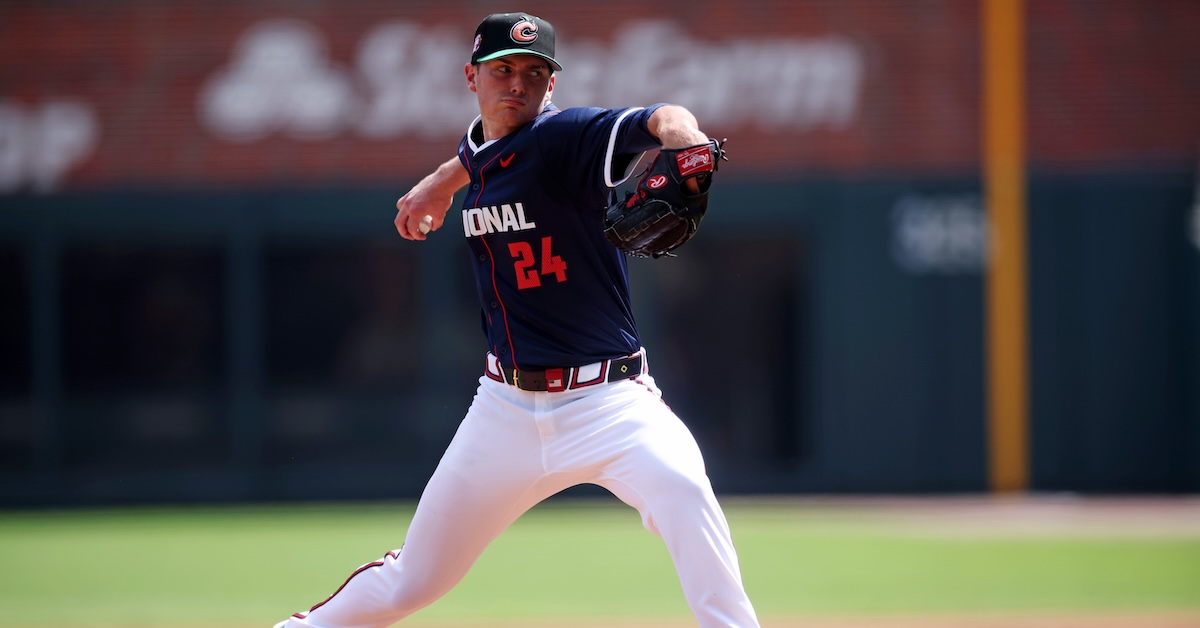
JR Richie Photo: Brett Davis-Imagn Images

Below is an analysis of the prospects in the farm system of the Atlanta Braves. Scouting reports were compiled with information provided by industry sources as well as my own observations. This is the sixth year we’re delineating between two anticipated relief roles, the abbreviations for which you’ll see in the “position” column below: MIRP for multi-inning relief pitchers, and SIRP for single-inning relief pitchers. The ETAs listed generally correspond to the year a player has to be added to the 40-man roster to avoid being made eligible for the Rule 5 draft. Manual adjustments are made where they seem appropriate, but we use that as a rule of thumb.

A quick overview of what FV (Future Value) means can be found here. A much deeper overview can be found here.

All of the ranked prospects below also appear on The Board, a resource the site offers featuring sortable scouting information for every organization. It has more details (and updated TrackMan data from various sources) than this article and integrates every team’s list so readers can compare prospects across farm systems. It can be found here.

Braves Top Prospects
Rk Name Age Highest Level Position ETA FV
1 JR Ritchie 22.7 AAA SP 2026 50
2 Didier Fuentes 20.7 MLB SP 2026 50
3 Cam Caminiti 19.6 A SP 2028 45+
4 Owen Murphy 22.5 A+ SP 2027 45+
5 Alex Lodise 22.0 A+ SS 2028 45
6 Garrett Baumann 21.6 A+ SP 2027 45
7 Luke Sinnard 23.4 A+ SP 2027 45
8 Diego Tornes 17.7 R LF 2030 45
9 John Gil 19.8 AA SS 2028 40+
10 Tate Southisene 19.4 A SS 2029 40+
11 Briggs McKenzie 19.4 R SP 2029 40+
12 Owen Carey 19.6 A CF 2028 40+
13 Conor Essenburg 19.5 R CF 2030 40+
14 Edelson Cabral 16.7 R SS 2032 40+
15 Raudy Reyes 17.5 R SIRP 2031 40
16 Eric Hartman 19.7 A CF 2028 40
17 Blake Burkhalter 25.5 AAA SIRP 2026 40
18 Rolddy Muñoz 25.9 MLB SIRP 2026 40
19 Carter Holton 23.5 A SP 2026 40
20 Luis Guanipa 20.2 A CF 2027 40
21 Landon Beidelschies 21.9 A SP 2028 40
22 Lucas Braun 24.5 AAA SP 2026 40
23 Drue Hackenberg 23.9 AAA SP 2026 35+
24 Ethan Bagwell 20.0 A SP 2029 35+
25 Hayden Harris 27.0 MLB SIRP 2026 35+
26 Herick Hernandez 22.6 A+ SIRP 2028 35+
27 Angel Carmona 18.4 R SS 2030 35+
28 Brett Sears 25.9 AAA SP 2026 35+
29 Cade Kuehler 23.8 A+ SIRP 2026 35+
30 Jose Perdomo 19.5 R 3B 2030 35+
31 Connor Thomas 27.8 MLB MIRP 2026 35+
32 Jose Manon 17.2 R SS 2032 35+
33 Starlyn De La Cruz 17.4 R CF 2032 35+
Reading Options
Detail Level
Data Only
Full
Position Filter
All

50 FV Prospects

1. JR Ritchie, SP

Drafted: 1st Round, 2022 from Bainbridge HS (WA) (ATL)
Age 22.7 Height 6′ 2″ Weight 185 Bat / Thr R / R FV 50
Tool Grades (Present/Future)
Fastball Slider Curveball Changeup Command Sits/Tops
50/50 50/55 50/55 45/55 45/55 92-95 / 97

Ritchie was Atlanta’s first-round pick back in 2022. After a scary arm injury early in 2023 put him on the shelf for more than a year, the right-hander came back showing no ill effects. He finished the 2024 season strong and then made 26 starts (27 if you want to count the Futures Game), tossing 140 innings across three levels last season. He finished with a 3.02 ERA and more than a strikeout per inning across nearly 60 frames of work in Triple-A, and is poised to become the first player from his high school — and mine! — to reach the big leagues.

Ritchie touches 97 with both of his fastballs, and after years of sitting 91-93, he added a tick and change in 2025, when his heater averaged 93.9 mph. While not a seismic breakout, it’s a meaningful step forward for a strike-thrower with a change and good feel to spin, one who has been on the 45/50 line in previous evaluation cycles. The extra velo gives him more wiggle room in the zone, and his ability to command the ball to both sides of the plate suggests he’ll fully leverage it.

Ritchie is a sum-of-his-parts pitcher. He’s a good athlete, and his low-effort, mostly-textbook delivery facilitates plenty of strikes. With both fastballs, a 12-6 curve, a slider, and a fading change, the righty is able to make the ball move in a lot of different directions, and can thus mix and match his attack to prey on the weaknesses of his opponents. He’s not going to be dominant, and he could wind up fairly dinger prone if he’s too loose within the zone, but the length and control give him the look of a solid innings-eater, a no. 4 with a shot to post a couple of mid-rotation campaigns at the peak of his arm strength, akin to the similarly-built Jake Odorizzi.

You Aren't a FanGraphs Member
It looks like you aren't yet a FanGraphs Member (or aren't logged in). We aren't mad, just disappointed.
We get it. You want to read this article. But before we let you get back to it, we'd like to point out a few of the good reasons why you should become a Member.
1. Ad Free viewing! We won't bug you with this ad, or any other.
2. Unlimited articles! Non-Members only get to read 10 free articles a month. Members never get cut off.
3. Dark mode and Classic mode!
4. Custom player page dashboards! Choose the player cards you want, in the order you want them.
5. One-click data exports! Export our projections and leaderboards for your personal projects.
6. Remove the photos on the home page! (Honestly, this doesn't sound so great to us, but some people wanted it, and we like to give our Members what they want.)
7. Even more Steamer projections! We have handedness, percentile, and context neutral projections available for Members only.
8. Get FanGraphs Walk-Off, a customized year end review! Find out exactly how you used FanGraphs this year, and how that compares to other Members. Don't be a victim of FOMO.
9. A weekly mailbag column, exclusively for Members.
10. Help support FanGraphs and our entire staff! Our Members provide us with critical resources to improve the site and deliver new features!
We hope you'll consider a Membership today, for yourself or as a gift! And we realize this has been an awfully long sales pitch, so we've also removed all the other ads in this article. We didn't want to overdo it.
Signed: International Signing Period, 2022 from Colombia (ATL)
Age 20.7 Height 6′ 0″ Weight 190 Bat / Thr R / R FV 50
Tool Grades (Present/Future)
Fastball Slider Curveball Changeup Command Sits/Tops
55/60 50/55 45/50 35/50 45/55 94-96 / 98

Fuentes entered 2025 with just 145.2 professional innings on his ledger, all in A-ball or on the complex. The 20-year-old made a meteoric rise through the system, starting three times at High-A, five at Double-A, and just once at Triple-A before the Braves summoned him to the majors for four starts. Big leaguers took him for a rough ride: He posted a 13.85 ERA, 9.14 FIP, and allowed six dingers in 13 innings. Still, last season was unambiguously positive for him, and we’re far less concerned about those major league outings than we are impressed with Fuentes’ trajectory.

Fuentes is advanced beyond his years. His delivery is simple and repeatable, with a quick and clean arm stroke and moderate effort throughout his delivery. He’s primarily a fastball/sweeper guy, and will sprinkle in a curve and splitter. He’s adept at spotting the fastball to the glove-side corner and the top rail of the zone, where mid-90s velo, plus extension, and a low release height all help it play as an above-average weapon. His low-80s sweeper projects similarly, and the interplay between that and a slurvier curve gives his breakers a couple of different shapes. As with the fastball, he can move his breaking balls around the plate. His splitter isn’t as advanced. He hasn’t thrown it much, and it’s often firm with limited sink. Improving this and his fastball command to the glove side seem like developmental priorities in 2026.

The quality of Fuentes’ best pitches and his aptitude for deploying them are both promising in the long run, and we’re comfortable projecting on both the change and command in a way that facilitates a no. 3/4 starter outcome. There’s an obvious comparison to Julio Teheran here, another advanced, 20-year-old Colombian righty whom the Braves promoted to The Show ahead of schedule. It would not surprise us if, like his countryman, Fuentes needs a couple years to find his bearings, nor would we be shocked if, like Teheran, he puts together a dozen-year career once he does.

45+ FV Prospects

Drafted: 1st Round, 2024 from Saguaro HS (AZ) (ATL)
Age 19.6 Height 6′ 0″ Weight 205 Bat / Thr L / L FV 45+
Tool Grades (Present/Future)
Fastball Slider Changeup Command Sits/Tops
45/55 50/60 35/50 45/55 92-95 / 97

Caminiti, cousin of the late Ken Caminiti, was a two-way star in high school even as his future was clearly on the mound. He signed for $3.5 million and has quickly grown into one of the top left-handed pitching prospects in baseball.

Caminiti is a plus athlete with great body control. He works out of the stretch and has a high leg kick that feeds into a long, crossfire delivery. He lands cleanly, and between that and a simple arm action, he has a great strike-throwing foundation. His fastball command is advanced for his age, as he’s able to work both sides of the plate and get to the top rail more reliably than just about all of his peers in Low-A. He’ll touch 97, but his fastball isn’t electric, as it sits 92-95 and misses bats more due to location, extension, and a flat release angle than velo. He gets good depth on his two-plane slider, and the way he releases the ball should give lefties fits. His change is a work in progress, a splitter with a lot of tail. It flashes, but it’s behind the other two offerings. No pitcher this age is a finished product, especially in this era, and you can imagine him adding a sweepy curve and/or a cutter as he matures to give him a little more variability; perhaps a two-seamer will be in the cards as well.

Caminiti was in consideration for our Top 100, and there’s an argument we should have just gone ahead and ranked the athletic southpaw. We had a couple of nitpicks. We want to see a little more consistency with his change, but also how his stuff looks in longer outings: Caminiti only threw 70 innings across his 17 starts last year, and given that his arm strength is just average at this point, we thought it prudent to see how he holds up under a more intense workload. This is a case where, if I was scouting for a team, I’d have just gone ahead and projected him as a no. 3. That’s still his long-term projection here, but from an FV standpoint, we can be a little more patient and see how things play out. Provided he passes that test, he’s in line to shoot toward the top of our list, as he has some of the highest potential in the system.

4. Owen Murphy, SP

Drafted: 1st Round, 2022 from Riverside-Brookfield HS (IL) (ATL)
Age 22.5 Height 6′ 1″ Weight 190 Bat / Thr R / R FV 45+
Tool Grades (Present/Future)
Fastball Slider Curveball Changeup Command Sits/Tops
50/55 45/55 50/55 40/50 45/60 88-92 / 95

Murphy was an under-slot first rounder in the 2022 draft. Selected as a polished high school arm with a carrying fastball either side of 90 mph, he had to battle through Low-A that summer and the following season. It looked like improved command and secondary feel was keying a breakout in 2024, but after seven dominant starts, he blew out. The injury happened early enough in the year for Murphy to get back on the field before the end of 2025, where he again overwhelmed High-A hitters.

Murphy’s game is to work the edges. He’s an above-average athlete with good body control, and his loose arm and flowing delivery form the basis of a plus command projection. His fastball has 20 inches of vertical break and he gets good extension, which has left lower-level hitters mostly helpless when he locates at the top rail. He’s able to do that consistently, and can also move his slider and change on and off the plate. His touch and feel is impressive for a pitcher his age, all the more so given how rusty pitchers often look in their return from Tommy John.

Length and durability will be key here, as Murphy’s stuff is more good than loud. He generates plus raw spin on his breakers and flashes a plus curve, but the pitch usually has too much hump to be a reliable bat-misser. He also has an average slider, tight but not especially sharp, while his change needs refinement. It’s a perfectly good mix for a starter, even at this velo band, but the margins are fine and if Murphy proves too hittable in a length role, he looks like more of a middle reliever than a high-leverage arm. We see a no. 4 ceiling and he could achieve that grade — and a spot toward the back of our next Top 100 — if he’s able to maintain the stuff he showed last summer over consistently deep outings and a heavier workload.

45 FV Prospects

5. Alex Lodise, SS

Drafted: 2nd Round, 2025 from Florida State (ATL)
Age 22.0 Height 6′ 1″ Weight 182 Bat / Thr R / R FV 45
Tool Grades (Present/Future)
Hit Raw Power Game Power Run Fielding Throw
20/30 50/55 35/45 55/55 50/60 70

Lodise signed for seven figures, receiving the third-highest bonus in the Braves’ spread-the-cash-around approach to the top of the 2025 draft. He performed well everywhere in an amateur career that included stops at North Florida and Florida State, along with a stint on the Cape. Scouts liked his glove and power, but were worried about his ability to hit, doubts that were reinforced by his post-draft numbers at High-A Rome. His topline production — .252/.294/.398, 110 wRC+ — was fine, but he registered 42 strikeouts and five walks in 109 plate appearances with scary peripherals under the hood.

Visually, Lodise has a shaky hit tool. He has above-average bat speed and raw power, but he’s a late and hard lander with his front foot, a combination that seems to leave him off balance when he isn’t sitting on the right pitch. He can manipulate the bat path, but it doesn’t always look natural: His A-swing features a steep, lofted path, while his flatter swings on balls up in the zone look pushy and a bit uncomfortable. Sometimes it works — he smoked a 108-mph double on a high fastball in a big league spring game the week before list publication with the latter swing — but he also ran a 35% whiff rate on heaters after the draft last year. That’s concerning on its own, but Lodise also has trouble with spin. On tape, you can find him flinching on front door strikes, chasing sliders well off the plate and in the dirt, or deciding to swing late on backdoor balls leaking over the plate. He’s going to need to do damage on contact, because it doesn’t look like he’s going to get the bat on the ball all that often.

Defensively, Lodise is a no-doubt shortstop. He moves well in all directions, his hands are fast, and he has a strong and accurate arm. Watching him, his instincts stand out, which is no small feat on video. Little things like his timing on when to leap for line drives, or how to get the ball out quickly from different angles, look big league quality, and I was impressed with the way he handled a couple of tricky plays at second, a position he’s barely ever played. Nobody’s perfect, and sometimes he’ll kick a ball when he has to hurry, but this is a very good defensive shortstop.

Reconciling it all, Lodise projects as a solid utility player, with a chance for better if he gets to more power than projected or if he can find a way to make more contact. His glove at short gives him a high floor if he makes any contact at all, and he looks like a guy who could play a long time in some kind of reserve role.

Drafted: 4th Round, 2023 from Hagerty HS (FL) (ATL)
Age 21.6 Height 6′ 8″ Weight 240 Bat / Thr R / R FV 45
Tool Grades (Present/Future)
Fastball Slider Curveball Changeup Command Sits/Tops
50/50 50/55 40/45 45/60 45/60 93-97 / 99

Baumann was Atlanta’s fourth rounder in 2023, signing for an over-slot $750,000. In a development that sequential readers of this list should not get accustomed to, he had a healthy and productive 2025 campaign, breezing through High-A with a 3.40 ERA, 22.5% strikeout rate, and a tidy 2.45 BB/9. If anything, the numbers undersell what looks like a mini breakout, as Baumann added two ticks of velo and now sits 93-97 with both of his fastballs, touching 99 with the four-seamer. It was a big and unexpected development for a pitcher with just fair fastball shape who didn’t seem especially projectable.

The velo is especially welcome because it was the only missing ingredient in what otherwise looked like a starter’s profile. Despite his immense frame, Baumann has excellent body control. He repeats his delivery well and has advanced fastball command for a pitcher his age, much less one his size. The additional velo has also sharpened all of Baumann’s breaking balls. He has an overhand curve, a slider, and a cutter, the latter two of which now project average. The potential out pitch is still the split. It’s a hard, high-80s offering with a big gap between how it looks at its best — plus, with nasty late tumble — and the meatball Baumann is prone to leaving out over the middle of the plate. It missed plenty of bats last year, but better hitters will take advantage of the mistakes in a way that A-ball opponents could not; refining the command of that pitch in particular looms as a developmental goal.

The more you look, the more there is to like here. All else being equal, we generally prefer pitchers with a low release angle, as that tends to help them miss bats upstairs. But Baumann’s stature gives him a release point that’s so unusually high that it should work just fine, and it also comes with well above-average extension. We’d like to see him throw more — he averaged a bit less than five innings per outing while pitching once per week in 2025, though he was starting to work deeper down the stretch — and ideally miss more bats before we go nuts, but Baumann has the look of an innings-eating No. 4 starter. He might even have a tick of upside beyond that, and he’s a sleeper for next year’s edition of the Top 100 if he’s able to hold his newfound velocity and execute his secondaries more consistently. The stuff has looked good early this spring; he’s an exciting follow in 2026.

7. Luke Sinnard, SP

Drafted: 3rd Round, 2024 from Indiana (ATL)
Age 23.4 Height 6′ 8″ Weight 250 Bat / Thr R / R FV 45
Tool Grades (Present/Future)
Fastball Slider Curveball Cutter Command Sits/Tops
50/50 55/55 55/55 55/60 30/40 92-94 / 96

This one comes courtesy of Eric, who selected Sinnard as a Pick to Click this offseason: The 6-foot-8 Sinnard only began playing baseball during his senior year of high school. He started his college career at Western Kentucky, then had a sophomore breakout at Indiana when he set the school’s single-season strikeout record with 114 Ks in 86.1 innings. He blew out during his Regional start at the end of 2023, had Tommy John, and was back in time to throw some scouted pre-draft bullpens in 2024, including at the Combine. Sinnard looked good enough in those settings for the Braves to use a third-round pick on him, then he saw his first pro action in 2025 and worked an efficient 72.1 innings split between Low- and High-A. He missed roughly six weeks in June and July recovering from an elbow stress reaction and picked up innings in Arizona during Fall League.

Sinnard has added a splitter that wasn’t there in college, he can mix breaking ball shapes from cutters to curveballs, and he commands a 92-96 mph fastball with uncommon precision for a guy his size. He isn’t the most fluid or graceful athlete, but he has a innings-eater’s build and pretty good feel for location. He’s a candidate to be the guy Atlanta pushes through the minors at a surprisingly quick pace in 2026, and is really only a more robust innings load from landing on our Top 100.

8. Diego Tornes, LF

Signed: International Signing Period, 2025 from Cuba (ATL)
Age 17.7 Height 6′ 3″ Weight 190 Bat / Thr S / R FV 45
Tool Grades (Present/Future)
Hit Raw Power Game Power Run Fielding Throw
25/50 50/60 25/60 50/45 40/45 40

Tornes was Atlanta’s biggest signing in the 2025 international class, inking a $2.3 million bonus. He had a solid first season in the DSL, hitting .279/.395/.402 with average exit velocity data, though he didn’t homer in his 32 games. He showed up to camp in great shape and even got into a game this spring, where he worked a walk against a big league reliever.

Tornes was signed for his stick. He’s quick to the ball with a fast bat and projects to grow into plus power at maturity. He can switch-hit, but his days of actually doing it may be numbered, as he was significantly better against righties last year, and it’s on that side of the plate where his hands and big bat speed really shine. His long-term defensive home is up in the air, though he did play exclusively in center last year. We’ll see in time; for now, the dearth of available complex video complicates the evaluation. Like any 17-year-old, he’s eons away from Atlanta, and we’re going to learn a lot more about him, as the jump in pitching is about to challenge him in a way that DSL arms mostly can’t. Those caveats aside, this is what a middle-of-the-order hitter looks like at this age, and Tornes has the highest offensive ceiling in the system.

40+ FV Prospects

9. John Gil, SS

Signed: International Signing Period, 2023 from Dominican Republic (ATL)
Age 19.8 Height 6′ 1″ Weight 205 Bat / Thr R / R FV 40+
Tool Grades (Present/Future)
Hit Raw Power Game Power Run Fielding Throw
30/50 45/50 30/45 60/60 45/50 55

Gil was a $110,000 signee in the 2023 international period, just enough to graze the radar. He’s been a pleasant surprise since, as plus wheels, solid defense, and a knack for making contact gave him the ceiling of an everyday shortstop.

Then he rolled into camp looking like a strong safety.

Gil’s new physique throws everything into question. For years now, he has graded out as a player with just enough power to be dangerous, but the calling card was his ability to shoot line drives and avoid striking out. Now, up 15 pounds of muscle, he’s hitting balls 110-plus mph, and he may get to above-average raw. At the plate, it’s a boon for a player who already had a promising hit tool, as his successful Low-A season as a 19-year-old stood out in an era where young players, particularly from Latin America, are struggling with the transition from the complex to full-season ball. His pitch recognition and strike zone judgment are mature for this demographic of player: Well-executed spin just off the plate and low is the one pitch he can’t handle, but even that’s less from an inability to recognize spin than from the way his swing pulls him off the dish.

Defensively, Gil has (or at least had) the range to be an average defender at short. He moves well to both sides and does a good job keeping himself in front of the ball where possible. The glovework itself needs polish, though nothing that can’t be cleaned up with time and reps. But suddenly there are a lot of ways this profile can go. Where once he looked like a prospective utility player with end-of-the-order upside on the strength of his glove, it now seems that there’s a little more impact in the bat and correspondingly more uncertainty defensively; a slide to third is a definite possibility. The talent and variance here makes him a high-priority follow in 2026.

10. Tate Southisene, SS

Drafted: 1st Round, 2025 from Basic HS (NV) (ATL)
Age 19.4 Height 5′ 11″ Weight 170 Bat / Thr R / R FV 40+
Tool Grades (Present/Future)
Hit Raw Power Game Power Run Fielding Throw
20/40 45/55 20/50 60/60 40/50 50

The Braves had a long gap between their first pick in the 2025 draft and their second, as well as one of the lowest bonus pools. They decided to spread the money around rather than take the top talent available at pick no. 22. There they grabbed Southisene, a high-variance athlete with middle-of-the-diamond projection and less certainty at the plate than you normally see at this spot in the draft. He’s a plus athlete and runner who could wind up being very good either at short or in center field. He’s twitchy and has good body control, which shows up both in his movements when he’s running or on defense, and at the plate, where he stays balanced despite a ton of big movements in his swing.

Southisene’s timing was off in his Low-A cameo last summer, when he struck out 27 times and walked only once in 66 plate appearances. Some of that is surely down to rust, as the stop-restart nature of late-season debuts doesn’t do these guys any favors. Mechanically, though, this is a high-maintenance swing, and things can get a little ugly if he isn’t aligned. It starts with a huge leg lift and then a late landing as he loads deep. He then swings very hard with a big scissor kick. There are a lot of ways to hit, and we aren’t rigid in our approach to how guys operate in the box, but Southisene was often landing far too late last summer. I’m inclined to give him a pass despite a huge whiff rate, particularly since he tended to hit the ball very hard when he did connect, and the adjustment he needs to make is manageable.

Southisene played a mix of second and short last summer, and looked really athletic doing it. He moves well in all directions, has a quick release, and looks like he has a knack for making plays on the run and at the edge of his range. His arm is light for short at the moment, but there’s a long way between now and when that’ll matter. For now, I’m projecting that it’ll be viable. Ultimately, this is an exciting prospect of extreme variance. There are tools galore here, and it behooves observers from all quarters to take a patient approach as he tries to figure out pro pitching.

11. Briggs McKenzie, SP

Drafted: 4th Round, 2025 from Corinth Holders HS (NC) (ATL)
Age 19.4 Height 6′ 1″ Weight 190 Bat / Thr L / L FV 40+
Tool Grades (Present/Future)
Fastball Curveball Changeup Command Sits/Tops
40/50 50/60 45/55 25/55 88-92 / 94

Tate Southisene was the top pick and Alex Lodise is the toolshed, but it was actually McKenzie who got the biggest bonus in Atlanta’s draft last year. He’s an athletic and projectable lefty with a clean, if long, arm swing and a two-plane breaking ball with long but sharp movement. He also has pretty good change up feel for a high schooler, and his ability to hit both sides of the plate with the fastball is similarly advanced. McKenzie’s size complicates the long-term evaluation. He’s tall and moves well, but he’s very thin. Eric comp’d him to Triston McKenzie last year, and while I wouldn’t go that far, he has the look of someone likely to stay wiry. Sometimes those guys hold up — Chris Sale, to name one, mostly has — but this isn’t a Skenes or Kershaw level of physicality. Perhaps he’ll find a way to fill out in a pro environment, and if doing so helps push McKenzie’s arm strength from the fringy/average line to something more, the ceiling is pretty high given how polished he is. For now, he projects as a high-variance no. 4.

12. Owen Carey, CF

Drafted: 15th Round, 2024 from Londonderry HS (NH) (ATL)
Age 19.6 Height 6′ 0″ Weight 185 Bat / Thr L / L FV 40+
Tool Grades (Present/Future)
Hit Raw Power Game Power Run Fielding Throw
30/50 40/50 30/45 55/55 45/50 50

Carey was a 15th rounder in 2024 who signed for a modest bonus out of high school, an increasingly rare player demographic. He quickly emerged as an intriguing outfield prospect, a do-a-little-bit-of-everything type and a sleeper in this system for both scouts and analysts. He has gotten a little bit of run in big league games this spring, where he has taken good at-bats against major league arms while looking stronger than he did a year ago.

Carey has a plan at the plate. He’s looking to drive the ball early in counts, and he’ll dust off the A-swing when he’s ahead and sitting on a fastball. When behind, he’s able to shorten up and spray line drives, and he has the bat control to go the other way and adjust off the fastball. The swing itself is simple, connected and on time with enough adjustability to hit pitches all over the zone. Soft stuff low and away poses a challenge, but that’s hardly unique to Carey. Defensively, he saw time at all three outfield spots last year. Normally that’s a harbinger for a corner, but Carey is fast and has good instincts out there; perhaps he’ll slow and need to move off of center, but for now, he projects as an average defender up the middle.

How much power is coming here? Carey didn’t hit for a ton of pop last season, and his style at the plate suggests he’s going to be more of a doubles guy than a bopper. He has the ceiling of a big league regular if I’m wrong about that, but between questions about the power and the chance that he’ll need to slide down the defensive spectrum, I’m projecting him as a quality fourth outfielder for now. Ultimately, he’s a skilled player for his age, and the way he’s a favorite for different types of evaluators kept pushing him up the list.

13. Conor Essenburg, CF

Drafted: 5th Round, 2025 from Lincoln-Way West HS (IL) (ATL)
Age 19.5 Height 6′ 2″ Weight 200 Bat / Thr R / L FV 40+
Tool Grades (Present/Future)
Hit Raw Power Game Power Run Fielding Throw
20/40 45/55 25/50 55/60 40/50 60

Essenburg is a cold-weather prep bat who signed for more than a $1 million, Atlanta’s final big investment in a stratified 2025 draft. He has the physicality of a power-hitting corner outfielder and, for now at least, the speed to project as a center fielder. He has long levers and a steep swing but enough bat speed to make it work, and, surprisingly given the demographic and bat path, he ran a 90% contact rate on the showcase circuit. With no pro track record to go off, this is a boom-bust profile, and the Braves may need to stay patient as Essenburg adjusts to pro-caliber velo and spin. But both on paper and video, there’s a lot to like here. In a system desperate for high-upside bats, Essenburg is a really intriguing addition and a player I’m interested to follow in 2026.

14. Edelson Cabral, SS

Signed: International Signing Period, 2026 from Dominican Republic (ATL)
Age 16.7 Height 6′ 1″ Weight 170 Bat / Thr L / R FV 40+
Tool Grades (Present/Future)
Hit Raw Power Game Power Run Fielding Throw
25/55 35/45 20/45 50/50 40/50 55

This one comes from Eric’s overview of the 2026 international class: Cabral was originally going to sign with the D-backs for roughly $200,000, but he got better and re-entered the market, where his deal with Atlanta grew to almost $600,000. He’s a well-rounded infielder with great footwork and hands. On offense, Cabral is a contact-oriented lefty with burgeoning thump thanks to improving athleticism. He isn’t super projectable but is otherwise a pretty complete prospect, and one of the better six-figure prospects in the 2026 class.

40 FV Prospects

15. Raudy Reyes, SIRP

Signed: International Signing Period, 2025 from Dominican Republic (ATL)
Age 17.5 Height 6′ 4″ Weight 200 Bat / Thr R / R FV 40
Tool Grades (Present/Future)
Fastball Slider Curveball Command Sits/Tops
60/70 60/60 45/55 20/35 96-99 / 101

Teams are often leery of giving big bonuses to pitchers in the international market, but the Braves rolled the dice on Reyes, and spent $1.8 million to see if they could turn elite arm strength into impact pitching. The Dominican flamethrower lulls batters into a false sense of security with his languid delivery. He has a slow leg rise and a low-effort motion that produces some of the easiest upper-90s velocity you’ll find. His fastball touches 101 and comes with an average of 18 inches of vertical break, though his high-three-quarters slot limits the efficacy of that somewhat. He can spin it too, most apparently in a visual way with his sharp and slurvy curve, but he’s also got a hard and tight slider that ran roughshod over DSL bats.

All of this sounds promising, but Reyes isn’t on the fast track. He isn’t a great athlete, and he’s having a ton of trouble getting to release consistently. He’s all over the place with everything, and so while nobody could hit him last year (20 hits and 35 strikeouts in 27 innings), nobody can really catch him yet either (10 wild pitches, 29 walks, two poor hit batsmen). He’s big and young and deserves time to grow into his frame and limbs. With stuff like this, you can live with even well below-average control in some capacity. He’s projected here as a late-inning reliever, though the variance bars are almost as big as Reyes himself. Atlanta should give him every chance to start, as his ceiling is sky high if he can find a way to throw strikes.

16. Eric Hartman, CF

Drafted: 20th Round, 2024 from Holy Trinity Academy (CAN) (ATL)
Age 19.7 Height 6′ 1″ Weight 185 Bat / Thr L / R FV 40
Tool Grades (Present/Future)
Hit Raw Power Game Power Run Fielding Throw
20/40 35/45 25/40 70/70 40/55 40

Hartman was an over-slot pick out of an Alberta high school in 2024. Despite the cold weather background, he worked his way into the Low-A lineup in short order. Speed is the outlier trait here, and he made good use of it, stealing 48 bases in 54 attempts on the season. Defensively, he saw time in left and center field, and at second base. Hartman is still getting his feet wet up the middle, but with his wheels, he should be at least average there at maturity. The question is how much he’ll hit. He held his own in Low-A, but Hartman isn’t likely to grow into a ton of power, and the pull-heavy nature of his swing path looks like it might wind up producing a lot of weak grounders to the pull side. Still, it’s better to pull the ball a tick too much than to have the opposite problem, and his approach was pretty good, particularly for someone with limited previous exposure to high-level baseball. He projects as a versatile fourth outfielder.

Drafted: 2nd Round, 2022 from Auburn (ATL)
Age 25.5 Height 6′ 0″ Weight 204 Bat / Thr R / R FV 40
Tool Grades (Present/Future)
Fastball Slider Curveball Splitter Cutter Command Sits/Tops
55/60 50/55 40/45 45/50 50/50 35/40 93-97 / 99

Burkhalter blew out soon after Atlanta drafted him in 2022. He didn’t make his full-season debut until 2024 and has worked back to full strength somewhat slowly. He split time between the rotation and bullpen last season as a way to manage innings (there was no uptick in his stuff in relief, strangely), and had a solid, if unspectacular campaign across both upper levels.

Burkhalter is probably a reliever. There’s a violent shoulder torque in his delivery, and the effort involved induces a head whack and a heel grind, both of which make it hard to command the ball. Starting isn’t out of the question — he’s kept his walk rates in check throughout his career and he has the arsenal depth to turn a lineup over — but the stuff itself may not support a multi-inning role. While his fastball touches 99 and has 19 inches of vertical break, none of his secondaries reliably miss bats. Burkhalter’s slider and split drop late at their best, though the former doesn’t have the velocity to induce a bunch of chases out of the zone, and he doesn’t have a ton of feel for the latter just yet. He leans more on the cutter anyway, which helps manage contact, albeit with a lower whiff rate than the split or slider.

There are orange flags in the batted ball profile as well, as Burkhalter is a fly ball pitcher who has gotten by thus far in part on his ability to suppress homers. That’s a tough game to play and the guess here is that he doesn’t get away with it against elite hitters. It all feels a tick light for regular rotation work. While it’s a little odd that Burkhalter didn’t get much of a velo bump in relief last year, I suspect he will in the long run, especially if he’s mostly working in one-inning stints. If he can sit closer to the top of his velo range, and if his breaking balls see a corresponding increase in sharpness, his stuff should play just fine in a mid-leverage relief role.

18. Rolddy Muñoz, SIRP

Signed: July 2nd Period, 2018 from Dominican Republic (ATL)
Age 25.9 Height 6′ 2″ Weight 183 Bat / Thr R / R FV 40
Tool Grades (Present/Future)
Fastball Slider Command Sits/Tops
60/60 65/70 30/35 96-99 / 100

Muñoz again struggled with walks in 2025, though he pitched well for stretches and worked his way up to Atlanta for a cup of coffee. The 25-year-old is a slingy low-slot reliever with a loose arm swing. He generates elite arm strength with very little effort, and touches triple digits with both fastballs. Neither has great shape, and the way Muñoz falls off the mound limits his ability to consistently throw strikes. He has a plus slider with late bite, and I wouldn’t argue with anyone inclined to project a 70 on it.

Muñoz is a good candidate for a “throw it down the middle and see what happens” approach because his stuff is good enough to live in the zone. Walks — his career BB/9 is 4.5 and it hasn’t gotten better in the upper levels — are the main thing separating him from a C1, mid-to-high-leverage evaluation. A scintillating run through the Dominican Winter League, where he struck out 14 and walked two in 9.2 innings of work while notching a 0.93 ERA, offers a glimpse of how his stuff can play when he limits traffic on the bases. As is, Muñoz projects as a low-to-mid-leverage reliever who occasionally teases more.

19. Carter Holton, SP

Drafted: 2nd Round, 2024 from Vanderbilt (ATL)
Age 23.5 Height 5′ 11″ Weight 191 Bat / Thr L / L FV 40
Tool Grades (Present/Future)
Fastball Slider Curveball Changeup Command Sits/Tops
45/45 55/60 45/45 45/50 30/40 92-94 / 97

Holton, Atlanta’s second rounder in 2024, made one pro start before he blew out and required TJ, which knocked him out for all of the 2025 season. The lefty’s track record in college was spotty — after a stellar freshman year, his ERA climbed a full run in each successive season — and his delivery has a few relief markers in it: He’s not especially loose, and the effort level often pushes him off balance toward third base. As Eric covered in last year’s list cycle, in his lone pro appearance, Holton worked with a hard and tight slider in the upper 80s in lieu of the shapely but softer curve he deployed in college. It’ll be interesting to see what his breaking balls look like in his return to action, as the slider looks like a better bat-misser and fit for the bullpen role he’s likely to slide into.

20. Luis Guanipa, CF

Signed: International Signing Period, 2023 from Venezuela (ATL)
Age 20.2 Height 5′ 10″ Weight 175 Bat / Thr R / R FV 40
Tool Grades (Present/Future)
Hit Raw Power Game Power Run Fielding Throw
30/50 40/45 30/40 60/60 40/45 40

Guanipa is an odd duck. He was a $2.5 million international signee but, plus wheels aside, he’s not especially toolsy or projectable. Instead, he makes a lot of contact and has some of the best measurable swing decisions I’ve encountered: His overall swing rate is about average, but he damn near always pulls the trigger on balls in the heart of the plate, which is exactly what you want to see. The way he does it is a little scary, though. He’s an open strider with an inside-out swing, and is only really able to pull pitches with authority if they’re right on the inside corner. Short levers help him get away with average bat speed, but there’s not a whole lot of physical projection, and Guanipa is already playing more right field than center; he’s also missed a ton of time with injuries. The long-term hope is that he has a little more strength coming than you’d think just eyeballing him, and that he’s able to grow into average power while maintaining his bat-to-ball skill and approach against better arms. It’s a fourth-outfielder ceiling, and Guanipa’s feel for the barrel gives him a puncher’s chance to reach it.

Drafted: 6th Round, 2025 from Arkansas (ATL)
Age 21.9 Height 6′ 3″ Weight 230 Bat / Thr L / L FV 40
Tool Grades (Present/Future)
Fastball Slider Curveball Changeup Command Sits/Tops
35/40 50/55 45/50 45/50 40/50 91-93 / 95

After two years at Ohio State, Beidelschies transferred to Arkansas for his junior year, where he worked out of the rotation and helped the Razorbacks make a deep run in the College World Series. The Braves selected him in the sixth round, and they’re getting a good strike-thrower with two above-average secondaries — generally more than you can ask for in that part of the draft. The issue is Beidelschies’ fastball. It sits in the low 90s without bat-missing shape and comes out of a three-quarters slot; it basically behaves exactly as a hitter would expect. Both in college and during his Low-A cameo, opponents did a lot of damage against the heat, and something will have to give here for the southpaw to reach this projection. Beidelschies’ feel to spin both a slider and a curve should be tough on lefties in one role or another, and there’s enough of a change to give him a shot at a length role. He’s a sneaky interesting follow this spring: If Atlanta can change tweak something to make the fastball more playable, he has the foundation of a quick-moving backend starter. If not, we’re likely looking at a future lefty reliever.

22. Lucas Braun, SP

Drafted: 6th Round, 2023 from Cal State Northridge (ATL)
Age 24.5 Height 6′ 0″ Weight 185 Bat / Thr R / R FV 40
Tool Grades (Present/Future)
Fastball Slider Curveball Changeup Command Sits/Tops
40/40 45/45 45/45 45/50 50/60 92-94 / 96

Braun hit the ground running in pro ball, and after ascending to Triple-A late last season, he’s another upper-level arm in line for big league starts in 2026. Most guys with this command projection and a history of plus control are graceful, if unexplosive, athletes, but Braun is both a forceful and precise mover; in another life, he might’ve been a great gymnast. His delivery isn’t simple, as there’s a high leg kick and long stride, and the effort level leads to some head movement at finish, but he’s balanced throughout with a clean arm swing. Deception is key here as well, both modern (a slightly low release) and old school (glove throw, a little hesitation toward the top that can mess with timing).

All of those factors are going to be important to maintain because Braun’s stuff is just okay. He works with both fastballs and sits in the low 90s with unremarkable shape. He has the full package of secondaries, and while the variety gives him a lot of ways to attack, he doesn’t have an out pitch. The ceiling is as a sum-of-his-parts no. 5, while the median projection is a length guy who can flex in and out of the rotation as needed.

35+ FV Prospects

23. Drue Hackenberg, SP

Drafted: 2nd Round, 2023 from Virginia Tech (ATL)
Age 23.9 Height 6′ 2″ Weight 220 Bat / Thr R / R FV 35+
Tool Grades (Present/Future)
Fastball Slider Curveball Changeup Cutter Command Sits/Tops
40/45 40/44 45/50 30/40 40/50 30/40 92-95 / 96

Hackenberg was one of Atlanta’s biggest risers on last year’s list, as he had ridden his new fastball to a breakout 2024 campaign that finished with four successful starts in Triple-A. Last season was the opposite experience, as he never got in a rhythm and turned in 18 mostly disastrous Double-A outings. Pretty much every number plunged dramatically, most alarmingly his walk rate, going from a shaky 4.33 BB/9 in 2024 to an untenable 6.57 last season. A year after looking like a big league option, Hackenberg is now at something of a career crossroads.

If there’s a silver bullet answer as to what happened, it may be the oblique injury that pushed him onto the IL in mid-May. He spent the better part of two months on the shelf, and while he wasn’t really better on one side of his IL stint than the other, it would explain a couple things. Visually, Hackenberg’s delivery looked less dynamic last year, and he experienced a corresponding, if slight, velocity dip. An ab injury is also the kind of thing that could make it difficult to execute a delivery consistently, and thus might have something to do with the big surge in walks.

The hope is that a new year sparks a return to form. What that means is up for debate, though, as Hackenberg was already a bit of an “eye of the beholder” type. Even at his peak, he was a 40 strike-thrower with a fair sinker/four-seam mix. Eric projected a 60 slider last year, and while he’s not an island in liking that pitch, other sources don’t see it the same way, and I’m more in the latter camp as well. Ultimately, even with a bounce back I see Hackenberg as more of a middle relief option, with a little upside if a clean bill of health and more reps fuel both better command and a fully actualized breaking ball.

24. Ethan Bagwell, SP

Drafted: 6th Round, 2024 from Collinsville HS (IL) (ATL)
Age 20.0 Height 6′ 4″ Weight 230 Bat / Thr R / R FV 35+
Tool Grades (Present/Future)
Fastball Slider Changeup Command Sits/Tops
40/45 45/55 40/50 40/55 90-93 / 96

Atlanta’s sixth rounder in 2024, Bagwell signed for an over-slot $820,000. He’s a relatively slow-twitch athlete with a strong frame — he was a quarterback in high school — and a repeatable, low-three-quarters delivery. His ability to hit both sides of the plate with all three of his weapons is advanced for his age. He’s particularly good at getting the fastball to the glove-side corner and fading the change off the plate to the arm side. His change and sweeping slider aren’t fully baked, but they flash above average. Despite a tight pitch count, Bagwell averaged five innings across his 10 Low-A starts. Part of that is because he’s an efficient strike-thrower; more concerningly, opponents didn’t swing and miss much, and hit into a lot of the outs he registered. Even though he’s got a very low release, his low-90s fastball (and correspondingly fringy arm strength on everything else) just isn’t conducive to generating swing and miss, and he fanned only 15.5% of Low-A opponents. Perhaps he could emphasize his four-seamer up in the zone more often, as that played like a bat-misser here and there. As is, he projects as a quick-moving longman with a control foundation but not a ton of projection.

25. Hayden Harris, SIRP

Undrafted Free Agent, 2022 (ATL)
Age 27.0 Height 6′ 0″ Weight 186 Bat / Thr L / L FV 35+
Tool Grades (Present/Future)
Fastball Slider Splitter Command Sits/Tops
55/55 50/50 40/50 35/40 89-91 / 92

Harris is a drop-and-drive lefty with a quick arm and a very low release point. If that’s not enough deception for you, he also generates about seven feet of extension. Minor league hitters have been unable to deal with his carrying fastball, and it has performed like a plus (or better) pitch even though he sits either side of 90 with it. He’ll mix in an average sweeper and a split that flashes, but Harris is attacking with the fastball and his success is predicated on sneaking it above barrels. He didn’t manage that in a very brief big league cameo last September, but he was dominant in the minors — 79 strikeouts in 52 innings with a 0.52 ERA between Gwinnett and Columbus — and deserves another crack at the majors. He projects as an optionable bullpen arm, and has the ceiling of a more regular middle reliever if the deception translates better than I’m anticipating.

26. Herick Hernandez, SIRP

Drafted: 4th Round, 2024 from Miami (ATL)
Age 22.6 Height 5′ 10″ Weight 205 Bat / Thr L / L FV 35+
Tool Grades (Present/Future)
Fastball Slider Curveball Changeup Command Sits/Tops
50/55 50/55 40/45 40/50 30/40 91-94 / 95

Hernandez is a lefty with a simple “fastball up, slider/curve/occasional change down” approach. His four-seamer reaches the mid-90s with nearly 20 inches of vertical break, and the slider flashes above average, so it’s mostly worked so far despite the predictability. Partly because he’s frequently chasing whiffs out of the zone, but also due to a very long and deep arm swing, his control and command are both well below average. Between that and a somewhat shallow arsenal — he’s mainly fastball/slider — Hernandez is almost certainly a reliever. He could sit in the mid-90s with a 55 snapper, though, which is enough to keep any lefty employed.

27. Angel Carmona, SS

Signed: International Signing Period, 2025 from Venezuela (ATL)
Age 18.4 Height 6′ 2″ Weight 195 Bat / Thr R / R FV 35+
Tool Grades (Present/Future)
Hit Raw Power Game Power Run Fielding Throw
20/40 30/50 20/45 50/50 30/50 50

The Raudy Reyes and Diego Tornes signings didn’t leave a whole lot of spending room in the Braves’ 2025 international class, but they managed to find an interesting shortstop with their third-largest expenditure, too. Carmona is an above-average, high-waisted athlete with good bat speed for his age and max exit velo data that suggests he could grow into average power, if not more. His path can get steep and, as is the case for many a teenager in the DSL, spin recognition looms as a potential issue. For now, though, he’s toolsy and performing — .253/.374/.453, 119 wRC+ with acceptable strikeout totals and a 14.3% walk rate — which makes him an intriguing follow.

28. Brett Sears, SP

Drafted: 7th Round, 2024 from Nebraska (ATL)
Age 25.9 Height 6′ 0″ Weight 205 Bat / Thr R / R FV 35+
Tool Grades (Present/Future)
Fastball Slider Curveball Changeup Cutter Command Sits/Tops
40/40 40/45 40/45 45/55 45/50 45/60 88-92 / 94

A year after he was selected in the seventh round, Sears checked in at all four of the Braves’ affiliates, as his advanced control proved too much for low-level hitters to handle. There’s a lot riding on Sears’ ability to turn that control into plus command or better, because the stuff is soft. His fastball sits either side of 90, and while he gets a little carry on it from a low-three-quarters release, he’s not going to be able to miss big league bats with it as reliably as he did in Double-A. He can throw strikes with the rest of the mix, but there isn’t an out pitch here — his Bugs Bunny change comes closest, but it’s also the pitch he has the least feel for — which means he’ll need to be very sharp for this to work. In particular, that means a more consistent release point, as his outings often feature a mix of surgically accurate locations and pitches that miss the target by a foot to the east or west. The forecast here is for more of the former and less of the latter as he matures, and with it, a spot starter projection.

29. Cade Kuehler, SIRP

Drafted: 2nd Round, 2023 from Campbell (ATL)
Age 23.8 Height 6′ 1″ Weight 205 Bat / Thr R / R FV 35+
Tool Grades (Present/Future)
Fastball Slider Splitter Command Sits/Tops
40/55 55/60 30/45 30/40 89-92 / 94

Kuehler got seven figures in the 2023 draft. Though he was a reliever in college, Atlanta opted to develop him as a starter, and in the rotation, his stuff backed up a little bit. Up to 98 in college, he was sitting in the 89-92 mph range in pro ball with a diminished slider. He also seemed to scrap his college curveball and instead began working with a splitter, which was fresh and relatively ineffective. He then blew out and needed Tommy John surgery in the middle of the 2024 season.

After missing all of 2025, the former Campbell Camel is healthy again and throwing down in Florida. Between the injury, the role change, and the deterioration of his stuff, there’s quite a bit up in the air right now, enough so that I’m rounding down on his FV. In the long run, a relief fit seems most likely, and we’ll see if he can get back to the above-average stuff he had in college. His projections reflect my optimism that he’ll be able to. One way or the other, we’ll know more soon.

30. Jose Perdomo, 3B

Signed: International Signing Period, 2024 from Venezuela (ATL)
Age 19.5 Height 6′ 1″ Weight 195 Bat / Thr R / R FV 35+
Tool Grades (Present/Future)
Hit Raw Power Game Power Run Fielding Throw
25/50 45/50 25/45 40/40 35/50 60

Perdomo signed for $5 million in the 2024 class, the highest bonus ever inked by a Venezuelan player. He played just eight games while battling hamstring injuries in his first season, then endured a rocky 2025 campaign on the Florida complex, where he hit .223/.275/.270. He was signed in large part for his feel to hit, and while a 79% contact rate is decent for an 18-year-old in the FCL, it isn’t awesome, particularly if it comes without power and a tendency to chase stuff off the plate. Defensively, even though he’s played nothing but shortstop thus far, the stiffness in Perdomo’s lower half could force him off the position, which external sources think will happen eventually. It’s not what you want to see when you give all of your bonus pool to one guy.

31. Connor Thomas, MIRP

Drafted: 5th Round, 2019 from Georgia Tech (STL)
Age 27.8 Height 5′ 11″ Weight 195 Bat / Thr L / L FV 35+
Tool Grades (Present/Future)
Fastball Slider Changeup Cutter Command Sits/Tops
40/40 55/55 50/55 50/50 40/45 88-91 / 92

Thomas was Milwaukee’s Rule 5 pick last offseason, and he made a couple of big league appearances in the spring before he developed bone spurs in his elbow. That required an internal brace procedure, which knocked him out for the rest of 2025; he’s just now throwing again. The Brewers outrighted him off the roster after the season, which led him to Atlanta. Thomas gets by on movement instead of velocity. Working out of a low-three-quarters slot, he barely crests 90 mph with his sinker, but the pitch’s late tail and drop misses barrels and pairs well with an upper-80s cutter. He’s good at peppering the arm-side corner with those, as well as a change and sweeper that share similar shapes but add velo variability. Thomas projects as an optionable reliever, though as an odd-look lefty, he could be a longer-term roster fit in the right situation.

32. Jose Manon, SS

Signed: International Signing Period, 2026 from Dominican Republic (ATL)
Age 17.2 Height 6′ 2″ Weight 175 Bat / Thr R / R FV 35+
Tool Grades (Present/Future)
Hit Raw Power Game Power Run Fielding Throw
20/30 40/55 20/50 50/40 40/50 60

Another from Eric’s overview of the 2026 international class: Manon stood out for his bat speed and physical projection on Dominicana’s U-18 PanAm qualifier roster late in 2024, but also struggled with his timing at the dish and often looked out of control. He has the athleticism and arm strength to develop at shortstop, but his size puts him on the 3B/SS line for the long haul. His contact puzzle piece made him a high-variance $1.5 million bet by Atlanta in the 2026 international class.

Signed: International Signing Period, 2026 from Dominican Republic (ATL)
Age 17.4 Height 5′ 9″ Weight 170 Bat / Thr L / L FV 35+
Tool Grades (Present/Future)
Hit Raw Power Game Power Run Fielding Throw
20/50 30/40 20/40 60/60 45/60 45

Another from Eric’s overview of the 2026 international class: De La Cruz is a speedy, lefty-hitting outfielder whose $1.2 million deal was one of the earlier seven-figure agreements in the 2026 class. He’s a smaller guy with more of an old school leadoff hitter’s profile.

Other Prospects of Note

Grouped by type and listed in order of preference within each category.

DSL Crew
Dayner Matos, RHP
Yoelvis Betancourt, C
Michael Martinez, OF
Juan Mateo, INF
Mario Baez, SS

The Braves have spent big on their top international signees in recent years, which has left them thin on the complexes, even though they only have one DSL squad. Matos was already 21 when he debuted and pitched well out of the rotation in the DSL. He’s a good athlete, up to 96, and can spin a breaking ball. Betancourt makes a ton of contact and, at least on the grainy videos available to me, is posting pop times in the low 1.90s. He’s on the small side for the position. Martinez has projectable power and hit his way from the DSL complex to Florida last year. Mateo has a utility infielder’s ceiling, but questions about everything from his fit at shortstop and his arm strength projection to his ability to cover the outer half of the plate leave too many things up in the air for the main section of the list. Baez performed in the DSL back in 2023 and he remains an interesting athlete, but after flirting with the Mendoza Line again, he’s going to need a junior year in the FCL.

Reliever Battery
Cedric De Grandpre, RHP
Jhancarlos Lara, RHP
Jeremy Reyes, RHP
Elison Joseph, RHP
Anderson Pilar, RHP
Austin Pope, RHP
Blane Abeyta, RHP
Rayven Antonio, RHP

De Grandpre missed all of 2024 recovering from Tommy John surgery and was erratic in his return. He has average arm strength or a tick more, but the fastball plays down due to its shape. He’ll flash a plus slider, and there’s a chance everything clicks for him in relief. Lara has upper-90s heat and a slider that flashes above average, but he’s also very scattered and prone to leaving both offerings over the heart of the plate. A shift to relief didn’t help. The arm strength will always give him latent upside, but it’s 20 pitchability right now. Reyes had a good year out of Augusta’s rotation. He has a low slot and a mid-90s fastball, but he’s not a great athlete or strike-thrower and doesn’t yet have an average breaking ball.

Joseph is a stiff athlete with an upper-90s fastball and a slider that flashes plus. He walked more than a batter per inning in Double-A last year and is a threat to hit the bull at any time. A closer for Gigantes del Cibao in the Dominican Winter League, Pilar is a sinker/cutter/slider reliever with average command and stuff. The Braves must like him because they’re back to the well again after an unsuccessful Rule 5 attempt last year. Pope debuted with Arizona last September and signed a minor league deal. He has a bunch of average offerings and is projected for an up-down role here. Abeyta is an upper-level reliever with a good slider/cutter; his fastball has worked in the mid-minors, but it looks fringy. In addition to having the coolest name in the system, Antonio added three ticks to his fastball in 2025 and saw his strikeout rate nearly double year over year. All of his secondaries are below average and need work; the splitter looks like the most promising of the group.

Good Control, Light Stuff
Davis Polo, RHP
Luis Arestigueta, RHP
Ian Mejia, RHP

Polo is a projectable righty with a starter’s frame and command, and projectable secondaries. He has main section talent, but he strained his rotator cuff in August of 2024 and hasn’t appeared in a game since, so we’re sliding him down here until we see how everything looks on the field. Arestigueta has a starter’s delivery and shapely stuff, but he badly needs to get stronger. Mejia has plus control of a mostly fringy pitch mix and projects as a depth length arm. To my eye, his slider is on the 45/50 line, but it has played well for years and will play a key role if he exceeds this forecast.

Bench Bats
Dixon Williams, INF
Cody Miller, INF
David McCabe, INF
Patrick Clohisy, OF
Kevin Kilpatrick Jr., OF
Adam Zebrowski, C
Jim Jarvis, SS
Luke Waddell, INF

Williams signed for just shy of $500,000 last year. He has plus speed, a good approach, and a little versatility on the infield, but there isn’t much power, and his lack of contact, especially on spin, in his Low-A debut was a little concerning. If that improves, or he can become even more versatile defensively, you can see a potential roster fit. Miller, Atlanta’s third rounder last year, is a plus runner who has played shortstop and third base thus far. He hit for a ton of power as a junior at East Tennessee State, but likely won’t as a pro. To my eye, he’s had more of a bat wrap in his at-bats this spring, and the additional length doesn’t work well with his bat speed.

McCabe is a tweener, a corner infielder with a third baseman’s bat and a first baseman’s defensive abilities. Clohisy is a burner who stole 100 bases last year if you count his AFL stint. He’d have been an easier roster fit in the five-man bench era. Kilpatrick is a speedy center fielder who has long projected as a fourth or fifth outfielder, but the way he’s struggled at the plate in recent seasons suggests a fifth or sixth outfielder projection would be more appropriate. Zebrowski has plus power, and is a subpar, if playable, defensive catcher. Jarvis is a fundamentally sound shortstop defender with a light bat. Waddell gets the bat on everything (his 87% contact rate paced the system), but he’s a singles hitter and stretched at shortstop.

Tools, Shaky Feel to Hit
Isaiah Drake, CF
Ambioris Tavarez, SS
Nick Montgomery, C

Drake shortened his once unviable swing, and he’s now making an appropriate amount of contact. It’s still an odd swing, though, and I’m concerned about both the chippy bat path and his tendency to get off balance. He has a fourth outfielder’s ceiling, but I’m a little skeptical he’ll hit enough. Tavarez’s ability to play short helped him stay on scouts’ radar even while he was running untenable strikeout rates as a teenager. He’s still doing that, and this may not work even in an up-down capacity. Montgomery entered 2025 as a potential breakout catching prospect with projectable power and soft hands behind the plate, but he looked overmatched at the dish and struggled behind it. If anybody deserves the benefit of the doubt on a rough debut season, it’s a large-framed seven-figure high school catcher who skipped the complex despite limited showcase experience as an amateur; hopefully he can get back on track in 2026.

System Overview

Last week, we highlighted the Tigers as the most hitter-heavy system in the game; Atlanta is the opposite. There isn’t a safe bat in the entire system, and the upper levels in particular are almost entirely bereft of prospects at all. We saw the consequences last summer, when a run of injuries, underperformance, and Jurickson Profar’s suspension highlighted the org’s lack of upper-level depth and thrust glove-only backups into load-bearing starting roles. The seven-figure signings of Tate Southisene, Alex Lodise, and Conor Essenburg, as well as positive years for John Gil, Owen Carey, and Eric Hartman, signal that help is on the way, if not imminently.

A few factors explain why this is such a thin system. The Braves tend to promote guys quickly, they’re always drafting late, they only have one DSL team, and they’ve tended to sink most of their international bonus pool into a guy or two, all of which limits the club’s ability to accumulate minor league depth. And while injuries and pitching underperformance hit every farm, they perhaps bit Atlanta’s a little harder than most last year. Several arms toward the bottom of the main section are down relative to a season ago, which had a further deflationary effect.

The good news is that there are a lot of arrow-up pitchers toward the top of the group. Didier Fuentes rocketed to the big leagues, Owen Murphy is back healthy, and JR Ritchie and Garrett Baumann rode velo breakouts to increases in their FV grades. It’s a significant development because Atlanta’s big league rotation depth will be tested early.

One final thought: Three cheers for the amateur group finding a couple of relatively low-dollar projectable cold-weather prep bats. Carey and Hartman both fit the bill, and at a time when it’s harder than ever to get high schoolers to sign for less than seven figures, Atlanta went against the grain to conjure up a couple of prospects.


Brendan covers prospects and the minor leagues for FanGraphs. Previously he worked as a Pro Scout for the Pittsburgh Pirates.

13 Comments
Oldest
Newest Most Voted
Inline Feedbacks
View all comments
riibettMember since 2020
1 hour ago

It probably makes karmic sense that even though the international players that were released as part of the bonus pool sanctions didn’t turn into anything that the subsequent intl Braves players (Perdomo, Guanipa, Tavarez) have mostly been a black hole until now

TKDCMember since 2016
33 minutes ago
Reply to  riibett

Why? Because Coppy was obnoxious? It certainly can’t be because you believe he actually acted less ethically than the other 29 teams, right?

riibettMember since 2020
19 minutes ago
Reply to  TKDC

Just because I’m inclined to agree that what happened in the Coppy era wasn’t unique and has continued since, that doesn’t make me want to hand wave off stashing 16 year olds in hotel rooms to get around bonus pool rules

TKDCMember since 2016
21 seconds ago
Reply to  riibett

I’m not sure specifically what you’re talking about here, but while I agree that it was correct for MLB to not ignore what happened, and they faced penalties, my point is about “karmic” justice, which doesn’t seem like it should apply to the Braves over other teams simply because they were worse at hiding what they were doing.